


1968 Corvette Horn

Thread Starter
Pro


Joined: Jul 2007
Posts: 742
Likes: 2
From: Cincinnati Ohio
 1968 Corvette Horn
For the 1968 corvette is the center piece on the steering wheel spring loaded for the horn to work. My center piece does not move nor does the horn work. IS there a certain part i need to get. How do i take it apart to repair. Anything you could provide will be great.

Le Mans Master


Joined: Jul 2000
Posts: 6,001
Likes: 115
From: Saginaw Michigan
This following picture is pretty generic and is valid for most GM steering wheel and horn systems. (The telescoping column or the T&T column may have some additional hardware but the horn operation is the same.)
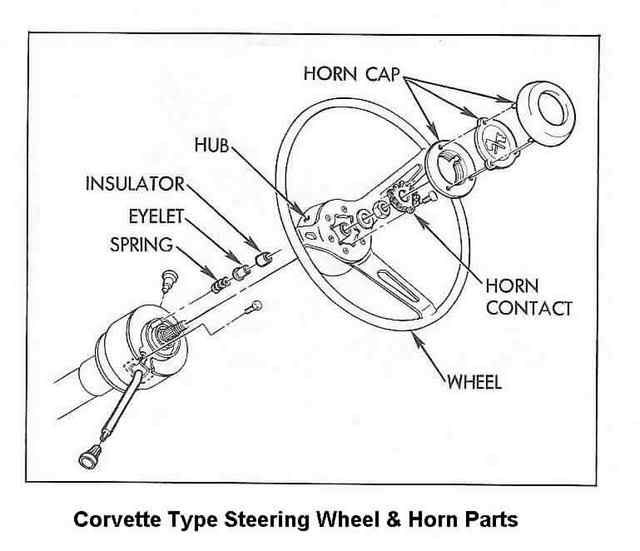
The horn cap assembly consists of three parts. The cap, the emblem, and the retainer. The cap assembly snaps into the upper contact. This part moves a slight amount and makes metal to metal contact when you press on the horn cap. This contact grounds the horn relay and blows your horn.
Sticking up through the steering wheel hub is a spring loaded plunger called an eyelet. There should be 12 volts at that point coming from the horn relay. The eyelet should always be in contact with the lower portion of the upper horn contact. The contact may even have a "leg" portion that extends down and presses on the eyelet. Again, if you have 12 volts at the eyelet and the eyelet is touching the upper horn contact then movement of the horn contact should complete the electrical circuit and ground the horn relay.
The ground path is as follows: Through the upper portion of the upper contact; down through the screws into the steering wheel hub; down through the steering shaft; through the flexible coupling; through the steering gear into the frame and back to the - side of the battery.
If you do not have continuous 12 Volts at the eyelet then your problem is somewhere between the feed to the horn relay, the horn relay itself, or the black wire that connects up through your column to the eyelet.
The following paper was written about the 1969 and later Corvette horn system. Other than the shape of the connector at the column, the diagnostics should be correct for your 1968 vehicle as well.
http://jimshea.corvettefaq.com/wp-co...osis13JN06.doc
The steering column electrical connector on a 1969 or later column is flat and is nick-named the "harmonica connector." The connector on a 1968 column is curved. I think that the horn ground wire is the black one that is the last wire on the end of the connector. (You should have continuity from that black wire all the way up to the eyelet.)
Jim
The horn cap assembly consists of three parts. The cap, the emblem, and the retainer. The cap assembly snaps into the upper contact. This part moves a slight amount and makes metal to metal contact when you press on the horn cap. This contact grounds the horn relay and blows your horn.
Sticking up through the steering wheel hub is a spring loaded plunger called an eyelet. There should be 12 volts at that point coming from the horn relay. The eyelet should always be in contact with the lower portion of the upper horn contact. The contact may even have a "leg" portion that extends down and presses on the eyelet. Again, if you have 12 volts at the eyelet and the eyelet is touching the upper horn contact then movement of the horn contact should complete the electrical circuit and ground the horn relay.
The ground path is as follows: Through the upper portion of the upper contact; down through the screws into the steering wheel hub; down through the steering shaft; through the flexible coupling; through the steering gear into the frame and back to the - side of the battery.
If you do not have continuous 12 Volts at the eyelet then your problem is somewhere between the feed to the horn relay, the horn relay itself, or the black wire that connects up through your column to the eyelet.
The following paper was written about the 1969 and later Corvette horn system. Other than the shape of the connector at the column, the diagnostics should be correct for your 1968 vehicle as well.
http://jimshea.corvettefaq.com/wp-co...osis13JN06.doc
The steering column electrical connector on a 1969 or later column is flat and is nick-named the "harmonica connector." The connector on a 1968 column is curved. I think that the horn ground wire is the black one that is the last wire on the end of the connector. (You should have continuity from that black wire all the way up to the eyelet.)
Jim



