




telescoping steering lock

Le Mans Master


Joined: Dec 2007
Posts: 6,422
Likes: 591
From: McHenry Illinois

I'll try. when you pull the horn button off you will see the lever for the telescoping lock. It attaches to a star shaped bolt using a small screw. If all that is attached then you will have to move the lock lever toward lock, remove the screw and then move the lever back to line up the next screw hole and re-install it.
The star shaped bolt basically pushes on a long rod that goes on down and causes a half moon shaped woodruff key to be pushed outward to lock against the shaft to stop it from going up or down. What you will be doing is screwing the star shaped bolt in further.
If this doesn't make sense I will try to find pics or a diagrahm.
Dean
The star shaped bolt basically pushes on a long rod that goes on down and causes a half moon shaped woodruff key to be pushed outward to lock against the shaft to stop it from going up or down. What you will be doing is screwing the star shaped bolt in further.
If this doesn't make sense I will try to find pics or a diagrahm.
Dean

Safety Car


Joined: Aug 2001
Posts: 4,883
Likes: 11
From: North Easton Mass
If the rod is missing from the mechanism the column won't lock. I had my column out and turned it upside-down and the rod fell out and the column wouldn't lock. Jim Shea straightened me out on that problem, but I don't know if the rod shows up on diagrams. If you can turn the ring and it tightens then the star wheel is probably OK and you are missing the rod piece.

Rick B.
Rick B.

Le Mans Master

Joined: Jul 2000
Posts: 6,001
Likes: 112
From: Saginaw Michigan
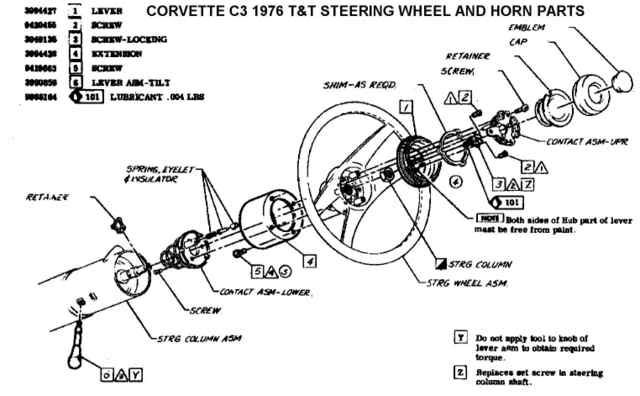
Here is a blowup of the 1976 T&T steering wheel and telescope lock. I am afraid that the picture is not the best. The star screw is called out as #3 in the picture. The rod is not shown. It would be about 4 inches long and would be right under the star screw. It would pass through all of the components and would slide right down inside the steering shaft that is just sticking out from the steering column in the picture.
Hope that this helps,
Jim
Hope that this helps,
Jim
Pro

Joined: Jun 2007
Posts: 688
Likes: 1
From: Stevens Point WI
On my car its not loose but the opposite
It sticks and once you pull the wheel toward you it takes two guys to push it back in
Is there parts in the column that need lube or is it just out of adjustment?
It sticks and once you pull the wheel toward you it takes two guys to push it back in
Is there parts in the column that need lube or is it just out of adjustment?
Racer


Joined: Jan 2007
Posts: 385
Likes: 3
From: RTP NC
Tab,
http://s189.photobucket.com/albums/z...oval/?start=20
Le Mans Master
Joined: Jul 2000
Posts: 6,001
Likes: 112
From: Saginaw Michigan
Fonz,
Disconnect your battery.
Use a small screwdriver to reach under your horn cap and remove it.
Remove the three screws and the upper horn contact.
Remove the two screws that hold the telescope lever to the star screw.
Use a large phillips screwdriver to loosen and tighten the star screw.
Does "adjusting" the star screw allow your telescope function to work easier?
I turn the star screw in with the phillips so that it locks the telescope function.
Then I reinstall the above hardware with the telescope lever in a nearly full clockwise location. (You will have several places where you can reattach the lever to the star screw.) Now with the lever installed and rotating it CCW the column should telescope freely.
One thing to keep in mind. You can put a lot more torque on the star screw with the T&T locking lever than you can with just a phillips screwdriver. So when you tighten with the screwdriver so that the column shaft stops telescoping, you will still be able to tighten it a bit further when the locking lever is reinstalled. That is why I mentioned attaching the lever to the star screw in "a nearly full CW location."
Hope that this helps,
Jim
Disconnect your battery.
Use a small screwdriver to reach under your horn cap and remove it.
Remove the three screws and the upper horn contact.
Remove the two screws that hold the telescope lever to the star screw.
Use a large phillips screwdriver to loosen and tighten the star screw.
Does "adjusting" the star screw allow your telescope function to work easier?
I turn the star screw in with the phillips so that it locks the telescope function.
Then I reinstall the above hardware with the telescope lever in a nearly full clockwise location. (You will have several places where you can reattach the lever to the star screw.) Now with the lever installed and rotating it CCW the column should telescope freely.
One thing to keep in mind. You can put a lot more torque on the star screw with the T&T locking lever than you can with just a phillips screwdriver. So when you tighten with the screwdriver so that the column shaft stops telescoping, you will still be able to tighten it a bit further when the locking lever is reinstalled. That is why I mentioned attaching the lever to the star screw in "a nearly full CW location."
Hope that this helps,
Jim
Pro
Joined: Jun 2007
Posts: 688
Likes: 1
From: Stevens Point WI
Fonz,
Disconnect your battery.
Use a small screwdriver to reach under your horn cap and remove it.
Remove the three screws and the upper horn contact.
Remove the two screws that hold the telescope lever to the star screw.
Use a large phillips screwdriver to loosen and tighten the star screw.
Does "adjusting" the star screw allow your telescope function to work easier?
I turn the star screw in with the phillips so that it locks the telescope function.
Then I reinstall the above hardware with the telescope lever in a nearly full clockwise location. (You will have several places where you can reattach the lever to the star screw.) Now with the lever installed and rotating it CCW the column should telescope freely.
One thing to keep in mind. You can put a lot more torque on the star screw with the T&T locking lever than you can with just a phillips screwdriver. So when you tighten with the screwdriver so that the column shaft stops telescoping, you will still be able to tighten it a bit further when the locking lever is reinstalled. That is why I mentioned attaching the lever to the star screw in "a nearly full CW location."
Hope that this helps,
Jim
Disconnect your battery.
Use a small screwdriver to reach under your horn cap and remove it.
Remove the three screws and the upper horn contact.
Remove the two screws that hold the telescope lever to the star screw.
Use a large phillips screwdriver to loosen and tighten the star screw.
Does "adjusting" the star screw allow your telescope function to work easier?
I turn the star screw in with the phillips so that it locks the telescope function.
Then I reinstall the above hardware with the telescope lever in a nearly full clockwise location. (You will have several places where you can reattach the lever to the star screw.) Now with the lever installed and rotating it CCW the column should telescope freely.
One thing to keep in mind. You can put a lot more torque on the star screw with the T&T locking lever than you can with just a phillips screwdriver. So when you tighten with the screwdriver so that the column shaft stops telescoping, you will still be able to tighten it a bit further when the locking lever is reinstalled. That is why I mentioned attaching the lever to the star screw in "a nearly full CW location."
Hope that this helps,
Jim
Thanks for the advice, I have the column out of the car at this time but I will check out what you described

Corvette Stories
The Best of Corvette for Corvette Enthusiasts

Top 10 Corvette Engines RANKED by Peak Torque (70+ Years of Muscle!)
Joe Kucinski
Corvette ZR1X Will Be Pacing the Indy 500, And Could Probably Race, Too!
Verdad Gallardo
Top 10 Corvettes Coming to Mecum Indy 2026!
Brett Foote
Top 10 C9 Corvette MUST-HAVES to Fix These C8 Generation Flaws!
Michael S. Palmer
10 Revolutionary 'Corvette Firsts' Most People Don't Know
Joe Kucinski
5 Reasons to Upgrade to an LS6-Powered Corvette; 5 Reasons to Stay LT2
Michael S. Palmer
2027 Corvette vs The World: Every C8 vs Its Closest Competitor
Joe Kucinski
10 Most Common Corvette Problems of the Last 20 Years!
Joe Kucinski
5 MOST and 5 LEAST Popular Corvette Model Years in History!
Joe Kucinski
Safety Car
Joined: Aug 2001
Posts: 4,883
Likes: 11
From: North Easton Mass
Rick B.
Racer
Joined: Jan 2007
Posts: 385
Likes: 3
From: RTP NC
If you take off the star screw there is a hole underneath. The rod is down in the hole. I believe what happens is when the star screw is tightened it pushes down on the rod and the rod stops the telescoping function using unseen powerful forces, possibly derived from UFO technology. I got into trouble when I took off the star screw and then inverted the column. The rod fell out onto the floor and I had no idea where it came from in the column. Thankfully Jim was able to tell me how to get things back in order. As he mentioned, the rod is not shown in the column assembly drawing.
Rick B.
Rick B.
Rick, strange... I went through changing all that stuff but I never moved the column from the table I was working which explains why I didn't see the rod. I think I see the tip of it in the picture (link) below. The method that is described is how I tightened the telescoping. I thought it was a little "rinky dinky" design... Sorry Jim!!
Later,
Tab
http://s189.photobucket.com/albums/z...lchange030.jpg
Le Mans Master
Joined: Jul 2000
Posts: 6,001
Likes: 112
From: Saginaw Michigan
Here is a sectioned picture of the T&T column head. You can see the locking rod. It pushes against a half circular steel piece with a notch taken out of it called a wedge.
The star screw is threaded into the end of the telescoping upper shaft. When you tighten the star screw it pushes on the rod and the rod tips the wedge and ***** it against the upper steering shaft yoke locking the two parts together.

The star screw is threaded into the end of the telescoping upper shaft. When you tighten the star screw it pushes on the rod and the rod tips the wedge and ***** it against the upper steering shaft yoke locking the two parts together.
