



CAD chassis

Thread Starter
Heel & Toe

Joined: Feb 2008
Posts: 19
Likes: 0
 CAD chassis
for all of you chassis guys. esp Twin_Turbo. what CAD / method do you guys use to design your chassis, were talkin cornering, road race. not drag. any recommendations? im using ProEngineer and im having a difficult time with it.
please help!!
Chris
please help!!
Chris

Pro


Joined: Oct 2004
Posts: 624
Likes: 24
From: Shoreline WA
I work with AutoCAD and haven't gotten too far along either. Good luck. There's a small community out there that are "dabbling" with frame and suspension details but not a lot being shared. Probably not a lot of progress. Interest is there though.
Personally, I'd really like to see a bare-bones C3 frame in Computer Assisted Drafting & Design (in a format all of us can view and use) as a resource for all Corvette Forum members. After that I believe the rest of our car's form will follow (engine parts to scale, wiring harness routes, etc.) because there's a lot of talented folks out there that would contribute. Perhaps in time.
Personally, I'd really like to see a bare-bones C3 frame in Computer Assisted Drafting & Design (in a format all of us can view and use) as a resource for all Corvette Forum members. After that I believe the rest of our car's form will follow (engine parts to scale, wiring harness routes, etc.) because there's a lot of talented folks out there that would contribute. Perhaps in time.

Le Mans Master


Joined: Jan 2006
Posts: 6,506
Likes: 139
From: Butler Pa
What kind of problems are you having?
Thread Starter
Heel & Toe
Joined: Feb 2008
Posts: 19
Likes: 0
im a civil guy, so i am big with AutoCAD but its not the right program for this application. im tryin to get my self started with ProE and im having a difficult time getting taking the measurements of the chassis with a tape and caliper to get really good dimensions. once i put the chassis and design the suspension the way i want it, will i be able to test the kinematics of the entire system, and simulate how it will perform at the track?
Le Mans Master
Joined: Jan 2006
Posts: 6,506
Likes: 139
From: Butler Pa
The assembly will need to be put together using the proper constraints to allow component movement. The Mechanica application will then be used to simulate movement.
Ansys, or some other FEA software will then be used to impose forces on the assembly and simulate the reactions from these forces. Identifying and quantifying these forces could be a bit of a challenge.
All in all, it's going to be a fairly complicated project. Pro/e is one of the more complex CADD softwares out there. But if used correctly, amazing things can be accomplished with it.
You mentioned that you were just getting started with Pro/e. I'm the Design/Drafting Department Manager for a large Defense contracter. On average, it takes approximately 6 months of full time use for someone to become familiar enough with the software to be able to produce useable models.
Ansys, or some other FEA software will then be used to impose forces on the assembly and simulate the reactions from these forces. Identifying and quantifying these forces could be a bit of a challenge.
All in all, it's going to be a fairly complicated project. Pro/e is one of the more complex CADD softwares out there. But if used correctly, amazing things can be accomplished with it.
You mentioned that you were just getting started with Pro/e. I'm the Design/Drafting Department Manager for a large Defense contracter. On average, it takes approximately 6 months of full time use for someone to become familiar enough with the software to be able to produce useable models.

Racer


Joined: Mar 2006
Posts: 276
Likes: 1
From: Pistoia PT (ITALY)

.....and then..... how much time to create a correct model of the frame?
(considering the used steel, any hole, any chamfer, any weld.....)
My opinion is.... weld on some good roll-cage and be in the "safe" area!

Thread Starter
Heel & Toe
Joined: Feb 2008
Posts: 19
Likes: 0
How do you think Ferrari builds their successful racecars? F1, LMS, etc.
Corvette Stories
The Best of Corvette for Corvette Enthusiasts

5 Best & 5 Worst Corvette Daily Drivers
Joe Kucinski
The Headlights of Every Corvette Generation Explained
Joe Kucinski
5 Best & 5 Most Overrated Corvette Track Packages of All Time!
Joe Kucinski
Every 2027 Corvette Engine Explained
Joe Kucinski
Designer Imagines A Corvette That Looks More Like a Corvette Than the Corvette
Verdad Gallardo
10 Ugly Corvettes That We Still Kinda Love
Joe Kucinski
Top 10 Most Expensive Corvettes Ever Sold on Bring A Trailer
Brett Foote
10 Things Every Corvette Owner Needs (2026 Edition)
Michael S. Palmer
8 Most "Only Corvette Owners Understand" Quirks and Problems
Pouria Savadkouei
Le Mans Master


Joined: Apr 2007
Posts: 7,353
Likes: 72
From: Graceland in a Not Correctly Restored Stingray
I don't think Stroker-427 intended any flames (nor do I), but how much effort are you willing to put into re-inventing the wheel, as it were? There's been a huge amount of previous groundwork already laid when it comes to addressing the C3 chassis' shortcomings on which to lean without necessarily going all the way back to square one, unless you're designing a whole new platform. However, by all means don't let us discourage you if that's what you're about.

Thread Starter
Heel & Toe
Joined: Feb 2008
Posts: 19
Likes: 0
I don't think Stroker-427 intended any flames (nor do I), but how much effort are you willing to put into re-inventing the wheel, as it were? There's been a huge amount of previous groundwork already laid when it comes to addressing the C3 chassis' shortcomings on which to lean without necessarily going all the way back to square one, unless you're designing a whole new platform. However, by all means don't let us discourage you if that's what you're about.
I am doing this on my own at my company's equipment yard, If you have links to what others have done, i have seen twin turbo's chassis, and another guy's on the forum, I don't remember the guys name but I know his car is red. But if you have any insight you would like to add, please let me know.
Chris

Racer
Joined: Jul 2006
Posts: 315
Likes: 0
Try TurboCad V10.2, V11 or V12; it's innexpensive, easier than ACAD, it's mature, lots of users, lots of training material, runs well on a PC, its a 2D, 3D drawing package, it can render a 3D model. It is nowhere near ProEngineer. It does not have any FEA type functionality.
Racer
Joined: Mar 2006
Posts: 276
Likes: 1
From: Pistoia PT (ITALY)
Even in my company we utilize CAD and FEM in order to calculate the frames of our systems!
If you have the skill, the time and the patience to do it..... I'm happy for you and for us.... if you will share your work!

I only say that for the average guy this is a too big job!

Le Mans Master
Joined: Apr 2007
Posts: 7,353
Likes: 72
From: Graceland in a Not Correctly Restored Stingray
Matter of fact, Stroker-427 himself just completed re-engineering the rear suspension on his red C3. 84rzv500r is another guy here who has done it. Don't know just how much they'll be willing to share (and I don't have a problem with that), but IMHO when you go this far you'll want to do your own math anyway, as every application has different variables.
Tho I've done a bit of road racing and have earnestly tried to become a student of C3 suspension tech, I'm only on the research (read, "bench racing", lol) side for now, so the best insight I can give is to find some suspension simulation software, or learn how to play with the paper dolls described in Carrol Smith's "Tune to Win" so you can put together a poor man's suspension computer (the larger the scale the better). IMHO, that is where you should spend time calculating, as it's relatively easy to build balsa models or just follow other tried and true examples of chassis stiffening.
BTW, I too have come around to the idea of the telescoping 1/2 shafts to get them out of the equation as upper links, and believe dual trailing links (such as the 5-bar and C4 have) are worth adapting so that "anti-squat" can be introduced. Going full-blown double A-arm SLA looks like a real PITA...
Tho I've done a bit of road racing and have earnestly tried to become a student of C3 suspension tech, I'm only on the research (read, "bench racing", lol) side for now, so the best insight I can give is to find some suspension simulation software, or learn how to play with the paper dolls described in Carrol Smith's "Tune to Win" so you can put together a poor man's suspension computer (the larger the scale the better). IMHO, that is where you should spend time calculating, as it's relatively easy to build balsa models or just follow other tried and true examples of chassis stiffening.
BTW, I too have come around to the idea of the telescoping 1/2 shafts to get them out of the equation as upper links, and believe dual trailing links (such as the 5-bar and C4 have) are worth adapting so that "anti-squat" can be introduced. Going full-blown double A-arm SLA looks like a real PITA...
Last edited by TheSkunkWorks; Feb 27, 2008 at 05:29 PM.
Racer
Joined: Mar 2006
Posts: 276
Likes: 1
From: Pistoia PT (ITALY)
Regarding antisquat of an IRS..... there is very litle to do.... because the torque is applyed by the differential directely to the frame.
No reaction at the suspensions!
The only way to have some antisquat is to point the reaction rods upwards..... and it's very hard to have more than 30% antisquat.
Taking in consideration that with live axe it is possible to bild more than 100% antisquat..... I should design the rear suspension in order to avoid wheel-hop (it is the opposite than antisquat) during braking.
In road racing the traction isn't the bigger issue.... but braking and apex speed !!!
The main problem for the C3 IRS are:
1) Jacking
2) Torque steer
3) bump steer
The connection of the T/A isn't too bad for antisquat!
Unless you will race in a track with very tight corners, it is better to invest the max traction of your tires in the apex speed.... and to apply the power very smootly approaching the stright lane.
As you may know, any tire in a particular car, have a maximum traction capability.... and if you corner at the limit..... you can't apply any power to the wheel.
The traction of the tire increase with the load..... but not in a linear way..... double load equal less than double traction.
So the trick is less weight, good tires and good suspension design.
Even if you are able to design a lot of antisquat in a road race car..... it will be not a good move.... because for consequence you will loose a lot of braking efficience at the rear end.
The result will be that any other racer will be able to overtake you when braking....... due to the bad insertion.
Races aren't an exact science....... but the way to design a very good race car is based on phisics, wich is an exact science.
The target is the optimal comprimise between any characteristic.
My opinion, of course.
No reaction at the suspensions!
The only way to have some antisquat is to point the reaction rods upwards..... and it's very hard to have more than 30% antisquat.
Taking in consideration that with live axe it is possible to bild more than 100% antisquat..... I should design the rear suspension in order to avoid wheel-hop (it is the opposite than antisquat) during braking.
In road racing the traction isn't the bigger issue.... but braking and apex speed !!!
The main problem for the C3 IRS are:
1) Jacking
2) Torque steer
3) bump steer
The connection of the T/A isn't too bad for antisquat!
Unless you will race in a track with very tight corners, it is better to invest the max traction of your tires in the apex speed.... and to apply the power very smootly approaching the stright lane.
As you may know, any tire in a particular car, have a maximum traction capability.... and if you corner at the limit..... you can't apply any power to the wheel.
The traction of the tire increase with the load..... but not in a linear way..... double load equal less than double traction.
So the trick is less weight, good tires and good suspension design.
Even if you are able to design a lot of antisquat in a road race car..... it will be not a good move.... because for consequence you will loose a lot of braking efficience at the rear end.
The result will be that any other racer will be able to overtake you when braking....... due to the bad insertion.
Races aren't an exact science....... but the way to design a very good race car is based on phisics, wich is an exact science.
The target is the optimal comprimise between any characteristic.
My opinion, of course.

Racer
Joined: Mar 2004
Posts: 292
Likes: 2
From: Plumas Lake CA
Rear suspension CAD designs
FLEXUSMARK included some cad stuff concerning rear suspension geometry in this post:
http://forums.corvetteforum.com/show...ghlight=6+link
I haven't seen any cad drawings of an entire chassis though. Twin Turbo might have some. Anyone else?
http://forums.corvetteforum.com/show...ghlight=6+link
I haven't seen any cad drawings of an entire chassis though. Twin Turbo might have some. Anyone else?

Melting Slicks


Joined: Jun 2003
Posts: 2,802
Likes: 241
From: Niles, MI
 If that is true, I think you need to look at your training program or your software. I'm running Solid Edge and it didn't take anywhere near that long.
Le Mans Master
Joined: Jan 2006
Posts: 6,506
Likes: 139
From: Butler Pa
Have you ever used Pro/e? There really is no comparison between Solid Edge and Pro/e.

Racer
Joined: Aug 2006
Posts: 493
Likes: 1
From: yarmouth ma
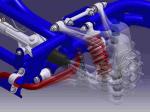
Well if you are talking Cad, I would recommend Solidworks. Can handle anything, easy to use and you can put any constraint on it that you can imagine. Top down or bottom up assembly. You can add motion to it, exploded views etc...I have used all the high end cad systems out there from Unigraphics, Autocad, Cadkey, Computer vision, HP. Solidworks is the best bang for the buck. Its about 5K to buy. Autocad is not to good for this, its a good 2d program though.
my .02 worth, thanks
my .02 worth, thanks
6th Gear
Joined: Aug 2009
Posts: 6
Likes: 0
From: Kuching Sarawak
I used CATIA V5 to design a chassis based on the SRIII tubular design w/ C5/C4 IFS/IRS. It's a very powerful system used by many of the auto companies worldwide. It is a "parametrized" system and I can get the CG and weight of the frame using a particular tube wall thickness. This can be changed with one dimensional update. The specific gravity (density) of the material can be changed for different materials as well.
I'm overseas at the moment so I don't have access to any vehicle to measure the hard points. Can anyone please help me with the dimensions from the wheel centerlines to the body mounts?
Please check out my website at http://bndtechsource.ucoz.com to see the progress.
I'm overseas at the moment so I don't have access to any vehicle to measure the hard points. Can anyone please help me with the dimensions from the wheel centerlines to the body mounts?
Please check out my website at http://bndtechsource.ucoz.com to see the progress.

Racer
Joined: Mar 2008
Posts: 428
Likes: 0
Well if you are talking Cad, I would recommend Solidworks. Can handle anything, easy to use and you can put any constraint on it that you can imagine. Top down or bottom up assembly. You can add motion to it, exploded views etc...I have used all the high end cad systems out there from Unigraphics, Autocad, Cadkey, Computer vision, HP. Solidworks is the best bang for the buck. Its about 5K to buy. Autocad is not to good for this, its a good 2d program though.
my .02 worth, thanks
my .02 worth, thanks
