




vacuum advance questions!!!!

Safety Car


Joined: Feb 1999
Posts: 3,631
Likes: 14
From: Fountain Hills AZ
 Re: vacuum advance questions!!!! (daily_driver)
I agree with the others about the benefits of vacuum advance for a street engine. As far as ported vs unported vacuum goes, once off idle it doesn't make a difference which one you're using. Once the throttle is opened, the signal to the canister is the same. In most cases, I prefer ported vacuum only because it eliminates a variable in idle speed and quality.
Techno, I think you're looking at it correctly but in reverse. Vacuum advance does not retard timing. As vacuum increases, it adds advance. When vacuum decreases, such as under load, so does the amount of advance that it added in the first place. It's function is completely independent of centrifugal advance, which is strictly rpm related, and at no time affects centrifugal advance.
Techno, I think you're looking at it correctly but in reverse. Vacuum advance does not retard timing. As vacuum increases, it adds advance. When vacuum decreases, such as under load, so does the amount of advance that it added in the first place. It's function is completely independent of centrifugal advance, which is strictly rpm related, and at no time affects centrifugal advance.
Safety Car
Joined: Feb 1999
Posts: 3,631
Likes: 14
From: Fountain Hills AZ
Re: vacuum advance questions!!!! (Vetterodder)
Oops, forgot another point I wanted to make :). Daily-Driver, I'm assuming that your distributor has been recurved so that total advance is all in by 2500 rpm. I mention this only because there have been some missunderstandings as the result of posts in other threads here. After reading that timing should be set to a certain advance at a certain rpm, some guys have done exactly that with unmodified distributors that are still adding more advance beyond that point. The end result is an engine that's actual total advance is way too high. For example, if a distributor's advance stops at 4000 rpm, setting it's total timing at any rpm below that point will result in a bogus setting that will result in a higher than desired total advance. It doesn't sound like this applies to you but I want prevent any problems for those reading this thread.

Drifting


Joined: Nov 2001
Posts: 1,469
Likes: 6
From: 68 427 4.11s Roadster
Re: vacuum advance questions!!!! (Vetterodder)
I never said it changed the mecahnical advance. I said it retarded the timing.
You have 3 different adjustments for timing.
If you run with a total of 48* and eliminate the 20 * that the V adv. added the timing has been reduced by 20* to 28* BTDC. It then goes back up to 48*. total timing. The timing has been retarded 20*
The mechanical advance also retards the timing, when the rpms drop, so does the timing that was increased by the mechanism.
Another part which is usually disconnected. I think its called the Spark Advance Module or is it Valve. That wax filled thing on the block for AC cars. When it heats up it valves the vacuum advance to a higher vacuum. This speeds the engine up which cools the coolant, which cools the wax pellet and drops the rpm again.
I don't have a "modern" car so I tend to forget about those emission things. with all the electronic crap and spagetti nest of hoses.
Getting back to the original question if you have a total of 48* again.
with V adv. of 20* you would have 10* static, 18* mech.
Without V. adv. Either you need to run 30* static or make it up in the mechanical adv.
With 30* static the engine will crank over very hard If at all.
With 38* mechanical the engine will ping under acceleration. It also won't have the ~30* provided by the V. adv. and static timing at idle or low rpms.
This is my recommendation to anyone thinking of eliminating it. Before you do. disconnect the vacuum hose and plug. Re-time if you can and try driving the car.
For daily driver, you can't do this cause its broke. You can check this partially by increasing static timing( try it only 1/2 the value of the V adv. This will show how the car would run with the proper timing but will cause the above problems. Your car now has retarded timing----less than the total timing called for in the book. With only 36 * total you are still about 12* too low.
A better way of setting timing is to set the static and drive the car. If it pings reduce it, if not increase it untill it does. Now reduce it slightly. Air temp, fuel quality and engine age affects this, so a book value isn't worth much. With all the timing added together you shouldn't be over 52* and some require less as a total.
You have 3 different adjustments for timing.
If you run with a total of 48* and eliminate the 20 * that the V adv. added the timing has been reduced by 20* to 28* BTDC. It then goes back up to 48*. total timing. The timing has been retarded 20*
The mechanical advance also retards the timing, when the rpms drop, so does the timing that was increased by the mechanism.
Another part which is usually disconnected. I think its called the Spark Advance Module or is it Valve. That wax filled thing on the block for AC cars. When it heats up it valves the vacuum advance to a higher vacuum. This speeds the engine up which cools the coolant, which cools the wax pellet and drops the rpm again.
I don't have a "modern" car so I tend to forget about those emission things. with all the electronic crap and spagetti nest of hoses.
Getting back to the original question if you have a total of 48* again.
with V adv. of 20* you would have 10* static, 18* mech.
Without V. adv. Either you need to run 30* static or make it up in the mechanical adv.
With 30* static the engine will crank over very hard If at all.
With 38* mechanical the engine will ping under acceleration. It also won't have the ~30* provided by the V. adv. and static timing at idle or low rpms.
This is my recommendation to anyone thinking of eliminating it. Before you do. disconnect the vacuum hose and plug. Re-time if you can and try driving the car.
For daily driver, you can't do this cause its broke. You can check this partially by increasing static timing( try it only 1/2 the value of the V adv. This will show how the car would run with the proper timing but will cause the above problems. Your car now has retarded timing----less than the total timing called for in the book. With only 36 * total you are still about 12* too low.
A better way of setting timing is to set the static and drive the car. If it pings reduce it, if not increase it untill it does. Now reduce it slightly. Air temp, fuel quality and engine age affects this, so a book value isn't worth much. With all the timing added together you shouldn't be over 52* and some require less as a total.

Thread Starter
Melting Slicks

Joined: Apr 2001
Posts: 2,280
Likes: 0
From: colorado springs CO
Re: vacuum advance questions!!!! (Techno)
thanks techno you really cleared it up for me....
i was thinking that with the vacc adv and everything i was supposed to be having ~36 total.....
ill order a new adj can from summit racing and throw it on there...
ill kep the mech adv curve i have now since it is setup correctly..
thanks everyone!!
:cheers: :cheers:
i was thinking that with the vacc adv and everything i was supposed to be having ~36 total.....
ill order a new adj can from summit racing and throw it on there...
ill kep the mech adv curve i have now since it is setup correctly..
thanks everyone!!
:cheers: :cheers:
Safety Car
Joined: Feb 1999
Posts: 3,631
Likes: 14
From: Fountain Hills AZ
Re: vacuum advance questions!!!! (Techno)
Techno, I suspect that you might not understand that total timing does not include vacuum advance. Total timing is the sum of initial + whatever amount is added by centrifugal. Vacuum advance advances timing as vacuum increases (that's why it's called vacuum "advance"). As already stated, is not a part of total. Take a timing reading at 2000 rpm with the vacuum canister disconnected. Take another reading with the vacuum line connected. Is the timing higher or lower? If lower, your engine has a serious problem and the vacuum advance canister has failed. If the same, only the vacuum advance canister has failed.
Thread Starter
Melting Slicks
Joined: Apr 2001
Posts: 2,280
Likes: 0
From: colorado springs CO
Re: vacuum advance questions!!!! (Vetterodder)
yah thats the mistake i made!!
im new to distributors :)
but now i know whats up thanks to you guys.....
:cheers: :cheers:
summit racing only sells 1 adjustable can kit for GM HEI dist...
has anyone installed that one?? and know what vacuum Hg operating range is needed and how adjustable it is??
from lars paper, i need 8 deg dist (16 crank..) to complete my timing.
my manifold vacuum reads about 21 Hg right now.
:)
im new to distributors :)
but now i know whats up thanks to you guys.....
:cheers: :cheers:
summit racing only sells 1 adjustable can kit for GM HEI dist...
has anyone installed that one?? and know what vacuum Hg operating range is needed and how adjustable it is??
from lars paper, i need 8 deg dist (16 crank..) to complete my timing.
my manifold vacuum reads about 21 Hg right now.
:)

Melting Slicks

Joined: Apr 1999
Posts: 2,010
Likes: 3
From: Moon Twp. PA USA
Re: vacuum advance questions!!!! (Vetterodder)
According to David Vizard's book "Max Performance Chevy Small Blocks", total timing includes initial, mechanical, and vacuum.
He states that initial + mechanical should be about 35 degrees @ 3000 rpm or less. Full vacuum advance should should be in @ 12 - 14". He recommends a total timing of 50 degrees. This is about what I run.
He states that initial + mechanical should be about 35 degrees @ 3000 rpm or less. Full vacuum advance should should be in @ 12 - 14". He recommends a total timing of 50 degrees. This is about what I run.
Pro


Joined: Aug 2000
Posts: 610
Likes: 168
From: Vancouver B.C.
Re: vacuum advance questions!!!! (Vetterodder)
I'd just like to thank everyone for taking the time to provide all this info.
It seems everyone is in agreement that for street driven machines the vacuum advance canister should be connected. Also, when using either ported or manifold vacuum, at part throttle or at cruise, the vacuum advance unit works the same.
The last peice of the puzzle for me, is what is better at idle - ported or full manifold vacuum. Some have said full manifold vacuum affects idle quality, others have said that ported is only for emmissions and that during the 60s most engines used manifold vacuum.
I looked at Lars technical paper, he discusses ported and manifold, and he appears to suggest that if you have a radical cam you should use manifold vacuum. This would be understandable because you would want to advance timing at idle to smoothen out the radical cam idle. But what about a mild street engine, does this mean that ported is best?
I have also noticed that smog engines have static timing 2 to 4 degrees higher than the same engines of the 60s. Was this to compensate for the loss of vac adv timing lost on the change to ported vacuum from manifold? Just a thought, don't know if this is the reason.
So what's best at idle for a street engine - Ported or manifold vacuum? Most seem to favor ported.
STEVEG75: Is your vacuum line hooked up to ported (off idle) or manifold vacuum.
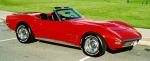
GORDONM: Looks like twins. The Wanderer (from Arizona) might be next, he also has a red '72, but with saddle interior and thinking of changing to black.
[Modified by Dino_'72, 12:01 PM 12/8/2001]
It seems everyone is in agreement that for street driven machines the vacuum advance canister should be connected. Also, when using either ported or manifold vacuum, at part throttle or at cruise, the vacuum advance unit works the same.
The last peice of the puzzle for me, is what is better at idle - ported or full manifold vacuum. Some have said full manifold vacuum affects idle quality, others have said that ported is only for emmissions and that during the 60s most engines used manifold vacuum.
I looked at Lars technical paper, he discusses ported and manifold, and he appears to suggest that if you have a radical cam you should use manifold vacuum. This would be understandable because you would want to advance timing at idle to smoothen out the radical cam idle. But what about a mild street engine, does this mean that ported is best?
I have also noticed that smog engines have static timing 2 to 4 degrees higher than the same engines of the 60s. Was this to compensate for the loss of vac adv timing lost on the change to ported vacuum from manifold? Just a thought, don't know if this is the reason.
So what's best at idle for a street engine - Ported or manifold vacuum? Most seem to favor ported.
STEVEG75: Is your vacuum line hooked up to ported (off idle) or manifold vacuum.
GORDONM: Looks like twins. The Wanderer (from Arizona) might be next, he also has a red '72, but with saddle interior and thinking of changing to black.
[Modified by Dino_'72, 12:01 PM 12/8/2001]
Corvette Stories
The Best of Corvette for Corvette Enthusiasts

Top 10 Most Expensive Corvettes Ever Sold on Bring A Trailer
Brett Foote
10 Things Every Corvette Owner Needs (2026 Edition)
Michael S. Palmer
8 Most "Only Corvette Owners Understand" Quirks and Problems
Pouria Savadkouei
10 Reasons the C6 Z06 is Still A Performance Benchmark After 20 Years
Joe Kucinski
How Much Horsepower Every Corvette Engine "LOST" in 1972
Joe Kucinski
Top 10 DOs and DON'Ts for Protecting Your Convertible Top!
Michael S. Palmer
Top 10 Most Explosive Corvettes Ever Made: Power-to-Weight Ratio Ranked!
Joe Kucinski
150 hp to 1,250 hp: Every Corvette Generation Compared by the Specs That Matter
Joe Kucinski
8 Coolest Corvette Pace Cars (and Replicas) of All Time
Verdad Gallardo
Safety Car
Joined: Jun 2001
Posts: 4,004
Likes: 2
From: Severna Park Md
Re: vacuum advance questions!!!! (Dino_'72)
Vacuum advance if set up corectly will help throttle response and mileage under normal driving conditions. Vacuum advance will do nothing for your full throttle performance, as there is virtually no vacuum available at WOT. Thats why, for 1/4mi drags, its so important to get your mechanical advance curve correct. My setup seems to like the vacuum advance and the car seems less luggish on part throttle acceleration. Motor doesnt hound as much at lower speeds either with vacuum connected. Im set at 16 initial with 36 total in by 2500 and another 6 degrees advance from vacuum at normal cruise. So my cruise timing above 2500 is a total of 42. When you punch it wide open the vacuum drops out and the timing is back to depending on mechanical to give you the desired 36.
[Modified by Jvette73, 12:17 AM 12/8/2001]
[Modified by Jvette73, 12:17 AM 12/8/2001]
Race Director


Joined: Jun 2000
Posts: 10,046
Likes: 675
From: FL
Re: vacuum advance questions!!!! (Dino_'72)
STEVEG75: Is your vacuum line hooked up to ported (off idle) or manifold vacuum.
I believe I am running ported vacuum. Lars helped me hook it up when he tweaked my carb. Moved the vacuum hose from the front driver's side (top) of the Q-jet to the lower port on the passenger's side front.
My specs are as follows:
14 BTDC (initial) + 22 centrifugal (all in by 2800) = 36 BTDC mechanical advance + 14 vacuum (used adjustable can) = 52 BTDC total
Pro
Joined: Aug 2000
Posts: 610
Likes: 168
From: Vancouver B.C.
Re: vacuum advance questions!!!! (SteveG75)
Thanks Steve. Is that port above the carb baseplate?
I only have 4 ports on my Qjet. Two large base plate ports for P/brake (rear) and PCV/Charcoal cannister (front). These get full manifold vacuum.
I will have to put a vacuum gauge on the other two, but they are both above the baseplate, so they must be ported. The front driver side one also goes to the charcoal cannister. The other one is on the passenger side halfway up the carb. Capped right now, but was used for TCS solenoid which was connected to the Vac adv can. I guess I will have to test both with a vac gauge to see at what throttle position they get vacuum. My guess right now is that I will have to tee into the charcoal line on the front to get ported vacuum. It seems to be just above the throttle plates, the other one seems too high.
Thanks for sharing your distributor specs. They are probably what I will need once I make my engine mods. because I plan on using a similar cam. With 14 degrees initial, I also think you are hooked up to ported vacuum.
JVETTE: What compression are you running? I plan to change to 64cc heads and the XE268. I have stock dish pistons (bored .030 over) and hope to get just over 9:1 compression after the change. How is your idle quality with this cam? Any comments on the lope, I have only heard this cam in a 10:1 motor, had a nice lope, not too radical.
Dino.
[Modified by Dino_'72, 1:34 PM 12/8/2001]
I only have 4 ports on my Qjet. Two large base plate ports for P/brake (rear) and PCV/Charcoal cannister (front). These get full manifold vacuum.
I will have to put a vacuum gauge on the other two, but they are both above the baseplate, so they must be ported. The front driver side one also goes to the charcoal cannister. The other one is on the passenger side halfway up the carb. Capped right now, but was used for TCS solenoid which was connected to the Vac adv can. I guess I will have to test both with a vac gauge to see at what throttle position they get vacuum. My guess right now is that I will have to tee into the charcoal line on the front to get ported vacuum. It seems to be just above the throttle plates, the other one seems too high.
Thanks for sharing your distributor specs. They are probably what I will need once I make my engine mods. because I plan on using a similar cam. With 14 degrees initial, I also think you are hooked up to ported vacuum.
JVETTE: What compression are you running? I plan to change to 64cc heads and the XE268. I have stock dish pistons (bored .030 over) and hope to get just over 9:1 compression after the change. How is your idle quality with this cam? Any comments on the lope, I have only heard this cam in a 10:1 motor, had a nice lope, not too radical.
Dino.
[Modified by Dino_'72, 1:34 PM 12/8/2001]


Melting Slicks
Joined: Dec 2000
Posts: 3,407
Likes: 2
From: Carmichael CA
Re: vacuum advance questions!!!! (Dino_'72)
Posted by Dino_'72
That is not entirely true. Some systems work on maniforld vacuum and some work on ported vacuum. You can NOT interchange them without additional engineering. They pretty much function in opposition to each other. At idle manifold vacuum is maxed out while ported vacuum is minimal to zero. As you open the throttle manifold vacuum drops while ported vacuum increases. At WOT manifold vacuum is zero while ported vacuum is about midrange.
posted by SteveG75
On some systems that would be fine, but on the 75 a lot of things changed, most obvious is the smog pump and purge valve connection among other things. Chilton's shows the lower passenger side port to be for the choke pull-off, and the driver's side port to be for the distributor vacuum can. I have not tested those ports so they may be the same vacuum signal, or close enough for street...I'm not saying it's going to cause a problem, but it's not correct for a 75 according Chilton's so maybe you could check with a smog control referee cause they have all the diagrams for all vehicles.
Also, when using either ported or manifold vacuum, at part throttle or at cruise, the vacuum advance unit works the same.
posted by SteveG75
I believe I am running ported vacuum. Lars helped me hook it up when he tweaked my carb. Moved the vacuum hose from the front driver's side (top) of the Q-jet to the lower port on the passenger's side front.
Safety Car
Joined: Feb 1999
Posts: 3,631
Likes: 14
From: Fountain Hills AZ
Re: vacuum advance questions!!!! (Rockn-Roll)
Rockn-Roll, once the throttle is opened manifold and ported do work the same. There is only one source of vacuum and that's from the manifold. The difference between them is that ported vacuum is disconnected from manifold vacuum until the throttle is opened. Once opened, manifold vacuum is allowed to pass through the "port". At that point and beyond there is no difference. Also, under normal conditions (i.e., not under heavy load or wot) manifold vacuum increases with rpm and that's how the vacuum advance system works. As vacuum increases it pulls the advance lever to increase advance. When conditions reduce vacuum, the advance lever is allowed to move back and reduce the amount of advance that it added to begin with. To see how this all works, connect a vacuum guage to watch how vacuum increases as you open the throttle and rpm increases. Take readings from both direct manifold and from a ported source. To see the effects of vacuum advance, hook up a timing light and take readings at idle and then at higher rpm. Take readings with the vacuum line connected and with it plugged. If vacuum doesn't increase as you increase rpm, you have a defective guage or a serious engine problem. In both tests, if you suddenly stab the throttle you will see a sudden drop in both vacuum and advance, and also rpm, readings but they will quickly recover.

Race Director
Joined: Apr 2000
Posts: 17,676
Likes: 201
From: Who says "Nothing is impossible" ? I've been doing nothing for years.
Re: vacuum advance questions!!!! (Vetterodder)
This subject has been kicked around many times and the only thing I can say is
I am amazed how these cars can run with so many different setups.
For example, you can run with ported vacuum, manifold vacuum or no vacuum and the engine seems to run fine if you set the initial timing in the right place and there is nothing else wrong.
I have tried all of these setups and for my money I seem to get a little more torque or low end power if I run with the vacuum advance disconnected :D
I am amazed how these cars can run with so many different setups.
For example, you can run with ported vacuum, manifold vacuum or no vacuum and the engine seems to run fine if you set the initial timing in the right place and there is nothing else wrong.
I have tried all of these setups and for my money I seem to get a little more torque or low end power if I run with the vacuum advance disconnected :D
Thread Starter
Melting Slicks
Joined: Apr 2001
Posts: 2,280
Likes: 0
From: colorado springs CO
Re: vacuum advance questions!!!! (Vetterodder)
from the tests i have conducted with my vacuum guage, the ported source operates exactly as vetterodder has described....
once the port opens, then its same as manifold vacc....
once the port opens, then its same as manifold vacc....


Safety Car
Joined: Jun 2001
Posts: 4,004
Likes: 2
From: Severna Park Md
Re: vacuum advance questions!!!! (SteveG75)
I run ported vacuum to a stock can that has been limited. I put a tiny metal strap across the pull rod slot. This limits my vacuum advance to 6 degrees. I found that this is enough to give you the the better throttle response. With the vacuum advance limited, you dont get all that extra that you dont need at cruise. 16initial 36total and 6 from vacuum. The total will never exceed 42.
Race Director
Joined: Jun 2000
Posts: 10,046
Likes: 675
From: FL
Re: vacuum advance questions!!!! (Rockn-Roll)
On some systems that would be fine, but on the 75 a lot of things changed, most obvious is the smog pump and purge valve connection among other things. Chilton's shows the lower passenger side port to be for the choke pull-off, and the driver's side port to be for the distributor vacuum can. I have not tested those ports so they may be the same vacuum signal, or close enough for street...I'm not saying it's going to cause a problem, but it's not correct for a 75 according Chilton's so maybe you could check with a smog control referee cause they have all the diagrams for all vehicles.
My setup ain't exactly stock. Since I am using an Edlebrock 2101, no EGR, no EFE with the headers, AIR pump same reason. :eek:
I have all the parts if anyone cares but I bet I could pass a sniffer test with a well tuned engine as is. :cheers:
Steve
[Modified by SteveG75, 10:25 AM 12/9/2001]
Pro
Joined: Aug 2000
Posts: 610
Likes: 168
From: Vancouver B.C.
Re: vacuum advance questions!!!! (marky mark)
Well, just fired mine up and ran a few vacuum tests. Just for info. I only have one ported vacuum source on my QJet. Dials in like this: 0 @ idle; 2" @ 1500; 10" @ 2000; and 18" at 2500. Idle vacuum is 20".
So full vac. to this port occurs at cruise at 2500 RPM. But I guess more importantly I am going to have to find out what amount of vac is required to get my vac can at full advance.
Having said that, in the end I think I will also have to agree with Motorhead. Mine on manifold vacuum runs fine, passed the sniff test years ago when it had to be tested - no problems. I think I'm gonna leave it on manifold vac for now.
Dino
So full vac. to this port occurs at cruise at 2500 RPM. But I guess more importantly I am going to have to find out what amount of vac is required to get my vac can at full advance.
Having said that, in the end I think I will also have to agree with Motorhead. Mine on manifold vacuum runs fine, passed the sniff test years ago when it had to be tested - no problems. I think I'm gonna leave it on manifold vac for now.
Dino