





Shark Bite Rear Coilovers

Thread Starter
Safety Car


Joined: Nov 2005
Posts: 3,961
Likes: 573
From: Lompoc, CA. Santa Barbara County

Same here, more references than credit card though. If money was no problem, I wouldn't need the huge discount. The beauty of your kit, is....the beauty. Looks do count. Yellow Corvette, Flowmasters and coilovers at the rear, showing off to whoever I just passed. They will remember that day.
Melting Slicks

Joined: Jul 2006
Posts: 2,373
Likes: 6
From: Baltimore MD
How would that setup hold up if you ran it at the track?Hole shots might be kinda hard on it ,looks like a hard take off might compress the spring real hard and mess something up ,I could be wrong though.I guess what im really asking can it take quick take offs?Or is it just for handling.Maybe ,you guys could get a video of a hole shot to show how the setup would act in that situation.I could be interested in something like that. Bill
Last edited by Billysvette; Mar 13, 2008 at 05:41 PM.

Drifting

Joined: Feb 2005
Posts: 1,738
Likes: 2
From: San diego ca
I would presume because the leaf is grounded in the center any upward motion of one tire results in upward motion of the pumpkin. the geometry of this is different it seems to me. - just a guess

Drifting

Joined: Sep 2004
Posts: 1,959
Likes: 1
From: North Bend Ohio
I believe this is the real reason why these are being offered. These are used in race cars to reduce unsprung weight and for aerodynamics. The stock leaf spring is a very simple system. No need to go to this kind of complication. The only job springs have is to hold the car up. If there is some communication going on through the stock leaf spring (which I seriously doubt) simply add a rear sway bar. That would be a lot creaper than this.
A well setup stock suspension will do 90% of what 90% of the people on this board ask of it. This is simply something to look at.
And we know what those kinds of people are called.
BigBlockk
Later.....
A well setup stock suspension will do 90% of what 90% of the people on this board ask of it. This is simply something to look at.
And we know what those kinds of people are called.
BigBlockk
Later.....

Burning Brakes

Joined: Feb 2000
Posts: 1,246
Likes: 1
The system above is truly independent but is that good? It offers no additional roll resistance, I'm not seeing a sway bar even.
I've been looking at the rockers and they seem to have a 3:2 ratio or thereabouts. What this does is, it gives a reduced shock & spring travel for a given wheel travel. This reduces shock efficiency and spring efficiency. You'll need a higher rate spring to control the suspension because of this ratio and your shock will need stiffer dampening and the shock will work over a shorter compression/extension range. Also, consider that spring rate is a load per inch of compression, this means that if the effective travel is reduced, the actual load is reduced too. For example, if you have a 500# spring you have to put a 1000 lbs on it to compress it 2 inches. Compared to this (assuming the actual wheel rate is the same, and they are fairly close if you check out where the rocker actuator rod attaches to the trailing arm) it would only take 666 lbs to compress the same 500# over 2", so to carry the same load you will need a 1.5* bigger spring rate. This is just a crude example, the reality is that as the rocker angles the relationship changes, for every Z of wheel travel the shock/spring don't move 1/ratio * Z because angularity comes into play on both the pushrod side and the shock side. Looking at the pics, on the pushrod side it looks to pretty much stay close to ideal but on the shock side with the ratio in play there the shock compression vs. suspension compression gets uglier than it is in the 90 deg. angle to the cam you see in the pic. So in reality, if you take the example above, it takes relativly less and less additional spring load to compress the suspension. So, unlike the simple explanation above where the actual effective rate stays the same, in reality it does not because of the angular effects This means that the softest spring that you can use to keep the suspension from hitting the bump stops will be a higher rate than if you had a 1:1 ratio. A ratio promoting increased shock & spring travel for a given suspension travel is favorable because it increases the efficiency.
Check out this photo:
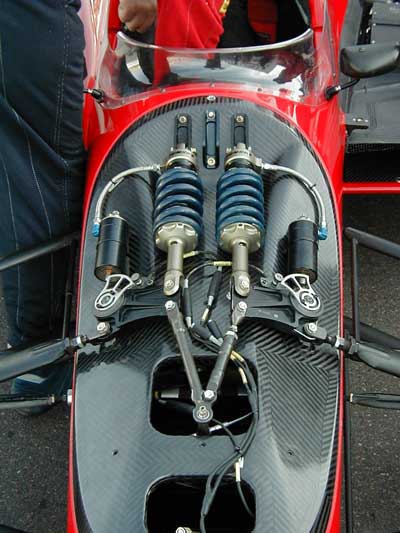
Notice how the pushrod is much closer to the pivot than the shock, this is because this race car has very limited suspension travel and this allows them to still use the full (or close to) stroke of the shock and the complete range of the spring load through it's compression.
Another thing, sure coil overs allow you to adjust ride height, however static ride height should be set by design first and foremost. You determine the expected suspension travel (and add a little) and then check what your bump and rebound positions will be for the unsprung mounting point, and then you select a shock to suit the extended and compressed lengths (so that the spring doesn't sit loose in the coil over because you have a too long extended length shock so that you have tu run the collar all the way down and run the spring on the last bit of travel it has before hitting full compression), or you choose the lower mounting point to suit the closest fitting shock you can find. This way you can use the adjuster collar to preload the spring and thus affect the stiffness(see if you adjust the collar to preload the spring by 1" compression the spring load starts off there and climbs by the rate from there on) This way you can select the spring you want to suit your suspension and vehicle dynamics, instead of having to select a certain minimum rate because otherwise the ride height is too high (collar won't adjust lower) or the other way around. It also allows you to for example set your suspension firm but not gaining such a spring load (by rate) through compression that it appears rock hard. For example, my rear coil overs use only 450lbs springs and the shocks are in front of the spindle, giving it a lever ratio in regard to the wheel such that they would normally act as a maybe 300 lbs rear spring. Now adjust the collar 1" and it takes 900# on the spring to compress it another inch. Does this act the same as if I had used a 900# spring with the collar just tightened? No, because @ 2" compression the spring load will be only 1350 lbs compared to a whopping 1800 for the 900 pounder.
Just noticed another thing, with the suspension static your shock is perpendicular to the rocker, it would have been better to move the shock mounting point on the rocker outboard (relative to the pivot point), that way when the rocker tips it goes towards a perpendicular state and then away from it again. This means that over the entire susp. travel the rocker moves around the ideal situation with max effective shock engagement (the angles are kept close to perpendicular, reducing the angular loss of efficiency), your system is most effective in this static condition and gets worse once the suspension bumps.
Last edited by V-Twin; Mar 14, 2008 at 08:50 AM.
Corvette Stories
The Best of Corvette for Corvette Enthusiasts

Top 10 Most Expensive Corvettes Ever Sold on Bring A Trailer
Brett Foote
10 Things Every Corvette Owner Needs (2026 Edition)
Michael S. Palmer
8 Most "Only Corvette Owners Understand" Quirks and Problems
Pouria Savadkouei
10 Reasons the C6 Z06 is Still A Performance Benchmark After 20 Years
Joe Kucinski
How Much Horsepower Every Corvette Engine "LOST" in 1972
Joe Kucinski
Top 10 DOs and DON'Ts for Protecting Your Convertible Top!
Michael S. Palmer
Top 10 Most Explosive Corvettes Ever Made: Power-to-Weight Ratio Ranked!
Joe Kucinski
150 hp to 1,250 hp: Every Corvette Generation Compared by the Specs That Matter
Joe Kucinski
8 Coolest Corvette Pace Cars (and Replicas) of All Time
Verdad Gallardo




Premium Supporting Vendor


Joined: Nov 2002
Posts: 1,485
Likes: 81
From: Santo TX
An under car exhaust is no problem. If you notice the center spring mount it doesn't sit any lower than the strut mount. So a standard exhaust will fit easily with this spring package.
__________________
www.SpeedDirect.com
Corvette Forum Members get 10% off with code: CF10
Steeroids rack & pinion conversion kit for '53-'82 Corvettes
Shark Bite Suspension Front & Rear Coil-Overs, Aluminum A-Arms & Diff Covers, Stage Kits
Rod Links Spherical rod end clutch linkage for '65-'82 Corvettes
www.SpeedDirect.com
Corvette Forum Members get 10% off with code: CF10
Steeroids rack & pinion conversion kit for '53-'82 Corvettes
Shark Bite Suspension Front & Rear Coil-Overs, Aluminum A-Arms & Diff Covers, Stage Kits
Rod Links Spherical rod end clutch linkage for '65-'82 Corvettes



Racer

Joined: Mar 2005
Posts: 294
Likes: 1
From: Racine Wisconsin
I am a pushover for excellent design and fabrication and this certainly is an example. I also hear quite a bit about coil-overs in general. However, the simple elegance of the transverse spring seems to have lots of fans as well. http://en.wikipedia.org/wiki/Corvette_leaf_spring

Le Mans Master


Joined: Dec 2003
Posts: 5,727
Likes: 38
From: Fremont CA
They will probably have "issues" before the 20K mile mark but, they do look cool. I'll take the parts GM engineered for us and spent years developing for a good service life. They will look COOL for a low mileage show car type Vette, I have to admit that and are only a little more expensive than the Penske shocks I have for my Vette. I just had a BRAINSTORM! I think someone needs to install these with a Vette Brakes transverse front leaf spring set-up and see how this works talk about REVERSE ENGINEERING! What an idea!
Last edited by Solid LT1; Jul 10, 2009 at 12:49 PM.
Race Director


Joined: Jan 2000
Posts: 12,399
Likes: 247
From: San Jose CA
They will probably have "issues" before the 20K mile mark but, they do look cool. I'll take the parts GM engineered for us and spent years developing for a good service life. They will look COOL for a low mileage show car type Vette, I have to admit that and are only a little more expensive than the Penske shocks I have for my Vette. I just had a BRAINSTORM! I think someone needs to install these with a Vette Brakes transverse front leaf spring set-up and see how this works talk about REVERSE ENGINEERING! What an idea!
Thread Starter
Safety Car
Joined: Nov 2005
Posts: 3,961
Likes: 573
From: Lompoc, CA. Santa Barbara County
I am a pushover for excellent design and fabrication and this certainly is an example. I also hear quite a bit about coil-overs in general. However, the simple elegance of the transverse spring seems to have lots of fans as well. http://en.wikipedia.org/wiki/Corvette_leaf_spring
Bee Jay