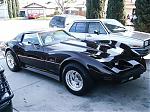
a sad day......

Le Mans Master


Joined: Apr 2001
Posts: 5,941
Likes: 281
From: Was New Orleans but swam to Baton Rouge LA
Cruise-In IX Veteran

Yes it does. The problem with Chassis dynos are that not all operators are created equal. Some dyno shops can change correction factors or mess with the weather station to inflate results. Then the type of dyno some times will play into account, but most of the result differences are due to weather differences and each dyno companies correction factors. You will hear some people talk about Dynojet and others about Mustang dynos, and even dynos that can load the car. I use a dyno on a regular basis with my Z06 to troubleshoot and figure out performance gains after modifications. When I finally get my 71 rebuilt I plan on posting engine dyno results as well as chassis dyno results to show the powertrain loss.

Melting Slicks


Joined: Jul 1999
Posts: 3,030
Likes: 17
From: White Pine / Dandridge TN
I installed a rebuilt pair of vortec heads on an otherwise tired old 350. I did not even change the cam. After 14 pulls on the dyno I ran a best 251 rwhp and 310 lb-ft of torque. I believe if I ever get around to upgrading the cam I could significantly increase my hp. You may want to consider a pair of vortec heads matched with a good cam. You can build a solid budget engine with these heads and save some $$. Also, did you tune the carb while on the dyno? I did and picked up some solid gains in power by setting the carb properly. Another thing to consider is replacing the mechanical fan with an electric fan. I picked up 15 hp on the dyno while making a run without the mechanical fan. Just some food for thought.
Jim
Jim

Safety Car

Joined: Oct 1999
Posts: 4,101
Likes: 10
From: NorCal
I also use a G-tech RR for road race data and find it pretty accurate, but you have to be honest with the baseline entry to get accurate results. It is VERY useful for tracking progress with changes. In my case it's brake pad choices, swaybar settings, shift points, etc., and each change shows up. I'll have to try it as a dyno or drag race tool with my GTA that I just got fired up.
Hans
Hans
Sounds like your car is running as one would expect.
I use a G-tech and MEASURED weights to check RWHP:
The following are G-tech results:
Stock '69 350-300 gross 170 RWHP
Stock '63 327-300 gross 165 RWHP
Stock '93 350-300 net 195 RWHP
Stock '04 505-500 net 414 RWHP (Viper SRT-10)
Heavily Modded 355 320 RWHP (My '69 Corvette)
Near Stock 427 L-88 345 RWHP (Taranchala Manifold, Headers)
1991 ZR-1 350-375 net 313 RWHP
2002 270 net Trailblazer 180 RWHP
These were all run using the same technique.
The G-tech was calibrated for each run (read 1 G when held vertically).
I believe that most Dynos are set up to give people the big numbers they like to hear. I think the one your car ran on was calibrated to provide accurate numbers.
I use a G-tech and MEASURED weights to check RWHP:
The following are G-tech results:
Stock '69 350-300 gross 170 RWHP
Stock '63 327-300 gross 165 RWHP
Stock '93 350-300 net 195 RWHP
Stock '04 505-500 net 414 RWHP (Viper SRT-10)
Heavily Modded 355 320 RWHP (My '69 Corvette)
Near Stock 427 L-88 345 RWHP (Taranchala Manifold, Headers)
1991 ZR-1 350-375 net 313 RWHP
2002 270 net Trailblazer 180 RWHP
These were all run using the same technique.
The G-tech was calibrated for each run (read 1 G when held vertically).
I believe that most Dynos are set up to give people the big numbers they like to hear. I think the one your car ran on was calibrated to provide accurate numbers.

Le Mans Master
Joined: Jul 2006
Posts: 8,117
Likes: 104
From: charlotte north carolina
ok, it's time for me to chime in again.
what everybody says is true, especially when stickshift states that most dynos are set up to give the customer what he wants-big numbers.
that being said, i'll tell you all a story from yester-year. back in '68 (when i was young and foolish) i had a brand new 350 firebird. standard pontiac 4 barrel set up. after a while i put a 3/4 race cam in her. i took it to a place in south chicago called ******* carburation and ignition because they had a dyno and could power tune it. these guys would tune a lot of the pro drag racers that would come in town to run at oswego and us30 drag strips, so they were more that competent. anyway, it put out 180hp at 3000rpm (the tech said he didn't have to go higher, because the timing and a/f ratio wouldn't change). i remember he said it was a "stong number". the number may not sound impressive, but i dusted a lot of z28s in that bird.
so, what i'm saying (and many others) is not to put too much trust in raw numbers.
jeff
what everybody says is true, especially when stickshift states that most dynos are set up to give the customer what he wants-big numbers.
that being said, i'll tell you all a story from yester-year. back in '68 (when i was young and foolish) i had a brand new 350 firebird. standard pontiac 4 barrel set up. after a while i put a 3/4 race cam in her. i took it to a place in south chicago called ******* carburation and ignition because they had a dyno and could power tune it. these guys would tune a lot of the pro drag racers that would come in town to run at oswego and us30 drag strips, so they were more that competent. anyway, it put out 180hp at 3000rpm (the tech said he didn't have to go higher, because the timing and a/f ratio wouldn't change). i remember he said it was a "stong number". the number may not sound impressive, but i dusted a lot of z28s in that bird.
so, what i'm saying (and many others) is not to put too much trust in raw numbers.
jeff

Drifting

Joined: Aug 2007
Posts: 1,924
Likes: 6
took my vette to a dyo place near by, lets just say......worst day ever.
my car has a new 4 barrel carb, headers and exhaust.
puts out only 144whp and 180wtq.
i knew the 74 motors were bad but didn't know they were that bad.
their dyno was a Dynomite Dyno. My friend who also got his car dyno (98 camaro ss with slp exhaust, intake, maf sensor.) said there dyno was bull**** cause he was pushin out 298whp and 289wtq.
all i know.......i was sad for the rest of the day.

my car has a new 4 barrel carb, headers and exhaust.
puts out only 144whp and 180wtq.
i knew the 74 motors were bad but didn't know they were that bad.
their dyno was a Dynomite Dyno. My friend who also got his car dyno (98 camaro ss with slp exhaust, intake, maf sensor.) said there dyno was bull**** cause he was pushin out 298whp and 289wtq.
all i know.......i was sad for the rest of the day.
yours is just as much a Corvette as those other guys's Corvettes

Team Owner

Joined: Jul 2001
Posts: 182,997
Likes: 88
From: Lakeland, FL
Cruise-In IV-V-VI-VII-VIII Veteran
St. Jude Donor '03, '06, '17
If he uses a TH400, drivetrain loss might be as high as 25%

Cruising

Joined: Jan 2008
Posts: 10
Likes: 0
From: Columbia SC
Im a new guy to the board, but not to vettes and F-Bodies. Remember that an F-body weighes 3600 lbs and thats with an aluminium block. power to weight ratio will stand tall everytime. My LS1 Trans Am had 441rwhp and barely walked a stock 04zo6. My 80 C3 has dyno'd 420rwhp on a dynojet, but it took an assload of engine mods to do it, ie: Dart heads, Crower roller cam etc. We loose a buttload of power goin through our rear ends and auto trannies, but we are lighter than most the competition, so engine numbers aren't as important as the relativity to curb weight. Just my .02
Burning Brakes

Joined: Jan 2007
Posts: 1,057
Likes: 4
From: Concord Calif
took my vette to a dyo place near by, lets just say......worst day ever.
my car has a new 4 barrel carb, headers and exhaust.
puts out only 144whp and 180wtq.
i knew the 74 motors were bad but didn't know they were that bad.
their dyno was a Dynomite Dyno. My friend who also got his car dyno (98 camaro ss with slp exhaust, intake, maf sensor.) said there dyno was bull**** cause he was pushin out 298whp and 289wtq.
all i know.......i was sad for the rest of the day.
my car has a new 4 barrel carb, headers and exhaust.
puts out only 144whp and 180wtq.
i knew the 74 motors were bad but didn't know they were that bad.
their dyno was a Dynomite Dyno. My friend who also got his car dyno (98 camaro ss with slp exhaust, intake, maf sensor.) said there dyno was bull**** cause he was pushin out 298whp and 289wtq.
all i know.......i was sad for the rest of the day.
Are you not happy with the way your car runs? Or are you only sad now because of the numbers from some dyno? Dyno numbers mean not to much in them selves, they only work well for the comparestion from one config to another. They almost always show an automatic as makeing less power. But a car with a proper converter running through a powerglide will almost always be much quicker on the track than a car with a clutch, but the dyno will show otherwise. Be happy with your car and forget the numbers!!
Corvette Stories
The Best of Corvette for Corvette Enthusiasts

150 hp to 1,250 hp: Every Corvette Generation Compared by the Specs That Matter
Joe Kucinski
8 Coolest Corvette Pace Cars (and Replicas) of All Time
Verdad Gallardo
Top 10 Corvette Engines RANKED by Peak Torque (70+ Years of Muscle!)
Joe Kucinski
Corvette ZR1X Will Be Pacing the Indy 500, And Could Probably Race, Too!
Verdad Gallardo
Top 10 Corvettes Coming to Mecum Indy 2026!
Brett Foote
Top 10 C9 Corvette MUST-HAVES to Fix These C8 Generation Flaws!
Michael S. Palmer
10 Revolutionary 'Corvette Firsts' Most People Don't Know
Joe Kucinski
5 Reasons to Upgrade to an LS6-Powered Corvette; 5 Reasons to Stay LT2
Michael S. Palmer
2027 Corvette vs The World: Every C8 vs Its Closest Competitor
Joe Kucinski
Pro

Joined: Jun 2007
Posts: 634
Likes: 0
From: Hastings MN
I don't know why everyone thinks that dyno numbers are innaccurate. A dyno reads torque at the wheels, which it converts to power by P=T*N/5250. Torque is not a difficult thing to measure. As long as the dyno is calibrated, it shouldn't be wrong.
The raw data is going to be the same for any brand/manufacture of dyno (assuming that it isn't broken.) The only differences would be if people start putting in correction factors for altitude, temperature, and other stuff like that to give higher numbers.
The raw data is going to be the same for any brand/manufacture of dyno (assuming that it isn't broken.) The only differences would be if people start putting in correction factors for altitude, temperature, and other stuff like that to give higher numbers.
Burning Brakes
Joined: Jan 2007
Posts: 1,057
Likes: 4
From: Concord Calif
I don't know why everyone thinks that dyno numbers are innaccurate. A dyno reads torque at the wheels, which it converts to power by P=T*N/5250. Torque is not a difficult thing to measure. As long as the dyno is calibrated, it shouldn't be wrong.
The raw data is going to be the same for any brand/manufacture of dyno (assuming that it isn't broken.) The only differences would be if people start putting in correction factors for altitude, temperature, and other stuff like that to give higher numbers.
The raw data is going to be the same for any brand/manufacture of dyno (assuming that it isn't broken.) The only differences would be if people start putting in correction factors for altitude, temperature, and other stuff like that to give higher numbers.
In theory you are right, but we have 17 dynos here at work and they are different, close but always different. We do get them to repeat very well but not to each other. These dynos are calibrated every run and are mainly the same type and brand. They are also all computer run dynos. So I know that cheap brand and different brand dynos with many different people running them that there will be a big difference in results seen in the field. Use the numbers wisely.
Pro
Joined: Jun 2007
Posts: 634
Likes: 0
From: Hastings MN
In theory you are right, but we have 17 dynos here at work and they are different, close but always different. We do get them to repeat very well but not to each other. These dynos are calibrated every run and are mainly the same type and brand. They are also all computer run dynos. So I know that cheap brand and different brand dynos with many different people running them that there will be a big difference in results seen in the field. Use the numbers wisely.
1) Someone doesn't know how to calibrate correctly
2) The operator doesn't know how to run the tests properly
3) The dynos are so crappy they can't hold a calibration for the duration of a test. (How accurate are they supposed to be? I would assume at worst +/- 5 or 10%...)
This is just like taking 17 sticks and calibrating them all to a meter stick. There's only so many ways for this not to work out.
Now, I don't dispute that other shops and what not might be wrong, but it's still just a matter of either someone know knowing what is going on, or their dyno being ****y.
Drifting


Joined: Jul 2005
Posts: 1,623
Likes: 29
From: The Netherlands
That's why I'm going back to the same dyno I went to the first time. First visit was just to set a benchmark, second visit is to measure actual gains of engine rebuild. Gains like a faster 0-60 time will differ from the gain according to the dyno numbers as I also dropped 120 lbs since the first time I went to the dyno.

Burning Brakes
Joined: Dec 2003
Posts: 1,004
Likes: 7
From: Adelaide South Australia
This same discussion pops up on every forum....
dyno accuracy....
I wouldn't be too concerned about the actual number you get from the dyno.
What IS relevant though, is the before and after results from mods and tuning, and it should be done on the same dyno, with the car setup the same way. Tyre pressures and clamp down pressures affect results so they also need to be recorded and duplicated for repeatability of tests.
In Australia, the Dyno Dynamics dynos are gaining a lot of credibility for repeatability and good comparitive results when used by trained operators.
There is a shootout mode which standardises the load and environmental factors to give good comparitive results. The national dyno competitions run around the country use this method and are very consistent from state to state.
Having said that... Yes, it is very easy to fudge numbers with dynos.
It still comes back to the operator.
I was initially disappointed when my vette pulled 311 rwhp from a 475hp spec motor (35% losses with a manual gearbox ) but on the road, when unleashed, it runs damn hard.
I am happy with that.
The real test is on the track.
That's what really counts. If you're not getting quicker times after tuning and mods, then there is definitely something amiss.
dyno accuracy....
I wouldn't be too concerned about the actual number you get from the dyno.
What IS relevant though, is the before and after results from mods and tuning, and it should be done on the same dyno, with the car setup the same way. Tyre pressures and clamp down pressures affect results so they also need to be recorded and duplicated for repeatability of tests.
In Australia, the Dyno Dynamics dynos are gaining a lot of credibility for repeatability and good comparitive results when used by trained operators.
There is a shootout mode which standardises the load and environmental factors to give good comparitive results. The national dyno competitions run around the country use this method and are very consistent from state to state.
Having said that... Yes, it is very easy to fudge numbers with dynos.
It still comes back to the operator.
I was initially disappointed when my vette pulled 311 rwhp from a 475hp spec motor (35% losses with a manual gearbox
) but on the road, when unleashed, it runs damn hard. I am happy with that.
The real test is on the track.
That's what really counts. If you're not getting quicker times after tuning and mods, then there is definitely something amiss.

Racer
Joined: Dec 2007
Posts: 404
Likes: 2
From: Kingston Ontario
A lot of guys kind of pull HP numbers out of the air and those same numbers increase with the number of people around to impress or amount of beer consumed. If your car goes fast enough for your liking then be happy .If your not pleased with the performance ,well…………
Advanced
Joined: Jan 2007
Posts: 96
Likes: 0
From: Sandnes Norway
I don't know why everyone thinks that dyno numbers are innaccurate. A dyno reads torque at the wheels, which it converts to power by P=T*N/5250. Torque is not a difficult thing to measure. As long as the dyno is calibrated, it shouldn't be wrong.
The raw data is going to be the same for any brand/manufacture of dyno (assuming that it isn't broken.) The only differences would be if people start putting in correction factors for altitude, temperature, and other stuff like that to give higher numbers.
The raw data is going to be the same for any brand/manufacture of dyno (assuming that it isn't broken.) The only differences would be if people start putting in correction factors for altitude, temperature, and other stuff like that to give higher numbers.
http://www.1bad69.vettepics.com/photo.html

Burning Brakes
Joined: Dec 2003
Posts: 1,004
Likes: 7
From: Adelaide South Australia
Have a look at the dyno sheet on this page, the HP line and the TQ line crosses at about 4650 rpm.
http://www.1bad69.vettepics.com/photo.html
http://www.1bad69.vettepics.com/photo.html
Look again at the graph and note that the torque scale is different to the power scale....
Power and torque are actually similar at 5250 rpm
Advanced
Joined: Jan 2007
Posts: 96
Likes: 0
From: Sandnes Norway