




Rear Coilovers ???
Thread Starter
Race Director


Joined: Jun 2000
Posts: 10,045
Likes: 675
From: FL
 Rear Coilovers ???
Well, starting to think about spending more money and have been looking at the competing rear coilover packages.
On one hand, you have the new Speeddirect kit. Looks cool and will work with my stock T-arms. More expensive than the Van Steel kit. The Van Steel kit comes with new offset T-Arms, is cheaper, but more involved to install (welding). Also, trying to see which would work better with the Drag Vette 6 link setup.
Thoughts, opinions, product reviews welcome.
Speeddirect:


Van Steel:
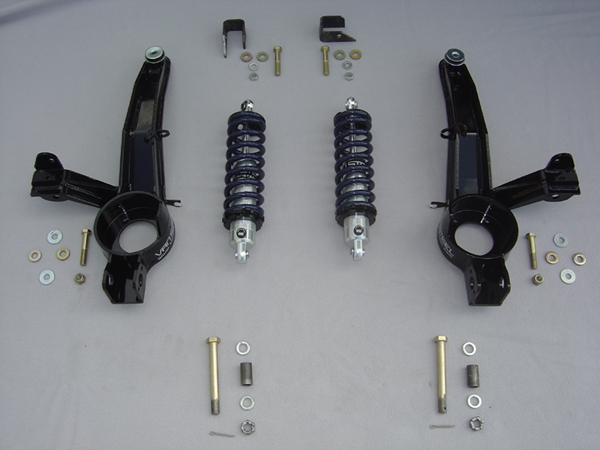
Drag Vette 6 link:

On one hand, you have the new Speeddirect kit. Looks cool and will work with my stock T-arms. More expensive than the Van Steel kit. The Van Steel kit comes with new offset T-Arms, is cheaper, but more involved to install (welding). Also, trying to see which would work better with the Drag Vette 6 link setup.
Thoughts, opinions, product reviews welcome.
Speeddirect:
Van Steel:
Drag Vette 6 link:

Le Mans Master


Joined: Apr 2007
Posts: 7,353
Likes: 72
From: Graceland in a Not Correctly Restored Stingray
You haven't stated your priorities, as for what purpose(s) are your mods? The better path may not be the simplest, and may not be listed on the current menu you're looking at.
Thread Starter
Race Director
Joined: Jun 2000
Posts: 10,045
Likes: 675
From: FL

Currently running a FE-7 bars, poly bushings, 340# TRW rear spring, 460# (1/2 coil cut) fronts, Bilstein shocks. Car is fun but a little rough riding.
Other mods I am thinking off is an LS swap.
High performance street is the goal. The guys I run with are all C5's and C6's. I want to be able to drive this car comfortably for the next 40 years. (Assuming there is still gas)
Last edited by SteveG75; Apr 21, 2008 at 02:40 AM.
Le Mans Master
Joined: Apr 2007
Posts: 7,353
Likes: 72
From: Graceland in a Not Correctly Restored Stingray
As far as improved handling and ride comfort, the two don't necessarily go hand in hand very well with the C3, so you may be forced to decide between the two if you're going to run with the C5 & C6 crowd. Beyond any improved suspension geometry, the biggest advantage they have over a C3 is chassis stiffness, which means frame flex is pretty much non-factor. Thus, a C3 must have comparatively higher effective spring rates due to our chassis negating a substantial amount of those rates out of the true wheel rate equation. That doesn't mean sharks can't be made to hang with the later generation Vettes, but this disadvantage does remain an obstacle to matching them in both ride and comfort. Something to keep this in mind when contemplating your path forward...
Another thing about making improvements is to know where you stand. Short of going out and backing into the Armco at your nearest cloverleaf, have you established your car's understeer/oversteer balance? With your bias towards rear stiffness (relative to the front), I'd be surprised if your rear doesn't tend to step out near the limits and/or when you give up the throttle mid-corner. Also, that "rough riding" complaint could be due to being over-shocked and/or having too much rear bar/spring (it's certainly not those still relatively soft front coils). What Bilsteins are on it? And, are you actually experiencing significant wheel hop? If so, it may not be due to geometry as much as frequency...
Performance means different things to different people, and the requirements for drag racing and handling curves are not the same. For maximum traction when launching it is desirable to virtually eliminate negative camber gain in the rear suspension to keep the tires as straight up and down as possible when the car squats, but when handling curves a measure of negative camber gain is desirable to keep the outside rear tire from leaning out as much as the chassis leans in roll. Dragvette's version of the 6-link, nicely designed as it may be, is designed for the former, so unless you're a regular at the strip it likely wouldn't serve to improve "performance" as defined by your purposes. Then again, I suppose you could go about modifying it to achieve decent camber curve...
Regardless, if you're not up to the task of designing and fabricating your own improved rear suspension system, don't overlook Guldstrand's 5-Bar link rear suspension, which has favorable similarities to the C4 setup. It will work with transverse leaf or coil-overs, and may well fit with the SpeedDirect kit. Note that in the event you retain the stock type TA's in your setup, I recommend against poly TA bushings as the TA's move in more than one plane during suspension travel. I'd stay with rubber there, replace them with sphericals or, better yet, Johnny Joints.
In the pursuit of better handling, here are improvements you should have on your list if you haven't already checked them off: 1) make certain your steering box is properly adjusted and that neither it nor the idler arm are worn, as these can have an enormous effect on responsiveness and handling; 2) get rid of the rubber control arm and sway bar bushings in favor of poly; 3) install a spreader bar between the shock towers to improve front chassis stiffness (solid motor mounts would also help); 4) toss the stock camber struts and eccentrics in favor of heim-jointed rods and camber lock plates (poly doesn't belong here); 5), place a 1/2" thick spacer between the diff and camber strut bracket (longer bolts required) to slightly reduce rear camber gain; 6) install a solid diff x-member locating kit; 7) lower your ride heights (D & Z) to those recommended in the Chevy Power book, if that leaves you sufficient ground clearance to avoid bottoming on the roads on which you drive (this is the major reason my front coils are nearly twice as stiff as yours); and 8) anything you can tolerate doing to stiffen the chassis. Oh, oh, and proper alignment settings are a must which should not be omitted.
As for whether or not to choose either coil-over system, while they would both be an improvement, how much you get out of either of them will depend on what else you're willing to add to the overall package. IMHO, shy of going SLA double wishbone, a true 6-link (with C4 style dual trailing links) designed with a proper camber curve, telescopic 1/2 shafts and coil-overs would be the ultimate C3 rear suspension redux. On second thought, that may be a 10-link, depending on how you count. My $.02...

Another thing about making improvements is to know where you stand. Short of going out and backing into the Armco at your nearest cloverleaf, have you established your car's understeer/oversteer balance? With your bias towards rear stiffness (relative to the front), I'd be surprised if your rear doesn't tend to step out near the limits and/or when you give up the throttle mid-corner. Also, that "rough riding" complaint could be due to being over-shocked and/or having too much rear bar/spring (it's certainly not those still relatively soft front coils). What Bilsteins are on it? And, are you actually experiencing significant wheel hop? If so, it may not be due to geometry as much as frequency...
Performance means different things to different people, and the requirements for drag racing and handling curves are not the same. For maximum traction when launching it is desirable to virtually eliminate negative camber gain in the rear suspension to keep the tires as straight up and down as possible when the car squats, but when handling curves a measure of negative camber gain is desirable to keep the outside rear tire from leaning out as much as the chassis leans in roll. Dragvette's version of the 6-link, nicely designed as it may be, is designed for the former, so unless you're a regular at the strip it likely wouldn't serve to improve "performance" as defined by your purposes. Then again, I suppose you could go about modifying it to achieve decent camber curve...
Regardless, if you're not up to the task of designing and fabricating your own improved rear suspension system, don't overlook Guldstrand's 5-Bar link rear suspension, which has favorable similarities to the C4 setup. It will work with transverse leaf or coil-overs, and may well fit with the SpeedDirect kit. Note that in the event you retain the stock type TA's in your setup, I recommend against poly TA bushings as the TA's move in more than one plane during suspension travel. I'd stay with rubber there, replace them with sphericals or, better yet, Johnny Joints.
In the pursuit of better handling, here are improvements you should have on your list if you haven't already checked them off: 1) make certain your steering box is properly adjusted and that neither it nor the idler arm are worn, as these can have an enormous effect on responsiveness and handling; 2) get rid of the rubber control arm and sway bar bushings in favor of poly; 3) install a spreader bar between the shock towers to improve front chassis stiffness (solid motor mounts would also help); 4) toss the stock camber struts and eccentrics in favor of heim-jointed rods and camber lock plates (poly doesn't belong here); 5), place a 1/2" thick spacer between the diff and camber strut bracket (longer bolts required) to slightly reduce rear camber gain; 6) install a solid diff x-member locating kit; 7) lower your ride heights (D & Z) to those recommended in the Chevy Power book, if that leaves you sufficient ground clearance to avoid bottoming on the roads on which you drive (this is the major reason my front coils are nearly twice as stiff as yours); and 8) anything you can tolerate doing to stiffen the chassis. Oh, oh, and proper alignment settings are a must which should not be omitted.
As for whether or not to choose either coil-over system, while they would both be an improvement, how much you get out of either of them will depend on what else you're willing to add to the overall package. IMHO, shy of going SLA double wishbone, a true 6-link (with C4 style dual trailing links) designed with a proper camber curve, telescopic 1/2 shafts and coil-overs would be the ultimate C3 rear suspension redux. On second thought, that may be a 10-link, depending on how you count. My $.02...
Last edited by TheSkunkWorks; Apr 21, 2008 at 12:53 PM.
Thread Starter
Race Director
Joined: Jun 2000
Posts: 10,045
Likes: 675
From: FL
Great info, thanks.
Guess I should add some more info. I have the Bilstein Sports and noticed an immediate improvement over the KYB shocks I had on previously. My steering box has been rebuilt within the last 1500 miles by Gary up in CT and is nice and tight, no issues there. New idler arm at the other end. PS control valve leaks a little so that is on the list for replacment (rebuilt once already, bore is pitted). Gary also replaced my T-Arm bushings with new rubber as well.
I do have poly in the strut rods so that may have to go and am running the Smart Struts. The rods are set up parallel to the halfshafts so I am getting minimal camber change in turns which is probably an issue. I may working on adjusting the inner pivot points up so that I get some camber gain in turns.
Also, still running 15" wheels and tires and enjoy the older look. The car is lighter than stock with the rear spare assembly removed, sidepipes, aluminum heads, manifold, radiator, etc up front. Being an original FE-7 car with 550# springs, we installed the TRW 340# rear. It has the stock FE-7 front (1-1/8") and rear (7/16") bars with poly bushings.
Most annoying things right now are:
1) Bump steer
2) A tendency for the rear to step out at the limit
3) Wheel hop at stoplights (if I really push it)
I know that coilovers are $$$ so maybe I'll stick to some basics for now. How does this sound:
1) Bump steer blocks. Worth the $$$ to bring the tie rods more in line with the lower control arms?
2) Adjust the strut rods to get some negative camber gain in the rear. What would be a good amount to adjust them? Any ideas?
3) Softer rear spring to balnce the front. I am not too happy with the arch in the TRW spring. It seems like the VBP 330# would not be too different from my curent 340#. With the 460# front coils, can I get away with a 300# rear. Seems awfully light. Don't want too much squat on acceleration.
4) New front diff mount. I have poly now but it is probably 12 years old. No clunking but may be worth replacing. I already have the stiffner plates for the crossmember bushings.
I do have the old Chevy Power manual and will reread it.
5) Replace poly strut rod ends with heim joints.
The ultimate solution may be to avoid doing crutch work and spend the $$$ for a tube frame with C4/5 suspension components. Just hate that intial outlay.
A lot of this is dreaming and planning while I am deployed. Got almost three months to come up with some plans.
BTW: What do you think about reducing the unsprung weight at the wheels? My stock brakes are good but will the Wilwood kits reduce weight enough to make a noticeable difference.
Guess I should add some more info. I have the Bilstein Sports and noticed an immediate improvement over the KYB shocks I had on previously. My steering box has been rebuilt within the last 1500 miles by Gary up in CT and is nice and tight, no issues there. New idler arm at the other end. PS control valve leaks a little so that is on the list for replacment (rebuilt once already, bore is pitted). Gary also replaced my T-Arm bushings with new rubber as well.
I do have poly in the strut rods so that may have to go and am running the Smart Struts. The rods are set up parallel to the halfshafts so I am getting minimal camber change in turns which is probably an issue. I may working on adjusting the inner pivot points up so that I get some camber gain in turns.
Also, still running 15" wheels and tires and enjoy the older look. The car is lighter than stock with the rear spare assembly removed, sidepipes, aluminum heads, manifold, radiator, etc up front. Being an original FE-7 car with 550# springs, we installed the TRW 340# rear. It has the stock FE-7 front (1-1/8") and rear (7/16") bars with poly bushings.
Most annoying things right now are:
1) Bump steer
2) A tendency for the rear to step out at the limit
3) Wheel hop at stoplights (if I really push it)
I know that coilovers are $$$ so maybe I'll stick to some basics for now. How does this sound:
1) Bump steer blocks. Worth the $$$ to bring the tie rods more in line with the lower control arms?
2) Adjust the strut rods to get some negative camber gain in the rear. What would be a good amount to adjust them? Any ideas?
3) Softer rear spring to balnce the front. I am not too happy with the arch in the TRW spring. It seems like the VBP 330# would not be too different from my curent 340#. With the 460# front coils, can I get away with a 300# rear. Seems awfully light. Don't want too much squat on acceleration.
4) New front diff mount. I have poly now but it is probably 12 years old. No clunking but may be worth replacing. I already have the stiffner plates for the crossmember bushings.
I do have the old Chevy Power manual and will reread it.
5) Replace poly strut rod ends with heim joints.
The ultimate solution may be to avoid doing crutch work and spend the $$$ for a tube frame with C4/5 suspension components. Just hate that intial outlay.
A lot of this is dreaming and planning while I am deployed. Got almost three months to come up with some plans.
BTW: What do you think about reducing the unsprung weight at the wheels? My stock brakes are good but will the Wilwood kits reduce weight enough to make a noticeable difference.
Last edited by SteveG75; Apr 21, 2008 at 02:01 PM.

Race Director
Joined: Feb 2005
Posts: 16,100
Likes: 17
Try removing the rear sway bar...sounds like your rear is to tight...I took mine off my 78 (FE7) years ago when I use autocross...made big improvement as rear end would tend to get loose...
As for the composte spring question......I dumped my TRW off my 69 502 because that composite tended to have a weird lope/bounce on bumps at speed...replaced it with a Guldstrand 7 leaf,and issue went away...(also running Bilstein Sports).
Noticed you are talking "street" running with C5/C6 guys...I do all the time..biggest thing is brakes...they can stop much quicker...so look into that...
Skunkworks and others can can provide info on polys and aftermarket suspension kits...I'm not into all that stuff...
As for the composte spring question......I dumped my TRW off my 69 502 because that composite tended to have a weird lope/bounce on bumps at speed...replaced it with a Guldstrand 7 leaf,and issue went away...(also running Bilstein Sports).
Noticed you are talking "street" running with C5/C6 guys...I do all the time..biggest thing is brakes...they can stop much quicker...so look into that...
Skunkworks and others can can provide info on polys and aftermarket suspension kits...I'm not into all that stuff...

Instructor

Joined: Mar 2005
Posts: 104
Likes: 0
From: Perkasie PA
Sorry to hijack a bit but SkunkWorks touched on something that has me perplexed with the reference to Guldstand's kit. I perosnally have the full VB&P suspension with 16" wheels and Gatorbacks. The item I have been trying to solve is brutal squat on power. Wheel hop is less of an issue because I can crush the rear tires hard enough to make them spin mercilously with my BBC. The solutions from VB&P, VanSteel, SharkBites etc. do not seem to address this directly. More spring, stiffer shocks etc. all at the price of something so stuff running over a cigarette butt would make it step out at the limit.
It looks like the Guldstrand kit actually revises the instant center which could completely eliminate the anti squat characteristics. Is this correct? I have been tempted to fit a short pair of longitudinal links to replace the t-arm for a long time now. I suspect the arms may be too short and be very twitchy to small changes.
It looks like the Guldstrand kit actually revises the instant center which could completely eliminate the anti squat characteristics. Is this correct? I have been tempted to fit a short pair of longitudinal links to replace the t-arm for a long time now. I suspect the arms may be too short and be very twitchy to small changes.
Le Mans Master
Joined: Apr 2007
Posts: 7,353
Likes: 72
From: Graceland in a Not Correctly Restored Stingray
SteveG75, I like VB&P's smart strut bracket (have one I've yet to play with, available separately, #52000B?) as it has vertical rather than horizontal slots which allow one to easily vary the camber curve. John Greenwood recommends the inner link height be lowered 1/2" below the original height, and I believe that height should be within the range of adjustment of the VB&P bracket. The downside is the 45 year old eccentric adjustment, which has been cause for so many Bubba's resorting to bending the struts out of frustration thru the years. I plan to fab up a several lock plates for different settings, despite the added difficulty, as they absolutely don't shift about. Don't panic over having the poly camber strut bushings. Just be aware that you should keep an eye on them for loosening and deterioration due to being torqued in directions beyond the simple rotational axis. (Poly's virtual lack of compliance, while great for control arms and such, isn't best suited to this situation.) You can always get a set of heim-jointed rods and lock plates down the road should any issues present or after you wear them out.
I neglected to mention installing modern tires because I often take it for granted that everyone knows they are what all this suspension stuff is about. So I'll put "paid" to that issue and state the obvious that you should put on the best tire/wheel combo available which suits your tastes and pocketbook.
There have been a number of cautions against installing bump-steer blocks on non-lowered C3's, but haven't done the related math and/or mock-ups to prove that to myself since my shark is already a "bottom feeder". (Maybe I ought to bring that question up next time I call Guldstrand.) The blocks most definitely reducing bump steer, and increase Ackerman to boot, which IMHO is desirable as well.
If your rear is stepping out, remove that rear bar. Following Dick Guldstrand's advice, I was able to balance my BB '78 without any rear bar at all. Should that bring on a push, try improving front grip before putting that crutch back on the rear and you'll achieve greater overall cornering capacity without making the car as nervous.
I'm with rihwoods on the rear spring. Try another one and see what happens to your wheel hop. I've never had a problem with it, and I've have had a number of stout BB C3 combos, a few of them in my SA alone (I should rename it "Francis the Mule"). It's been too long ago when I was chasing balance to recall which rear spring Dick ended up sending me, but I'm almost certain it's less than 300#, as he use to run a 250# rear behind the same 860# front coils I have (and same front bar as mine) in his SCCA A Production BB C3.
Reducing unsprung weight is a big deal, and along with tires belongs on that list I made out earlier. The lighter the components which the suspension has to control, the less spring and shock will be required to do so, and as Martha says, "that's a good thing." Yes, the Wilwoods are on my wish list, too. In fact, any lightening you can do is good for performance. (Ask panic, here on the CF, if you run out of ideas on that front. I think his C3 is down to about 500#, soaking wet. )
)
A "C4/C5" chassis transplant would be plain cheating. Think of all the fun and fulfillment you'll miss.
Mark Snyder, unfortunately the stock C3 type suspension doesn't do anything geometrically to address squat, relying strictly on the rear spring to counter loading. Thus, counter-productively, big F>R weight transfers require a high rear spring rate and/or stiff shocks to "control" otherwise excessive squat, which is yet another fault of the stock C3 rear suspension design. Zora was a genius, but the General made him work with one hand behind his back and the fingers of his other hand taped together on the C2/C3 suspension.
While the slightly lower camber strut/toe link rods of Guldstrand's 5-Bar link do increase the IC and lower the roll center by a bit, it's actually the dual trailing links (or longitudinal links, as you've referred to them) which are responsible for introducing anti-squat geometry into the picture. I believe it works out to on the order of about 30%, but there may be some latitude to change that by some amount during installation. Also, I doubt there's anything inherent in Dick's system that would make anything worse (afterall, he's the guy that finally straightened out the C4 somewhat while working on the GS edition), but if you head out on your own I'd make certain you understood the theory and did the homework first.
BTW, the lessening of camber gain from the stock amount which appears to be designed into Guldstrand's 5-Bar link looks to be pretty much in keeping Greenwood's recommendation, but I haven't asked him point blank if his inner link positions have been lowered by that same 1/2".
I'm sure I've overlooked some critical items (haven't even mentioned rear toe-steer), but I'm due to rest my little gray cells now...
I neglected to mention installing modern tires because I often take it for granted that everyone knows they are what all this suspension stuff is about. So I'll put "paid" to that issue and state the obvious that you should put on the best tire/wheel combo available which suits your tastes and pocketbook.
There have been a number of cautions against installing bump-steer blocks on non-lowered C3's, but haven't done the related math and/or mock-ups to prove that to myself since my shark is already a "bottom feeder". (Maybe I ought to bring that question up next time I call Guldstrand.) The blocks most definitely reducing bump steer, and increase Ackerman to boot, which IMHO is desirable as well.
If your rear is stepping out, remove that rear bar. Following Dick Guldstrand's advice, I was able to balance my BB '78 without any rear bar at all. Should that bring on a push, try improving front grip before putting that crutch back on the rear and you'll achieve greater overall cornering capacity without making the car as nervous.
I'm with rihwoods on the rear spring. Try another one and see what happens to your wheel hop. I've never had a problem with it, and I've have had a number of stout BB C3 combos, a few of them in my SA alone (I should rename it "Francis the Mule"). It's been too long ago when I was chasing balance to recall which rear spring Dick ended up sending me, but I'm almost certain it's less than 300#, as he use to run a 250# rear behind the same 860# front coils I have (and same front bar as mine) in his SCCA A Production BB C3.
Reducing unsprung weight is a big deal, and along with tires belongs on that list I made out earlier. The lighter the components which the suspension has to control, the less spring and shock will be required to do so, and as Martha says, "that's a good thing." Yes, the Wilwoods are on my wish list, too. In fact, any lightening you can do is good for performance. (Ask panic, here on the CF, if you run out of ideas on that front. I think his C3 is down to about 500#, soaking wet.
) A "C4/C5" chassis transplant would be plain cheating. Think of all the fun and fulfillment you'll miss.
Mark Snyder, unfortunately the stock C3 type suspension doesn't do anything geometrically to address squat, relying strictly on the rear spring to counter loading. Thus, counter-productively, big F>R weight transfers require a high rear spring rate and/or stiff shocks to "control" otherwise excessive squat, which is yet another fault of the stock C3 rear suspension design. Zora was a genius, but the General made him work with one hand behind his back and the fingers of his other hand taped together on the C2/C3 suspension.
While the slightly lower camber strut/toe link rods of Guldstrand's 5-Bar link do increase the IC and lower the roll center by a bit, it's actually the dual trailing links (or longitudinal links, as you've referred to them) which are responsible for introducing anti-squat geometry into the picture. I believe it works out to on the order of about 30%, but there may be some latitude to change that by some amount during installation. Also, I doubt there's anything inherent in Dick's system that would make anything worse (afterall, he's the guy that finally straightened out the C4 somewhat while working on the GS edition), but if you head out on your own I'd make certain you understood the theory and did the homework first.
BTW, the lessening of camber gain from the stock amount which appears to be designed into Guldstrand's 5-Bar link looks to be pretty much in keeping Greenwood's recommendation, but I haven't asked him point blank if his inner link positions have been lowered by that same 1/2".
I'm sure I've overlooked some critical items (haven't even mentioned rear toe-steer), but I'm due to rest my little gray cells now...
Last edited by TheSkunkWorks; Apr 22, 2008 at 02:34 AM.
Corvette Stories
The Best of Corvette for Corvette Enthusiasts

Top 10 Most Expensive Corvettes Ever Sold on Bring A Trailer
Brett Foote
10 Things Every Corvette Owner Needs (2026 Edition)
Michael S. Palmer
8 Most "Only Corvette Owners Understand" Quirks and Problems
Pouria Savadkouei
10 Reasons the C6 Z06 is Still A Performance Benchmark After 20 Years
Joe Kucinski
How Much Horsepower Every Corvette Engine "LOST" in 1972
Joe Kucinski
Top 10 DOs and DON'Ts for Protecting Your Convertible Top!
Michael S. Palmer
Top 10 Most Explosive Corvettes Ever Made: Power-to-Weight Ratio Ranked!
Joe Kucinski
150 hp to 1,250 hp: Every Corvette Generation Compared by the Specs That Matter
Joe Kucinski
8 Coolest Corvette Pace Cars (and Replicas) of All Time
Verdad Gallardo
Instructor
Joined: Mar 2005
Posts: 104
Likes: 0
From: Perkasie PA
Following up - thanks for the information. Referring to the instant center laterally using the mounting bolt of the T-arm and the tire contact patch where it passes through the cg. Mathmatically it seems like a simple move to raise the T-arm bolt could add anti-squat. Has anyone tried that? A simple drag race four link type of change. The only wrinkle I can see is it could aggrevate the camber problem as the wheel gets to the top half of the travel.
Opinions?
Opinions?

Drifting

Joined: Feb 2005
Posts: 1,738
Likes: 2
From: San diego ca
I'll add my agreement to remove the rear sway bar.. same thing on my 78 with the rear really wanting to step out - i disconnected that bar and its nice and neutral (for street purposes) right now.
