




Why would I need a double roller timing chain?

Le Mans Master


Joined: Jun 2004
Posts: 6,231
Likes: 65
From: Seattle WA
St. Jude Donor '14

I routinely drill a small hole in the cam gear thrust surface on the block directly into the #1 main oil gallery. This provides pressurized oiling to the back of the cam gear when you don't have a needle type deal to save the thrust surface from becoming chewed up. Plus whatever leaks out covers the chain..but that isn't necessary. It gets plenty in normal use.
JIM
JIM
If the surface is 'chewed up', then a cam button was used and never appropriately set.
Everyone has their tips-and-tricks, and I respect that completely - but this is just not needed.
Burning Brakes


Joined: Feb 2005
Posts: 894
Likes: 91
"Nylon" Timing Sets=Add'l HP
I wouldn't be too quick to condemn these "old" nylon gear sets so quickly!
We have a few very "high-end" units that use these today. They will deliver some upstairs HP by retarding the cam timing at the top!
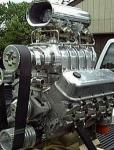
The photo below is a Dart aluminum 540" blown BB, some Brodix heads, and a 10-71 on top. Photo taken during some pre-assembly showing all the components including the "extra-large" primaries! That timing setup on the front has been in there 2 seasons now.
It uses some 1.625" springs, 300# spring pressures closed and 800# open. The timing set stays for the 2 seasons and will get replaced during the "freshen-up" period.
This particular ride weighs very close to 3900# (with driver and fuel, it's not a Vette) and runs consistent 9.20's @ 148/149. This is a "streeter" that drives around town on pump-gas, races with "fuel"!
Thanks, Gary in N.Y.
P.S. We've had this style timing setup in this customer's builds for over 20 years now, all with high spring pressures! Has NOT broken a single time. At one stage in between it did break a Cloyes "Tru-Roller" for no apparent reason. Mike (Senia) at Cloyes was aware of this "nylon" setup a few years back and was surprised to hear of it not being an issue! Couldn't believe we were using it!

We have a few very "high-end" units that use these today. They will deliver some upstairs HP by retarding the cam timing at the top!
The photo below is a Dart aluminum 540" blown BB, some Brodix heads, and a 10-71 on top. Photo taken during some pre-assembly showing all the components including the "extra-large" primaries! That timing setup on the front has been in there 2 seasons now.
It uses some 1.625" springs, 300# spring pressures closed and 800# open. The timing set stays for the 2 seasons and will get replaced during the "freshen-up" period.
This particular ride weighs very close to 3900# (with driver and fuel, it's not a Vette) and runs consistent 9.20's @ 148/149. This is a "streeter" that drives around town on pump-gas, races with "fuel"!
Thanks, Gary in N.Y.
P.S. We've had this style timing setup in this customer's builds for over 20 years now, all with high spring pressures! Has NOT broken a single time. At one stage in between it did break a Cloyes "Tru-Roller" for no apparent reason. Mike (Senia) at Cloyes was aware of this "nylon" setup a few years back and was surprised to hear of it not being an issue! Couldn't believe we were using it!

Le Mans Master
Joined: Oct 2006
Posts: 7,123
Likes: 433
From: Gladstone MO
C3 of Year Finalist (appearance mods) 2019
Interesting. How often does the engine come down so you can take a look at everything? Not doubting your success or your results a bit, but many of us use the steel gears to put that on the list of things to NOT wonder about.

Race Director


Joined: Nov 2002
Posts: 12,142
Likes: 54
From: Taylor Michigan
.
My earlier reply indicated that ALL Gm performance engines have the nylon upper gear. That includes there production off road engines such as the L88`s, ZL1, and the LS7`s. I put personally placed 28,000 miles on one of my L88`s and the chain was stretched but the gear was still intact. Yes, a Cloyes went back into it. [we sell Cloyes timing sets} In other words, the OE stuff is a good durable package even with lots of HP........
My earlier reply indicated that ALL Gm performance engines have the nylon upper gear. That includes there production off road engines such as the L88`s, ZL1, and the LS7`s. I put personally placed 28,000 miles on one of my L88`s and the chain was stretched but the gear was still intact. Yes, a Cloyes went back into it. [we sell Cloyes timing sets} In other words, the OE stuff is a good durable package even with lots of HP........

Burning Brakes
Joined: Dec 2007
Posts: 952
Likes: 0

As to oiling a true roller, GM Perf. used to sell oil gally plugs pre-drilled .035" for just this purpose. I have an 84 BBC in my shop now with 2 of these factory installed. So even GM used the at times.

If your using a high volume pump, you'll never to any bad effects to these mods, only benefits.
Burning Brakes
Joined: Dec 2007
Posts: 952
Likes: 0
I would like to add the GM nylon sprocket is trash. I have changed too many that have cracked, broken, shattered, and crap falls to the pan. The GM link belt chain stretches continually from first start. The cloyes is cheap mod that lasts.
Any arguement that the GM unit is better is...........
Any arguement that the GM unit is better is...........
Le Mans Master
Joined: Jun 2004
Posts: 6,231
Likes: 65
From: Seattle WA
St. Jude Donor '14
Uh, no. The taper ground onto each lobe to spin the lifters also tends to pull the cam rearward as they pull against the lifters. Even though there is no "bearing" per say, it is still a thrust bearing.
As to oiling a true roller, GM Perf. used to sell oil gally plugs pre-drilled .035" for just this purpose. I have an 84 BBC in my shop now with 2 of these factory installed. So even GM used the at times.
If your using a high volume pump, you'll never to any bad effects to these mods, only benefits.
As to oiling a true roller, GM Perf. used to sell oil gally plugs pre-drilled .035" for just this purpose. I have an 84 BBC in my shop now with 2 of these factory installed. So even GM used the at times.
If your using a high volume pump, you'll never to any bad effects to these mods, only benefits.
There's no bearing and it's not flat - and the cam will typically 'walk' both fore and aft. GMPP sold the pre-drilled plugs strictly for "offroad" use.
Finally, a high volume pump is never a good idea on a street engine for a variety of reasons.
So we're on opposite sides of this one...and that's OK
 I continue the challenge for pictures of a standard GEN I showing a problem with the back of the cam sprocket or the front of the block. Show me a problem before you point so solutions

Drifting

Joined: Apr 2006
Posts: 1,911
Likes: 2
From: gold coast queensland
if my motor was a totally disassembled bare block i would have drilled the hole into the gallery but as it was just a head and roller cam swap etc etc i didnt want to risk a sharp of metal going in there so i didnt do it. i did however do the recommendation of creating a path for the oil to lubricate the torrington bearing by cutting a small indent behind it on the cam seat.i have been smashing it for over a year now and no problems so far. i think a single good quality chain is just fine. got the torrington cheap so didnt give it a second thought.

Corvette Stories
The Best of Corvette for Corvette Enthusiasts

Top 10 Most Expensive Corvettes Ever Sold on Bring A Trailer
Brett Foote
10 Things Every Corvette Owner Needs (2026 Edition)
Michael S. Palmer
8 Most "Only Corvette Owners Understand" Quirks and Problems
Pouria Savadkouei
10 Reasons the C6 Z06 is Still A Performance Benchmark After 20 Years
Joe Kucinski
How Much Horsepower Every Corvette Engine "LOST" in 1972
Joe Kucinski
Top 10 DOs and DON'Ts for Protecting Your Convertible Top!
Michael S. Palmer
Top 10 Most Explosive Corvettes Ever Made: Power-to-Weight Ratio Ranked!
Joe Kucinski
150 hp to 1,250 hp: Every Corvette Generation Compared by the Specs That Matter
Joe Kucinski
8 Coolest Corvette Pace Cars (and Replicas) of All Time
Verdad Gallardo
Race Director


Joined: Jan 2000
Posts: 13,018
Likes: 2,262
From: Corsicana, Tx
2020 C2 of the Year - Modified Winner
2020 Corvette of the Year (performance mods)
C2 of Year Winner (performance mods) 2019
2017 C2 of Year Finalist
Well, I guess we'll just have to disagree too. Chewed up thrust surfaces are pretty common out there. I've torn down many engines and have seen the issue to varying degrees. In fact we just tore down a 496 that was a feature car in a recent Vette magazine that had that area really torn up to the point it wiped out the motor with all the metal. Someone had attempted to install a spacer/Torrington setup..to probably repair minor damage but obviously couldn't do math too well and ended up with a horrible mess. The block is fixable..but it will take some work.
About a 2 second google search found you some pics.
http://misn.com/~frd460/Chevytool.html
The whole Torrington bearing deal started with a way to repair this area. Seems like the first sets used some automatic trans bearings. There are other methods where you just machine off the block and install a thick spacer for a wear plate. Or you machine the cam gear to make it fit.
Torrington bearings in general..and any caged needle bearing like this is characterized by NOT needing that much oil. Misting does fine..that's one of their strongpoints. Extra sure won't hurt anything though.
I don't really like the hole at the end of the plug deal....it doesn't put oil where it is needed IMHO. GM started this as a warranty fix for BBC's with noisy lifters. It works for some particular issues like air trapped that causes hyd lifter rattle etc..and again...is a small enough leak that it doesn't really hurt oil pressure...and it doesn't hurt to blow a bunch of oil on the chain. But I still prefer to have pressurized oil to the back of the cam gear...and yes it IS a thrust surface....not a bearing...but a surface...look it up anywhere. Flat tappet cams will slightly pull back into the block against it. If it's not a thrust surface why are you so excited about putting that big 'ole low friction Torrington bearing in there??? Roller cams are another issue and none of these things were originally designed to use them. Surely that .005 or so you set the end play up with a thrust button allows plenty of oil to blow out everywhere on that Torrington? With my way there is wear protection and whatever oil gets by just goes to chain too.
And on the whole HV oil pump deal....there can be a variety of reasons to use one on the street. Oil pressure is regulated by the spring. You can get 100 psi+ out of a stock pump with a spring change....and only 30 psi out of a HV the same way. A HV's only real advantage is it will get to whatever pressure you have the spring set at quicker. It still only makes *X* pressure. Plus it will help *outrun* leaks that we create with extra oiling holes for Torrington bearings, the 16 extra in the EDM flat tappet lifters, the up to 48 extra for some of the solid roller pressurized lifters, the extra slot we cut to lube dist gears, maybe an extra .0005 for bearings or something, etc etc. They are a big help to keep low speed oil pressure up yet still only produce a max of whatever your spring is set to.
Making blanket statements like *never* is something I try not to do. Too many variables.
But as mentioned....everyone does it a little different....
JIM
About a 2 second google search found you some pics.
http://misn.com/~frd460/Chevytool.html
The whole Torrington bearing deal started with a way to repair this area. Seems like the first sets used some automatic trans bearings. There are other methods where you just machine off the block and install a thick spacer for a wear plate. Or you machine the cam gear to make it fit.
Torrington bearings in general..and any caged needle bearing like this is characterized by NOT needing that much oil. Misting does fine..that's one of their strongpoints. Extra sure won't hurt anything though.
I don't really like the hole at the end of the plug deal....it doesn't put oil where it is needed IMHO. GM started this as a warranty fix for BBC's with noisy lifters. It works for some particular issues like air trapped that causes hyd lifter rattle etc..and again...is a small enough leak that it doesn't really hurt oil pressure...and it doesn't hurt to blow a bunch of oil on the chain. But I still prefer to have pressurized oil to the back of the cam gear...and yes it IS a thrust surface....not a bearing...but a surface...look it up anywhere. Flat tappet cams will slightly pull back into the block against it. If it's not a thrust surface why are you so excited about putting that big 'ole low friction Torrington bearing in there??? Roller cams are another issue and none of these things were originally designed to use them. Surely that .005 or so you set the end play up with a thrust button allows plenty of oil to blow out everywhere on that Torrington? With my way there is wear protection and whatever oil gets by just goes to chain too.
And on the whole HV oil pump deal....there can be a variety of reasons to use one on the street. Oil pressure is regulated by the spring. You can get 100 psi+ out of a stock pump with a spring change....and only 30 psi out of a HV the same way. A HV's only real advantage is it will get to whatever pressure you have the spring set at quicker. It still only makes *X* pressure. Plus it will help *outrun* leaks that we create with extra oiling holes for Torrington bearings, the 16 extra in the EDM flat tappet lifters, the up to 48 extra for some of the solid roller pressurized lifters, the extra slot we cut to lube dist gears, maybe an extra .0005 for bearings or something, etc etc. They are a big help to keep low speed oil pressure up yet still only produce a max of whatever your spring is set to.
Making blanket statements like *never* is something I try not to do. Too many variables.
But as mentioned....everyone does it a little different....
JIM

Team Owner

Joined: Aug 2006
Posts: 24,125
Likes: 15
From: Columbia Missouri
I would like to add the GM nylon sprocket is trash. I have changed too many that have cracked, broken, shattered, and crap falls to the pan. The GM link belt chain stretches continually from first start. The cloyes is cheap mod that lasts.
Any arguement that the GM unit is better is...........
Any arguement that the GM unit is better is...........
 This came out of a Cad 472. The rod bearings and main bearings were all trash because the pickup was stuffed and stopped up with all the nylon crumbs from what used to be the gear coating.

Team Owner
Joined: Aug 2006
Posts: 24,125
Likes: 15
From: Columbia Missouri
427Hotrod, I would like to see a picture of where exactly you drill the hole. I don't know that I will for sure drill it, but I'm at a point where I 'can' and I have a double roller timing set with the integrated Torrington bearing. It's also a roller cam, and I have a timing cover with the integrated cam button.

Race Director
Joined: Mar 2006
Posts: 14,112
Likes: 28
From: Florida
Uh, no. The taper ground onto each lobe to spin the lifters also tends to pull the cam rearward as they pull against the lifters. Even though there is no "bearing" per say, it is still a thrust bearing.
As to oiling a true roller, GM Perf. used to sell oil gally plugs pre-drilled .035" for just this purpose. I have an 84 BBC in my shop now with 2 of these factory installed. So even GM used the at times.
If your using a high volume pump, you'll never to any bad effects to these mods, only benefits.
As to oiling a true roller, GM Perf. used to sell oil gally plugs pre-drilled .035" for just this purpose. I have an 84 BBC in my shop now with 2 of these factory installed. So even GM used the at times.
If your using a high volume pump, you'll never to any bad effects to these mods, only benefits.
BINGO

For lubrication, more oil is almost always better. That is just the way metal moving on metal works. Pretty basic concept.
A lot of people spend big bucks for many improvement mods, so why not do a simple no cost one?
A lot of Mercedes engines have used a single real roller chain for years and years to time the sohc on both heads with very little wear and thus very little stretch. Over engineered??? Maybe. But you certainly did not have to worry about it. They used to give grill badges for every 100,000 miles acuumulated.
DB
I drill an .030 hole in the pass side oil galley plug and also on the center one. I've done it with engines assembled by putting grease on the bit and having someone turn the oil pump with a drill just like you prime an engine. Don't bottom out the bit, just far enough to make the hole. Oil pressure doesn't let the shavings into the galley. I also use a 25% over hv pump and a 7 quart oil pan with a 1 qt filter. Never a problem. All of the good Melling pumps I have ever seen come with a 70psi relief spring, so that is the max it will ever put out unless the oil flow overcomes the relief port capability. Flow is much more important than psi.

Le Mans Master
Joined: Mar 2004
Posts: 7,502
Likes: 1,510
From: Little Rock AR
I have only one example of a plastic tooth timing gear setup going bad on me and costing me a LOT of grief. It wasn't a Chevy, it was a 4 overhead cam all aluminum Jaguar V8 in my Vanden Plas. The tensioners and gear teeth wore out, came apart and this caused me to punch a hole in a piston with the head of a valve. This failure comes with a $12,000 repair bill attached to it.  Obviously that failure would not be anywhere near as catastrophic in a Chevy V8 but still...
No, I would not advise anyone to run base engine style plastic tooth timing sets on high performance engines. L-82's got better stuff than that from the factory so why not you?
-Mark.
Obviously that failure would not be anywhere near as catastrophic in a Chevy V8 but still... No, I would not advise anyone to run base engine style plastic tooth timing sets on high performance engines. L-82's got better stuff than that from the factory so why not you?
-Mark.
Le Mans Master
Joined: Jun 2004
Posts: 6,231
Likes: 65
From: Seattle WA
St. Jude Donor '14
After a couple of hundred SBC myself - I've never seen one, so we all go by our own experiences. There's pictures of just about every crazy event on the Internet, but I have yet to see one personally. I talked to my machine shop as well to see if I was just a statistical anomaly and their comment was that the only time they see this is when something wasn't set up correctly during the build...which was the case that 427Hotrod noted. Torrington bearing use started as a means to combine a cam button with a bearing to eliminate cam walk and subsequent timing variation on high RPM racing engines.
I'll also stand by a "never" for an HV pump on the street. There are always variables - incorrect bearing clearance, wacky oiling approaches, etc - but at that point IMHO you're correcting for poor design/implementation...and giving up HP to do it. If you're building some kind of 1.4HP/CID+ fire breather...then that's really not a "street" engine and there are no rules
I recognize we're (I'm) so I just encourage people to read up on both HV oil pumps and how (un)common timing chain failures really are. Everyone's got to set their own risk tolerance and what they feel are the best ways to ensure their engine survives a heavy right foot...and we are all certainly united in the enjoyment of what happens when we push the Big American Pedal
I'll also stand by a "never" for an HV pump on the street. There are always variables - incorrect bearing clearance, wacky oiling approaches, etc - but at that point IMHO you're correcting for poor design/implementation...and giving up HP to do it. If you're building some kind of 1.4HP/CID+ fire breather...then that's really not a "street" engine and there are no rules
I recognize we're (I'm)
so I just encourage people to read up on both HV oil pumps and how (un)common timing chain failures really are. Everyone's got to set their own risk tolerance and what they feel are the best ways to ensure their engine survives a heavy right foot...and we are all certainly united in the enjoyment of what happens when we push the Big American Pedal

Team Owner
Joined: Apr 1999
Posts: 21,953
Likes: 1,445
From: Reno Nevada
2024 C3 of the Year Finalist- Modified
I went online and compared the pictures of the top of the line cloyes timing set and the my Crane Pro Billets and they are different. Here is what the Crane adds says. Is cloyes a German manufacturer? I also had to machine both of my blocks to use the timing set.
Pro-Series Steel Billet, CNC Machined, Roller Timing Chain Sets
Crane Cams? Pro-Series Steel Billet Gear and Roller Chain Sets offer the precision, strength and accuracy of billet steel, nitride hardened, CNC machined camshaft and crankshaft sprockets with the strength, friction reduction and wear resistance of a premium quality, German manufactured, double-row, roller timing chain. The billet 4140 steel nitride hardened crankshaft sprocket features nine separate keyway locations, providing up to eight degrees of advance or retard.
Note: Due to the increased width of the sprockets and chain, clearance must be checked between the timing set and the block casting. Some applications may require minor grinding of the block for clearance.
Pro-Series Steel Billet, CNC Machined, Roller Timing Chain Sets
Crane Cams? Pro-Series Steel Billet Gear and Roller Chain Sets offer the precision, strength and accuracy of billet steel, nitride hardened, CNC machined camshaft and crankshaft sprockets with the strength, friction reduction and wear resistance of a premium quality, German manufactured, double-row, roller timing chain. The billet 4140 steel nitride hardened crankshaft sprocket features nine separate keyway locations, providing up to eight degrees of advance or retard.
Note: Due to the increased width of the sprockets and chain, clearance must be checked between the timing set and the block casting. Some applications may require minor grinding of the block for clearance.
Burning Brakes
Joined: Jan 2007
Posts: 1,057
Likes: 4
From: Concord Calif
These nylon gears do seem to only have a problem in the very long use. Seems the oil temps additives and combution gases all add to it getting hard and breaking away after years of use. Still I would not use it.
Also I have put the hole in the front of the blocks and in the galley plugs only because the custermer wanted it. As said before the oil hole in the galley plug was there to release air to help keep the lifters quite. The front hole was for gear drive set ups, and then really not needed. Remember that you have oil already at the back of the gear under presure! It comes from the clearance between the cam and it's bearing and leaks out all sides includeing to the back of the timing gear under presure. But what ever one wants to do here will probaly work just fine sense there is nothing wrong with the stock set up so how are you going to see an inprovement when there was no problem??
Also I have put the hole in the front of the blocks and in the galley plugs only because the custermer wanted it. As said before the oil hole in the galley plug was there to release air to help keep the lifters quite. The front hole was for gear drive set ups, and then really not needed. Remember that you have oil already at the back of the gear under presure! It comes from the clearance between the cam and it's bearing and leaks out all sides includeing to the back of the timing gear under presure. But what ever one wants to do here will probaly work just fine sense there is nothing wrong with the stock set up so how are you going to see an inprovement when there was no problem??

Race Director
Joined: Apr 2000
Posts: 17,676
Likes: 201
From: Who says "Nothing is impossible" ? I've been doing nothing for years.
Jeese for 30 bucks just use the double roller 
Now if you really want overkill I used the Cloyes billet true roller speed set with encapsulated torrington bearing 9-3600TX9. I also drilled a hole in one of the galley plugs on the front, and I had to grind some material off the front of my block to make it fit. I also use a HV oil pump for the same reasons 427Hotrod, only 10% but it seems pegged at anything over 2000RPM
I have been playing around with engines ( started with Mopars ) for 35 some odd years and I am always learning something new. Some things in the past I thought were gospel turned out to be old wives tales repeated over and over again.
It is never too late to learn something new or change your opinion on something especially when it comes to motors....hint, hint

Now if you really want overkill I used the Cloyes billet true roller speed set with encapsulated torrington bearing 9-3600TX9.
I also drilled a hole in one of the galley plugs on the front, and I had to grind some material off the front of my block to make it fit. I also use a HV oil pump for the same reasons 427Hotrod, only 10% but it seems pegged at anything over 2000RPM I have been playing around with engines ( started with Mopars ) for 35 some odd years and I am always learning something new. Some things in the past I thought were gospel turned out to be old wives tales repeated over and over again.
It is never too late to learn something new or change your opinion on something especially when it comes to motors....hint, hint
Last edited by MotorHead; Nov 8, 2008 at 09:52 AM.

Team Owner

Joined: Jul 1999
Posts: 65,492
Likes: 230
From: Orange Park Florida
All the stupid GM engines I have torn down, all the engines by other makers torn down....Mopar, Ford, GM, for some 50 freeking years now......most all have had that plastic cam gear in there, and EVERY FREEIKING ONE OF THEM WAS BAD, broken or severe wear to the point of failure......them damn thing good for 50-60k miles and that's IT.....
I call it the factory 'fuse' almost guaranteed to fail on the public and cause a expensive toe into some shop....and a nice hefty bill.....
The ONLY so called 'excuse' I have heard is that it's 'quieter'....
it certainly can't be cheeeeeper, no way, all that plastic cast over a aluminum core, vs a casting cut quick on a automatic milling machine......
but I have NEVER heard any other chain make any noise at ALL, even in Caddy's.....but I damn sure seen ALL them plastic POS cause problems across the lines.....
I have had the metal replacements, even the link cog style run well over 100k miles....I would replace it, but it was not actually in failure mode, just stretched all to hell....like a hooker in a bordertown bar.....
I call it the factory 'fuse' almost guaranteed to fail on the public and cause a expensive toe into some shop....and a nice hefty bill.....
The ONLY so called 'excuse' I have heard is that it's 'quieter'....
it certainly can't be cheeeeeper, no way, all that plastic cast over a aluminum core, vs a casting cut quick on a automatic milling machine......
but I have NEVER heard any other chain make any noise at ALL, even in Caddy's.....but I damn sure seen ALL them plastic POS cause problems across the lines.....
I have had the metal replacements, even the link cog style run well over 100k miles....I would replace it, but it was not actually in failure mode, just stretched all to hell....like a hooker in a bordertown bar.....