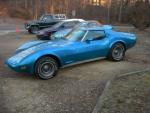
Preparing my 76 for a top speed run

Pro


Joined: Jan 2005
Posts: 535
Likes: 0
From: Southaven MS

It wasn't much on take off but it would absolutely hall after 70mph.
and yes I went to jail that night, but did not stay.... lets say it is who you know and not who you are that counts

My father was part time deputy, who was very good friends with the sheriff. The sheriff new the judge and the highway patrol officer, and the prosecutor was good friends with my American history teacher. I got off with 32.00 court cost, but I was on probation for 2 years. Basically if I got a ticket within those two years the judge said he would put me under the jail. Needless to say I ran 5mph under the speed limit for those 2 years. I honestly got into the habit of driving slow after that...
It was kind of scary... the car had terrible brakes... I tried to slow down to make a turn and the brake petal just hit the floor with a little vibration... good thing I lived in the Mississippi delta... everything is flat and straight.
anyway did not mean to go into all of this... and I definitely do not think it is a wise thing to run that fast down a public road... I have grown up since then.... and I definitely would not want to go over 100mph in the 72 convertible that I have.
Pro
Joined: Oct 2006
Posts: 545
Likes: 2
From: Peoplez Republik (communist portland) Orygun
I have had my track prepared 80 (5 speed Tremec, 3:55 gears, 350 hp crate engine & vb&p suspension) up to 130 mph on a track. Sure, with the gears & 5 speed, I still had plenty of pedal left but... Why?
Being on a racetrack and going 130 in a C3 is fast enough for me. I can absolutely not fathom why you would want to go faster than that, on the STREET!?!?!
But... If you want to try, get a nomex fire suit, helmet, sharkbar (or roll cage) with 5 point seatbelt harness and rosary beads. Sorry to hurt your feelings but a stock 78 auto will probably only go 115-122 mph tops. Sorry.
Being on a racetrack and going 130 in a C3 is fast enough for me. I can absolutely not fathom why you would want to go faster than that, on the STREET!?!?!
But... If you want to try, get a nomex fire suit, helmet, sharkbar (or roll cage) with 5 point seatbelt harness and rosary beads. Sorry to hurt your feelings but a stock 78 auto will probably only go 115-122 mph tops. Sorry.

Race Director


Joined: May 2005
Posts: 10,674
Likes: 122
From: Millington Illinois
St. Jude Donor '08-'09
I had a front tire come apart on my 1972 challenger @ 125 MPH. Ripped chucks out of the sheet metal fender. Would have removed at least the fender on a vette. I am lucky to be here. Hit both ditches and did a 360 in the second one. No speed rated tires in 15" profile.
Drifting

Joined: Jun 2007
Posts: 1,404
Likes: 1
From: Ansonia/NYC CT
I got my bone stock 76 L48 4 speed with 3.08 rear gears up to 120, and it would not go ANY faster, even downhill, with the wind to my back.
Speedo said 90, and that was going to be my excuse if a cop pulled me over, too.
After getting my rear tire radius and final drive ratio into a speed calculator, I determined I was doing roughly 122mph.
Speedo said 90, and that was going to be my excuse if a cop pulled me over, too.
After getting my rear tire radius and final drive ratio into a speed calculator, I determined I was doing roughly 122mph.
Melting Slicks


Joined: Mar 2005
Posts: 2,187
Likes: 7
From: Chetwynd B.C.
Back in the day (1981) I had my '71 coupe LT1 up to 155MPH. That is what the speedo said and I'm sure it wasn't accurate!!!! I was trying to tap out the speedo but it was nite and there were horses on the road so I had to back out of it. My friend in his '78 Trans-am couldn't catch me until I got out of it. 
shmoky
shmoky
Corvette Stories
The Best of Corvette for Corvette Enthusiasts

Every 2027 Corvette Engine Explained
Joe Kucinski
Designer Imagines A Corvette That Looks More Like a Corvette Than the Corvette
Verdad Gallardo
10 Ugly Corvettes That We Still Kinda Love
Joe Kucinski
Top 10 Most Expensive Corvettes Ever Sold on Bring A Trailer
Brett Foote
10 Things Every Corvette Owner Needs (2026 Edition)
Michael S. Palmer
8 Most "Only Corvette Owners Understand" Quirks and Problems
Pouria Savadkouei
10 Reasons the C6 Z06 is Still A Performance Benchmark After 20 Years
Joe Kucinski
How Much Horsepower Every Corvette Engine "LOST" in 1972
Joe Kucinski
Top 10 DOs and DON'Ts for Protecting Your Convertible Top!
Michael S. Palmer
Drifting
Joined: Jun 2007
Posts: 1,404
Likes: 1
From: Ansonia/NYC CT
Yeah, but a 500hp car with gearing made to only go to 90mph....is only going to go 90mph.
I mean, my vette has more power than my honda, but my honda has a higher top speed, because it has an overdrive 5th gear, while my vette only has a 1 to 1 4th gear.
The older vettes mostly came with 3.7 rear gears, or around that ball park range, right? And NONE of them had overdrives....
So how CAN they be doing 155 mph, stock?
I mean, yes, I understand that they had higher RPM ranges than my 5,000rpm redline L-48, but even then, that should only mean about a 20mph diff, at the most.
I mean, my vette has more power than my honda, but my honda has a higher top speed, because it has an overdrive 5th gear, while my vette only has a 1 to 1 4th gear.
The older vettes mostly came with 3.7 rear gears, or around that ball park range, right? And NONE of them had overdrives....
So how CAN they be doing 155 mph, stock?
I mean, yes, I understand that they had higher RPM ranges than my 5,000rpm redline L-48, but even then, that should only mean about a 20mph diff, at the most.
Race Director
Joined: Apr 1999
Posts: 11,520
Likes: 13
From: CORVETTE 77 385 C.I. TEXAS
It takes HP for high top speeds as stated. Typical street manual trans. gears would be around 3.36. Peak HP on some was over 6000rpm. Higher power cars will get closer to peak rpm than lower HP cars.
Some quick nos.
1971 MPH tested together.
L-48 132 3.O8 AUTO.
LT-1 137 3.70 4 SPD.
LS-5 141 3.08 AUTO
LS-6 152 3.36 4 SPD
Remember it is common for perf. enthusiasts to increase power so stock nos. are nothing but a baseline.
Some quick nos.
1971 MPH tested together.
L-48 132 3.O8 AUTO.
LT-1 137 3.70 4 SPD.
LS-5 141 3.08 AUTO
LS-6 152 3.36 4 SPD
Remember it is common for perf. enthusiasts to increase power so stock nos. are nothing but a baseline.
Instructor

Joined: Aug 2004
Posts: 102
Likes: 1
From: Montgomery Alabama
76 Vette
I haven't had the chance or the guts to try my total top end speed, but I have a 330HP GM crate Motor with a 4.11 gears and T56 six speed with double overdrive. I can cruise the interstate in 6th gear at 90mph at 2,000rpm. I've hit 125 in 5th gear and let out of it on the interstate with it still pulling hard. I do plan one day to see what the top end speed is one day. I will also say that I've been completely through my car with new suspension, bushings, gears and ujoints, basically everything.
Instructor
Joined: May 2008
Posts: 171
Likes: 0
From: Newportville PA
put on 550# one inch shorter front springs. It will lower the front end giving the car rake to prevent front end lift. Get a set of Z-speed rated tires.
Get a GPS to get an accurate speed. Unless you have calibrated your speedo they are notoriously off.
I installed a gps for the passenger to get a constant speed read out. No more possible BS. Anyway I only have a 140 mph speedo. So it it takes math and RPM to know how fast you are going.
I might have the record for the highest speeding ticket on the forum. This back when the national speed limit was 55. I had to appear in court and explain why I was driving nearly 100 mph over @152 going down the freeway for many miles The CHP man told me that he could not even keep up chasing me in his Mustang because they top at at @130
Get a GPS to get an accurate speed. Unless you have calibrated your speedo they are notoriously off.
I installed a gps for the passenger to get a constant speed read out. No more possible BS. Anyway I only have a 140 mph speedo. So it it takes math and RPM to know how fast you are going.
I might have the record for the highest speeding ticket on the forum. This back when the national speed limit was 55. I had to appear in court and explain why I was driving nearly 100 mph over @152 going down the freeway for many miles
The CHP man told me that he could not even keep up chasing me in his Mustang because they top at at @130Question:
I have the Tremec 5sp, VB&P Suspension front and rear, and Michelin PS II tires, and a front spoiler.
Will my car feel stable at high speeds above 150 or will if feel like a death ride?
If I need the extra pedal I would really like to be able to use it...........like at the trake or running from the Jakes


Team Owner


Joined: Apr 1999
Posts: 21,953
Likes: 1,445
From: Reno Nevada
2024 C3 of the Year Finalist- Modified
The first thing I noticed years ago in preparation for 150 mph class for 94 mile silver state classic is that the steering is too fast. So you need slower steering ratio box and run up around 4.0 caster.
Your Vette can be made to be very stable. Where drag cars I have driven feel very unsafe after the lights because of the flexy wrinkle wall slicks

Melting Slicks
Joined: Feb 2006
Posts: 3,428
Likes: 5
From: Japan
A previous poster mentioned rather inaccurately that a C3 Corvette is shaped roughly 'like an airplane wing' making the front end light at high speed and even went to the trouble of providing an elementary profile of a simple airplane wing shape to try and illustrate the point. If you look at the shape of a C3 you will notice that (like most other cars) there is an assortment of curves, bumps, and bulges going every which way across the top while roughly the same thing is going on underneath the car only to a greater extent. In order for air to have a consistent effect on a given body the shape of said body has to be smooth enough for the airflow to remain 'attached' to it, and most automobiles prior to the mid-1980s just don't have that. The lift is caused by GROUND EFFECT. The body of the car as it moves along the ground is trapping such a volume of air underneath itself that it causes a significant pressure differential between the bottom of the car and the top, and the faster you go the worse the problem gets. The simplest and best way to prevent this is to fashion a dam or fence across bottom of the front end that is as close to the ground as you can safely get it without worrying about it being torn away under suspension compression. Such a device will not only kill lift but will eliminate drag greatly as well, increasing the potential for speed. Driving at unusually high speed also generally requires that you use stiffer-than-stock springs (ESPECIALLY on wavy, unpredictably irregular public road surfaces) so your C3 doesn't rear-steer its way off the road when you instantaneously go from full bounce to full rebound. Also, a check of any Hoosier Tire vendor's website will reveal that they do still make some very good V- and Z-rated tires in a variety of 15-inch sizes. They're not cheap (unless you happen to be at a vintage race and can get one of the racers to sell you their takeoffs cheap) but they ARE available. In the end, though, unless you have access to a LONG stretch of straight, SMOOTH road any attempt at finding out just how fast your car will go on a public road is a sketchy proposition even on the best day with a car that is properly set up for such an attempt. If you absolutely must do it, though, GodSPEED and we'll be expecting a full report!


Le Mans Master


Joined: Apr 2007
Posts: 7,353
Likes: 72
From: Graceland in a Not Correctly Restored Stingray
Speed is relative. In a well set up car under the right conditions 120 is a walk in the park, while under the wrong circumstances and/or in a poorly set up car even doing just 80 may carry a very high pucker factor. Prepare properly the car as well as the driver and the definition of what's fast moves considerably up the scale. Fail to do so, and brave isn't exactly the term I'd use to describe anyone who unwarily chooses to plunge in over their head. With that in mind, it's probably a good thing that so many a C3 is underpowered.
Bottom line IMHO, while there may be no stupid questions at large, the real key here is coming to know which little ones to be asking and how to apply the answers; that's where doing your homework comes in. And, it's worth pointing out that there's nothing wrong with anyone who wisely chooses not to press their luck.

Bottom line IMHO, while there may be no stupid questions at large, the real key here is coming to know which little ones to be asking and how to apply the answers; that's where doing your homework comes in. And, it's worth pointing out that there's nothing wrong with anyone who wisely chooses not to press their luck.
Thread Starter
Instructor
Joined: Apr 2008
Posts: 190
Likes: 0
From: Melbourne FL
A previous poster mentioned rather inaccurately that a C3 Corvette is shaped roughly 'like an airplane wing' making the front end light at high speed and even went to the trouble of providing an elementary profile of a simple airplane wing shape to try and illustrate the point. If you look at the shape of a C3 you will notice that (like most other cars) there is an assortment of curves, bumps, and bulges going every which way across the top while roughly the same thing is going on underneath the car only to a greater extent. In order for air to have a consistent effect on a given body the shape of said body has to be smooth enough for the airflow to remain 'attached' to it, and most automobiles prior to the mid-1980s just don't have that. The lift is caused by GROUND EFFECT. The body of the car as it moves along the ground is trapping such a volume of air underneath itself that it causes a significant pressure differential between the bottom of the car and the top, and the faster you go the worse the problem gets. The simplest and best way to prevent this is to fashion a dam or fence across bottom of the front end that is as close to the ground as you can safely get it without worrying about it being torn away under suspension compression. Such a device will not only kill lift but will eliminate drag greatly as well, increasing the potential for speed. Driving at unusually high speed also generally requires that you use stiffer-than-stock springs (ESPECIALLY on wavy, unpredictably irregular public road surfaces) so your C3 doesn't rear-steer its way off the road when you instantaneously go from full bounce to full rebound. Also, a check of any Hoosier Tire vendor's website will reveal that they do still make some very good V- and Z-rated tires in a variety of 15-inch sizes. They're not cheap (unless you happen to be at a vintage race and can get one of the racers to sell you their takeoffs cheap) but they ARE available. In the end, though, unless you have access to a LONG stretch of straight, SMOOTH road any attempt at finding out just how fast your car will go on a public road is a sketchy proposition even on the best day with a car that is properly set up for such an attempt. If you absolutely must do it, though, GodSPEED and we'll be expecting a full report!