





brake problem, C3

Thread Starter
1st Gear

Joined: Apr 2009
Posts: 1
Likes: 0
 brake problem, C3
On my 1968 roadster, the front calipers were leaking, I did a rebuild on them. The front fluid level was low but not empty, I filled before touching the brake pedal. The rear part of the system was not touched.
The pedal went all the way to the floor with no resistance. My first question is what happened to the safety factor of the dual system?
Under the master cylinder is a "pressure differential valve, brake warning switch.
Is it possible that this is stuck, causing a pressure drop to rear ?
I bleed the front brakes, and got pedal, and also bleed rear brakes, made sure the rear pistons were not stuck, and verified they were moving against the rotors.
After driving the car , it stops, but doesn't seem like I'm getting full action ( I doubt it would slide on pavement) In gravels, I did a slide, and all 4 wheels did slide.
Has anyone seen this before ?
Thanks !
The pedal went all the way to the floor with no resistance. My first question is what happened to the safety factor of the dual system?
Under the master cylinder is a "pressure differential valve, brake warning switch.
Is it possible that this is stuck, causing a pressure drop to rear ?
I bleed the front brakes, and got pedal, and also bleed rear brakes, made sure the rear pistons were not stuck, and verified they were moving against the rotors.
After driving the car , it stops, but doesn't seem like I'm getting full action ( I doubt it would slide on pavement) In gravels, I did a slide, and all 4 wheels did slide.
Has anyone seen this before ?
Thanks !
Racer
Joined: Jul 2008
Posts: 281
Likes: 0
From: Forest Va
The valve thing that you are talking about can be rested by hard (heavy ) breaking. When I redid my brakes on my 79 the peddel never felt right after I bleed the system, so when I took the car down the road I slammed on the brakes and the peddle got frim.
From what I understand the valve is design that when you loss your breaks it cut off the brake fluid from going to the rear so that you always have front breaks.
I hope this helps and that you get your brake problem fixed.
From what I understand the valve is design that when you loss your breaks it cut off the brake fluid from going to the rear so that you always have front breaks.
I hope this helps and that you get your brake problem fixed.
Drifting


Joined: Apr 2007
Posts: 1,970
Likes: 45
From: Cameron Park CA
The valve thing that you are talking about can be rested by hard (heavy ) breaking. When I redid my brakes on my 79 the peddel never felt right after I bleed the system, so when I took the car down the road I slammed on the brakes and the peddle got frim.
From what I understand the valve is design that when you loss your breaks it cut off the brake fluid from going to the rear so that you always have front breaks.
I hope this helps and that you get your brake problem fixed.
From what I understand the valve is design that when you loss your breaks it cut off the brake fluid from going to the rear so that you always have front breaks.
I hope this helps and that you get your brake problem fixed.
If, for instance, a hose going to a front caliper is severed there will be NO front braking, the rears will do all the stopping, the BRAKE light on the tach will illuminate, alerting you to DO SOMETHING to the brake system.
NOTE: The heavy duty brake system, identified by having two pad retaining pins on the front calipers, does have a real proportioning valve that limits fluid pressure to the rear brakes.

Team Owner


Joined: Mar 2002
Posts: 24,160
Likes: 78
Now of course this begs the question, why do you need such a device in a braking system where the front and rear circuits are isolated? I can only imagine that the GM engineers were thinking of the MC piston seals going bad and leaking from one half to the other. In that situation, you no longer have 2 separate hydraulic circuits, and a leak at any corner could potentially drain the entire system if not for that shutoff valve.
@ the OP, your shutoff valve likely has blocked off the front circuit because of the pressure drop the leak caused. Is your brake light on? To reset it, push the pedal down as hard as you can with an idling engine. Hold it down until you feel a thump in the pedal. That's the piston sliding back to center. If that doesn't work then you might need to pull it off and recenter it manually or replace it. (Or do what a few us have now and just plumb it out)
Last edited by wcsinx; Apr 28, 2009 at 09:26 AM.

Le Mans Master

Joined: Aug 2006
Posts: 7,431
Likes: 1,561
From: mount holly NC
2025 c3 ('74-'82) of the Year Finalist - Unmodified
2019 C3 of Year Finalist (appearance mods)
Pump up the brake pedal and hold the pressure for 30 seconds, if the pedal goes down than repair the M/C. If the pedal stays hard try bleeding again. PG.
Corvette Stories
The Best of Corvette for Corvette Enthusiasts

5 Best & 5 Worst Corvette Daily Drivers
Joe Kucinski
The Headlights of Every Corvette Generation Explained
Joe Kucinski
5 Best & 5 Most Overrated Corvette Track Packages of All Time!
Joe Kucinski
Every 2027 Corvette Engine Explained
Joe Kucinski
Designer Imagines A Corvette That Looks More Like a Corvette Than the Corvette
Verdad Gallardo
10 Ugly Corvettes That We Still Kinda Love
Joe Kucinski
Top 10 Most Expensive Corvettes Ever Sold on Bring A Trailer
Brett Foote
10 Things Every Corvette Owner Needs (2026 Edition)
Michael S. Palmer
8 Most "Only Corvette Owners Understand" Quirks and Problems
Pouria Savadkouei





Drifting
Joined: Apr 2007
Posts: 1,970
Likes: 45
From: Cameron Park CA
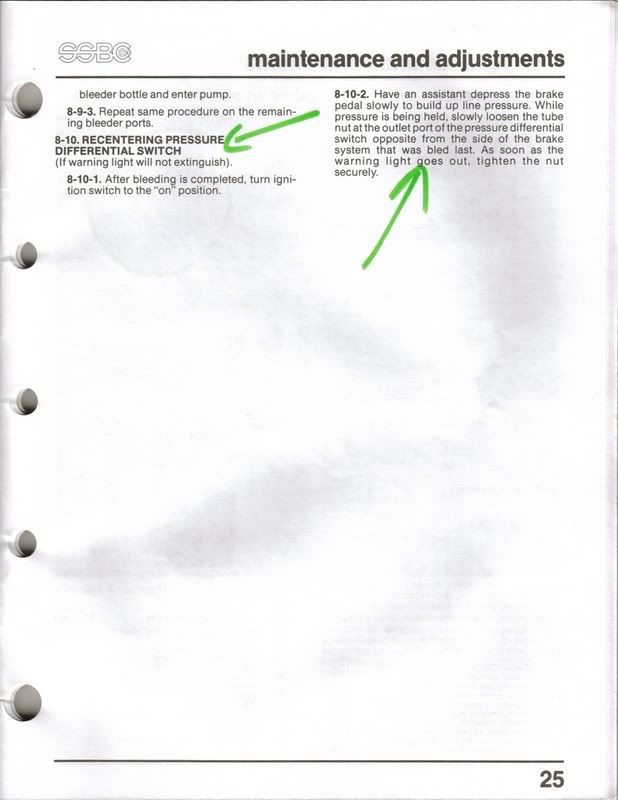
Pete, No matter how many times you repeat this, you'll still be wrong. No, it isn't a proportioning valve, but its function is more than just turning on a light. It also serves to block off the low pressure (leaking) side of the brake system. If you don't believe me, I suggest you open a rear bleeder, jam on the brakes until the light comes on, and then see how much flow you can get from that bleeder. It will be a trickle if anything. I've done this.
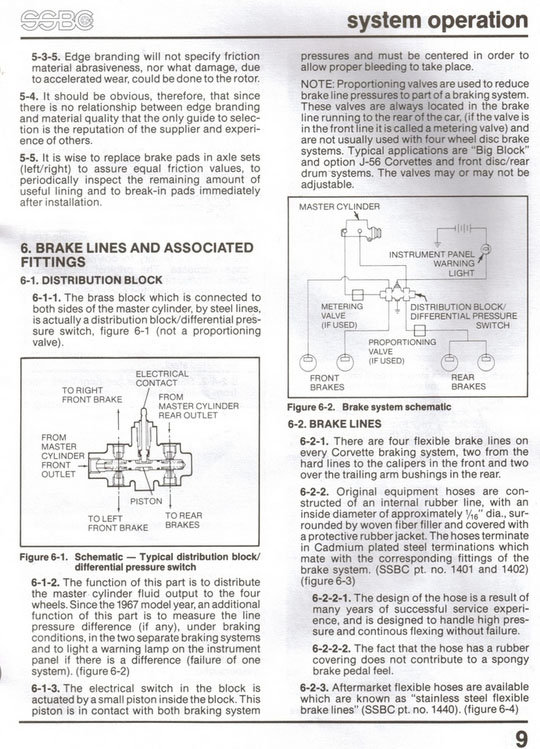
Para. 6-1-2.
Anyway the point I was trying to make was that this statement made by J.T. Vette was wrong.
From what I understand the valve is design that when you loss your breaks it cut off the brake fluid from going to the rear so that you always have front breaks.
I hope this helps and that you get your brake problem fixed.
I hope this helps and that you get your brake problem fixed.
Cheers,
Pete
Last edited by PeteZO6; Apr 29, 2009 at 08:15 PM.
Le Mans Master
Joined: Aug 2006
Posts: 7,431
Likes: 1,561
From: mount holly NC
2025 c3 ('74-'82) of the Year Finalist - Unmodified
2019 C3 of Year Finalist (appearance mods)
Different switches for different years?
Could be your both correct, on my 74 the "Dogbone" (the part in the middle that trips the light switch) has a spring on each end. Once a front caliper leaked, and when I steped on the brake the light would go on and when I released the brake pedal the switch would go off. Each time I pressed on the brake more fluid would leak out of the caliper. A year later a rear caliper leaked and the same thing happened, press the brake pedal and the light came on, release the brake and the light went off, and the more I used the brake the more the fluid would leak out. Maybe some switches will stop the fluid flow but mine will not. PG.
Team Owner
Joined: Mar 2002
Posts: 24,160
Likes: 78
Try reading it. It supports what I'm telling you. It is not just a light switch.
Actually no, he is correct. It will shut off the flow to the low pressure side.
Thanks, I know what it looks like. I have mine out. I've verified what I'm telling you both in and out of the car. Look carefully at the diagram you posted. What do you think is going to happen if that piston slides all the way left or right?
Anyway the point I was trying to make was that this statement made by J.T. Vette was wrong.
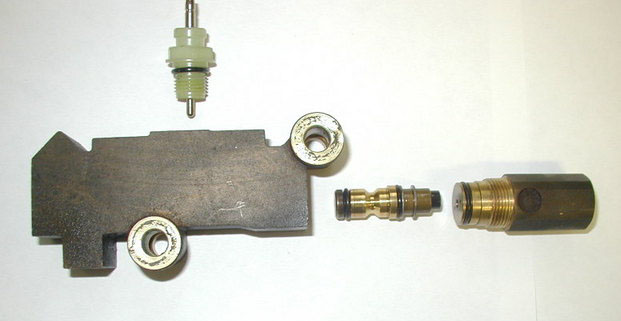
Here is a photo of the valve disassembled:
Le Mans Master
Joined: Aug 2006
Posts: 7,431
Likes: 1,561
From: mount holly NC
2025 c3 ('74-'82) of the Year Finalist - Unmodified
2019 C3 of Year Finalist (appearance mods)
Team Owner
Joined: Mar 2002
Posts: 24,160
Likes: 78
Could be your both correct, on my 74 the "Dogbone" (the part in the middle that trips the light switch) has a spring on each end. Once a front caliper leaked, and when I steped on the brake the light would go on and when I released the brake pedal the switch would go off. Each time I pressed on the brake more fluid would leak out of the caliper. A year later a rear caliper leaked and the same thing happened, press the brake pedal and the light came on, release the brake and the light went off, and the more I used the brake the more the fluid would leak out. Maybe some switches will stop the fluid flow but mine will not. PG.
Team Owner
Joined: Mar 2002
Posts: 24,160
Likes: 78
Here's what mine looks like.
http://s243.photobucket.com/albums/f...rakeswitch.jpg
http://s243.photobucket.com/albums/f...rakeswitch.jpg

Advanced
Joined: Nov 2011
Posts: 60
Likes: 0
Wow, a lot ofopinions here, they all soundrihtonewayor another. I will describe why i started to look on the forum, you will see why..... Ok, when i press my brake real hard, the brake ligh comes on.... Do Some chkg and the rear resevoir is low, i fill it aand in a short time, the cycle continues. All of the calipers look dry, the engine lines etc. The rear cross member that the cross brake line is on is wet. Found it! What pete described is what happens, press extra hard i am being notified by a light to look. Needs fluid. On a side note, i called andrew at muskegon brake to get some part info, he described the proportioning valve as pete described it..... No matter, i like the fact that it will isolate a problem. Ok, here is the question, in the process of removing the rear cross line, one fitting after another rounded, so i started to just cut them off. I loosened most everything so i can see what the re-assembly needs to look like. I will replace from the proportioning block rearward, what is the bes way to fish the long line thru the frame rail, and would you guys mess with the rear calipers or just put the lines on. I am just not a brake guy, but i am a quick read! Thx much

5th Gear
Joined: Jul 2013
Posts: 5
Likes: 0
new to forum
Just wanted to say that I,m old in years but new as owner of a 1974 corvette. And very new to this forum . Started with the brakes because that's where I,m at. Got some good help already and plan on seeing me a lot because I have just got started on this life time dream restoring an old vett,
