



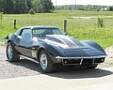

F---ed myself somehow.

Thread Starter
Advanced

Joined: Jun 2009
Posts: 92
Likes: 0
 F---ed myself somehow.
I bought the 'vette about 2 months ago and have been investing time and money since then to get it back on the road in a stable condition. I put on a new intake manifold (EB 2701) and the car is running worse. Before I had it timed to about 8 initial with 1100rpm in park and 550 in drive but now,with everything timed similarly, won't stay above 500rpm in drive. I'm no mechanic but I think my problem is vacuum pressure.
he picture I'm including is of everything installed but before I rigged the vacuum system up. I've used my extensive Microsoft paint skills to highlight all or most of the lines that require vacuum pressure.
Before the switch my PCV valve was hooked to a port at the rear of carb but ON the spacer. When I switched manifolds I no longer needed the spacer. Currently its hooked to small vacuum manifold which also services the lines for my headlights/wipers. I'm THINKING this is where my problem lies but I'm not 100% certain how to fix it. The speed shop guys told me a should of had a port on my carb in the same position as it was on the spacer.
Ideas?

he picture I'm including is of everything installed but before I rigged the vacuum system up. I've used my extensive Microsoft paint skills to highlight all or most of the lines that require vacuum pressure.
Before the switch my PCV valve was hooked to a port at the rear of carb but ON the spacer. When I switched manifolds I no longer needed the spacer. Currently its hooked to small vacuum manifold which also services the lines for my headlights/wipers. I'm THINKING this is where my problem lies but I'm not 100% certain how to fix it. The speed shop guys told me a should of had a port on my carb in the same position as it was on the spacer.
Ideas?
Last edited by Nealjr; Sep 11, 2009 at 03:11 PM. Reason: Forgot picture....

Pro


Joined: Jun 2005
Posts: 540
Likes: 4
St. Jude Donor '09, '24
Get a can of carb. cleaner and while the car is ideling spray the carb cleaner on the head/intake manifold gasket area to make sure you don't have a small leak there. When using the carb cleaner if you encounter a leak you will know because the RPMs will pick right up when the cleaner hits it. I would go to a parts store that rents tools and get a vacuum gauge that you can create a vacuum with. These will look like a pair of pliers with a vacuum gauge attached. The EGR test with the vacuum gauge to make sure it is opening would be a good place to start. I myself get rid of the carbs, vacuum master cylinder and use a Hydroboost for the brakes. Using electric motors for the headlight doors on my cars too. You will recieve plenty of good suggestions here as I am sure plenty of members have had these vacuum problems on their car. The C3 in it's stock form has a lot of vacuum lines as you will be finding out, houstonvett
Thread Starter
Advanced
Joined: Jun 2009
Posts: 92
Likes: 0
I was just talking to my dad about the carb cleaner trick. I'm definitely going to try that. I bought the vacuum gauge/tester yesterday but haven't so much as looked at it again yet. I'm not sure what you mean by EGR test or when you say:
"I myself get rid of the carbs, vacuum master cylinder and use a Hydroboost for the brakes"
but if you could provide links to what you consider GOOD reading material I would appreciate it greatly. As for electronic motors, I've heard good things but once again I'm no mechanic. I'll begin googling the terminology I haven't understood now. Thanks for your advice.
"I myself get rid of the carbs, vacuum master cylinder and use a Hydroboost for the brakes"
but if you could provide links to what you consider GOOD reading material I would appreciate it greatly. As for electronic motors, I've heard good things but once again I'm no mechanic. I'll begin googling the terminology I haven't understood now. Thanks for your advice.

Team Owner


Joined: Jun 2000
Posts: 38,923
Likes: 1,482
From: Southbound
Cruise-In II Veteran
Blue line in your pic is power brakes; nothing should be sharing this line with the booster. It usually runs from the base of the carb.
Green line should be the vacuum advance to the distributor.
Red line from the PCV should route to the base of the carb, not the headlight supply.
Caution: Your rubber fuel lines to the carb are dangerous. A potential fire hazard.

Last edited by Easy Mike; Sep 11, 2009 at 03:54 PM.

Race Director

Joined: Mar 2006
Posts: 14,112
Likes: 28
From: Florida
Run your pcv to the blue port on the carb all by itself.
Run your brake booster to another port on the manifold by itself or tee it into your purple on the manifold. Really all the rest of the of the vacuum lines can go to any port on the manifold, that is available like the one mentioned above.
Distributer is good.
To test for leaks, you can temporarily disconnect and plug all except the pcv and the distributer.
Run your brake booster to another port on the manifold by itself or tee it into your purple on the manifold. Really all the rest of the of the vacuum lines can go to any port on the manifold, that is available like the one mentioned above.
Distributer is good.
To test for leaks, you can temporarily disconnect and plug all except the pcv and the distributer.

Safety Car

Joined: Aug 2001
Posts: 4,883
Likes: 11
From: North Easton Mass
Where was your brake booster hose connected previously? Usually the booster hose is run from a fitting on the manifold. That hole to the right rear of the carb can be drilled out for a fitting. Another thing you may have done wrong is plug the distributer in a tooth off.

Rick B.
Rick B.

Racer


Joined: Jul 2004
Posts: 444
Likes: 0
From: Dallas TX
Here's what I'd do. Run the PCV line to the large vacuum port on your carb. Cap off the remaining ported vacuum and small manifold vacuum ports on the carb. Don't plumb up the green, purple or blue lines to the carb or manifold since you won't be using the brakes or headlights while you are troubleshooting and it eliminates a potential leak source. Make sure the carb is tightened down, but not super tight.
Set your timing to give you about 35 degrees of advance at around 3000 or 3500 rpm. Then plumb the vacuum advance to run off the small manifold vacuum port. This should put your timing at idle up around 30 degrees which will help your idle quality significantly. You'll probably notice your idle speed will be higher which you can then adjust using the idle speed screw. Also, make sure your idle mixture screws are at the factory setting which should be 1 1/2 turns out.
Reattach the blue line from the brake booster and see if there is any change in the idle. Then put the car in drive and fine tune your idle speed using the screw.
Is the carb new? Has it been thoroughly cleaned and properly reassembled if it wasn't new? What is your manifold pressure at idle? Do you have around 6 to 8 psi of fuel pressure?
Set your timing to give you about 35 degrees of advance at around 3000 or 3500 rpm. Then plumb the vacuum advance to run off the small manifold vacuum port. This should put your timing at idle up around 30 degrees which will help your idle quality significantly. You'll probably notice your idle speed will be higher which you can then adjust using the idle speed screw. Also, make sure your idle mixture screws are at the factory setting which should be 1 1/2 turns out.
Reattach the blue line from the brake booster and see if there is any change in the idle. Then put the car in drive and fine tune your idle speed using the screw.
Is the carb new? Has it been thoroughly cleaned and properly reassembled if it wasn't new? What is your manifold pressure at idle? Do you have around 6 to 8 psi of fuel pressure?
Corvette Stories
The Best of Corvette for Corvette Enthusiasts

Top 10 Most Expensive Corvettes Ever Sold on Bring A Trailer
Brett Foote
10 Things Every Corvette Owner Needs (2026 Edition)
Michael S. Palmer
8 Most "Only Corvette Owners Understand" Quirks and Problems
Pouria Savadkouei
10 Reasons the C6 Z06 is Still A Performance Benchmark After 20 Years
Joe Kucinski
How Much Horsepower Every Corvette Engine "LOST" in 1972
Joe Kucinski
Top 10 DOs and DON'Ts for Protecting Your Convertible Top!
Michael S. Palmer
Top 10 Most Explosive Corvettes Ever Made: Power-to-Weight Ratio Ranked!
Joe Kucinski
150 hp to 1,250 hp: Every Corvette Generation Compared by the Specs That Matter
Joe Kucinski
8 Coolest Corvette Pace Cars (and Replicas) of All Time
Verdad Gallardo
Thread Starter
Advanced
Joined: Jun 2009
Posts: 92
Likes: 0
Holy cow.
I expected a few responses but nothing prepared me for this.
From the bottom up:
yellow94coupe
"Is the carb new? Has it been thoroughly cleaned and properly reassembled if it wasn't new? What is your manifold pressure at idle? Do you have around 6 to 8 psi of fuel pressure?"
I'm not sure about the condition of the carb or how to check the manifold or fuel pressure but I'll get back to you as soon as I can. Most of this will have to wait until my day off (tomorrow). My only question is whether or not you're suggesting the brake booster line be attached at the manifold instead of the carb to make room for the PCV's line. I only have 1 port on the carb of this diameter that I can find. My other vacuum port (smaller) is hooked to my distributor. Thank you for taking the time to respond.
72LS1Vette
"Where was your brake booster hose connected previously? Usually the booster hose is run from a fitting on the manifold. That hole to the right rear of the carb can be drilled out for a fitting. Another thing you may have done wrong is plug the distributer in a tooth off."
Brake booster is in the same place it was originally... on my only large diameter vacuum port from the carb. Are you saying I can potentially have another port added to my carb of this diameter? I'm not sure what you mean by your last sentence. However thank you for responding.
noonie
Definitely something I will be trying. Thank you for the suggestions.
Easy Mike
"Red line from the PCV should route to the base of the carb, not the headlight supply.
Caution: Your rubber fuel lines to the carb are dangerous. A potential fire hazard."
In the pic my PCV is resting off to the side. I mentioned I hadn't hooked all the vacuum stuff up yet. I took the pic while pulling my hair out wondering why it all couldn't go back in the same way it came out. lol. I've seen metal fuel lines but haven't invested due to my towering ignorance. Any advice in this area? Thanks for your time and response.
Fishndude
I apologize for not communicating myself effectively. The picture is of the system before I rigged the vacuum system. That port is now holding a small plug with 3 vacuum ports on it; my PVC valve, headlights and wipers. Thanks for your response all the same.
From the bottom up:
yellow94coupe
"Is the carb new? Has it been thoroughly cleaned and properly reassembled if it wasn't new? What is your manifold pressure at idle? Do you have around 6 to 8 psi of fuel pressure?"
I'm not sure about the condition of the carb or how to check the manifold or fuel pressure but I'll get back to you as soon as I can. Most of this will have to wait until my day off (tomorrow). My only question is whether or not you're suggesting the brake booster line be attached at the manifold instead of the carb to make room for the PCV's line. I only have 1 port on the carb of this diameter that I can find. My other vacuum port (smaller) is hooked to my distributor. Thank you for taking the time to respond.
72LS1Vette
"Where was your brake booster hose connected previously? Usually the booster hose is run from a fitting on the manifold. That hole to the right rear of the carb can be drilled out for a fitting. Another thing you may have done wrong is plug the distributer in a tooth off."
Brake booster is in the same place it was originally... on my only large diameter vacuum port from the carb. Are you saying I can potentially have another port added to my carb of this diameter? I'm not sure what you mean by your last sentence.
However thank you for responding.noonie
Definitely something I will be trying. Thank you for the suggestions.
Easy Mike
"Red line from the PCV should route to the base of the carb, not the headlight supply.
Caution: Your rubber fuel lines to the carb are dangerous. A potential fire hazard."
In the pic my PCV is resting off to the side. I mentioned I hadn't hooked all the vacuum stuff up yet. I took the pic while pulling my hair out wondering why it all couldn't go back in the same way it came out. lol. I've seen metal fuel lines but haven't invested due to my towering ignorance. Any advice in this area? Thanks for your time and response.
Fishndude
I apologize for not communicating myself effectively. The picture is of the system before I rigged the vacuum system. That port is now holding a small plug with 3 vacuum ports on it; my PVC valve, headlights and wipers. Thanks for your response all the same.
Pro
Joined: Jun 2005
Posts: 540
Likes: 4
St. Jude Donor '09, '24
I was just talking to my dad about the carb cleaner trick. I'm definitely going to try that. I bought the vacuum gauge/tester yesterday but haven't so much as looked at it again yet. I'm not sure what you mean by EGR test or when you say:
"I myself get rid of the carbs, vacuum master cylinder and use a Hydroboost for the brakes"
but if you could provide links to what you consider GOOD reading material I would appreciate it greatly. As for electronic motors, I've heard good things but once again I'm no mechanic. I'll begin googling the terminology I haven't understood now. Thanks for your advice.
"I myself get rid of the carbs, vacuum master cylinder and use a Hydroboost for the brakes"
but if you could provide links to what you consider GOOD reading material I would appreciate it greatly. As for electronic motors, I've heard good things but once again I'm no mechanic. I'll begin googling the terminology I haven't understood now. Thanks for your advice.

Burning Brakes

Joined: Apr 2007
Posts: 1,028
Likes: 1
From: SOUTH ELGIN IL
First, the reference to having the distributor in 1 tooth off: When you took off your old intake you had to remove the distributor. Did you mark the position of the rotor so you can reinstall in the same position? The rotor turns using a gear that runs off the cam in the engine. If the gear is "off 1 tooth" the car will ikely run choppy like you have described because the distributor will fire at the wrong time for all intensive purposes and be impossible to tune.
Take a look around the base of the carb, sometimes there are other ports hiding down there. If you don't find any disconenct that brake booster line and plug in the PCV. I don't think you need that brake booster vacuum line to idle or even drive and brake (you wil lose your power brakes, however). If your idle smoothes out and comes up you have identified the problem. If not, move to some of the other more complicated suggestions. Carb cleaner is a great trick, when it finds the leak rpm should jump noticeably. Last time i had a leak, I had a vacuum plug on my carb dissintegrate and the end fell off... harder to see because it looked like the cap was on there but $2 fix.
Plug up all those holes in the manifold too - what are those holes up by the water neck? Heck, while the car is running stick your finger in them and see if the idle comes up. They are big enough that you can probably hear the air whistling in them. Another trick you might try is to start the engine and cup your hands over the top of the carb to cut off the air. The car should die because you've choked off the air. If it does not you know you have a vacuum leak because it's running on air coming in from somewhere else.
Lastly, you used new intake manifold gaskets and remembered to put the gasket back between the carb and manifold right?
Take a look around the base of the carb, sometimes there are other ports hiding down there. If you don't find any disconenct that brake booster line and plug in the PCV. I don't think you need that brake booster vacuum line to idle or even drive and brake (you wil lose your power brakes, however). If your idle smoothes out and comes up you have identified the problem. If not, move to some of the other more complicated suggestions. Carb cleaner is a great trick, when it finds the leak rpm should jump noticeably. Last time i had a leak, I had a vacuum plug on my carb dissintegrate and the end fell off... harder to see because it looked like the cap was on there but $2 fix.
Plug up all those holes in the manifold too - what are those holes up by the water neck? Heck, while the car is running stick your finger in them and see if the idle comes up. They are big enough that you can probably hear the air whistling in them. Another trick you might try is to start the engine and cup your hands over the top of the carb to cut off the air. The car should die because you've choked off the air. If it does not you know you have a vacuum leak because it's running on air coming in from somewhere else.
Lastly, you used new intake manifold gaskets and remembered to put the gasket back between the carb and manifold right?
Last edited by Dantana; Sep 11, 2009 at 05:04 PM.
Burning Brakes
Joined: Apr 2007
Posts: 1,028
Likes: 1
From: SOUTH ELGIN IL
Fuel line pics dude...
This is the tired engine compartment i inherited:

First thing I changed was fuel lines:

I bought this:
http://www.summitracing.com/parts/RU...0/?image=large
but you have to make sure it is for your carb. They are carb specific. If you are looking at my vacuum lines note that I do NOT have power brakes.
This is the tired engine compartment i inherited:
First thing I changed was fuel lines:
I bought this:
http://www.summitracing.com/parts/RU...0/?image=large
but you have to make sure it is for your carb. They are carb specific. If you are looking at my vacuum lines note that I do NOT have power brakes.
Last edited by Dantana; Sep 11, 2009 at 05:20 PM.

Le Mans Master


Joined: Jun 2008
Posts: 5,284
Likes: 235
From: Rockledge FL
i think the main problem is lack of vacuum ports.
many holly carbs only have 1 large vacuum port on the back for the power brakes.
the street avenger series i believe has two.
you may have not gotten the new intake manifold sealed properly.
many holly carbs only have 1 large vacuum port on the back for the power brakes.
the street avenger series i believe has two.
you may have not gotten the new intake manifold sealed properly.

Race Director
Joined: Sep 2004
Posts: 11,874
Likes: 263
From: Arlington Va Current ride 04 vert, previous vettes: 69 vert, 77 resto mod
like noonie said plug all of your vacuum lines except for the distributor vacuum advance and see if the car runs better...
and be sure to check to see if the vacuum advance cannister is holding vacuum that could have a bad diaphram
and be sure to check to see if the vacuum advance cannister is holding vacuum that could have a bad diaphram

Race Director
Joined: May 2006
Posts: 16,528
Likes: 53
From: Dayton, Ohio
I apologize if I say what someone else has already said because I didnt read everything.
#1--It appears from the pic you have an open vacuum port at the rr of the carb.
#2-- You could run your PVC to the blue port on the carb( i believe that is the pvc port),leave the green hose going to the dist. , and block all other vac hoses until you get it running right in the driveway.
#1--It appears from the pic you have an open vacuum port at the rr of the carb.
#2-- You could run your PVC to the blue port on the carb( i believe that is the pvc port),leave the green hose going to the dist. , and block all other vac hoses until you get it running right in the driveway.
Pro
Joined: Apr 2007
Posts: 736
Likes: 1
From: Chester VA
Did you set timing with the vacuum advance disconnected and plugged? If you think your engine performance is related to the vacuum hoses, plug everything and see if it runs better. You need nothing connected (engine side plugged of course if not connected), to make the engine run. If it runs the same, move on and explore other potential issues. If it runs good, start connecting vacuum one thing at a time to determine what thing is the cause.
To respond to some info already given-
1: You don't need vacuum advance connected for the motor to run, plug it to rule that out.
2: Vacuum leaks usually raise idle.
To respond to some info already given-
1: You don't need vacuum advance connected for the motor to run, plug it to rule that out.
2: Vacuum leaks usually raise idle.
Last edited by wiseman79; Sep 11, 2009 at 07:02 PM.


Pro
Joined: Jan 2009
Posts: 576
Likes: 3
Stick with it Neal, getting something to run right is a very rewarding experience.
In the beginning you'll make lotsa mistakes..I know I did (still do).
Buy yourself a couple of good books:
Distributor 180 degrees off
Plug wires in the wrong order
Vacuum lines on the wrong ports
using a hammer when you need a screw driver all of it.

In the beginning you'll make lotsa mistakes..I know I did (still do).
Buy yourself a couple of good books:
- Haynes Corvette manual (pretty much every auto store)
- Books dealing with building/rebuilding Small Block Chevy
- Books by David Vizard
Distributor 180 degrees off
Plug wires in the wrong order
Vacuum lines on the wrong ports
using a hammer when you need a screw driver
all of it.
