



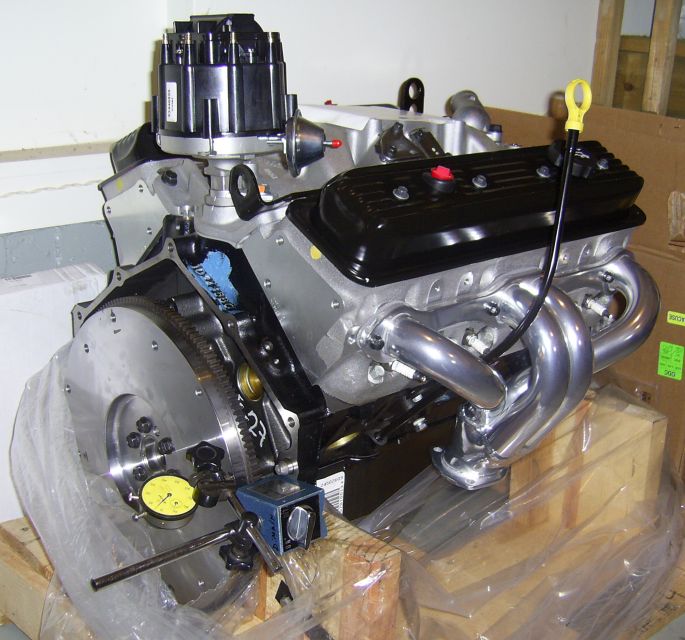


Patriot Block Hugger Headers

Thread Starter
Intermediate

Joined: Mar 2007
Posts: 31
Likes: 0
From: Flower Mound Texas
 Patriot Block Hugger Headers
I have a set of these - am in the process of installing - on a '71 350 as a part of a Corvette Central complete system with Magnaflow mufflers.
Question for those out there that have these or similar...how in @#$%*! do you tighten the inside bolt on the header outlet flange? These are three-bolt flanges and the inside hole is just adjacent to the block on each side (and veerry close), such that you cannot get anything up in there to hold the nut as you tighten the bolt...at least I have not been able to figure out what to use / how to do it.
Any suggestions out there?
Thanks!
Question for those out there that have these or similar...how in @#$%*! do you tighten the inside bolt on the header outlet flange? These are three-bolt flanges and the inside hole is just adjacent to the block on each side (and veerry close), such that you cannot get anything up in there to hold the nut as you tighten the bolt...at least I have not been able to figure out what to use / how to do it.
Any suggestions out there?
Thanks!

Melting Slicks


Joined: Oct 2008
Posts: 2,154
Likes: 69
From: Regina Sk Canada
Sure throw another problem at me now lolol. I have one header on my mock up engine, and it looks like it could be a pain int the a$$. Mind you if you have the starter off, that could work, and the oil filter off the driver side.
Thread Starter
Intermediate
Joined: Mar 2007
Posts: 31
Likes: 0
From: Flower Mound Texas
Yeah, they are tight to pan rail on the block / the block itself like Grumpy 427 describes. I suppose your heads could make a difference i.e. if they moved the ports out slightly you would have more clearance.
I note that Binnie77 has aluminum heads, where I have Dart Iron Eagle which mimic the stock envleope. Maybe a differnce there...?
Other thoughts?
I note that Binnie77 has aluminum heads, where I have Dart Iron Eagle which mimic the stock envleope. Maybe a differnce there...?
Other thoughts?
Last edited by 3869942; Nov 1, 2009 at 12:23 AM.
Corvette Stories
The Best of Corvette for Corvette Enthusiasts

Top 10 Most Expensive Corvettes Ever Sold on Bring A Trailer
Brett Foote
10 Things Every Corvette Owner Needs (2026 Edition)
Michael S. Palmer
8 Most "Only Corvette Owners Understand" Quirks and Problems
Pouria Savadkouei
10 Reasons the C6 Z06 is Still A Performance Benchmark After 20 Years
Joe Kucinski
How Much Horsepower Every Corvette Engine "LOST" in 1972
Joe Kucinski
Top 10 DOs and DON'Ts for Protecting Your Convertible Top!
Michael S. Palmer
Top 10 Most Explosive Corvettes Ever Made: Power-to-Weight Ratio Ranked!
Joe Kucinski
150 hp to 1,250 hp: Every Corvette Generation Compared by the Specs That Matter
Joe Kucinski
8 Coolest Corvette Pace Cars (and Replicas) of All Time
Verdad Gallardo
Melting Slicks
Joined: Jan 2007
Posts: 2,589
Likes: 5
From: Salisbury Maryland
I have the Hooker Block huggers. While the bolts were pretty easy to get to, I had to get Accel "short" plugs to address this issue. Gave me about another 1/2".

Team Owner


Joined: Apr 1999
Posts: 21,953
Likes: 1,445
From: Reno Nevada
2024 C3 of the Year Finalist- Modified
Why would any thinking person even consider using block hugging shorty headers?  Just read up on them as to performance gains. since they are not tuned length pipes they are only marginally better than a good set of factory iron ram horns.
Just read up on them as to performance gains. since they are not tuned length pipes they are only marginally better than a good set of factory iron ram horns.

Advanced
Joined: Jun 2008
Posts: 68
Likes: 0
From: Murphy Texas
Headers -- Primary Pipe Lengths
Misconceptions concerning exhaust pipe lengths are widespread. Take for instance the much-overworked phrase "equal-length headers." More than the odd engine builder/racer, or two, have made a big deal about headers with the primary pipes uniform within 0.5 inch. The first point this raises is whether or not what was needed was known within 0.5 inch! If not, the system could have all the pipes equally wrong within 0.5 inch! Trying to build a race header for a two-planed crank V-8 with lengths to such precision is close to a waste of valuable time. Under ideal conditions it is entirely practical for an exhaust system to scavenge at or near maximum intensity over a 4,000 rpm bandwidth. Most race engines use an rpm bandwidth of 3,000 or less rpm. If the primary pipe scavenging effect overlaps by 3,000 rpm then it matters little that one pipe tunes as much as 1,000 rpm different to another. Since this is the case, then all other things being equal, pipe lengths varying by as much as 9 inches have little effect on performance. A positive power-increasing attribute of differing primary lengths is that it allows larger-radius, higher-flowing bends and more convenient pipe routing to the collector in often confined engine bays.
Apart from the reasons just mentioned, there is also another sound reason why we should not unduly concern ourselves about equal primary lengths. In practice, the two-plane cranks that typically equip V-8 race engines render the exhaust insensitive to quite substantial primary length changes. Experience indicates inline four-cylinder engines are more sensitive to primary pipe length, but a two-plane cranked V-8 is not two inline fours lumped together. It is two V-4s and, as such, does not have even exhaust pulses along each bank. With a conventional, as opposed to a 180-degree header, exhaust pulses are spaced 90, 180, 270, 180, 90 and so on. The two cylinders discharging only 90 degrees apart are seen, by the collector, as one larger cylinder and accounts for the typical rumble a V-8 is known for. This means the primaries act like they do on a four-cylinder engine, but the collector acts as if it were on a 3-cylinder engine having different sized cylinders turning at less revs. (Doesn't life get complicated?) This, plus the varied spacing between the pulses appears to be the cause of the system's reduced sensitivity to primary length.
These uneven firing pulses on each bank seem to work in our favor. Evidence to date suggests that single-plane cranked V-8s, which have the same exhaust discharge pattern as an in-line four-cylinder engine, make less horsepower and are more length sensitive. Dyno tests with headers having primary lengths adjustable in three-inch increments show that lengths between 24 and 36 inches have only a minor effect on the power curve of V-8s that you and I can typically afford, although the longer pipes do marginally favor the low end.
Complete article http://www.superchevy.com/technical/...exh/index.html
Team Owner
Joined: Apr 1999
Posts: 21,953
Likes: 1,445
From: Reno Nevada
2024 C3 of the Year Finalist- Modified
Here is a different opinion by David Vizard.
Complete article http://www.superchevy.com/technical/...exh/index.html
Complete article http://www.superchevy.com/technical/...exh/index.html
 There is a big difference between a talk about unequal length 4-1 primary tubes vs equal length within a 1/2 inch 4-1's and block huggers
You need to find an article comparing iron OEM manifolds, shorty block huggers, 4 into 1 collectors, and various tri-Y designs. The tri Y's win. As do the modern merge collector 4-1
David Vizard is a half baked bumbler who can get you in the ball park.
Advanced
Joined: Jun 2008
Posts: 68
Likes: 0
From: Murphy Texas
If you want to quote an article you should at least read it There is a big difference between a talk about unequal length 4-1 primary tubes vs equal length within a 1/2 inch 4-1's and block huggers
You need to find an article comparing iron OEM manifolds, shorty block huggers, 4 into 1 collectors, and various tri-Y designs. The tri Y's win. As do the modern merge collector 4-1
David Vizard is a half baked bumbler who can get you in the ball park.
There is a big difference between a talk about unequal length 4-1 primary tubes vs equal length within a 1/2 inch 4-1's and block huggersYou need to find an article comparing iron OEM manifolds, shorty block huggers, 4 into 1 collectors, and various tri-Y designs. The tri Y's win. As do the modern merge collector 4-1
David Vizard is a half baked bumbler who can get you in the ball park.
I posted a question a few months ago asking for real dyno results showing the difference between short tube headers and long tube and there was not one response with any real results. If the question can't be answered here then we look for other sources, ie David Vizard and others. Now if you have those results from real dyno pulls then I would be more than happy to see them.
Last edited by rham; Nov 2, 2009 at 10:02 PM.
Melting Slicks
Joined: Oct 2008
Posts: 2,154
Likes: 69
From: Regina Sk Canada
An engine builder i know did dyno work on headers, and there was only a 7 hp an 9 ft tq difference from a shorty to a full race header. a full length header has its place, doesnt mean its worth the money on all applications. I take my advice from my local engine builder, he hs not been wrong yet.
Team Owner
Joined: Apr 1999
Posts: 21,953
Likes: 1,445
From: Reno Nevada
2024 C3 of the Year Finalist- Modified
I admit that my choice of words were not the best. I just don't like to see people duped into spending money in non beneficial ways. I could not find any tech articles on shorty headers. I did find some good info. Every car I see at the race tracks winning has some type of 2-1 and then those 2 into 1 with a merge collector. Or 4-1 with a merge collector. Stepped headers seem to be a thing of the past.
Header collectors aren't always the lowest point on a car.
I'm also outspoken about junky side pipes. They are rarely designed as a real performance device.
http://www.carcraft.com/techarticles...rbs/index.html
Header collectors aren't always the lowest point on a car.
I'm also outspoken about junky side pipes. They are rarely designed as a real performance device.
http://www.carcraft.com/techarticles...rbs/index.html
Last edited by gkull; Nov 3, 2009 at 04:23 AM.
Team Owner
Joined: Apr 1999
Posts: 21,953
Likes: 1,445
From: Reno Nevada
2024 C3 of the Year Finalist- Modified
An engine builder i know did dyno work on headers, and there was only a 7 hp an 9 ft tq difference from a shorty to a full race header. a full length header has its place, doesnt mean its worth the money on all applications. I take my advice from my local engine builder, he hs not been wrong yet.
Years ago we used to use shop open dyno headers on motors just to give big number print outs to the owners. We now use the cars full exhaust system if we can or just similar headers and mufflers. So now when the motor is installed it is ready to go with the max average power figures. We also tune for the highest average not just peak numbers.
I like working on this car of ours. Almost "ZERO" clearance around this motor and to the ground, but they didn't use shorty headers.

Team Owner
Joined: Apr 1999
Posts: 21,953
Likes: 1,445
From: Reno Nevada
2024 C3 of the Year Finalist- Modified
I have a set of these - am in the process of installing - on a '71 350 as a part of a Corvette Central complete system with Magnaflow mufflers.
Question for those out there that have these or similar...how in @#$%*! do you tighten the inside bolt on the header outlet flange? These are three-bolt flanges and the inside hole is just adjacent to the block on each side (and veerry close), such that you cannot get anything up in there to hold the nut as you tighten the bolt...at least I have not been able to figure out what to use / how to do it.
Any suggestions out there?
Thanks!
Question for those out there that have these or similar...how in @#$%*! do you tighten the inside bolt on the header outlet flange? These are three-bolt flanges and the inside hole is just adjacent to the block on each side (and veerry close), such that you cannot get anything up in there to hold the nut as you tighten the bolt...at least I have not been able to figure out what to use / how to do it.
Any suggestions out there?
Thanks!
The cutting, grinding, and bending of cheap tools is always an option.

Last edited by gkull; Nov 3, 2009 at 08:07 AM.

Le Mans Master

Joined: Oct 2007
Posts: 7,451
Likes: 974
From: RI, Now Franklin/Nashville TN
All of my comments are related to almost stock engines and NOT high horsepower engines or race engines-another words street engines of stock or near stock configurations. My 78 L-82 4 speed has McJack's shorty headers (exact dimensionally to the OEM ramhorn manifolds, not block huggers), a 73 Nova SS with full length headers, and a 1994 Mustang GT with BBK shorty headers (replacing the OEM shorty headers but with much bigger primaries). All 3 header types make a seat of the pants difference in power and all 3 headers increased the exhaust sound noticeably without changing any other part of the exhaust (pipes or mufflers) which indicates better exhaust flow. Better exhaust flow, more horsepower, the exact amount is unknown to me. To me, full length headers on a street engine are not worth the hassle of fit, access, power gain, and road clearance issues, thus my selection of McJacks shorty for the vette. Do they make a difference, absolutely! Even on the mustang replacing the OEM tubular exhaust manifold to BBK's shorty headers made a noticeable difference in power and sound. In my experience any time you improve the exhaust flow, you will feel a benefit, even if it is a small improvement! All of my exhaust improvements on the vette were done incrementally over 25 years and every single change made a difference. The overall change on the vette from the OEM 2-1-2 cat system with the OEM very restrictive mufflers with the ramhorns to its current configuration of 2.5 inch true duals, Monza Turbo mufflers, and McJack's shorty headers made a very BIG difference in power in the car. Again, just the McJacks shorty headers made a difference in power over 3,500 RPM and especially over 4,500 RPM's! A 74 Vette L-82 and a 78 L-82 are exactly the same engine with the only difference being the exhaust. The 74 was rated a 250 HP and the 78 220 HP. That difference of 30 HP is solely due to the true duals on the 74, and even if headers added only 10-15 HP, the exhaust configuration can add 40-45 HP on a 78 L-82, which is not small peanuts. My point is that any headers will help. The ramhorns are not bad but any type of header will help, even a little. Just my 2 cents.
Last edited by jb78L-82; Nov 3, 2009 at 07:38 AM.
Thread Starter
Intermediate
Joined: Mar 2007
Posts: 31
Likes: 0
From: Flower Mound Texas
Okay, now that the demons have been exorcised (and thanks to those the gave suggestions), here is what I did to finally solve this.
First, there is no tool configuration that will help per se. By this I mean that you can bend, cut, whatever any open or box end wrench type (and I tried crows-foot, et al as well) that will physically fit - the clearance to block on one side and the collector weldment on the other will allow no wrench size envelope in there with the access directions and angle that you have. You could put an open-end on it if you could punch a hole thru the pan rail from the crank side, but you get the idea. Socket head will not work either, as you would have to feed the bolt from the top and there is no clearance for that either.
So, no tool that I can envision will work/fit. So I threw-out the existing bolts and self-locking nuts (which is why you have to be able to get a tool on them to hold'em), bought slightly longer stainless bolts, nuts, split lockwashers and external toothed lockwashers. Put the the split washer next to the bolt head and fed the bolt up through, added, the toothed washer on top and finally the nut. As soon as I spun it down, the toothed washer caught and locked it, allowing only tightening with a socket wrench from below.
Removal will also be easy (another huge problem before i.e. can't tighten, can't loosen either), e.g. loosen bolt from below and as soon the toothed washer lets go, you can spin the nut off by holding it with your finger.
Still can't believe they make these things with this kind of clearance/access... Thanks again.
First, there is no tool configuration that will help per se. By this I mean that you can bend, cut, whatever any open or box end wrench type (and I tried crows-foot, et al as well) that will physically fit - the clearance to block on one side and the collector weldment on the other will allow no wrench size envelope in there with the access directions and angle that you have. You could put an open-end on it if you could punch a hole thru the pan rail from the crank side, but you get the idea. Socket head will not work either, as you would have to feed the bolt from the top and there is no clearance for that either.
So, no tool that I can envision will work/fit. So I threw-out the existing bolts and self-locking nuts (which is why you have to be able to get a tool on them to hold'em), bought slightly longer stainless bolts, nuts, split lockwashers and external toothed lockwashers. Put the the split washer next to the bolt head and fed the bolt up through, added, the toothed washer on top and finally the nut. As soon as I spun it down, the toothed washer caught and locked it, allowing only tightening with a socket wrench from below.
Removal will also be easy (another huge problem before i.e. can't tighten, can't loosen either), e.g. loosen bolt from below and as soon the toothed washer lets go, you can spin the nut off by holding it with your finger.
Still can't believe they make these things with this kind of clearance/access... Thanks again.