







Rag joint help

Thread Starter
Melting Slicks


Joined: Oct 2008
Posts: 2,154
Likes: 69
From: Regina Sk Canada
 Rag joint help
I went to install the steering box and rag joint, and it is slightly off. About the distance of the bolt. Now i am thinking this is due to the body mount change, i went from rubber to polly and there may be a thickness issue. I basically bolted the rag joint to the coupler on the steering column, and then forced the box onto the frame. The pins on the rag joint, now hit back and forth on the slots when you turn the steering wheel. Is this an issue?
I can see a couple options here, i can slot the holes on the coupler to line this up, or try to lift the body at the firewall and shim the body mount a bit more .
How much forgiveness is there is there for the rag joint? Or am i making more of this than needs to be.

I can see a couple options here, i can slot the holes on the coupler to line this up, or try to lift the body at the firewall and shim the body mount a bit more .
How much forgiveness is there is there for the rag joint? Or am i making more of this than needs to be.

Burning Brakes

Joined: Oct 2006
Posts: 1,006
Likes: 28
From: Lutz Florida
Did you take a look at Jim Shea's flex coupling articles to see if there was anything that could help you?http://corvette.wikia.com/wiki/Steering. Did your new flex coupler come with the plastic spacers over the pins to help keep the coupler in alignment when installing? Did you leave the steering column loose until you had everything installed and lined up?
I don't understand how the pins would hit from side to side either unless the rubber disc is damaged.
I don't understand how the pins would hit from side to side either unless the rubber disc is damaged.

Le Mans Master


Joined: Jul 2000
Posts: 6,001
Likes: 113
From: Saginaw Michigan
The problem when the stop pins bottom out is that you can't tell how much pressure is holding the pin against the window opening in the column flange. What can happen is this:
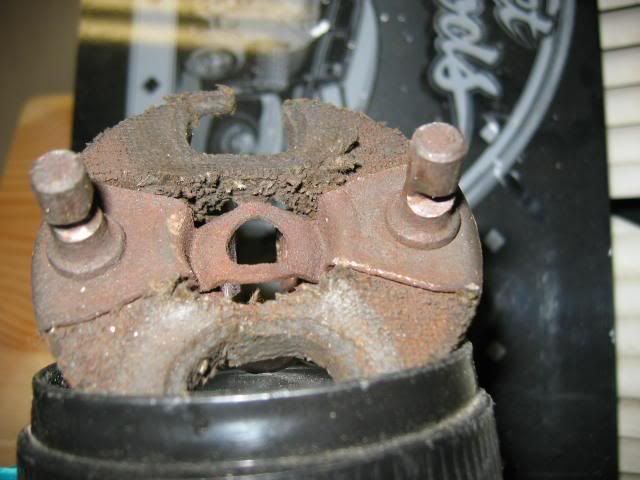
The pressure on the pin actually causes the column flange to "saw" its way through the pin itself. The interesting thing is that you cannot actually feel the problem in the steering wheel.
Turn the steering wheel one quarter turn and see if the pin is still hard against the window. You really need to look at the pins in two different positions in order to get a sense as to which way the column needs to move to centralize the pins in the window opening.
Loosen the column mounting bolts (both the vertical bolts under the dash and the two nuts on the inside that attach the lower end of the steering column.) This might allow the column to seek a neutral position.
One thing that I do notice is that the flexible coupling is an offshore manufactured part. You might try and reassemble your original flexible coupling in its place. I am wondering if the replacement part may not be as accurate as the original.
BTW, the offshore part has a rubber disc that has four layers of cloth and four layers of rubber. The original Saginaw part was the same thickness but had seven layers of cloth and rubber. The new part would be a lot softer (because of the thickness of rubber) than the original. The steering would feel more direct with the original seven lamination disc.
Jim
The pressure on the pin actually causes the column flange to "saw" its way through the pin itself. The interesting thing is that you cannot actually feel the problem in the steering wheel.
Turn the steering wheel one quarter turn and see if the pin is still hard against the window. You really need to look at the pins in two different positions in order to get a sense as to which way the column needs to move to centralize the pins in the window opening.
Loosen the column mounting bolts (both the vertical bolts under the dash and the two nuts on the inside that attach the lower end of the steering column.) This might allow the column to seek a neutral position.
One thing that I do notice is that the flexible coupling is an offshore manufactured part. You might try and reassemble your original flexible coupling in its place. I am wondering if the replacement part may not be as accurate as the original.
BTW, the offshore part has a rubber disc that has four layers of cloth and four layers of rubber. The original Saginaw part was the same thickness but had seven layers of cloth and rubber. The new part would be a lot softer (because of the thickness of rubber) than the original. The steering would feel more direct with the original seven lamination disc.
Jim
Last edited by Jim Shea; Nov 8, 2009 at 06:25 PM.
Corvette Stories
The Best of Corvette for Corvette Enthusiasts

Top 10 Most Expensive Corvettes Ever Sold on Bring A Trailer
Brett Foote
10 Things Every Corvette Owner Needs (2026 Edition)
Michael S. Palmer
8 Most "Only Corvette Owners Understand" Quirks and Problems
Pouria Savadkouei
10 Reasons the C6 Z06 is Still A Performance Benchmark After 20 Years
Joe Kucinski
How Much Horsepower Every Corvette Engine "LOST" in 1972
Joe Kucinski
Top 10 DOs and DON'Ts for Protecting Your Convertible Top!
Michael S. Palmer
Top 10 Most Explosive Corvettes Ever Made: Power-to-Weight Ratio Ranked!
Joe Kucinski
150 hp to 1,250 hp: Every Corvette Generation Compared by the Specs That Matter
Joe Kucinski
8 Coolest Corvette Pace Cars (and Replicas) of All Time
Verdad Gallardo
Le Mans Master
Joined: Jul 2000
Posts: 6,001
Likes: 113
From: Saginaw Michigan
Coupling Disc 101 - just a bit more technical information.
There were basically two different constructions: One with seven laminations of cloth and rubber; the other with four laminations of the same material. The discs had the same dimensions for thickness and diameters. So the seven ply disc just had a lot less rubber with the addition of the extra cloth. Since the disc dimensions were the same, all of the flexible coupling hardware was the same between the power versus manual applications (except the flange itself that attached to the 3/4 shaft for manual steering or the 13/16 flange for typical integral power steering gears.)
The disc with seven laminations of cotton cloth and neoprene rubber was known as the "manual steering" disc. This disc was mostly cloth with thin layers of rubber holding it together. It was quite stiff and was quite durable. It would provide a somewhat more precise feel of the road because it was so stiff. This was the primary reason that Corvette specified the seven ply disc on all Corvettes regardless if they had power steering or not.
The other disc was with four laminations of neoprene rubber and cotton cloth. This was known as the disc used with power steering. Most power steering systems (unlike the Corvette) had the hydraulic valve built into the input side of the gear. If there was no isolating element in the steering shaft connection, hydraulic fluid noise could travel up the gear input shaft, up the steering column shaft, and up into the driver compartment. (The hydraulic noise could be quite annoying.) The four ply disc did a much better job of isolating the hydraulic noise and keeping it in the engine compartment than the seven ply disc. Since power steering reduced the amount of steering effort, the fact that the four ply disc was "softer" than a seven ply disc was not all that important on most GM cars and trucks.
Since the 1963 through 1982 Corvette used the "valve and adapter" type power steering, the hydraulic valve was down on the relay rod and not directly a part of the gear. This tended to isolate the hydraulic noise to the engine compartment, (more than a typical intergral power steering gear.)
Jim
There were basically two different constructions: One with seven laminations of cloth and rubber; the other with four laminations of the same material. The discs had the same dimensions for thickness and diameters. So the seven ply disc just had a lot less rubber with the addition of the extra cloth. Since the disc dimensions were the same, all of the flexible coupling hardware was the same between the power versus manual applications (except the flange itself that attached to the 3/4 shaft for manual steering or the 13/16 flange for typical integral power steering gears.)
The disc with seven laminations of cotton cloth and neoprene rubber was known as the "manual steering" disc. This disc was mostly cloth with thin layers of rubber holding it together. It was quite stiff and was quite durable. It would provide a somewhat more precise feel of the road because it was so stiff. This was the primary reason that Corvette specified the seven ply disc on all Corvettes regardless if they had power steering or not.
The other disc was with four laminations of neoprene rubber and cotton cloth. This was known as the disc used with power steering. Most power steering systems (unlike the Corvette) had the hydraulic valve built into the input side of the gear. If there was no isolating element in the steering shaft connection, hydraulic fluid noise could travel up the gear input shaft, up the steering column shaft, and up into the driver compartment. (The hydraulic noise could be quite annoying.) The four ply disc did a much better job of isolating the hydraulic noise and keeping it in the engine compartment than the seven ply disc. Since power steering reduced the amount of steering effort, the fact that the four ply disc was "softer" than a seven ply disc was not all that important on most GM cars and trucks.
Since the 1963 through 1982 Corvette used the "valve and adapter" type power steering, the hydraulic valve was down on the relay rod and not directly a part of the gear. This tended to isolate the hydraulic noise to the engine compartment, (more than a typical intergral power steering gear.)
Jim
