


3 inch exhaust


Thread Starter
Melting Slicks


Joined: Sep 2003
Posts: 2,114
Likes: 33
From: ct
 3 inch exhaust
Dose anyone make a 3 inch exhaust that fits? I just blew up the motor in my 69 so it's time for a new one. But I am thinking of getting rid of the Hooker side pipes. Under car headers and exhaust out the back would be a nice change.

Melting Slicks
Joined: Mar 2007
Posts: 2,100
Likes: 12
From: Frederick Maryland
A good speed shop or muffler shop should be able to fit you up with whatever size pipes you want. I'm not sure what 3" pipes will do for you...unless you have a really strong engine you run at high rpm's you might lose a bit of low end torque due to too little back pressure and somewhat reduced scavenging.

Safety Car


Joined: Nov 2008
Posts: 3,717
Likes: 551
From: Seattle Washington
You will have to have one made. The X-member will have to be changed on your 69. The tight spot is also the Rear Axel if you run 3" under it You will loose a bunch of ground clearance so you will want to tuck it up as tight as possible. Forget about useing the VB&P Dual Mount Spring they can't both be in the same place at once. I'm probably going to change mine in this area useing 3" oval Tube and gain back an inch of clearance.

Burning Brakes

Joined: Sep 2006
Posts: 1,242
Likes: 12
From: Kalispell MT
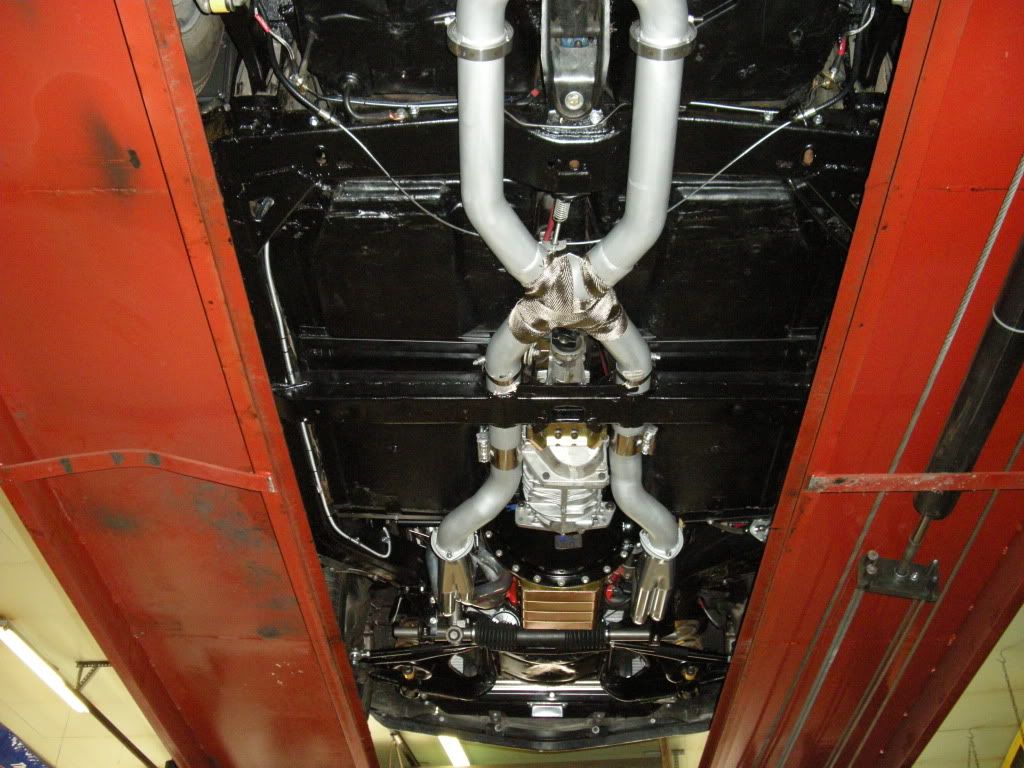
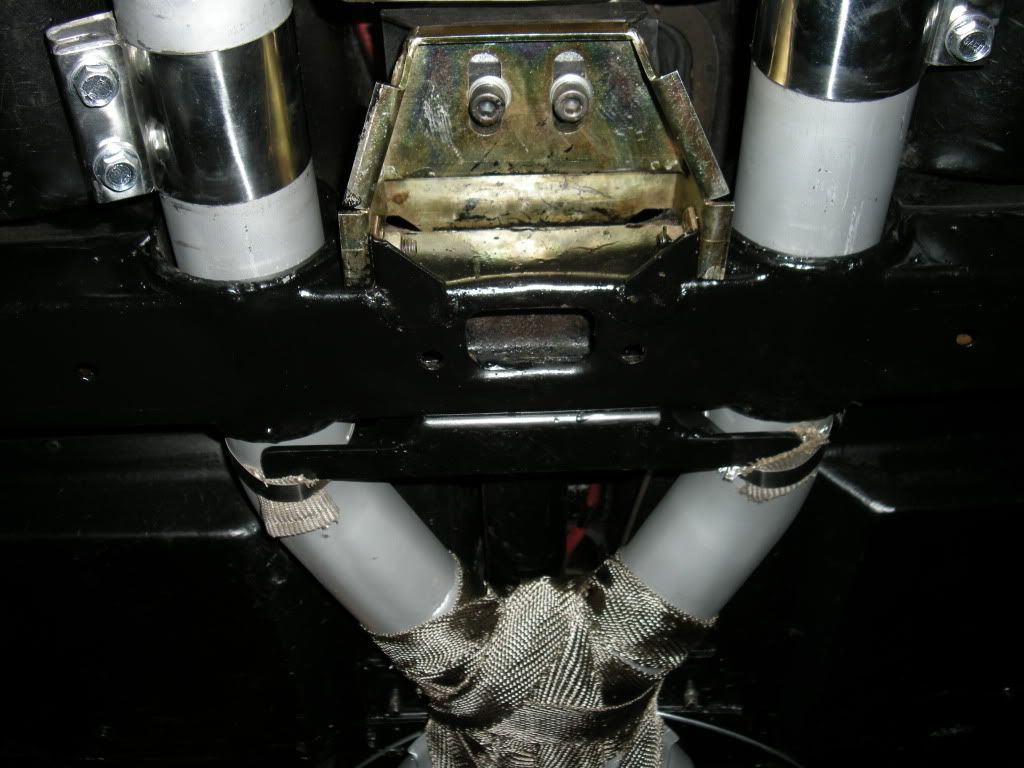
I just had a 3" custom mandrel bent system installed. I did not have to modify the frame pass throughs or any other part of the frame, and it's not necked down anywhere. 3" Magnaflow mufflers and X-Pipe. It's sounds great linked up to the Hooker Super Comps tied to the new 555.


Tech Contributor


Joined: Jun 2004
Posts: 20,894
Likes: 962
From: I tend to be leery of any guy who doesn't own a chainsaw or a handgun.
A good speed shop or muffler shop should be able to fit you up with whatever size pipes you want. I'm not sure what 3" pipes will do for you...unless you have a really strong engine you run at high rpm's you might lose a bit of low end torque due to too little back pressure and somewhat reduced scavenging.

Melting Slicks
Joined: Mar 2007
Posts: 2,100
Likes: 12
From: Frederick Maryland
From Magnaflow...
PIPE DIAMETER AND PERFORMANCE
Keep in mind that the goal is to improve exhaust flow. In most cases, just changing the restrictive OEM muffler and replacing it with the same size straight-through, Wide Open Performance MagnaFlow muffler will do this job.
To reduce additional backpressure, the OEM exhaust tubing can be replaced with madrel-bent tubing of the same size or one size up from the OEM. As a general rule, you can enlarge the pipe diameter of your OEM exhaust system by 1/4- to 1/2-inch to increase your horsepower. However, any additional increase in pipe diameter is likely to decrease your performance; specifically, low end torque.
PIPE DIAMETER AND PERFORMANCE
Keep in mind that the goal is to improve exhaust flow. In most cases, just changing the restrictive OEM muffler and replacing it with the same size straight-through, Wide Open Performance MagnaFlow muffler will do this job.
To reduce additional backpressure, the OEM exhaust tubing can be replaced with madrel-bent tubing of the same size or one size up from the OEM. As a general rule, you can enlarge the pipe diameter of your OEM exhaust system by 1/4- to 1/2-inch to increase your horsepower. However, any additional increase in pipe diameter is likely to decrease your performance; specifically, low end torque.
Tech Contributor
Joined: Jun 2004
Posts: 20,894
Likes: 962
From: I tend to be leery of any guy who doesn't own a chainsaw or a handgun.
From Magnaflow...
PIPE DIAMETER AND PERFORMANCE
Keep in mind that the goal is to improve exhaust flow. In most cases, just changing the restrictive OEM muffler and replacing it with the same size straight-through, Wide Open Performance MagnaFlow muffler will do this job.
To reduce additional backpressure, the OEM exhaust tubing can be replaced with madrel-bent tubing of the same size or one size up from the OEM. As a general rule, you can enlarge the pipe diameter of your OEM exhaust system by 1/4- to 1/2-inch to increase your horsepower. However, any additional increase in pipe diameter is likely to decrease your performance; specifically, low end torque.
PIPE DIAMETER AND PERFORMANCE
Keep in mind that the goal is to improve exhaust flow. In most cases, just changing the restrictive OEM muffler and replacing it with the same size straight-through, Wide Open Performance MagnaFlow muffler will do this job.
To reduce additional backpressure, the OEM exhaust tubing can be replaced with madrel-bent tubing of the same size or one size up from the OEM. As a general rule, you can enlarge the pipe diameter of your OEM exhaust system by 1/4- to 1/2-inch to increase your horsepower. However, any additional increase in pipe diameter is likely to decrease your performance; specifically, low end torque.
Furthermore, the average Corvette has about five or six feet of exhaust pipe (and muffler) after the headers or exhaust manifolds. Every foot of that pipe causes a pressure drop due to wall friction, and smaller pipes have more wall area compared to volume than "big" pipes do, causing more pressure drop (more backpressure) to occur. Does anyone actually believe there is a streetable (ie: reasonably quiet) exhaust system out there that has no (or insufficient) backpressure? No, there isn't. And, if the system is that restrictive at low RPM (resulting in "needed" backpressure at low engine speeds), it's going to be significantly restrictive at high RPM. An engine in that configuration would appear to have acceptable power at low RPMs and unacceptable power at higher RPMs. It seems obvious that the bottom end was not improved, but appears relatively better due to the poor high RPM performance of the choked off engine.
I've given you physics and mechanical reasons why backpressure is undesirable. Can you please do the same explaining your position?
Melting Slicks
Joined: Mar 2007
Posts: 2,100
Likes: 12
From: Frederick Maryland
I bow to the Jedi Master.
I have seen much information over time on both sides of the issue...not just on the internet but publications...all professing to have the last and most accurate word...some written by car guys, some by techs, but all allegedly with proper knowledge.
If I'm wrong...I'm wrong. No point in denying that. What you say makes perfect sense...but so did the information in other sources, at least in the manner it was presented.
Who is correct...depends on whom you ask. I'm more than happy to accept what you say.
Have a cold on on me.
BTW - I'm another white guy clinging to my guns and religion...right on, bro!
I have seen much information over time on both sides of the issue...not just on the internet but publications...all professing to have the last and most accurate word...some written by car guys, some by techs, but all allegedly with proper knowledge.
If I'm wrong...I'm wrong. No point in denying that. What you say makes perfect sense...but so did the information in other sources, at least in the manner it was presented.
Who is correct...depends on whom you ask. I'm more than happy to accept what you say.
Have a cold on on me.
BTW - I'm another white guy clinging to my guns and religion...right on, bro!

Advanced

Joined: Dec 2007
Posts: 99
Likes: 0
From: Charlotte NC
What is your main reason for getting rid of the side exaust? I am highly considering it, thinking it will be the least restrictive exaust system, not mention largest primary header pipes with out custom headers(small block). I am sure noise is the big culpret.

Race Director


Joined: Dec 1999
Posts: 11,096
Likes: 990
From: Sierra Foothills CA
Noise and leg burns can be a problem- some love them, some hate them. As for being less restrictive, unless you choose components very carefully, sidepipes can be a fair bit more restrictive than a decent under-the-car system. Then there's the fitment issue for Hooker sidepipes that's been well documented in the thread started by Lars recently. Just some things you may want to be aware of....



Instructor
Joined: Mar 2010
Posts: 162
Likes: 8
69427 is 100% right.
But does this logic apply to headers. I am building new headers for my healthy 13.5:1 434 sb. 2" primaries into 3.5" merged collectors.
Too big people say. I don t think so!
What may be too big is when you install the hooker sidepipe headers on a stock 350 and expect it transform the car. 1 7/8" primaries albeit very long can t improve a stock motor.
But does this logic apply to headers. I am building new headers for my healthy 13.5:1 434 sb. 2" primaries into 3.5" merged collectors.
Too big people say. I don t think so!
What may be too big is when you install the hooker sidepipe headers on a stock 350 and expect it transform the car. 1 7/8" primaries albeit very long can t improve a stock motor.

Racer
Joined: Oct 2006
Posts: 435
Likes: 18
From: Florida
Its about velocity, just like running an intake port thats too big you lose velocity( it doesnt restrict flow, but doesn't help it along either), the same happens in the exhaust. Too big and you lose the scavenging at low rpms, too small and your exhaust chokes the engine out. I think too much is made out of going too big, but definitely go bigger than smaller. Again its all part of the engine combination of cubes and the heads/cam/intake used.
Tech Contributor
Joined: Jun 2004
Posts: 20,894
Likes: 962
From: I tend to be leery of any guy who doesn't own a chainsaw or a handgun.
Its about velocity, No, it's about removing exhaust mass with the least amount of parasitic power loss at the crank, usually by minimizing the pressure drop through the exhaust system. just like running an intake port thats too big you lose velocity(it doesnt restrict flow, but doesn't help it along either), the same happens in the exhaust. Too big and you lose the scavenging at low rpms, We're talking exhaust system size in this thread, not header primary pipe size. The post collector exhaust is poorly equipped to do much scavenging.too small and your exhaust chokes the engine out. Assuming your scavenging theory was correct, you would need an RPM-dependent variable-diameter exhaust pipe to do both scavenging and choke prevention as engine speed changes, as the exhaust mass flow rate varies due to the VE curve of the engine. I think too much is made out of going too big, We agree. but definitely go bigger than smaller. Again its all part of the engine combination of cubes and the heads/cam/intake used.
Apples and oranges.
Racer
Joined: Oct 2006
Posts: 435
Likes: 18
From: Florida
Apples to apples. You are still trying to move a column of air dictated by a port and cam, on top of the fact the gas temps from one end to the other are significantly different( anyone know what happens to air as it cools? hint, it doesnt flow faster). On the right engine it can help, or maybe a combination thats not so optimized it can be a bandaid. If your head has a bad exhaust port, and you run a single pattern cam an exhaust thats just the right size can help scavenge while one thats too big and you just dump exhaust into pulls nothing through the engine. If what you say is true why not just run big log manifolds and not hassle with LT headers? Their is a reason LT headers of the same size work better than a shorty or mid length header even though exhaust system volume is very close to the same size.
Tech Contributor
Joined: Jun 2004
Posts: 20,894
Likes: 962
From: I tend to be leery of any guy who doesn't own a chainsaw or a handgun.
Apples to apples. You are still trying to move a column of air dictated by a port and cam, on top of the fact the gas temps from one end to the other are significantly different( anyone know what happens to air as it cools? hint, it doesnt flow faster). On the right engine it can help, or maybe a combination thats not so optimized it can be a bandaid. If your head has a bad exhaust port, and you run a single pattern cam an exhaust thats just the right size can help scavenge while one thats too big and you just dump exhaust into pulls nothing through the engine. If what you say is true why not just run big log manifolds and not hassle with LT headers? Their is a reason LT headers of the same size work better than a shorty or mid length header even though exhaust system volume is very close to the same size.

Intermediate
Joined: Oct 2024
Posts: 40
Likes: 19
A good speed shop or muffler shop should be able to fit you up with whatever size pipes you want. I'm not sure what 3" pipes will do for you...unless you have a really strong engine you run at high rpm's you might lose a bit of low end torque due to too little back pressure and somewhat reduced scavenging.


