









Post Radiator Upgrade - Big Gap

Thread Starter
Instructor

Joined: Apr 2010
Posts: 215
Likes: 0
From: Lakeland FL
 Post Radiator Upgrade - Big Gap
Hello members.
I have now removed the old radiator, shroud, and mechanical fan in favor of a 2-core radiator with dual electric fans and a Derale fan controller.
What do I do with the huge gap between the radiator and the front frame cross member that is just in front of the main pulley? Is there an air dam that can force air up into the engine compartment? Is there a part to seal this off from the weather/rain?

I have now removed the old radiator, shroud, and mechanical fan in favor of a 2-core radiator with dual electric fans and a Derale fan controller.
What do I do with the huge gap between the radiator and the front frame cross member that is just in front of the main pulley? Is there an air dam that can force air up into the engine compartment? Is there a part to seal this off from the weather/rain?
Thread Starter
Instructor
Joined: Apr 2010
Posts: 215
Likes: 0
From: Lakeland FL
http://public.fotki.com/kirt8548/rad.../p1060567.html
For some reason I can never post a link or a picture to my submissions. I hope that the above works ok.
Thanks...
For some reason I can never post a link or a picture to my submissions. I hope that the above works ok.
Thanks...

Instructor
Joined: Feb 2010
Posts: 118
Likes: 0
From: Ok
Those push thru tabs will rub a hole in the radiator... Seen several do it. Get a sheet metal bracket made and hang it over the top of the radiator. Only a matter of time till the heat causes the Tabs to "heat strech" and start rub'n the holes.
Thread Starter
Instructor
Joined: Apr 2010
Posts: 215
Likes: 0
From: Lakeland FL
Update
I appreciate the information on the push through connectors and I'll modify that asap.
I took my baby to my mechanic/friend who pressure tested the system and found no leaks.
On my way home the car temperature gauge climbed between 200 and 230 before I pulled over and turned her off.
I wasn't in stop/go traffic or anything and this wasn't a problem during the drive to work.
No fluid was being purged into the coolant reservoir and after 15 minutes the gauge returned to 200 and didn't climb again during the next 10 miles it took to get home.
My boss who is a car guy ('85 Mustang) tells me that without the shroud and the mechanical fan this will continue to be a problem.
Bottom line: I replaced the original radiator with a 2-core aluminum rad. I replaced the mechanical fan and severely altered shroud with two 12" electric. I have added (it didn't have one) a 185 temp thermostat.
I'm discouraged and don't what else to do. It's not drivable, at least not the way I want, if I don't find a solution.
HELP!
I took my baby to my mechanic/friend who pressure tested the system and found no leaks.
On my way home the car temperature gauge climbed between 200 and 230 before I pulled over and turned her off.
I wasn't in stop/go traffic or anything and this wasn't a problem during the drive to work.
No fluid was being purged into the coolant reservoir and after 15 minutes the gauge returned to 200 and didn't climb again during the next 10 miles it took to get home.
My boss who is a car guy ('85 Mustang) tells me that without the shroud and the mechanical fan this will continue to be a problem.
Bottom line: I replaced the original radiator with a 2-core aluminum rad. I replaced the mechanical fan and severely altered shroud with two 12" electric. I have added (it didn't have one) a 185 temp thermostat.
I'm discouraged and don't what else to do. It's not drivable, at least not the way I want, if I don't find a solution.
HELP!
Corvette Stories
The Best of Corvette for Corvette Enthusiasts

Top 10 Most Explosive Corvettes Ever Made: Power-to-Weight Ratio Ranked!
Joe Kucinski
150 hp to 1,250 hp: Every Corvette Generation Compared by the Specs That Matter
Joe Kucinski
8 Coolest Corvette Pace Cars (and Replicas) of All Time
Verdad Gallardo
Top 10 Corvette Engines RANKED by Peak Torque (70+ Years of Muscle!)
Joe Kucinski
Corvette ZR1X Will Be Pacing the Indy 500, And Could Probably Race, Too!
Verdad Gallardo
Top 10 Corvettes Coming to Mecum Indy 2026!
Brett Foote
Top 10 C9 Corvette MUST-HAVES to Fix These C8 Generation Flaws!
Michael S. Palmer
10 Revolutionary 'Corvette Firsts' Most People Don't Know
Joe Kucinski
5 Reasons to Upgrade to an LS6-Powered Corvette; 5 Reasons to Stay LT2
Michael S. Palmer
Pro


Joined: Jul 2005
Posts: 517
Likes: 7
From: Peoria IL
The electric fans you had in your picture only cover maybe 60% of the radiator area, and every square inch is needed to keep these things cool.
I'm working through trouble with my own, but your situation sounds more severe. If that's a DeWitts radiator, you probably have the right heat exchanger. A much larger fan set, or a much larger electric fan (like a Lincoln Mk VIII fan) OR restoring your mechanical clutch fan is going to be the direction you need to go in. Also, make sure your chin spoiler is in good condition or you replace it.
The other standard things you need to have done are:
Does that help?
I'm working through trouble with my own, but your situation sounds more severe. If that's a DeWitts radiator, you probably have the right heat exchanger. A much larger fan set, or a much larger electric fan (like a Lincoln Mk VIII fan) OR restoring your mechanical clutch fan is going to be the direction you need to go in. Also, make sure your chin spoiler is in good condition or you replace it.
The other standard things you need to have done are:
- Ensure that your lower radiator hose is equipped with a spring to keep it from collapsing
- Use stock pulleys, underdriven pulleys in these cars are not a good idea
- Check your water/antifreeze mix, pure water is not a better coolant as it will boil in the head and along the cylinder liners as the surface temperature here is higher than the water temperature at the center of flow (which is where your gauge and the thermostat are measuring it)
- Make sure your fan clutch (if mechanical) is in good condition, or replace with with a new H/D or severe duty one
- Check your timing, and it would be a good idea to post what you have it set at.
- You need a thermostat, the 180 degree one you have is a good choice as long as it's a brass one (Robertshaw or Mr. Gasket or equivalent). Good ones run $10-12, if you paid $3 it needs to be replaced with a good one in cars like a C3.
Does that help?
Instructor
Joined: Feb 2010
Posts: 118
Likes: 0
From: Ok
Well I would say possibly a air pocket issue in the engine, or possibly a bad sending unit. Do you have a infrared gun to check actual temp? Sure the thermostat is working?
With the electric fans mounted that way there should be no issue for the fan shroud, but in town driving the 2-12" fans I dont see being enough air flow. My V6 used a single 16" fan and my V8 pickup uses 2-16" fans.
But you said highway driving. Does the car seem to run rough? Timing and recently seen a issue with the heat riser in the passenger side exhaust manifold causing a issue, due to being shut.
With the electric fans mounted that way there should be no issue for the fan shroud, but in town driving the 2-12" fans I dont see being enough air flow. My V6 used a single 16" fan and my V8 pickup uses 2-16" fans.
But you said highway driving. Does the car seem to run rough? Timing and recently seen a issue with the heat riser in the passenger side exhaust manifold causing a issue, due to being shut.
Thread Starter
Instructor
Joined: Apr 2010
Posts: 215
Likes: 0
From: Lakeland FL
RJ68.... It runs great! It even ran great up until the time I gave up that it was going to cool down and stopped. The fans do move a lot of air, and the weird thing is that I was kind of expecting that when I put my hand near the a/c condensor on one side and the radiator on the other that I would feel a lot of radiated heat. I didn't get that at all, but the upper hose was really engorged. I completely forgot to check the bottom, but because of the way that it goes around the subframe/cross member I'll replace it with a flex hose so that it won't have an opportunity to collapse. I'll purge the air (something that I was unaware was really important 'cause I'm a newbie) and keep trying.
I do, as always, appreciate everyone's ideas/suggestions.
I do, as always, appreciate everyone's ideas/suggestions.

Pro
Joined: Jan 2009
Posts: 576
Likes: 3
I would be tempted to fabricate a piece of aluminum to close that gap.
The more air you can force through a radiator the better.
smaller gaps you can close with rubber/foam seals.
Take a look in DIY stores like Lowes or Homedepot.
Loof for stuff that's normally used in heating systems or heaters as they will be high temp.
How fancy do you want it to look?
The more air you can force through a radiator the better.
smaller gaps you can close with rubber/foam seals.
Take a look in DIY stores like Lowes or Homedepot.
Loof for stuff that's normally used in heating systems or heaters as they will be high temp.
How fancy do you want it to look?
Instructor
Joined: Feb 2010
Posts: 118
Likes: 0
From: Ok
I would say you need more fan. But highway cruisin, fans dont do a whole lot. Check for air pocket in motor.
I am new to the vettes but have done several e-fan setups. My twin fan on my V8 truck pulls about 5000cfm and has variable speed. With the C3's they like alot of air movement.
I also agree you need to get gap closed between condensor and radiator, or your ac will suffer alot. A custom shroud for your efans will help alot, look up flex-a-lite fan kits and see there dual setup for shroud ideas. Good luck!
I am new to the vettes but have done several e-fan setups. My twin fan on my V8 truck pulls about 5000cfm and has variable speed. With the C3's they like alot of air movement.
I also agree you need to get gap closed between condensor and radiator, or your ac will suffer alot. A custom shroud for your efans will help alot, look up flex-a-lite fan kits and see there dual setup for shroud ideas. Good luck!

Instructor


Joined: Jan 2008
Posts: 149
Likes: 8
From: Scarborough Qld
Hi Kirk,
For what its worth, I drilled a small hole in the thermostat to allow trapped air
to escape so that it was allways submerged. The thermostat then operated correctly.
That fixed my main overheating problem.
I also think that you need to force all the air thruogh the radiator, so seal any gaps around the frame.
Hope it helps. Cheers
For what its worth, I drilled a small hole in the thermostat to allow trapped air
to escape so that it was allways submerged. The thermostat then operated correctly.
That fixed my main overheating problem.
I also think that you need to force all the air thruogh the radiator, so seal any gaps around the frame.
Hope it helps. Cheers
Pro
Joined: Jul 2005
Posts: 517
Likes: 7
From: Peoria IL
The gap behind the radiator (between the frame and the radiator) does nothing to compromise cooling. In fact, it gives the air that has been through the radiator an escape path.
You need the seals between the radiator and the core support to be intact so that the air coming in the front of the car has no alternative but to go through the radiator.
There is no other need for sealing. If you had mechanical fans, you would need the ducts to be sealed up to the back of the fan, but that's it. There is no advantage to filling the space behind the fans between the frame and the core support. Once the air has been drawn through the radiator, it can be left free to exit under the car.
You need the seals between the radiator and the core support to be intact so that the air coming in the front of the car has no alternative but to go through the radiator.
There is no other need for sealing. If you had mechanical fans, you would need the ducts to be sealed up to the back of the fan, but that's it. There is no advantage to filling the space behind the fans between the frame and the core support. Once the air has been drawn through the radiator, it can be left free to exit under the car.
Drifting

Joined: Jul 2006
Posts: 1,871
Likes: 6
From: Sault Ste. Marie Ontario
The gap behind the radiator (between the frame and the radiator) does nothing to compromise cooling. In fact, it gives the air that has been through the radiator an escape path.
You need the seals between the radiator and the core support to be intact so that the air coming in the front of the car has no alternative but to go through the radiator.
There is no other need for sealing. If you had mechanical fans, you would need the ducts to be sealed up to the back of the fan, but that's it. There is no advantage to filling the space behind the fans between the frame and the core support. Once the air has been drawn through the radiator, it can be left free to exit under the car.
You need the seals between the radiator and the core support to be intact so that the air coming in the front of the car has no alternative but to go through the radiator.
There is no other need for sealing. If you had mechanical fans, you would need the ducts to be sealed up to the back of the fan, but that's it. There is no advantage to filling the space behind the fans between the frame and the core support. Once the air has been drawn through the radiator, it can be left free to exit under the car.
 Here's my set-up. As you can see I have a no shrouding behind the rad either.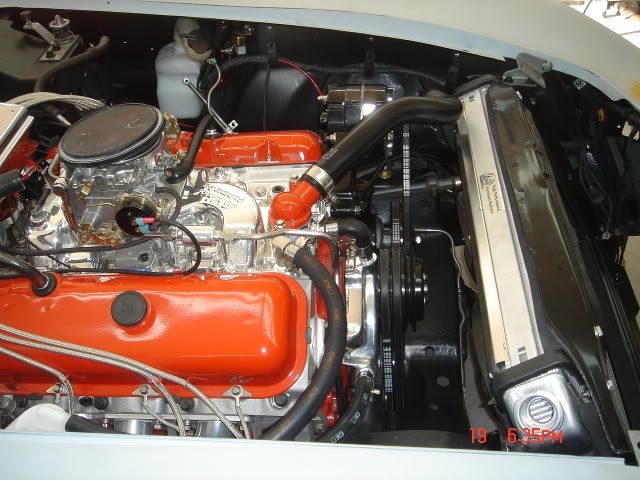

Former Vendor
Joined: Jan 2000
Posts: 5,593
Likes: 631
From: Brighton
The gap behind the radiator (between the frame and the radiator) does nothing to compromise cooling. In fact, it gives the air that has been through the radiator an escape path.
You need the seals between the radiator and the core support to be intact so that the air coming in the front of the car has no alternative but to go through the radiator.
There is no other need for sealing. If you had mechanical fans, you would need the ducts to be sealed up to the back of the fan, but that's it. There is no advantage to filling the space behind the fans between the frame and the core support. Once the air has been drawn through the radiator, it can be left free to exit under the car.
You need the seals between the radiator and the core support to be intact so that the air coming in the front of the car has no alternative but to go through the radiator.
There is no other need for sealing. If you had mechanical fans, you would need the ducts to be sealed up to the back of the fan, but that's it. There is no advantage to filling the space behind the fans between the frame and the core support. Once the air has been drawn through the radiator, it can be left free to exit under the car.
And it makes it a whole lot easier to change belts, water pump, and fuel pump.
Thread Starter
Instructor
Joined: Apr 2010
Posts: 215
Likes: 0
From: Lakeland FL
Thanks.
The seals that I removed from the original radiator basically fell apart as soon as I started to handle them. Since I didn't realize it then, but do now, that my high dollar digital camera should be used for just about every repair job (and I have a lot of them in my future), I don't recall their placement either. I now have a pretty significant gap between the radiator and the condenser and now that you talked about it it makes perfect sense that it has to be closed up. Could someone tell me what the seals/kit are called?
Here's my other dilemma. I bought a 2-row radiator aluminum instead of something beefier. I'm starting to question this decision, but I'm hopelessly optimistic that sealing it up will give me the cooling results I need.
Thanks to everyone for helping this newbie along in his road to discovery. It's funny how every little project, from fuel pump replacement to door jamb switch, makes me feel a little closer to my '75. Yeah, I might do a little bit of cussing, and a little bit of bleeding, but when I'm basking in the afterglow of the finished product of my toil, it's all worth it all over again.
The seals that I removed from the original radiator basically fell apart as soon as I started to handle them. Since I didn't realize it then, but do now, that my high dollar digital camera should be used for just about every repair job (and I have a lot of them in my future), I don't recall their placement either. I now have a pretty significant gap between the radiator and the condenser and now that you talked about it it makes perfect sense that it has to be closed up. Could someone tell me what the seals/kit are called?
Here's my other dilemma. I bought a 2-row radiator aluminum instead of something beefier. I'm starting to question this decision, but I'm hopelessly optimistic that sealing it up will give me the cooling results I need.
Thanks to everyone for helping this newbie along in his road to discovery. It's funny how every little project, from fuel pump replacement to door jamb switch, makes me feel a little closer to my '75. Yeah, I might do a little bit of cussing, and a little bit of bleeding, but when I'm basking in the afterglow of the finished product of my toil, it's all worth it all over again.
Last edited by kirt8548; Jul 12, 2010 at 07:42 AM.

Melting Slicks


Joined: May 2005
Posts: 2,486
Likes: 71
From: Elkhart Lake, Wisconsin
Stupid question, but you are using puller fans not pusher fans, correct?
My Summit aluminum rad with Spal fan pack. The 427 BB usually runs 180 and has never run 200 or above.


My Summit aluminum rad with Spal fan pack. The 427 BB usually runs 180 and has never run 200 or above.
Last edited by RobRace10; Jul 12, 2010 at 08:36 AM.

Burning Brakes

Joined: Apr 2007
Posts: 1,028
Likes: 1
From: SOUTH ELGIN IL
I would be damn sure you are running at the temp your gauge is telling you. I got all worked up over mine climbing up above 210 and replaced everything - water pump, radiator, spal fans for mechanical, pulleys (why not?), hoses. My new set up is awesome, but when the temps still came out higher than they should be I then realized my sending unit was wrong for corvette and it was reading incorrectly. Now, with a 180/190 thermostatic switch it fluctuates between 210 and 200 on my temp gauge. I'm still more than pleased with my new system because I feel like I can make the motor mods I want and not have to worry about it, but you may not be having the huge issue you think you are. I notice a suggestion for an IR gun. I didn't do it but you might...
btw I called corvette central and a few other places and they told me even the correct sending units are not reliable so I didn't bother to replace it yet. Also be aware the temp reading gets further off as the temp increases.
-Dan
btw I called corvette central and a few other places and they told me even the correct sending units are not reliable so I didn't bother to replace it yet. Also be aware the temp reading gets further off as the temp increases.
-Dan