



70 LT-1 Vacuum advance question

Le Mans Master


Joined: Apr 2004
Posts: 7,106
Likes: 38
From: Newark DE

I hope you guys are doing well.
Unfortunately, certain people's posts have reminded me why I stopped posting in the first place. It's simply not worth the aggrevation.
Roger, glad you are making use of the info on my site. please continue to utilize it as much as you want, that's what it's there for
Le Mans Master
Joined: Oct 2002
Posts: 7,098
Likes: 378
From: Las Vegas - Just stop perpetuating myths please.
Yes, to the contrary and just when we think we know it all.
Well i had the opinion that ported vac was only for emissions also until i recently read Ruggles book on Qjets. For applications with large cams the ported vac can prevent an engine stall and kill as vac drops when loaded by an automatic shifted to drive or energizing the AC compressor. I can recall this from past exprience myself though not everyone will.
The real answer to using ported vac is to try manifold vac then ported vac and compare the results. Larger cammed motors may respond better to a ports vac - but it may not. I can't tell if this is the stock LT1 cam from here in California.
My expectation is that none of the LT1 Qjet's in 1971 used a ported vac - but i could easily be wrong as my '74 Qjet has more vac ports then venturi barrels.
As far as detonation goes it can occur for a number of reasons and it only has to happen in one cylinder to ruin your day. Carbon build up, hot spot on sharp edge in just one chamber, high or higher than normal coolant temps, too much advance (of course). Myself, high compression on a short cammed motor would be istic (>9.5 c.r. with iron heads). The new trend using a large duration camshaft is to calc for a "Dynamic" c.r. and if u (or the owner) have accomplished this then good for you. But on a stock LT1 engine from 1970 who knows exactly what the c.r. and Dynamic C.r. is - unless u open the motor up and measure it. My belive is what Vizard, Lingenfelter, and other pros have published which is too keep the c.r. less than 9.5 in an iron head motor and less than 10.5 with aluminum heads. While that applies to most short street cams it would be useful here.
On the faceless internet u will read dynamic ratios of 8.0 to 8.2 is safe using pump gas with any static c.r.. I admit i don't have the dyno experience to say what won't work - i just use the best information source availible - thats my 2 cents.
From what i read here cooling is the biggest indicator and i would run the coolest T-stat availible (large open disk), check the shroud seals are intact and doing thier job (or replace all of them with new), the centrifical fan clutch is working (or install a fixed blade fan), recore the radiator, add water wetter to the coolant and last just not drive it on hot days.
But the real fix may have to be large chamber heads though it sounds like the engine is marginaly close and possibly just a thick azz head gasket can get it out of detonation - don't gamble on this though unless u think u really want to try it.
Bottom line is, that engine won't last long driving with detonation. And remember that detonation begins long before you can hear it from inside the car. If only 1 or 2 cylinders are detonating u probly can't hear it and it only takes on cylinder in detonation to destroy the engine.
Hope this helps more than it hurts,
cardo0
The real answer to using ported vac is to try manifold vac then ported vac and compare the results. Larger cammed motors may respond better to a ports vac - but it may not. I can't tell if this is the stock LT1 cam from here in California.
My expectation is that none of the LT1 Qjet's in 1971 used a ported vac - but i could easily be wrong as my '74 Qjet has more vac ports then venturi barrels.
As far as detonation goes it can occur for a number of reasons and it only has to happen in one cylinder to ruin your day. Carbon build up, hot spot on sharp edge in just one chamber, high or higher than normal coolant temps, too much advance (of course). Myself, high compression on a short cammed motor would be istic (>9.5 c.r. with iron heads). The new trend using a large duration camshaft is to calc for a "Dynamic" c.r. and if u (or the owner) have accomplished this then good for you. But on a stock LT1 engine from 1970 who knows exactly what the c.r. and Dynamic C.r. is - unless u open the motor up and measure it. My belive is what Vizard, Lingenfelter, and other pros have published which is too keep the c.r. less than 9.5 in an iron head motor and less than 10.5 with aluminum heads. While that applies to most short street cams it would be useful here.
On the faceless internet u will read dynamic ratios of 8.0 to 8.2 is safe using pump gas with any static c.r.. I admit i don't have the dyno experience to say what won't work - i just use the best information source availible - thats my 2 cents.
From what i read here cooling is the biggest indicator and i would run the coolest T-stat availible (large open disk), check the shroud seals are intact and doing thier job (or replace all of them with new), the centrifical fan clutch is working (or install a fixed blade fan), recore the radiator, add water wetter to the coolant and last just not drive it on hot days.
But the real fix may have to be large chamber heads though it sounds like the engine is marginaly close and possibly just a thick azz head gasket can get it out of detonation - don't gamble on this though unless u think u really want to try it.
Bottom line is, that engine won't last long driving with detonation. And remember that detonation begins long before you can hear it from inside the car.
If only 1 or 2 cylinders are detonating u probly can't hear it and it only takes on cylinder in detonation to destroy the engine.Hope this helps more than it hurts,
cardo0

Le Mans Master

Joined: Dec 2003
Posts: 5,727
Likes: 39
From: Fremont CA
WOW! I'm really getting educated here, can you tell me the correct numbers Qjet ofr a 70 LT-1. Are you by anychance involved with NCRS judging?
PS anyone want to buy a Holley List#4555 for cheap?
PS anyone want to buy a Holley List#4555 for cheap?
Last edited by Solid LT1; Jul 21, 2010 at 11:20 AM.

Racer


Joined: Oct 2004
Posts: 258
Likes: 1
From: Wilkesboro NC
Well i had the opinion that ported vac was only for emissions also until i recently read Ruggles book on Qjets. For applications with large cams the ported vac can prevent an engine stall and kill as vac drops when loaded by an automatic shifted to drive or energizing the AC compressor. I can recall this from past exprience myself though not everyone will.
The real answer to using ported vac is to try manifold vac then ported vac and compare the results. Larger cammed motors may respond better to a ports vac - but it may not. I can't tell if this is the stock LT1 cam from here in California.
My expectation is that none of the LT1 Qjet's in 1971 used a ported vac - but i could easily be wrong as my '74 Qjet has more vac ports then venturi barrels.
As far as detonation goes it can occur for a number of reasons and it only has to happen in one cylinder to ruin your day. Carbon build up, hot spot on sharp edge in just one chamber, high or higher than normal coolant temps, too much advance (of course). Myself, high compression on a short cammed motor would be istic (>9.5 c.r. with iron heads). The new trend using a large duration camshaft is to calc for a "Dynamic" c.r. and if u (or the owner) have accomplished this then good for you. But on a stock LT1 engine from 1970 who knows exactly what the c.r. and Dynamic C.r. is - unless u open the motor up and measure it. My belive is what Vizard, Lingenfelter, and other pros have published which is too keep the c.r. less than 9.5 in an iron head motor and less than 10.5 with aluminum heads. While that applies to most short street cams it would be useful here.
On the faceless internet u will read dynamic ratios of 8.0 to 8.2 is safe using pump gas with any static c.r.. I admit i don't have the dyno experience to say what won't work - i just use the best information source availible - thats my 2 cents.
From what i read here cooling is the biggest indicator and i would run the coolest T-stat availible (large open disk), check the shroud seals are intact and doing thier job (or replace all of them with new), the centrifical fan clutch is working (or install a fixed blade fan), recore the radiator, add water wetter to the coolant and last just not drive it on hot days.
But the real fix may have to be large chamber heads though it sounds like the engine is marginaly close and possibly just a thick azz head gasket can get it out of detonation - don't gamble on this though unless u think u really want to try it.
Bottom line is, that engine won't last long driving with detonation. And remember that detonation begins long before you can hear it from inside the car. If only 1 or 2 cylinders are detonating u probly can't hear it and it only takes on cylinder in detonation to destroy the engine.
Hope this helps more than it hurts,
cardo0
The real answer to using ported vac is to try manifold vac then ported vac and compare the results. Larger cammed motors may respond better to a ports vac - but it may not. I can't tell if this is the stock LT1 cam from here in California.
My expectation is that none of the LT1 Qjet's in 1971 used a ported vac - but i could easily be wrong as my '74 Qjet has more vac ports then venturi barrels.
As far as detonation goes it can occur for a number of reasons and it only has to happen in one cylinder to ruin your day. Carbon build up, hot spot on sharp edge in just one chamber, high or higher than normal coolant temps, too much advance (of course). Myself, high compression on a short cammed motor would be istic (>9.5 c.r. with iron heads). The new trend using a large duration camshaft is to calc for a "Dynamic" c.r. and if u (or the owner) have accomplished this then good for you. But on a stock LT1 engine from 1970 who knows exactly what the c.r. and Dynamic C.r. is - unless u open the motor up and measure it. My belive is what Vizard, Lingenfelter, and other pros have published which is too keep the c.r. less than 9.5 in an iron head motor and less than 10.5 with aluminum heads. While that applies to most short street cams it would be useful here.
On the faceless internet u will read dynamic ratios of 8.0 to 8.2 is safe using pump gas with any static c.r.. I admit i don't have the dyno experience to say what won't work - i just use the best information source availible - thats my 2 cents.
From what i read here cooling is the biggest indicator and i would run the coolest T-stat availible (large open disk), check the shroud seals are intact and doing thier job (or replace all of them with new), the centrifical fan clutch is working (or install a fixed blade fan), recore the radiator, add water wetter to the coolant and last just not drive it on hot days.
But the real fix may have to be large chamber heads though it sounds like the engine is marginaly close and possibly just a thick azz head gasket can get it out of detonation - don't gamble on this though unless u think u really want to try it.
Bottom line is, that engine won't last long driving with detonation. And remember that detonation begins long before you can hear it from inside the car.
If only 1 or 2 cylinders are detonating u probly can't hear it and it only takes on cylinder in detonation to destroy the engine.Hope this helps more than it hurts,
cardo0
I have seen at least 100 LT-1's and have never seen one that I thought was real with a Quadrajunk carburetor on it. Must be something real rare


Race Director

Joined: Jul 2001
Posts: 15,892
Likes: 42
Hi there Mike, Roger, and Pete. Nice to see you guys again and thanks for the kind welcome.
I hope you guys are doing well.
Unfortunately, certain people's posts have reminded me why I stopped posting in the first place. It's simply not worth the aggrevation.
Roger, glad you are making use of the info on my site. please continue to utilize it as much as you want, that's what it's there for
I hope you guys are doing well.
Unfortunately, certain people's posts have reminded me why I stopped posting in the first place. It's simply not worth the aggrevation.
Roger, glad you are making use of the info on my site. please continue to utilize it as much as you want, that's what it's there for
 , they're all watching this). Please keep in mind however that responses like yours above will jeopardize my chance of being Mr. Nasty 2010. I know that Roger thinks I'm a shoe-in but you've beat me to the punch on this one.
Last edited by Mike Ward; Jul 21, 2010 at 04:42 PM.

Team Owner

Joined: Mar 2003
Posts: 26,118
Likes: 1,874
From: Greenville, Indiana
Hook the line to the factory TCS soleniod on the intake manifold so it will NOT have vacuum advance, 11:1 compression and pump gas won't work in today's world. You need to retard ignition timing about 4-6 degrees and then your fighting heating problems due to retarding the timing and throwing extra heat into the exhaust ports. TCS spark control soleniod should only allow vacuum advance when motor is cold or in high gear (little switch on Muncie side cover is for TCS activation) when it is warm, otherwise it blocks vacuum signal to advance on distributor.
The best solution is to run 20% race gas and leave it at the factory settings, you'll knock out 20-40HP out of that motor retarding the ignition timing to run on normal pump fuel. There are also water injection systems from places like AEM or Snow Performance that will allow it to run on normal pump gas.
The best solution is to run 20% race gas and leave it at the factory settings, you'll knock out 20-40HP out of that motor retarding the ignition timing to run on normal pump fuel. There are also water injection systems from places like AEM or Snow Performance that will allow it to run on normal pump gas.

Team Owner
Joined: Mar 2003
Posts: 26,118
Likes: 1,874
From: Greenville, Indiana
I would like it to be factory but he is having issues with severe detonation at part throttle with todays so called Premium gas. The engine is completely original internally so it has the stock 11 to 1compression and I am believing that THIS is the main cause of the detonation. I have told him to try putting a half tank of "Cam2" racing gas in it mixed with 93 octane Premium and see how it runs then. He says the car runs GREAT until it gets warmed up, 180-190 degrees, and then it "pings " badly. He just had the Transistor Ignition distributor professionaly rebuilt/restored so I am VERY confident that the advance rate and all that is what it should be for a 70 LT-1.
Jim
Jim
Unhook your vacuum advance. Rev the engine until the mechanical advance stops advancing on the timing mark and note what you have including the initial. Anything up to 36* or so is fine. If you have more than that, start looking for the cause. Once you determine you have no more advance than about 36* total, hook up your vacuum advance straight to manifold vacuum. Record how much total advance you have now at idle. It could be anywhere between 15-25* or so. What is it? It would also be helpful if you post the numbers on the vacuum can.
Take the car out and run it and see what happens. It should run fine on 93 octane. That 11-1 compression isn't a problem with today's gas. Today's 93 octane is roughly equivalent to yesterday's 97 octane and that engine ran well on that.
My own 11-1 engine, tuned to factory specs runs on 89 octane with only a slight rattle on throttle tip in.
Bottom line, I think you're getting too much advance from somewhere.
Corvette Stories
The Best of Corvette for Corvette Enthusiasts

Every 2027 Corvette Engine Explained
Joe Kucinski
Designer Imagines A Corvette That Looks More Like a Corvette Than the Corvette
Verdad Gallardo
10 Ugly Corvettes That We Still Kinda Love
Joe Kucinski
Top 10 Most Expensive Corvettes Ever Sold on Bring A Trailer
Brett Foote
10 Things Every Corvette Owner Needs (2026 Edition)
Michael S. Palmer
8 Most "Only Corvette Owners Understand" Quirks and Problems
Pouria Savadkouei
10 Reasons the C6 Z06 is Still A Performance Benchmark After 20 Years
Joe Kucinski
How Much Horsepower Every Corvette Engine "LOST" in 1972
Joe Kucinski
Top 10 DOs and DON'Ts for Protecting Your Convertible Top!
Michael S. Palmer
Race Director
Joined: Jul 2001
Posts: 15,892
Likes: 42
1) the engine is in cold start cycle or almost overheating (that's where the temp switch comes in)
or
2) is in 3rd or 4th gear. 4th gear only on some years.
You might be on to something with a mismatch of the vac can.
Team Owner
Joined: Mar 2003
Posts: 26,118
Likes: 1,874
From: Greenville, Indiana
The TCS solenoid inhibits any vacuum advance unless
1) the engine is in cold start cycle or almost overheating (that's where the temp switch comes in)
or
2) is in 3rd or 4th gear. 4th gear only on some years.
You might be on to something with a mismatch of the vac can.
1) the engine is in cold start cycle or almost overheating (that's where the temp switch comes in)
or
2) is in 3rd or 4th gear. 4th gear only on some years.
You might be on to something with a mismatch of the vac can.
It's something simple, whatever it is.


Drifting


Joined: Apr 2007
Posts: 1,970
Likes: 45
From: Cameron Park CA
 I just checked the Corvette Black Book and it confirmed what I thought to be the case: LT1 engines for 1970, 1971, & 1972 were only equipped with Holley carburetors - no Quadrajets are listed.
 Furthermore, the 1969 Chassis Service Manual lists a Holley 4150 type carb for the 350/370, AKA LT1. I realize there were no LT1 equipped Corvettes produced for MY 1969, but apparently there were plans to do so until the Camaro "ate" up all the LT1 for use in the Z28
 .
.
Pete
Le Mans Master
Joined: Oct 2002
Posts: 7,098
Likes: 378
From: Las Vegas - Just stop perpetuating myths please.
Okay so the LT1 used a Holley, well i've never seen a Holley w/o ported vac port.
I just checked the Corvette Black Book and it confirmed what I thought to be the case: LT1 engines for 1970, 1971, & 1972 were only equipped with Holley carburetors - no Quadrajets are listed. Furthermore, the 1969 Chassis Service Manual lists a Holley 4150 type carb for the 350/370, AKA LT1. I realize there were no LT1 equipped Corvettes produced for MY 1969, but apparently there were plans to do so until the Camaro "ate" up all the LT1 for use in the Z28
.Pete

 Well look who's calling out correct part numbers now?
The OP says the carbs been changed and is considering ported vac. So what i said for ported vacuum still stands whether for Holley or Qjet carbs. It sounds like that TCS soleniod performs basically the same function as ported vacuum. But i don't know since my TCS has always been disconnected. But whichever one works the OP can choose for himself here.
Hook the line to the factory TCS soleniod on the intake manifold so it will NOT have vacuum advance, 11:1 compression and pump gas won't work in today's world. You need to retard ignition timing about 4-6 degrees and then your fighting heating problems due to retarding the timing and throwing extra heat into the exhaust ports. TCS spark control soleniod should only allow vacuum advance when motor is cold or in high gear (little switch on Muncie side cover is for TCS activation) when it is warm, otherwise it blocks vacuum signal to advance on distributor.
The best solution is to run 20% race gas and leave it at the factory settings, you'll knock out 20-40HP out of that motor retarding the ignition timing to run on normal pump fuel. There are also water injection systems from places like AEM or Snow Performance that will allow it to run on normal pump gas.
The best solution is to run 20% race gas and leave it at the factory settings, you'll knock out 20-40HP out of that motor retarding the ignition timing to run on normal pump fuel. There are also water injection systems from places like AEM or Snow Performance that will allow it to run on normal pump gas.
Running 20% race gas all the time? Good luck. Why not just trailer the car to the race track every time to drive it?

cardo0

Team Owner
Joined: Mar 2003
Posts: 26,118
Likes: 1,874
From: Greenville, Indiana
Why when for <$1000 u can have better flowing aftermarket heads that out perform the stock LT1 heads and will kill the detonation problem. Or even pocket ported large chamber chevy heads for $500 will do the job and still perform well - try Performance Heads: 2995 W Whitton Ave,Phoenix, AZ 85017,(602) 254-9586.
Running 20% race gas all the time? Good luck. Why not just trailer the car to the race track every time to drive it?
cardo0
Running 20% race gas all the time? Good luck. Why not just trailer the car to the race track every time to drive it?
cardo0
The OP needs to look elswhere for the root cause of the problem.
Le Mans Master
Joined: Dec 2003
Posts: 5,727
Likes: 39
From: Fremont CA
OK lets get the facts down "just the facts" as Joe Friday would say (I know most posters here have no idea who Joe Friday is, hint Google Jack Webb.)
TCS= Transmission Controlled Spark
TCS is a emissions system put on many vehicles starting with the 1970 model year. It blocked the vacuum signal to the advance unit on the distributor unless the motor was in high gear after the motor attained operating temprature. There are a few parts involved, a thermo switch mounted into the passenger side cylinder head that allowed spark advance until the motor warmed up to operation temprature as it was needed for driveability issues while the motor was operating cold. After reaching temprature the thermo switch closed activating the soleniod mounted on the intake manifold to energize and block the vacuum signal. The wiring to the soleniod was switched off by a small micro switch mounted into the transmission side cover of the Muncie 4 speed whan the transmission was in HIGH GEAR (that would be 4th gear ONLY for guys like Mike.)
Vacuum signal for this system is amost always MANIFOLD vacum and not timed vacuum signals, the LT-1 took its signal from the same source as the carb choke pull-off port on the FACTORY HOLLEY 4bbl carb of the LT-1 (sorry LT-1s never came with Qjets or vapor return lines no matter how many people tell me so, I know better.)
This was all done to reduce oxides of nitrogen caused by high combustion tempratures, it was a cheap fix that basically retarded spark timing under most operation conditions (the 11:1 copression of a 70 LT-1 made for some serious combustion tempratures.)
Once again another thread SPAMMED by "experts" thanks for all your contributions.
Not all water injection systems are that expensive and I would say unless you want to do "the cure" a stock 70 LT-1 won't run on todays premium pump fuels without compromising the ignition timing to prevent detonation.
As far as aftermarket heads SCREW THEM, if he has a real 70 LT-1 the 186 heads on the car can be made to perform well and they are the correct heads for the engine. Here is my "cure" for detonation on a 70 LT-1 or 67-9 Z/28 Camaro
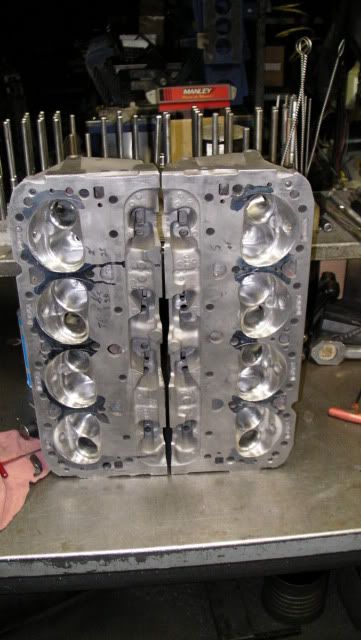
Yes I have about the same amount of $$$ into them as a set of aftermarket heads but, they will also outflow most "out of the box" heads I have put on a flow bench and THEY LOOK STOCK! and my car IS a LT-1, the BADA*S of the small block C3 Vettes. This makes it all the more worth while.
Mike W, we are still waiting for photos of your Vette on these forums PLEASE! post some. I'm dying to see it
TCS= Transmission Controlled Spark
TCS is a emissions system put on many vehicles starting with the 1970 model year. It blocked the vacuum signal to the advance unit on the distributor unless the motor was in high gear after the motor attained operating temprature. There are a few parts involved, a thermo switch mounted into the passenger side cylinder head that allowed spark advance until the motor warmed up to operation temprature as it was needed for driveability issues while the motor was operating cold. After reaching temprature the thermo switch closed activating the soleniod mounted on the intake manifold to energize and block the vacuum signal. The wiring to the soleniod was switched off by a small micro switch mounted into the transmission side cover of the Muncie 4 speed whan the transmission was in HIGH GEAR (that would be 4th gear ONLY for guys like Mike.)
Vacuum signal for this system is amost always MANIFOLD vacum and not timed vacuum signals, the LT-1 took its signal from the same source as the carb choke pull-off port on the FACTORY HOLLEY 4bbl carb of the LT-1 (sorry LT-1s never came with Qjets or vapor return lines no matter how many people tell me so, I know better.)
This was all done to reduce oxides of nitrogen caused by high combustion tempratures, it was a cheap fix that basically retarded spark timing under most operation conditions (the 11:1 copression of a 70 LT-1 made for some serious combustion tempratures.)
Once again another thread SPAMMED by "experts" thanks for all your contributions.
Not all water injection systems are that expensive and I would say unless you want to do "the cure" a stock 70 LT-1 won't run on todays premium pump fuels without compromising the ignition timing to prevent detonation.
As far as aftermarket heads SCREW THEM, if he has a real 70 LT-1 the 186 heads on the car can be made to perform well and they are the correct heads for the engine. Here is my "cure" for detonation on a 70 LT-1 or 67-9 Z/28 Camaro
Yes I have about the same amount of $$$ into them as a set of aftermarket heads but, they will also outflow most "out of the box" heads I have put on a flow bench and THEY LOOK STOCK! and my car IS a LT-1, the BADA*S of the small block C3 Vettes. This makes it all the more worth while.
Mike W, we are still waiting for photos of your Vette on these forums PLEASE! post some. I'm dying to see it

Drifting
Joined: Feb 2005
Posts: 1,879
Likes: 38
From: Los Gatos CA
Test: Disconnect and plug vacuum advance and I bet your low load ping will go away. What works for me is a vacuum can with about 10* advance rated at 2" vacuum less than your engine's idle vacuum, hooked up to full manifold vacuum. Remember, the smart one sez vacuum advance complements the mechanical advance curve... Just my 2 cents.
Race Director
Joined: Jul 2001
Posts: 15,892
Likes: 42
Please look up the meaning of 'spam', you consistently mis-use it.
We're waiting for pics of my car? Who is 'we'? I started this thread -as you requested- about three weeks ago. There was 850 or so views last time I looked.
http://forums.corvetteforum.com/c3-g...e-picture.html
Looks like you've (not we've) missed the boat, again.
Almost forgot, a review of GM documents, NCRS technical manuals and personal notes I've taken about known original cars confirms that 1970 Corvettes have a TCS switch for both 3rd and 4th gears. Surely you must be getting tired of being proven wrong?
Last edited by Mike Ward; Jul 22, 2010 at 11:55 AM. Reason: almost forgot-
Le Mans Master
Joined: Apr 2004
Posts: 7,106
Likes: 38
From: Newark DE
OK lets get the facts down "just the facts" as Joe Friday would say (I know most posters here have no idea who Joe Friday is, hint Google Jack Webb.)
TCS= Transmission Controlled Spark
TCS is a emissions system put on many vehicles starting with the 1970 model year. It blocked the vacuum signal to the advance unit on the distributor unless the motor was in high gear after the motor attained operating temprature. There are a few parts involved, a thermo switch mounted into the passenger side cylinder head that allowed spark advance until the motor warmed up to operation temprature as it was needed for driveability issues while the motor was operating cold. After reaching temprature the thermo switch closed activating the soleniod mounted on the intake manifold to energize and block the vacuum signal. The wiring to the soleniod was switched off by a small micro switch mounted into the transmission side cover of the Muncie 4 speed whan the transmission was in HIGH GEAR (that would be 4th gear ONLY for guys like Mike.)
Vacuum signal for this system is amost always MANIFOLD vacum and not timed vacuum signals, the LT-1 took its signal from the same source as the carb choke pull-off port on the FACTORY HOLLEY 4bbl carb of the LT-1 (sorry LT-1s never came with Qjets or vapor return lines no matter how many people tell me so, I know better.)
This was all done to reduce oxides of nitrogen caused by high combustion tempratures, it was a cheap fix that basically retarded spark timing under most operation conditions (the 11:1 copression of a 70 LT-1 made for some serious combustion tempratures.)
Once again another thread SPAMMED by "experts" thanks for all your contributions.
Not all water injection systems are that expensive and I would say unless you want to do "the cure" a stock 70 LT-1 won't run on todays premium pump fuels without compromising the ignition timing to prevent detonation.
As far as aftermarket heads SCREW THEM, if he has a real 70 LT-1 the 186 heads on the car can be made to perform well and they are the correct heads for the engine. Here is my "cure" for detonation on a 70 LT-1 or 67-9 Z/28 Camaro
Yes I have about the same amount of $$$ into them as a set of aftermarket heads but, they will also outflow most "out of the box" heads I have put on a flow bench and THEY LOOK STOCK! and my car IS a LT-1, the BADA*S of the small block C3 Vettes. This makes it all the more worth while.
Mike W, we are still waiting for photos of your Vette on these forums PLEASE! post some. I'm dying to see it
TCS= Transmission Controlled Spark
TCS is a emissions system put on many vehicles starting with the 1970 model year. It blocked the vacuum signal to the advance unit on the distributor unless the motor was in high gear after the motor attained operating temprature. There are a few parts involved, a thermo switch mounted into the passenger side cylinder head that allowed spark advance until the motor warmed up to operation temprature as it was needed for driveability issues while the motor was operating cold. After reaching temprature the thermo switch closed activating the soleniod mounted on the intake manifold to energize and block the vacuum signal. The wiring to the soleniod was switched off by a small micro switch mounted into the transmission side cover of the Muncie 4 speed whan the transmission was in HIGH GEAR (that would be 4th gear ONLY for guys like Mike.)
Vacuum signal for this system is amost always MANIFOLD vacum and not timed vacuum signals, the LT-1 took its signal from the same source as the carb choke pull-off port on the FACTORY HOLLEY 4bbl carb of the LT-1 (sorry LT-1s never came with Qjets or vapor return lines no matter how many people tell me so, I know better.)
This was all done to reduce oxides of nitrogen caused by high combustion tempratures, it was a cheap fix that basically retarded spark timing under most operation conditions (the 11:1 copression of a 70 LT-1 made for some serious combustion tempratures.)
Once again another thread SPAMMED by "experts" thanks for all your contributions.
Not all water injection systems are that expensive and I would say unless you want to do "the cure" a stock 70 LT-1 won't run on todays premium pump fuels without compromising the ignition timing to prevent detonation.
As far as aftermarket heads SCREW THEM, if he has a real 70 LT-1 the 186 heads on the car can be made to perform well and they are the correct heads for the engine. Here is my "cure" for detonation on a 70 LT-1 or 67-9 Z/28 Camaro
Yes I have about the same amount of $$$ into them as a set of aftermarket heads but, they will also outflow most "out of the box" heads I have put on a flow bench and THEY LOOK STOCK! and my car IS a LT-1, the BADA*S of the small block C3 Vettes. This makes it all the more worth while.
Mike W, we are still waiting for photos of your Vette on these forums PLEASE! post some. I'm dying to see it
fact - as "special and unique" you seem to think the LT1 motor is it's really nothing more than just another SBC motor and works on the same principles as they all do.
This is not saying anything bad at all about the LT1 which is a very nice motor and in so many ways the same as my own '65 L76 - both were the high performance SB motors of their day - but it's still just a SBC motor and the same operating principles apply to it. Talk around the issue all you want but you are simply blowing steam by believing anything else.
fact - your statement "a stock 70 LT-1 won't run on todays premium pump fuels without compromising the ignition timing to prevent detonation" is complete BS.
There is ZERO reason why a stock LT1 should not run perfectly fine on today's pump fuel. I asked you back earlier in the thread originally to give me the reason why you didn't think it would and I'm still waiting on your answer.
I know I'll never get it from you because there is no answer you can supply.
My L76 at 11:1 runs great on pump fuel.
LT1 cars in my local club (100% stock configured including factory timing specs) run great on pump fuel.
Seems like YOUR LT1 is the other one that won't run on pump fuel. Gee, maybe it's your car or your tuning that is the cause of it.
fact - previously you foolishly suggested to the OP that he needs to run race fuel and also recommended a water injection system. Now you seem to also recommend that the OP should gets his stock heads ported??!!
Fact - the "experts" you are slamming really ARE experts although you don't realize it. Maybe you don't like the fact that they disagree with you but that's only because you are wrong. These experts all have DECADES of real life experience with these cars, some of them most likely longer than you have been alive. You would greatly benefit from taking their information and learning from it rather than arguing with them
Really dude, you need to calm down, learn a bit more, and stop foolishly misleading the OP and others that may be reading this . You are WAY misinformed, and seem to love just throwing money and catalog racing parts to a simple problem. You are also extremely rude in this thread and other threads i've seen you post in to anyone that doesn't agree with what you say in your posts. The problem is that you post incorrect and misleading information and others are simply trying to correct you and you than you attack them and tell them they don't know what they are talking about. Classic defensive moves from someone not wanting to accept his own mistakes.
unless the engine in question was rebuilt at MUCH higher CR and there are other modification that have not been mentioned there is NO reason that the motor should not run great on pump fuel at factory specs and timing settings.
As MikeM already posted this should end up being a SIMPLE solution. Most likely just too much advance coming in from somewhere that needs to be found - could be a messed up curve on the distributor, incorrect timing belt cover so the timing indexing is wrong, or something else causing too much timing.
Also, as I mentioned in my earlier post, since the car is not being used for NCRS judging, the OP will also most likely gain better throttle response, performance, and lower operating temps if he bypasses the TCS system and connects the VA up to full manifold vacuum.
I see from your profile you are a mechanic. If you give your customers at the shop you work at the same advice you give here on the forums I feel sorry for them.
BTW, I entered this thread to help the OP with his problem, not deal with your problems so I'm done with you and will not waste more of my time responding to you, only to the OP.
Last edited by BarryK; Jul 22, 2010 at 06:35 PM.

Race Director
Joined: May 2006
Posts: 16,528
Likes: 53
From: Dayton, Ohio
Why don't you think back to when you assembled your tranny and recall how many divots were in the 3-4 shift shaft. If you recall 2 divots then I think you owe someone an apology. If there is only 1 and your car is a 70 I'm fairly certain its the wrong shaft for the car.