




Differentail Problems while AutoX'ing

Race Director


Joined: Dec 1999
Posts: 11,096
Likes: 990
From: Sierra Foothills CA

Here is the second round of the thread that hotly addressed this issue. I didn't bother to jump back in the second one. The first was enough. The first one that the drawings were posted in got deleted suddenly back then.
http://forums.corvetteforum.com/c3-t...-rear-end.html
http://forums.corvetteforum.com/c3-t...-rear-end.html


Racer


Joined: Dec 2004
Posts: 410
Likes: 0
From: Wichita Kansas
I autox'd my 72 for years on the factory stub axles, finally broke one last year. I bought a new heavy duty axle from International axle. http://www.internationalaxle.com/products.htm. I believe Tom's no longer makes them. Lowering your car should help handling and your sway bar is too big. Try driving the car with it disconnected, bet you will like it much better.
One other thing I shimmed my stub axles by putting a shim between the C clip and the spider gear to take all the play out I could. I was warned that would abnormally wear the end the axle and the pin that separates them, never had a problem.
Good luck, I sold my C-3 and now autox a Z06, miss the C-3.
One other thing I shimmed my stub axles by putting a shim between the C clip and the spider gear to take all the play out I could. I was warned that would abnormally wear the end the axle and the pin that separates them, never had a problem.
Good luck, I sold my C-3 and now autox a Z06, miss the C-3.

Team Owner

Joined: Apr 1999
Posts: 21,953
Likes: 1,445
From: Reno Nevada
2024 C3 of the Year Finalist- Modified
I've been able to road race with my rear end for years. It also helps working at a shop. I run big slicks and when things break it's no big deal.
I do have allot of Tom's stuff. Like the billet steel main caps. I used to break the posi unit cases until I went to the bigger pin.
Limiting rear tire vertical travel will make higher hp live
I do have allot of Tom's stuff. Like the billet steel main caps. I used to break the posi unit cases until I went to the bigger pin.
Limiting rear tire vertical travel will make higher hp live
Last edited by gkull; Jul 23, 2010 at 12:48 AM.

Race Director

Joined: Jul 2001
Posts: 15,892
Likes: 42
It is interesting to me that it actually pulls out on the left shaft when in a RH turn. Lots of upward push in the suspension plus the inward force on the tire contact is rotating around the strut joint to pull the shaft out. It would be interesting to note how much play is in the trailing arm bushing.
I'd be interested in knowing what sort of G forces were being developed and the reasons for the very short duration of the actual yoke pull out. The computer modelling that was done assumed constant load as would be seen on a high speed oval, not the short left-right-left-right movement as is typical of an autocross. What was the track layout, and was the car going from a hard left to a hard right in each case, or fast straight to hard RH?
It appears also that the wheels and tires are not stock width or offset. This affects the calculation to large degree also. In several corners the inside wall of the LH tire seems to come extremely close to the nut and washer at the bottom of the spring end bolt as it folds under. I'd worry about interference there and a possible blow out.
It's possible that the transient G loading on the tire with the modified offset exceeded the loading that was contemplated in the calculations, to say that if the driver had continued the corner at the same radius and vehicle speed would the car have 'spun out' as predicted, or would the yoke have remained pulled out and the car continue unaffected?
This video also proves that yokes DO NOT pull out in any sort of normal street driving as was the original contention, especially under straight ahead or typical highway curves as some will continue to believe.
Here's a drawing I wish I'd had back at the last thrash of this subject. Keeping in mind that the critical load path and pivot point for any yoke pull-out is at the outer end of the lower strut rod. The distance between this pivot point and the centre of tire is what determines how much lateral force is required to 'go negative' on the yoke. Again, the large degree of 'fold under' of the OPs tires concerns me from an interference point of view and to what degree this affects the centre point of the tire with respect to the pivot point of the strut rod.

Last edited by Mike Ward; Jul 23, 2010 at 11:00 AM. Reason: more details

Melting Slicks

Joined: Jun 2009
Posts: 2,343
Likes: 4
From: Anderson SC

Melting Slicks
Joined: Mar 2008
Posts: 2,666
Likes: 289
From: Spring Park MN
No attack intended, maybe a little vindication. I simply said on the original thread that it would be possible for lateral G force to exceed downward force and at that point the shaft would pull out. We were told by you that could only happen if you hit a curb or something to that affect. You also said we just did not understand. I do engineering and design. I fully understood.
Race Director
Joined: Jul 2001
Posts: 15,892
Likes: 42
No attack intended, maybe a little vindication. I simply said on the original thread that it would be possible for lateral G force to exceed downward force and at that point the shaft would pull out. We were told by you that could only happen if you hit a curb or something to that affect. You also said we just did not understand. I do engineering and design. I fully understood.
There's 'vindication' of sorts for both camps here.
Corvette Stories
The Best of Corvette for Corvette Enthusiasts

Top 10 Most Expensive Corvettes Ever Sold on Bring A Trailer
Brett Foote
10 Things Every Corvette Owner Needs (2026 Edition)
Michael S. Palmer
8 Most "Only Corvette Owners Understand" Quirks and Problems
Pouria Savadkouei
10 Reasons the C6 Z06 is Still A Performance Benchmark After 20 Years
Joe Kucinski
How Much Horsepower Every Corvette Engine "LOST" in 1972
Joe Kucinski
Top 10 DOs and DON'Ts for Protecting Your Convertible Top!
Michael S. Palmer
Top 10 Most Explosive Corvettes Ever Made: Power-to-Weight Ratio Ranked!
Joe Kucinski
150 hp to 1,250 hp: Every Corvette Generation Compared by the Specs That Matter
Joe Kucinski
8 Coolest Corvette Pace Cars (and Replicas) of All Time
Verdad Gallardo
Team Owner
Joined: Apr 1999
Posts: 21,953
Likes: 1,445
From: Reno Nevada
2024 C3 of the Year Finalist- Modified
It does not take big lateral force to pull the yokes in and out. If they are bad you can do it right in your garage by pulling/pushing the tops of your tires.
Thread Starter
Intermediate
Joined: Jul 2006
Posts: 38
Likes: 1
From: New Jersey
And that amazes me too. Thanks to the OP for posting it, I've added it to my favourites. I see the bashers have circled for the attack as expected.
I'd be interested in knowing what sort of G forces were being developed and the reasons for the very short duration of the actual yoke pull out. The computer modelling that was done assumed constant load as would be seen on a high speed oval, not the short left-right-left-right movement as is typical of an autocross. What was the track layout, and was the car going from a hard left to a hard right in each case, or fast straight to hard RH?
It appears also that the wheels and tires are not stock width or offset. This affects the calculation to large degree also. In several corners the inside wall of the LH tire seems to come extremely close to the nut and washer at the bottom of the spring end bolt as it folds under. I'd worry about interference there and a possible blow out.
It's possible that the transient G loading on the tire with the modified offset exceeded the loading that was contemplated in the calculations, to say that if the driver had continued the corner at the same radius and vehicle speed would the car have 'spun out' as predicted, or would the yoke have remained pulled out and the car continue unaffected?
This video also proves that yokes DO NOT pull out in any sort of normal street driving as was the original contention, especially under straight ahead or typical highway curves as some will continue to believe.
Here's a drawing I wish I'd had back at the last thrash of this subject. Keeping in mind that the critical load path and pivot point for any yoke pull-out is at the outer end of the lower strut rod. The distance between this pivot point and the centre of tire is what determines how much lateral force is required to 'go negative' on the yoke. Again, the large degree of 'fold under' of the OPs tires concerns me from an interference point of view and to what degree this affects the centre point of the tire with respect to the pivot point of the strut rod.
I'd be interested in knowing what sort of G forces were being developed and the reasons for the very short duration of the actual yoke pull out. The computer modelling that was done assumed constant load as would be seen on a high speed oval, not the short left-right-left-right movement as is typical of an autocross. What was the track layout, and was the car going from a hard left to a hard right in each case, or fast straight to hard RH?
It appears also that the wheels and tires are not stock width or offset. This affects the calculation to large degree also. In several corners the inside wall of the LH tire seems to come extremely close to the nut and washer at the bottom of the spring end bolt as it folds under. I'd worry about interference there and a possible blow out.
It's possible that the transient G loading on the tire with the modified offset exceeded the loading that was contemplated in the calculations, to say that if the driver had continued the corner at the same radius and vehicle speed would the car have 'spun out' as predicted, or would the yoke have remained pulled out and the car continue unaffected?
This video also proves that yokes DO NOT pull out in any sort of normal street driving as was the original contention, especially under straight ahead or typical highway curves as some will continue to believe.
Here's a drawing I wish I'd had back at the last thrash of this subject. Keeping in mind that the critical load path and pivot point for any yoke pull-out is at the outer end of the lower strut rod. The distance between this pivot point and the centre of tire is what determines how much lateral force is required to 'go negative' on the yoke. Again, the large degree of 'fold under' of the OPs tires concerns me from an interference point of view and to what degree this affects the centre point of the tire with respect to the pivot point of the strut rod.
I have now finally had the patience to fully read some of the other posts and threads about this, and my personal conclusion is that except for a few select members, most of them are keyboard mechanics with little knowledge about what actually goes on. They have their own big bang theory but make it sound like its a science fact.

This is what I did so far, I ordered the upgraded stubs with clips, but I am still searching for options on my diff, my budget is tight, (I still have monthly college loans to pay back) Im wondering if I upgrade my spiders, if I will be okay for a while until I have money; it really goes against my moral of fix it right the first time but money is at stake. Does anyone know who sells better spiders?
To answer your question, my trailing arms are offset aftermarket from VPB,
http://www.vbandp.com/C2-C3-Corvette...ight-Hand.html , Im running 16x9 rims with an additional 1" offset since I have extra clearance now. The tires are MT Street II which are 295/50R16, Im not a big fan of those since they are too soft on the sidewall, my next ones will be Nitto 295/40R16 or 275/40R16. I just have the MT's on there to keep my 600 rwhp in check and on the street.
If anyone is wondering about G-forces generated, I have a G-Tech Pro RR, not sure of its complete accuracy but it gives me a ballpark Idea. On an autox I will average 1.02 G's, while I managed to peak 1.06 on a 300' skidpad with my MT's and Nitto 555s upfront
http://www.gtechpro.com/rr.html

Burning Brakes

Joined: Mar 2004
Posts: 816
Likes: 1
From: Finland


 yes!
yes!Great video!
Last edited by Vesa; Jul 23, 2010 at 01:52 PM.
Race Director
Joined: Jul 2001
Posts: 15,892
Likes: 42
Mike, that is a real nice drawing! Thanks for spending time to make that CAD drawing. I hope this thread will become useful to others in the future who may be facing the same/simmilar problems.
I have now finally had the patience to fully read some of the other posts and threads about this, and my personal conclusion is that except for a few select members, most of them are keyboard mechanics with little knowledge about what actually goes on. They have their own big bang theory but make it sound like its a science fact.
To answer your question, my trailing arms are offset aftermarket from VPB,
http://www.vbandp.com/C2-C3-Corvette...ight-Hand.html , Im running 16x9 rims with an additional 1" offset since I have extra clearance now. The tires are MT Street II which are 295/50R16, Im not a big fan of those since they are too soft on the sidewall, my next ones will be Nitto 295/40R16 or 275/40R16. I just have the MT's on there to keep my 600 rwhp in check and on the street.
If anyone is wondering about G-forces generated, I have a G-Tech Pro RR, not sure of its complete accuracy but it gives me a ballpark Idea. On an autox I will average 1.02 G's, while I managed to peak 1.06 on a 300' skidpad with my MT's and Nitto 555s upfront
http://www.gtechpro.com/rr.html
I have now finally had the patience to fully read some of the other posts and threads about this, and my personal conclusion is that except for a few select members, most of them are keyboard mechanics with little knowledge about what actually goes on. They have their own big bang theory but make it sound like its a science fact.
To answer your question, my trailing arms are offset aftermarket from VPB,
http://www.vbandp.com/C2-C3-Corvette...ight-Hand.html , Im running 16x9 rims with an additional 1" offset since I have extra clearance now. The tires are MT Street II which are 295/50R16, Im not a big fan of those since they are too soft on the sidewall, my next ones will be Nitto 295/40R16 or 275/40R16. I just have the MT's on there to keep my 600 rwhp in check and on the street.
If anyone is wondering about G-forces generated, I have a G-Tech Pro RR, not sure of its complete accuracy but it gives me a ballpark Idea. On an autox I will average 1.02 G's, while I managed to peak 1.06 on a 300' skidpad with my MT's and Nitto 555s upfront
http://www.gtechpro.com/rr.html
Thanks also for giving details of your suspension, wheel, and tire set up. Obviously the 1" additional offset and additional diameter throws all the 'stock' calculations out the window, as does the extreme tire fold-under of the MT tires. That's far more than anything I've seen before.
I wish I still had access to the cad cam program previously used to calculate the dynamics of the stock set up. It would be great to use your existing set up as a new model and see what numbers fall out. Obviously your particular set up is more prone to pull-out than a stock set up, and in this circumstance the C lips are required to minimize camber change. That alone will solve the pull out and spline twisting issue IMHO.
I note that you're able to pull over 1G in a consistent manner, that's really cool and far exceeds the abilities of a stock wheel and tire. My own modelling stopped at 1G as stated many times before.
I'd be interested to see videos with the new tires, I still think you're coming very close to interference with the spring end.


Melting Slicks
Joined: Mar 2008
Posts: 2,666
Likes: 289
From: Spring Park MN
When I Autocrossed last weekend on my 255/60/15 tires, you would not have believed how far the tire could roll before I played with the caster and camber and got the tire pressure where I wanted it. It was showing wear about an inch up the side coming off the tread and up the sidewall. A friend of mine with his Roadmaster was a good 2'' up the sidewall. I couldn't believe it.

Le Mans Master

Joined: Dec 2003
Posts: 5,727
Likes: 38
From: Fremont CA
I autox'd my 72 for years on the factory stub axles, finally broke one last year. I bought a new heavy duty axle from International axle. http://www.internationalaxle.com/products.htm. I believe Tom's no longer makes them. Lowering your car should help handling and your sway bar is too big. Try driving the car with it disconnected, bet you will like it much better.
One other thing I shimmed my stub axles by putting a shim between the C clip and the spider gear to take all the play out I could. I was warned that would abnormally wear the end the axle and the pin that separates them, never had a problem.
Good luck, I sold my C-3 and now autox a Z06, miss the C-3.
One other thing I shimmed my stub axles by putting a shim between the C clip and the spider gear to take all the play out I could. I was warned that would abnormally wear the end the axle and the pin that separates them, never had a problem.
Good luck, I sold my C-3 and now autox a Z06, miss the C-3.
Int'l Axel also has shim sets for side yokes, I used to make them from valve spring shims, much easier to order from Int'l Axel. Run a differential crosspin from Tom's Differentials and you shouldn't see any wear, the stocker is a little too soft and will wear over time.
I wonder when the "BORG" will show up on this thread and give us some of their "expertise" on this subject (the BORG is of the opnion that you don't need C clips.)
Last edited by Solid LT1; Jul 24, 2010 at 02:48 AM.
Racer
Joined: Dec 2004
Posts: 410
Likes: 0
From: Wichita Kansas
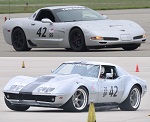
My car had 295/35/17 Auto X Hoosiers on 9 1/2 inch rims. Even those super stiff sidewall tires would move almost 1 inch and rub the exhaust. I was never able to decide if it was all tire movement or tire and suspension. My guess is it was both. There is a lot of play in the C-3 suspension design. I did everyyhing within SCCA rules to limit that flex. Too bad Zora wasn't allowed to use a double A arm set up like my C-5 Z06.
Melting Slicks

Joined: Jan 2004
Posts: 3,247
Likes: 210
From: Detroit MI
Int'l Axel also has shim sets for side yokes, I used to make them from valve spring shims, much easier to order from Int'l Axel. Run a differential crosspin from Tom's Differentials and you shouldn't see any wear, the stocker is a little too soft and will wear over time.
http://www.internationalaxle.com/products.htm
Thanks
Race Director

Joined: May 2003
Posts: 10,956
Likes: 409
From: California
 Very true.... and the reason for the "C" clips...
Racer
Joined: Dec 2004
Posts: 410
Likes: 0
From: Wichita Kansas
I didn't see any shims on their site specifically for side yokes, are you using shims intended for something else on your side yokes? I was looking on this page:
http://www.internationalaxle.com/products.htm
Thanks
http://www.internationalaxle.com/products.htm
Thanks
I bought my shims from Grainger. I shipped them off with the car, so I don't have the part number. I beleive it is called an Arbor Shim pack with various thicknesses. The I.D. of the shims I bought were a bit small and I had to grind them a bit larger to fit. I installed them between the clip and the spider gear, making the fit as tight as possible. Never had excessive pin or side yoke wear.
Jim
Melting Slicks
Joined: Jan 2004
Posts: 3,247
Likes: 210
From: Detroit MI
Thanks Jim. I'll wait to see if SolidLT-1 replies, it sounds like the ones he used didn't require any grinding to open up the i.d. I have four pigs that could all use shims, unfortunately I only have one set of the good stub axles.