




Quadra-bog?

Thread Starter
Advanced

Joined: Jul 2010
Posts: 70
Likes: 0
From: Austin, TX
 Quadra-bog?
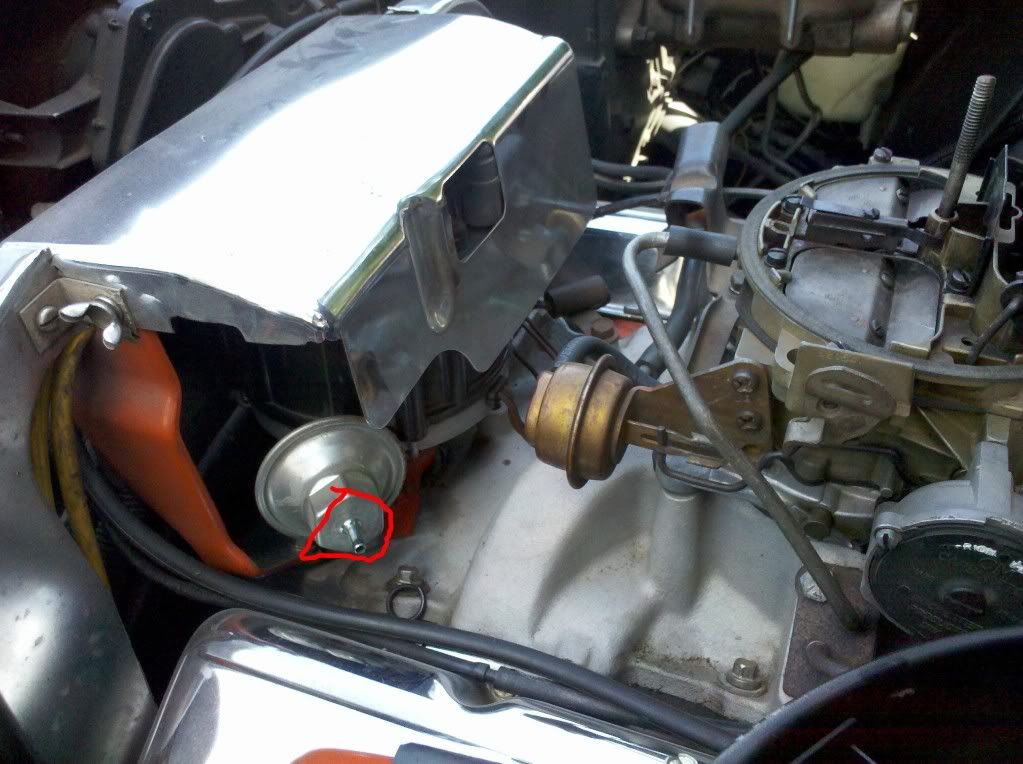
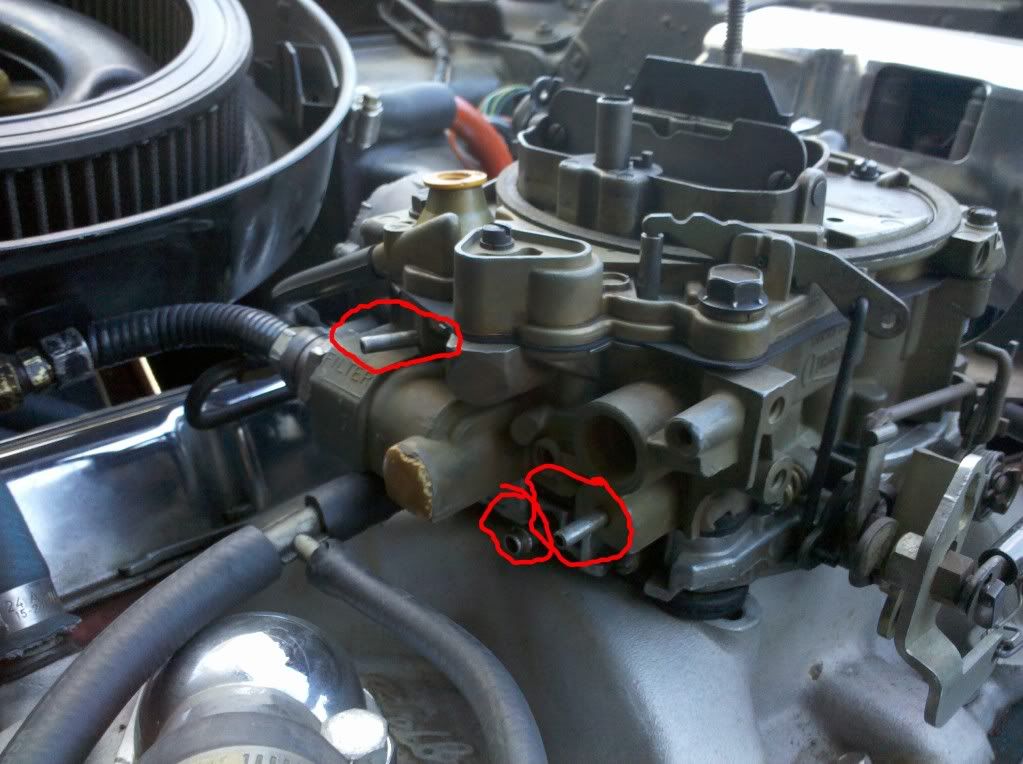
Hey guys, Sorry about another carb question, but I'm a complete newbie when it comes to carbs. I bought my 75' about a month ago now. It runs well, but when I go WOT in second or more more noticebly in 3rd gear, I get good buck and bog when I get up over 3000 rpm I'd say. It seems to me like it's a problem with the secondaries opening up. But in 1st, I can run to redline seemingly fine. A mechanic that I know took a very brief look at it and pointed out a place he thinks should be connected. He said that this vacuum break should be connected to one of these points in the front of the carb? He said to test and see which ones suck vacuum while the engine is running, seemingly both do. Does this make any sense to any of y'all?

Le Mans Master


Joined: Jun 2008
Posts: 5,284
Likes: 235
From: Rockledge FL
The nipple on the distributer is the vacuum advance. It should be hooked up. Read the timing sticky to see the differences in hooking up this item. The nipples on the carb are vacuum nipples. Some have vacuum at idle (use your finger to check) This is manifold vacuum. Others have no vacuum at idle. This is called ported. Depending on wether you want to use ported or manifold vacuum for your distributer (again read timing sticky) run a vacuum line from your selected nipple to the distributer and then plug the others.

Melting Slicks


Joined: Mar 2008
Posts: 2,023
Likes: 6
From: Austin Tx
Yes - you definately want to get your vacuum advance hooked up.
Your vacuum ports should be either hooked up, or capped.
The first port on the left I believe would be for a choke pull off - your's is on the rear of the carb, so that one I believe should be capped.
The port furtherst to the right, I think, should be the one you want to use for your vacuum advance.
The port in the center, I think you need to move a hose around for. The big hose on the left front, the one with the tee - does the big hose go to the PCV valve, and continue around to your vapor can. And the smaller hose that is teed off of it go straight to the vapor can? If so, the large hose is connected to the correct port, but I believe the smaller one should not be teed off of it - it should be connected to the circled port in the center.
Matt
Your vacuum ports should be either hooked up, or capped.
The first port on the left I believe would be for a choke pull off - your's is on the rear of the carb, so that one I believe should be capped.
The port furtherst to the right, I think, should be the one you want to use for your vacuum advance.
The port in the center, I think you need to move a hose around for. The big hose on the left front, the one with the tee - does the big hose go to the PCV valve, and continue around to your vapor can. And the smaller hose that is teed off of it go straight to the vapor can? If so, the large hose is connected to the correct port, but I believe the smaller one should not be teed off of it - it should be connected to the circled port in the center.
Matt

Le Mans Master

Joined: Jan 2006
Posts: 9,192
Likes: 27
From: Boca Raton Florida
The first pic indicates the vac advance can oon the distributor, for a good running engine you want that connected to manifold vacume, the bottom most nipple on the second pic.
Cap the other 2 and retest, bet ya see better results. Provided that your distributor advance mechanisms work properly.
Cap the other 2 and retest, bet ya see better results. Provided that your distributor advance mechanisms work properly.
Thread Starter
Advanced
Joined: Jul 2010
Posts: 70
Likes: 0
From: Austin, TX
Hey guys thanks a lot for the quick response! However, do we have two conflicting opinions here?
1. Hook the advance up to the rightmost port
2. Hook the advance up to the bottom port (larger port).
Am I reading right?
But hey thanks a bunch for the info already.
1. Hook the advance up to the rightmost port
2. Hook the advance up to the bottom port (larger port).
Am I reading right?
But hey thanks a bunch for the info already.
Melting Slicks
Joined: Mar 2008
Posts: 2,023
Likes: 6
From: Austin Tx
Thread Starter
Advanced
Joined: Jul 2010
Posts: 70
Likes: 0
From: Austin, TX
Corvette Stories
The Best of Corvette for Corvette Enthusiasts

Top 10 Most Explosive Corvettes Ever Made: Power-to-Weight Ratio Ranked!
Joe Kucinski
150 hp to 1,250 hp: Every Corvette Generation Compared by the Specs That Matter
Joe Kucinski
8 Coolest Corvette Pace Cars (and Replicas) of All Time
Verdad Gallardo
Top 10 Corvette Engines RANKED by Peak Torque (70+ Years of Muscle!)
Joe Kucinski
Corvette ZR1X Will Be Pacing the Indy 500, And Could Probably Race, Too!
Verdad Gallardo
Top 10 Corvettes Coming to Mecum Indy 2026!
Brett Foote
Top 10 C9 Corvette MUST-HAVES to Fix These C8 Generation Flaws!
Michael S. Palmer
10 Revolutionary 'Corvette Firsts' Most People Don't Know
Joe Kucinski
5 Reasons to Upgrade to an LS6-Powered Corvette; 5 Reasons to Stay LT2
Michael S. Palmer
Melting Slicks


Joined: Oct 2002
Posts: 2,317
Likes: 111
From: St Louis MO
I have a carb virtually identical to that except with a straight fuel filter boss...
The manifold vacuum is sourced from the nipple at the upper right (passenger side) of the carb above the fuel filter boss. The lower left nipple is ported vacuum; the mid-level left nipple is for EGR timing. It acts like ported vacuum, but is even slower to apply vacuum.
Next time you have the carb apart, take a look at where these passages go. BTW, the above reference is for a 4MC or 4MV carb; yours is an M4MC (post '74) and is considerably different and has different vacuum hookups.
The manifold vacuum is sourced from the nipple at the upper right (passenger side) of the carb above the fuel filter boss. The lower left nipple is ported vacuum; the mid-level left nipple is for EGR timing. It acts like ported vacuum, but is even slower to apply vacuum.
Next time you have the carb apart, take a look at where these passages go. BTW, the above reference is for a 4MC or 4MV carb; yours is an M4MC (post '74) and is considerably different and has different vacuum hookups.
Thread Starter
Advanced
Joined: Jul 2010
Posts: 70
Likes: 0
From: Austin, TX
Alright, so I hooked up the distributor advance to the upper right nipple. I went out for a cruise and the first blow seemed to work well: no bog in second or third gear. I ran her up a few more times and did find quite a bit of bog. I got one more clean pass out of it, but not much better if any better than before.
I'd be more than happy to post up the ID number. Where would I find that? I looked around initially but didn't see it.
Yea I found that as well, although the diagram seemed to look the same. Would there be that much difference?
At this point though you guys have answered my question, so I thank you for that.
I have a carb virtually identical to that except with a straight fuel filter boss...
The manifold vacuum is sourced from the nipple at the upper right (passenger side) of the carb above the fuel filter boss. The lower left nipple is ported vacuum; the mid-level left nipple is for EGR timing. It acts like ported vacuum, but is even slower to apply vacuum.
Next time you have the carb apart, take a look at where these passages go. BTW, the above reference is for a 4MC or 4MV carb; yours is an M4MC (post '74) and is considerably different and has different vacuum hookups.
The manifold vacuum is sourced from the nipple at the upper right (passenger side) of the carb above the fuel filter boss. The lower left nipple is ported vacuum; the mid-level left nipple is for EGR timing. It acts like ported vacuum, but is even slower to apply vacuum.
Next time you have the carb apart, take a look at where these passages go. BTW, the above reference is for a 4MC or 4MV carb; yours is an M4MC (post '74) and is considerably different and has different vacuum hookups.
At this point though you guys have answered my question, so I thank you for that.

Melting Slicks
Joined: Mar 2005
Posts: 2,838
Likes: 10
From: Austin TX
Agree with the above; run manifold vacuum to your vacuum advance on the distributor.
But that won't help your problem at WOT (vacuum advance is out of play). It sounds to me like your air valves (upper butterflies on the secondary side) are likely opening too early giving you a bit of a bog.
Do a search on how to adjust (tightened) a bit.
Good luck!
But that won't help your problem at WOT (vacuum advance is out of play). It sounds to me like your air valves (upper butterflies on the secondary side) are likely opening too early giving you a bit of a bog.
Do a search on how to adjust (tightened) a bit.
Good luck!

Melting Slicks
Joined: Apr 2006
Posts: 2,084
Likes: 14
From: Airdrie Alberta
Do a search on how to adjust (tightened) a bit.

Cliff Ruggles book on rebuilding performance Q-Jets is an excellent source of information.
 should be available at most performance stores or on line @ http://www.cliffshighperformance.com/

Drifting

Joined: Jan 2004
Posts: 1,991
Likes: 3
From: Piscataway NJ
I'd be more than happy to post up the ID number. Where would I find that? I looked around initially but didn't see it.
The numbrt will be on the main body. On a vertical plain above the secondary throttle shaf on the drivers side. Should begin with
170XXXXX
The numbrt will be on the main body. On a vertical plain above the secondary throttle shaf on the drivers side. Should begin with
170XXXXX
Race Director


Joined: Aug 2004
Posts: 10,628
Likes: 132
From: Duvall, WA
Since this engine is new to you, and you got it with the vacuum advance disconnected, I would suggest a complete tune up including checking the timing, advance curve and valve lash. I wouldn't look at the carb until you have done this.
Thread Starter
Advanced
Joined: Jul 2010
Posts: 70
Likes: 0
From: Austin, TX

Drifting
Joined: Aug 2009
Posts: 1,635
Likes: 8
From: Enid Oklahoma
I know you said you hooked up the distributor vacuum advance, but did you at least cap the others before your test? If not there is no way that thing will run right with those huge vacuum leaks. The large bottom one is for your PCV valve, and it needs a pcv valve, not to run properly but to get proper crankcase ventilation and burn the gases form the crankcase. But in any event cap those and make sure you have no other vacuum lines not hokked up, they are more than likely teed to something and will also cause a vacuum leak.
Thread Starter
Advanced
Joined: Jul 2010
Posts: 70
Likes: 0
From: Austin, TX
I know you said you hooked up the distributor vacuum advance, but did you at least cap the others before your test? If not there is no way that thing will run right with those huge vacuum leaks. The large bottom one is for your PCV valve, and it needs a pcv valve, not to run properly but to get proper crankcase ventilation and burn the gases form the crankcase. But in any event cap those and make sure you have no other vacuum lines not hokked up, they are more than likely teed to something and will also cause a vacuum leak.
Thread Starter
Advanced
Joined: Jul 2010
Posts: 70
Likes: 0
From: Austin, TX
Here it is: 17051194
