



Temperature Gauge Success

Burning Brakes


Joined: Jun 2000
Posts: 892
Likes: 0
From: GA

Okay... so I have never put this much time and effort into something so simple... but it has been enlightening to say the least.
I just called Borg Warner and gave them part number WT203. I requested technical specs to see if it was deltas in manufacturing...
standard reading 368ohms
220* reads at ... 80ohms
I informed him that it is understood that the gauge requires 79ohms to read 210*... no response.
I asked if there was someone else I could speak to about the possibility of inaccurate output... no response
I simply said thank you for the help and he replied "your welcome"
I just called Borg Warner and gave them part number WT203. I requested technical specs to see if it was deltas in manufacturing...
standard reading 368ohms
220* reads at ... 80ohms
I informed him that it is understood that the gauge requires 79ohms to read 210*... no response.
I asked if there was someone else I could speak to about the possibility of inaccurate output... no response
I simply said thank you for the help and he replied "your welcome"

Former Vendor
Joined: Aug 2006
Posts: 76,656
Likes: 1,851
From: Jeffersonville Indiana 812-288-7103
St. Jude Donor '08-'09-'10-'11-'12-'13-'14-'15
The dash unit has a 90 ohm resistor to ground and Roger has removed this resistor and then inserted a linear pot in place of it. This allows him to adjust the ohms to ground and make a running change in the way the dash unit works. Knowing the output of the sending unit will allow you to match the gauge to the sender.
Rogers pot is not on the green wire to the dash unit!..
Willcox
Former Vendor
Joined: Aug 2006
Posts: 76,656
Likes: 1,851
From: Jeffersonville Indiana 812-288-7103
St. Jude Donor '08-'09-'10-'11-'12-'13-'14-'15
One thing you have to always keep in mind... Not all dash units are the same in what is required per gauge. They will vary from gauge to gauge depending on the gauge condition. Even with GM there was an allowable margin for error in the gauges. Being able to dial in the ohms to make the gauge read at fixed points will help you establish what the specific requirement is for "That" gauge. Once you know what is expected for the gauge you have to either find a sender that will match this or manipulate the gauge to match the sending unit..
I'm pulling my chart down from the site this evening.. there are a few errors in there that are typo's and one thing that I've forgotten about is the 63-65 temp gauges were not screened properly from the factory.
Willcox
I'm pulling my chart down from the site this evening.. there are a few errors in there that are typo's and one thing that I've forgotten about is the 63-65 temp gauges were not screened properly from the factory.
Willcox
Former Vendor
Joined: Aug 2006
Posts: 76,656
Likes: 1,851
From: Jeffersonville Indiana 812-288-7103
St. Jude Donor '08-'09-'10-'11-'12-'13-'14-'15
But.. that is within the GM margin for error when the cars were built. I pretty sure the over under was +/- 10 percent.
Burning Brakes
Joined: Jun 2000
Posts: 892
Likes: 0
From: GA
I hope my sarcasm about Borg Warner has not influenced removing the page on temperature gauges. I think this is good baseline data....
My true sarcasm is how all these sending units are all over the place with their output... I suppose I expected a little more accuracy considering importance of temp reading.
I think Roger's test yielded excellent results and this is a good topic. BWD seems/has the most accurate sending units of the bunch for our application and with some tweaking the gauge could be real close. I am going to test my gauge this weekend to find out the ohms are required to hit the marks. Then see if I can get it all calibrated...
I know 210* is going to be real close to 79 ohms
My true sarcasm is how all these sending units are all over the place with their output... I suppose I expected a little more accuracy considering importance of temp reading.
I think Roger's test yielded excellent results and this is a good topic. BWD seems/has the most accurate sending units of the bunch for our application and with some tweaking the gauge could be real close. I am going to test my gauge this weekend to find out the ohms are required to hit the marks. Then see if I can get it all calibrated...
I know 210* is going to be real close to 79 ohms
Former Vendor
Joined: Aug 2006
Posts: 76,656
Likes: 1,851
From: Jeffersonville Indiana 812-288-7103
St. Jude Donor '08-'09-'10-'11-'12-'13-'14-'15
I hope my sarcasm about Borg Warner has not influenced removing the page on temperature gauges. I think this is good baseline data....
My true sarcasm is how all these sending units are all over the place with their output... I suppose I expected a little more accuracy considering importance of temp reading.
I think Roger's test yielded excellent results and this is a good topic. BWD seems/has the most accurate sending units of the bunch for our application and with some tweaking the gauge could be real close. I am going to test my gauge this weekend to find out the ohms are required to hit the marks. Then see if I can get it all calibrated...
I know 210* is going to be real close to 79 ohms
My true sarcasm is how all these sending units are all over the place with their output... I suppose I expected a little more accuracy considering importance of temp reading.
I think Roger's test yielded excellent results and this is a good topic. BWD seems/has the most accurate sending units of the bunch for our application and with some tweaking the gauge could be real close. I am going to test my gauge this weekend to find out the ohms are required to hit the marks. Then see if I can get it all calibrated...
I know 210* is going to be real close to 79 ohms
There is are two typo errors in the data for other gauges.. 
I need to fix this. Looks like this will be my tomorrow job now..


Le Mans Master


Joined: Jun 2008
Posts: 5,284
Likes: 235
From: Rockledge FL
OK so let me make sure I am reading right. I have a LL temp gauge sender in my 72 BB. The temp gauge settles around the 1/4 mark. Is my engine running hotter or colder than it is showing?

Thread Starter
Race Director

Joined: May 2006
Posts: 16,528
Likes: 53
From: Dayton, Ohio
Thermostats in general are pretty accurate ,what thermostat do you have in yours ?
Corvette Stories
The Best of Corvette for Corvette Enthusiasts

10 Reasons the C6 Z06 is Still A Performance Benchmark After 20 Years
Joe Kucinski
How Much Horsepower Every Corvette Engine "LOST" in 1972
Joe Kucinski
Top 10 DOs and DON'Ts for Protecting Your Convertible Top!
Michael S. Palmer
Top 10 Most Explosive Corvettes Ever Made: Power-to-Weight Ratio Ranked!
Joe Kucinski
150 hp to 1,250 hp: Every Corvette Generation Compared by the Specs That Matter
Joe Kucinski
8 Coolest Corvette Pace Cars (and Replicas) of All Time
Verdad Gallardo
Top 10 Corvette Engines RANKED by Peak Torque (70+ Years of Muscle!)
Joe Kucinski
Corvette ZR1X Will Be Pacing the Indy 500, And Could Probably Race, Too!
Verdad Gallardo
Top 10 Corvettes Coming to Mecum Indy 2026!
Brett Foote
Former Vendor
Joined: Aug 2006
Posts: 76,656
Likes: 1,851
From: Jeffersonville Indiana 812-288-7103
St. Jude Donor '08-'09-'10-'11-'12-'13-'14-'15
Nice talking with you again today! As always, very enjoyable!
Baxsom-
Are you sure the gauge is working properly. If the gauge's highest reading is 1/4 this usually indicates the gauge has a cooked resistor on the back of it..
So.. before you start testing.... remove the ohms wire from the sending unit and see if the gauge goes to cold, then ground out the ohms wire from the sender and see if the gauge peg's hot! If it pass's this test then your gauge is working fine. If the highest it will go grounded out is 1/4 then you have a blown resistor on the back of the gauge.
Willcox



Burning Brakes
Joined: Aug 2005
Posts: 1,164
Likes: 1
From: Europe, France
Hey, Roger !
Did you check if the battery voltage has any influence on the readings or not ?
I mean, is there any difference when battery voltage is 11.5 volts ( engine off ) or 14 V ( alternator charging ) ?
Did you check if the battery voltage has any influence on the readings or not ?
I mean, is there any difference when battery voltage is 11.5 volts ( engine off ) or 14 V ( alternator charging ) ?
Thread Starter
Race Director
Joined: May 2006
Posts: 16,528
Likes: 53
From: Dayton, Ohio
Same here , always a fun and informative discussion. You were right , searching for a potentiometer is much easier online. The surplus place had zillions for $ .25 each but most are just thrown in boxes and all mixed up.
I bought one that I could permanently attach to a gauge but it is small , .5 watt (not 5.0 like you said)and 200 ohm. Instant smoke ?
I'll set it up on a gauge and leave the input signal open, that should make the pot max hot,right ?
Roger
Thread Starter
Race Director
Joined: May 2006
Posts: 16,528
Likes: 53
From: Dayton, Ohio
When testing the senders in boiling water my ohm meter was the only thing connected to the sender.
When attached to the car , the engine was running most of the time.
When the engine was turned off and the key turned back on immediately the reading remained very close but would creep up , (assumed this was heat soak).
I will run this car today ,note gauge reading and measure voltage and then unplug the alternator note gauge and measure voltage. I'll report back.
Thread Starter
Race Director
Joined: May 2006
Posts: 16,528
Likes: 53
From: Dayton, Ohio
#1- A sender putting out an ohms reading around 109 when it should be 79 ( typical of the LL senders I've tested)
#2 ---------------
#3----------------
#4- No thermostat or a 160 degree thermostat and the engine is just running cold.
EDIT- I removed #2 and #3 from this post because I believe them to be wrong.
Baxsom-do Ernie's ground and unground of the green sender wire-this will tell us a lot.
Then try and get us an ohms reading from the sender with the engine at normal operating temp. If this reading is higher than 100 then this would explain the low temp reading.
I believe a good standard test is to put the sender in boiling water and read the ohms. It needs to be round 80 for a good gauge to read correctly.
Last edited by ...Roger...; Aug 29, 2010 at 04:41 PM.
Thread Starter
Race Director
Joined: May 2006
Posts: 16,528
Likes: 53
From: Dayton, Ohio
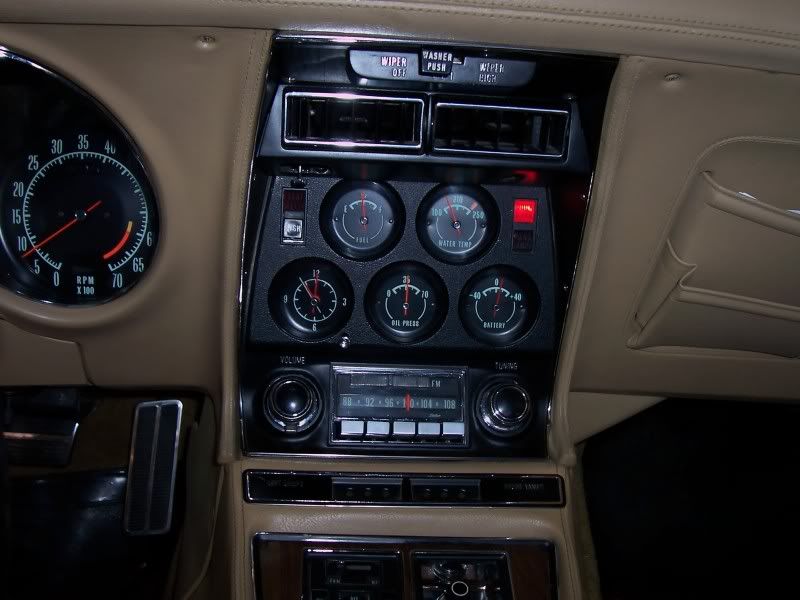
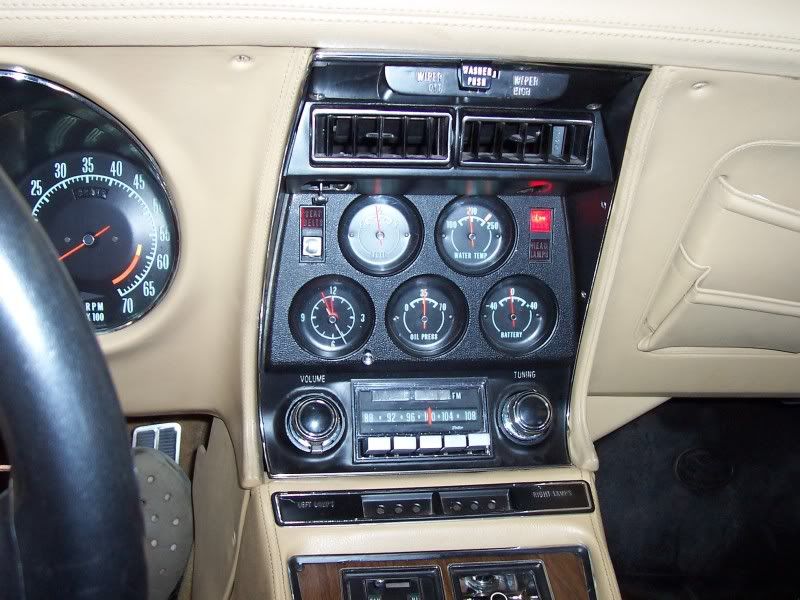
I had a request to reinstall the LL sender since I had changed the resistor on the back of the gauge to see if it would read more accurately. I started to explain by email the 102 ohms reading from the LL sender in boiling water would only make the gauge ........ blah blah blah ... crap........I really didn't want to remove the shielding and drain the coolant but I said what the hell it will probably take less time to just do it and take a pic than to try and type it out. So here is the car fully warmed up idling with a temp gun reading of 207 and the LL sender reinstalled.
Thread Starter
Race Director
Joined: May 2006
Posts: 16,528
Likes: 53
From: Dayton, Ohio
I measured the voltage at the back of the alternator at 14.1 , unplugged the alt and voltage measured 12.3 . There was no visible difference in the gauge reading. In fact in the pic above I have the alt unplugged so the gauge is operating off 12.3v.
Former Vendor
Joined: Aug 2006
Posts: 76,656
Likes: 1,851
From: Jeffersonville Indiana 812-288-7103
St. Jude Donor '08-'09-'10-'11-'12-'13-'14-'15
You are correct, the flux in voltage not make that much difference.
I'm going to dig up those pics of the test Pot on the gauge for you tonight if time permits.
Ernie

Racer

Joined: Nov 2009
Posts: 423
Likes: 7
From: Utah
I had a request to reinstall the LL sender since I had changed the resistor on the back of the gauge to see if it would read more accurately. I started to explain by email the 102 ohms reading from the LL sender in boiling water would only make the gauge ........ blah blah blah ... crap........I really didn't want to remove the shielding and drain the coolant but I said what the hell it will probably take less time to just do it and take a pic than to try and type it out. So here is the car fully warmed up idling with a temp gun reading of 207 and the LL sender reinstalled.
Thread Starter
Race Director
Joined: May 2006
Posts: 16,528
Likes: 53
From: Dayton, Ohio
Check your engine with a temp gun first , some small blocks with a stuck open thermostat will run about there.