




Brake Rotor Shims

Thread Starter
Pro


Joined: Jan 2010
Posts: 533
Likes: 18
From: Boca Raton Florida
 Brake Rotor Shims
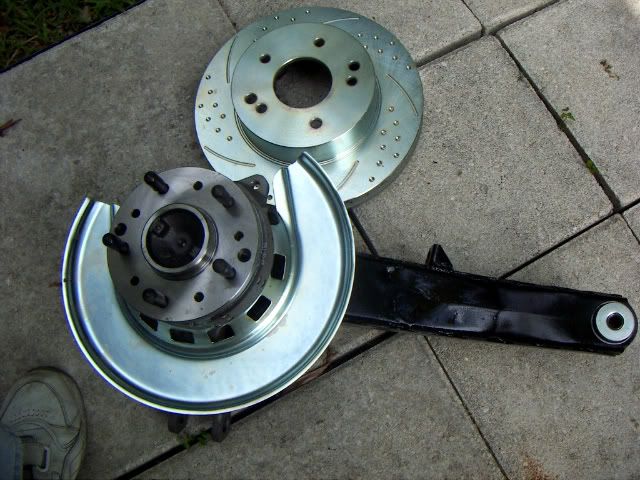
I thought I was done with the brakes. I purged the DOT 5 fluid and replaced everything in the system, including the brake pedal pad. Now I learn I need to check the rotor runout. I bought the dial indicator setup from Harbor Freight and I get it set up for the measurement, I watch the brake align video and I'm confused (more than usual). The video shows the dial indicator reading the runout at the edge of the rotor but the shims go on the hub. Are they telling me to measure the runout four inches from where the shim goes? When I take the reading at the edge, runout is .015 inch but on the edge of the hub (in picture below) it's only .005 inch.

I've never shimmed a rotor before but I'm thinking a .003 inch tapered shim would get the runout within spec. Of course, if the shim is intended to only give .003 inch at the edge, I'm not even close and even the .009 inch shim won't do the job. The video also tells me not to use more than one shim and never re-use a shim. At $20 a shim, this could get expensive real quick.
I've never shimmed a rotor before but I'm thinking a .003 inch tapered shim would get the runout within spec. Of course, if the shim is intended to only give .003 inch at the edge, I'm not even close and even the .009 inch shim won't do the job. The video also tells me not to use more than one shim and never re-use a shim. At $20 a shim, this could get expensive real quick.
Thread Starter
Pro
Joined: Jan 2010
Posts: 533
Likes: 18
From: Boca Raton Florida
Thanks Roger. I may just be over thinking this. I'm going to buy a shim and just assume they are tapered the amount indicated. I don't see how they could make them any other way. I know I need a .005 taper so I'll order the .006 shim.

Race Director

Joined: Mar 2006
Posts: 14,112
Likes: 28
From: Florida
I thought I was done with the brakes. I purged the DOT 5 fluid and replaced everything in the system, including the brake pedal pad. Now I learn I need to check the rotor runout. I bought the dial indicator setup from Harbor Freight and I get it set up for the measurement, I watch the brake align video and I'm confused (more than usual). The video shows the dial indicator reading the runout at the edge of the rotor but the shims go on the hub. Are they telling me to measure the runout four inches from where the shim goes? When I take the reading at the edge, runout is .015 inch but on the edge of the hub (in picture below) it's only .005 inch.
I've never shimmed a rotor before but I'm thinking a .003 inch tapered shim would get the runout within spec. Of course, if the shim is intended to only give .003 inch at the edge, I'm not even close and even the .009 inch shim won't do the job. The video also tells me not to use more than one shim and never re-use a shim. At $20 a shim, this could get expensive real quick.
I've never shimmed a rotor before but I'm thinking a .003 inch tapered shim would get the runout within spec. Of course, if the shim is intended to only give .003 inch at the edge, I'm not even close and even the .009 inch shim won't do the job. The video also tells me not to use more than one shim and never re-use a shim. At $20 a shim, this could get expensive real quick.
Make sure the brake lathe they have is in top condition and make sure they just take a minimum cut.
If doing the rears, almost the same thing, mount the new rotors to the hubs with the socket head bolts and find a shop that has an "on car lathe". It's pretty common these days since most newer cars have removeable rotors (with the same problems) and there are plenty of shops in Broward and Palm Beach with the lathes.

Race Director
Joined: May 2006
Posts: 16,528
Likes: 53
From: Dayton, Ohio

If doing the rears, almost the same thing, mount the new rotors to the hubs with the socket head bolts and find a shop that has an "on car lathe". It's pretty common these days since most newer cars have removeable rotors (with the same problems) and there are plenty of shops in Broward and Palm Beach with the lathes.
The front wheel drive rotor will not try to wobble side to side (due to the bearing design), there is no way you can keep the Corvette rotor in check when the wheel is off the ground unless you have dialed the bearings down to .000 end play.
Bob , IMO shimming is much safer and in "your"control and the tapered shims are the best because they support the entire hub face. I do wish the tapered shims were cheaper and came in smaller increments. I would love to find a supplier for tapered shim material so I could have the shims made.
Race Director
Joined: Mar 2006
Posts: 14,112
Likes: 28
From: Florida
Good luck with that,the operator will touch off , dial down and walk away,come back after the massive cut is done,dial down for a finish cut and walk away. Now your minus .030 and you go home and check the runout on the car , if its good GREAT but if its not your between a rock and a hard place.

If bearing play exists in the rears, no amount of shimming will cure runnout anyway.
The good machines are mounted in place of the rim, absolutely no rotor movement, same as having your wheels mounted, so bearing play doesn't come in to it at all anyway.
Thread Starter
Pro
Joined: Jan 2010
Posts: 533
Likes: 18
From: Boca Raton Florida
If all you are doing is the fronts, then mount the rotors to the hub permanently with flat head socket bolts and take it to a local place and have the rotor trued. Just like a regular rotor of that era. A lot better than goofing around with shims.
Make sure the brake lathe they have is in top condition and make sure they just take a minimum cut.
Make sure the brake lathe they have is in top condition and make sure they just take a minimum cut.
If doing the rears, almost the same thing, mount the new rotors to the hubs with the socket head bolts and find a shop that has an "on car lathe". It's pretty common these days since most newer cars have removeable rotors (with the same problems) and there are plenty of shops in Broward and Palm Beach with the lathes.
Corvette Stories
The Best of Corvette for Corvette Enthusiasts

Top 10 Most Explosive Corvettes Ever Made: Power-to-Weight Ratio Ranked!
Joe Kucinski
150 hp to 1,250 hp: Every Corvette Generation Compared by the Specs That Matter
Joe Kucinski
8 Coolest Corvette Pace Cars (and Replicas) of All Time
Verdad Gallardo
Top 10 Corvette Engines RANKED by Peak Torque (70+ Years of Muscle!)
Joe Kucinski
Corvette ZR1X Will Be Pacing the Indy 500, And Could Probably Race, Too!
Verdad Gallardo
Top 10 Corvettes Coming to Mecum Indy 2026!
Brett Foote
Top 10 C9 Corvette MUST-HAVES to Fix These C8 Generation Flaws!
Michael S. Palmer
10 Revolutionary 'Corvette Firsts' Most People Don't Know
Joe Kucinski
5 Reasons to Upgrade to an LS6-Powered Corvette; 5 Reasons to Stay LT2
Michael S. Palmer
Race Director
Joined: Mar 2006
Posts: 14,112
Likes: 28
From: Florida
I hear those stories all too often.
Supposedly vtech does good work, so nothing should be needed on your rears.
I'll try and get you a couple of names when I get a chance. A lot of places closed up around here in this economy.
Supposedly vtech does good work, so nothing should be needed on your rears.
I'll try and get you a couple of names when I get a chance. A lot of places closed up around here in this economy.




Team Owner


Joined: Jun 2000
Posts: 38,923
Likes: 1,481
From: Southbound
Cruise-In II Veteran


Thread Starter
Pro
Joined: Jan 2010
Posts: 533
Likes: 18
From: Boca Raton Florida
That may be a while. Car is disassembled at the moment. Would have to bring the on-car lathe to my house and I doubt anyone's gonna do that for what I'd expect to pay.
Mike, I have a couple of friends who do that for me. I'm a drunk who quit drinking six or seven years ago. Not an alcoholic 'cause I don't go to meetings.

Melting Slicks

Joined: Apr 2002
Posts: 2,337
Likes: 14
From: Norfolk VA
Why is rotor runout such a big issue with C3 corvettes? Yes I'm aware that these brakes will suck air and cause a soft pedal. I bought new rotors from napa three years ago when I installed them and did not check for runout and had a firm pedal then. I had my rear wheel bearings rebuilt by Bairs (had to buy spindles b/c bubba used the slip fit method for replacing wheel bearings) When my assemblies arrived, I put the same three year old rotors on the car and did not check for run out and I STILL have a firm pedal.
Race Director
Joined: May 2006
Posts: 16,528
Likes: 53
From: Dayton, Ohio
Why is rotor runout such a big issue with C3 corvettes? Yes I'm aware that these brakes will suck air and cause a soft pedal. I bought new rotors from napa three years ago when I installed them and did not check for runout and had a firm pedal then. I had my rear wheel bearings rebuilt by Bairs (had to buy spindles b/c bubba used the slip fit method for replacing wheel bearings) When my assemblies arrived, I put the same three year old rotors on the car and did not check for run out and I STILL have a firm pedal.
Thread Starter
Pro
Joined: Jan 2010
Posts: 533
Likes: 18
From: Boca Raton Florida
Sounds like three options.
1. Correct the runout with a shim.
2. Correct the runout with machinery.
3. Ignore the runout.
Option 3 is the cheapest but the risk is inadequate braking in an emergency (the whole reason for the post).
Option 2 is the most expensive and although it may correct the problem it is irrevrsible (once the rotor is cut I can't uncut it).
Option 1 looks like the middle of the road and I can fall back to either of the other two if it doesn't work.
1. Correct the runout with a shim.
2. Correct the runout with machinery.
3. Ignore the runout.
Option 3 is the cheapest but the risk is inadequate braking in an emergency (the whole reason for the post).
Option 2 is the most expensive and although it may correct the problem it is irrevrsible (once the rotor is cut I can't uncut it).
Option 1 looks like the middle of the road and I can fall back to either of the other two if it doesn't work.
Thread Starter
Pro
Joined: Jan 2010
Posts: 533
Likes: 18
From: Boca Raton Florida
I think I know what a brake lathe is for but as far as I know it isn't used to true up wheel hubs. Judging by the voids on the edges of my front hubs, GM didn't spend much time truing or inspecting them back in '71.
Let me take an extreme example. If my hub has 1 inch of runout and I mount a new rotor on that hub, the rotor will have even more than one inch of runout at its edge. The wheel rim runout will be even more than the rotor edge and the tire more than the rim. Cutting half the runout from one side of the front of the rotor and the other half from the other side on the back would fix the rotor runout and the brake caliper burping but won't address the wheel/tire or original hub runout problem.
If I put a one-inch tapered shim on the hub and then install the rotor, there should be no runout at the edge of the rotor, rim or tire.
I know the rim is going to have its own intrinsic runout -- I just don't want to add to it.
Seems to me using a brake lathe to fix this problem is like shaving tires when they wear unevenly because of a suspension alignment problem.
I started this thread because the .005" runout on my driver side hub translated into slightly more than .015 runout at the rotor edge. The video from a company that sells the shims shows the measurement taken at the edge of the rotor being used to select the shim taper. Made no sense to me so I was trying to find out if the video was wrong or there was some formula for selecting the hub shim based on the rotor edge runout. I now believe the video is wrong but it's more likely me who's wrong (as my wife frequently reminds me).
I'll let you know if the shims fix the problem.
Let me take an extreme example. If my hub has 1 inch of runout and I mount a new rotor on that hub, the rotor will have even more than one inch of runout at its edge. The wheel rim runout will be even more than the rotor edge and the tire more than the rim. Cutting half the runout from one side of the front of the rotor and the other half from the other side on the back would fix the rotor runout and the brake caliper burping but won't address the wheel/tire or original hub runout problem.
If I put a one-inch tapered shim on the hub and then install the rotor, there should be no runout at the edge of the rotor, rim or tire.
I know the rim is going to have its own intrinsic runout -- I just don't want to add to it.
Seems to me using a brake lathe to fix this problem is like shaving tires when they wear unevenly because of a suspension alignment problem.
I started this thread because the .005" runout on my driver side hub translated into slightly more than .015 runout at the rotor edge. The video from a company that sells the shims shows the measurement taken at the edge of the rotor being used to select the shim taper. Made no sense to me so I was trying to find out if the video was wrong or there was some formula for selecting the hub shim based on the rotor edge runout. I now believe the video is wrong but it's more likely me who's wrong (as my wife frequently reminds me).
I'll let you know if the shims fix the problem.
Race Director
Joined: May 2006
Posts: 16,528
Likes: 53
From: Dayton, Ohio


Race Director

Joined: Nov 2002
Posts: 12,142
Likes: 54
From: Taylor Michigan
