






View Poll Results: replace or rebuild caliper and what type seal
replace caliper with new O ring style seal


14
45.16%
replace caliper with old lip style seal


2
6.45%
rebuild with new O ring style seal


13
41.94%
rebuild with old lip style seal


2
6.45%
Voters: 31. You may not vote on this poll
Caliper repair options

Thread Starter
Melting Slicks


Joined: May 2003
Posts: 2,076
Likes: 281
From: Dyersburg TN
 Caliper repair options
Removing the caliper during a trailing arm replacement has caused a brake fluid leak. Now I need to decide rebuild or replace and what style seal (original or O-Ring). I rebuilt the fronts with original seals and did not enjoy the task. Looking for opinions.

Melting Slicks


Joined: Mar 2009
Posts: 3,126
Likes: 15
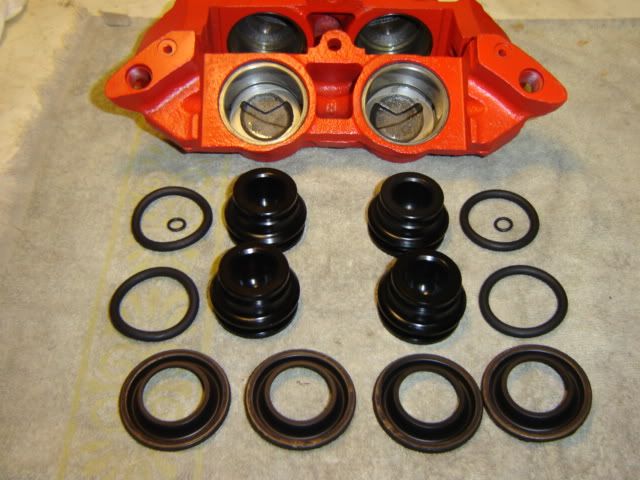
If your caliper is rebuildable the o-ring seals are alot easier to install. You will have to replace the pistons as the groove in them is different for the o-rings. You will not have the problem of getting the lip into the bore without damage. With the o-rings just lube them with brake fluid or brake assembly lube and push them in by hand. This is the contents of an o-ring rebuild kit for a front caliper. Good luck with it. mike...
Last edited by mds3013; Jan 30, 2011 at 09:38 AM.

Burning Brakes


Joined: Oct 2003
Posts: 1,090
Likes: 74
From: New Carlisle IN
Racer

Joined: Jan 2011
Posts: 266
Likes: 0
From: York Pa.
I think you got a bunch of good answers here..the o ring rebuild works great..the wilwood cost a ton more than rebuild and the lip seal style are cheap and like to leak..its how much money are you going to spend.

Team Owner

Joined: Mar 2002
Posts: 24,160
Likes: 78
Read this to find out how "superior" your o-rings are: http://www.duntovmotors.com/tech-calipers.php

Corvette Stories
The Best of Corvette for Corvette Enthusiasts

Top 10 Most Explosive Corvettes Ever Made: Power-to-Weight Ratio Ranked!
Joe Kucinski
150 hp to 1,250 hp: Every Corvette Generation Compared by the Specs That Matter
Joe Kucinski
8 Coolest Corvette Pace Cars (and Replicas) of All Time
Verdad Gallardo
Top 10 Corvette Engines RANKED by Peak Torque (70+ Years of Muscle!)
Joe Kucinski
Corvette ZR1X Will Be Pacing the Indy 500, And Could Probably Race, Too!
Verdad Gallardo
Top 10 Corvettes Coming to Mecum Indy 2026!
Brett Foote
Top 10 C9 Corvette MUST-HAVES to Fix These C8 Generation Flaws!
Michael S. Palmer
10 Revolutionary 'Corvette Firsts' Most People Don't Know
Joe Kucinski
5 Reasons to Upgrade to an LS6-Powered Corvette; 5 Reasons to Stay LT2
Michael S. Palmer
Pro

Joined: Jan 2002
Posts: 624
Likes: 0
From: Marietta ga
I can think of at least 3 specific times my lip seals have put my car and myself in danger over the past 10 years. They always feel great in the driveway and fail the minute I need them... It is on my list of items to fix this spring.
I remember sitting in on a panel of Corvette engineers, past and present, during the 2003 50th anniversary celebration in Bowling Green. When asked why C3 calipers were designed with seals that leak, they stumbled around for a bit and finally said in so many words that it was a design flaw.
"Floating piston-type brakes (like the C2-C3 brake system) must address piston knock-back resulting from deflections generated primarily from cornering forces." - http://www.duntovmotors.com/tech-calipers.php
I am very curious exactly how much deflection actually occurs in mild street driving in between the spindle and caliper mounting points.
I remember sitting in on a panel of Corvette engineers, past and present, during the 2003 50th anniversary celebration in Bowling Green. When asked why C3 calipers were designed with seals that leak, they stumbled around for a bit and finally said in so many words that it was a design flaw.
"Floating piston-type brakes (like the C2-C3 brake system) must address piston knock-back resulting from deflections generated primarily from cornering forces." - http://www.duntovmotors.com/tech-calipers.php
I am very curious exactly how much deflection actually occurs in mild street driving in between the spindle and caliper mounting points.

Race Director

Joined: Mar 2006
Posts: 14,112
Likes: 28
From: Florida
Lips seals work perfectly when used properly within the spec'd runout allowed by design. Part of that design is also maintenance flushing the system clean.
There is a reason only cup seals are used in EVERY master cylinder in the world.
Next best for calipers are "square cut" orings, that's what all the oem's use.
The round oring kits are a workaround that work very well for runout or seldom use.
Be aware that they become essentially "zero drag" calipers, but lack the 2 stage master cylinders the new designs use to achieve quick response.
There is a reason only cup seals are used in EVERY master cylinder in the world.
Next best for calipers are "square cut" orings, that's what all the oem's use.
The round oring kits are a workaround that work very well for runout or seldom use.
Be aware that they become essentially "zero drag" calipers, but lack the 2 stage master cylinders the new designs use to achieve quick response.
Pro
Joined: Jan 2002
Posts: 624
Likes: 0
From: Marietta ga
That past two times I have replaced calipers it was with the lip style versions. Maybe they were rebuilt improperly or maybe the cores used were out of spec. Either way, the calipers on the car at the time of purchase and two other sets have failed putting me in danger. It is really hard to get used to the idea of putting another set of death calipers back on the car.
Anyone know what kind of seals SSBC uses?
http://www.ssbrakes.com/commerce/det....cfm?nPID=8224
Anyone know what kind of seals SSBC uses?
http://www.ssbrakes.com/commerce/det....cfm?nPID=8224
Burning Brakes
Joined: Oct 2003
Posts: 1,090
Likes: 74
From: New Carlisle IN
I've had lip seals on my 73 and 76 for years with no problems except just after I bought my 76. I replaced the calipers with ss sleeved lip seals in 2006. The car had been sitting for a few years before I bought it and the seals had cracked.
The 73, my dad put ss lip seal calipers on when he built up the car back in 1994. We have never had a problem with stopping.
I autocross my cars during the summer, drive the 76 on the street occasionally, and they sit all winter (November-April). I try to go out there about once a month and step on the pedals to keep the seals lubricated. In fact, i should go out there and do so now, but with 20"+ of snow on the ground, it is kind of hard to get the the cars. I flush the system and put new fluid, Valvoline synthetic DOT 3-4, in there about every 2 years and bleed the system every year. Again, never once have I had a brake failure. In auto crossing, I can consistently lock up the tires.
Cory your problems might be exactly what you said, the bores are not good or the rebuild was poor. As long as these systems are maintained and used regularly, there should not be any problems. Go with a good quality rebuilder and that should be solved. I got my brakes from Muskegon brakes, but they just resell Lonestar rebuilt calipers. As for the SSBC calipers, i can't tell from the photos. You could call their number and ask.
The 73, my dad put ss lip seal calipers on when he built up the car back in 1994. We have never had a problem with stopping.
I autocross my cars during the summer, drive the 76 on the street occasionally, and they sit all winter (November-April). I try to go out there about once a month and step on the pedals to keep the seals lubricated. In fact, i should go out there and do so now, but with 20"+ of snow on the ground, it is kind of hard to get the the cars. I flush the system and put new fluid, Valvoline synthetic DOT 3-4, in there about every 2 years and bleed the system every year. Again, never once have I had a brake failure. In auto crossing, I can consistently lock up the tires.
Cory your problems might be exactly what you said, the bores are not good or the rebuild was poor. As long as these systems are maintained and used regularly, there should not be any problems. Go with a good quality rebuilder and that should be solved. I got my brakes from Muskegon brakes, but they just resell Lonestar rebuilt calipers. As for the SSBC calipers, i can't tell from the photos. You could call their number and ask.
Thread Starter
Melting Slicks
Joined: May 2003
Posts: 2,076
Likes: 281
From: Dyersburg TN
in the end
I decided to go with a rebuild caliper using lip style seals as they were available locally. While not a daily driver, it does get driven when the sun is out and nothing else is broken. Prehaps when daughter gets out of college I will go for a full set of performance calipers and rotors.
thanks to all
thanks to all

Le Mans Master

Joined: Apr 1999
Posts: 6,134
Likes: 46
From: Raleigh North Carolina
Read this to find out how "superior" your o-rings are: http://www.duntovmotors.com/tech-calipers.php

Race Director

Joined: Nov 2002
Posts: 12,142
Likes: 54
From: Taylor Michigan
Don't blame the system....most hydraulic brake problems are from moisture that is attracted from the brake fluid and forming rust, then cutting the seals no mater how expensive the parts are.........Brake fluid is clear, if it is brown or a orange tint there is probably rust involved...the first solution would be bleed them out unless one already leaks. It could still just be a matter of time before they do though.
