







SBC heads?

Le Mans Master


Joined: Jun 2004
Posts: 6,231
Likes: 65
From: Seattle WA
St. Jude Donor '14

Great price for sure - and the flow numbers are good if not remarkable. Always nice to see a set in person 
I don't see anything about made in the USA, which is often a misnomer anyway as it just means that 51% or more of the value of the part is created in the US...
I don't see anything about made in the USA, which is often a misnomer anyway as it just means that 51% or more of the value of the part is created in the US...
Le Mans Master
Joined: Jun 2004
Posts: 6,231
Likes: 65
From: Seattle WA
St. Jude Donor '14
Generally, DDA is around 5-10% optimistic on torque across the board.
Looks like a sweet build! Do you have the heads in-hand?
Le Mans Master

Joined: Mar 2008
Posts: 5,948
Likes: 72
From: Oxford MA-----You just lost the game!!!!
Scott

Advanced

Joined: Jan 2012
Posts: 83
Likes: 8
From: Chicxulub Yucatán
As for your conclusions of STH + OE, I respectfully disagree based on my own observations using engine and chassis dyno verification of numerous engine builds. However, in the spirit of full disclosure, EACH of these builds and eventual tests were conducted in one specific region of the USA. For that specific area, the STH + OE were nearly exact as long as good flow data and good compression ratio data were on.
Since I manually calculate compression ratio based on measured parameters and because I do flow-bench test cylinders heads, when I use them, I get very accurate results.
While I do have these heads in-hand, I haven't yet spent any time on them. The only thing that I've done with them is pulled one out of the box and given it a look-see. As far as such things go, they look *very good* for the price. I'm impressed by the quality of the ports.
I've heard (here and elsewhere) that these are basically "old style" Pro1 heads. The last 383 that I built used Pro1 heads. That engine was very similar to the one I'm currently building, with a few differences. The previous engine used a mechanical roller camshaft with significantly different specs, but I had an "old" but NIB Weiand "Stealth" dual plane intake, so I used it. I would *not* use that intake with that combination today. The manifold, while great for its purpose, wasn't "enough" for that particular combination. However, DD2K did accurately predict the output to within ± 1. The "real" dyno that I used was a SuperFlow 901. It wasn't mine, but I probably dyno'd close to 30 engines on it over the years. Whether it was "off by the same amount as" DD2K, I can't absolutely say, but in a few cases, I did chassis dyno the combination after engine dynoing them, too. Of course, the "estimated" drivetrain losses were "representative" of what one would expect based on the comparison of the engine dyno results and the chassis dyno results.
So, whether or not DD2K is really "on" or not in my combinations/builds is difficult to say with any real certainty, but my findings suggest that it is at least a good representation of what to expect from a "design" in terms of comparing parts before the build.
As a note, I also run the "iterator" feature of the program, sometimes letting it run for days on a quad-core machine. I usually use it to "try" to find a "better" camshaft for the specific objectives of the particular combination. What I usually find is that some specific number may be slightly better, but it is well within the scope of what I consider to be the range-of-error for the program...and, that the "better" numbers aren't good enough to warrant a "custom" cam grind price compared to what Comp has "off-the-shelf." I'm thorough impressed with Comp Cams' designs. You really can't get much better without a LOT more money for testing the actual combination.
The new engine will have an air-gap dual plane, but a HR camshaft that is more directly tailored to low-end torque and the smaller port heads. The previous engine used the 200cc intake ports.
Even if the numbers are somewhat optimistic, the shape of the curve should be fairly reasonable and significantly over 400 foot pounds for any RPM off-idle. The actual numbers don't matter much to a street-driven car...you can't use much of it on the street anyway!

MxB
Last edited by Mexican Bob; Jan 8, 2012 at 09:14 AM.
Le Mans Master
Joined: Jun 2004
Posts: 6,231
Likes: 65
From: Seattle WA
St. Jude Donor '14
As for your conclusions of STH + OE, I respectfully disagree based on my own observations using engine and chassis dyno verification of numerous engine builds. However, in the spirit of full disclosure, EACH of these builds and eventual tests were conducted in one specific region of the USA. For that specific area, the STH + OE were nearly exact as long as good flow data and good compression ratio data were on.
I've also calibrated against quite a few builds - if your comparisons are to engine dynos running small tube headers and open exhaust then I'd expect them to be close. But I'm surprised that you're seeing such a strong correlation between DD and chassis dyno results given mufflers, accessories, etc. Completely agree that it's all about good data - especially flow data - and that DD is a surprisingly good design tool!

Corvette Stories
The Best of Corvette for Corvette Enthusiasts

5 Best & 5 Worst Corvette Daily Drivers
Joe Kucinski
The Headlights of Every Corvette Generation Explained
Joe Kucinski
5 Best & 5 Most Overrated Corvette Track Packages of All Time!
Joe Kucinski
Every 2027 Corvette Engine Explained
Joe Kucinski
Designer Imagines A Corvette That Looks More Like a Corvette Than the Corvette
Verdad Gallardo
10 Ugly Corvettes That We Still Kinda Love
Joe Kucinski
Top 10 Most Expensive Corvettes Ever Sold on Bring A Trailer
Brett Foote
10 Things Every Corvette Owner Needs (2026 Edition)
Michael S. Palmer
8 Most "Only Corvette Owners Understand" Quirks and Problems
Pouria Savadkouei
Melting Slicks

Joined: Apr 1999
Posts: 2,010
Likes: 3
From: Moon Twp. PA USA
I use TF 23* 64cc heads with 195cc intake runner. I used these on my previous, lightly moded 350, and they are now on my 383 with a CC XE274 cam.
I like these heads as far as price vs performance.
I like these heads as far as price vs performance.

Race Director


Joined: Apr 2000
Posts: 17,676
Likes: 201
From: Who says "Nothing is impossible" ? I've been doing nothing for years.
If you haven't bought the heads I would consider maybe a little bigger than 180cc for the member building a 383ci ?, just trying to help.
Last edited by MotorHead; Jan 8, 2012 at 02:36 PM.
Le Mans Master
Joined: Mar 2008
Posts: 5,948
Likes: 72
From: Oxford MA-----You just lost the game!!!!
Advanced
Joined: Jan 2012
Posts: 83
Likes: 8
From: Chicxulub Yucatán
Remember that our OP is thinking about doing a 355...reusing his factory crank/rods and buying new pistons. The smaller ports will do much better if he elects this direction. However, I've built 454 CID "street" SBCs using the AFR 195s (back when the economy wasn't a POS)...and they were MAD CRAZY (is that the popular phrasing?) in terms of performance. I made over 600 HP on such a combination (albeit on race gas).
One year I made over 500 HP on "pump gas" (an outright lie from the magazine publisher who bought VP "premium unleaded" in drums for the contest; real pump fuel is--at best--total crap) from a "small block Chevy" using a "hydraulic flat tappet" cam. (You don't really want to know what I did to the "hydraulic" lifters, right?)
I *strongly* recommend using 180 to (absolute maximum 200) CC heads for any street car. IF you're running power accessories, brakes, AC, steering, etc., DEFINITELY "error" on the side of caution and go SMALLER an not larger. Bigger is rarely better in a streetable combination.
MxB
Race Director
Joined: Apr 2000
Posts: 17,676
Likes: 201
From: Who says "Nothing is impossible" ? I've been doing nothing for years.
For his 350ci, 180's will do especially on a budget but for a 383ci I personally wouldn't put anything smaller than 210 or the 195cc Eliminators. I am in the bigger is better camp especially when it comes to the big inch small blocks.
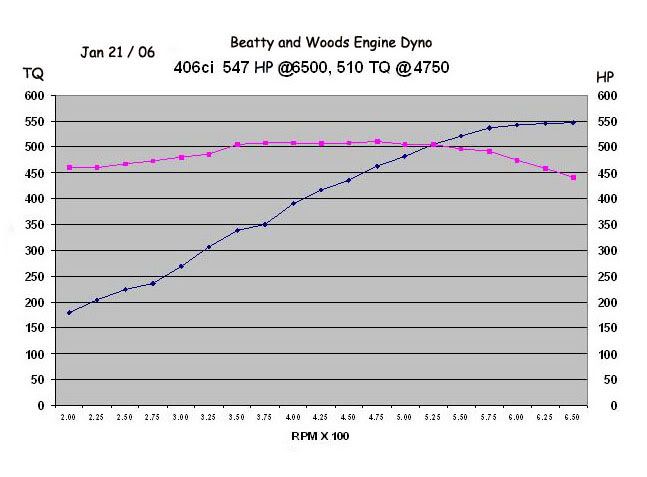
I built the last two motors for my Vette, perfectly streetable, my grandmother could drive them if she could shift. First was a 550hp / 510tq 406ci with Vic Jr heads cc'ed to 219cc's and the second is what I have now a 600+hp 427ci with AFR 227 eliminators.
The point I am trying to make is you are not gaining any tq by using smaller heads, you are just loosing power which puts the tq curve over the HP curve, and you think you have a torque monster when in fact it is a motor starving for the correct parts and once they are in there you get the same or more tq and the HP goes up, you are making more power now with a correctly matched component motor, I know I'll die before this sinks in to most.
406ci with 450 tq @ 2000RPM ( plotted water brake engine dyno )
And my 427ci, this was a chassis dyno prinout the one and only pull I made to get a baseline
I have fixed a few things like the lag in torque midway, took out some restrictive baffles I put in because my neighbor is an arsehole and done some other tuning anyway he punched this one at 2000RPM and got over 300RWTQ @ 1900 RPM so I know a few things about the sbc

Might as well throw in the videos for the 2 or 3 members that haven't seen them
406ci
427ci
I built the last two motors for my Vette, perfectly streetable, my grandmother could drive them if she could shift. First was a 550hp / 510tq 406ci with Vic Jr heads cc'ed to 219cc's and the second is what I have now a 600+hp 427ci with AFR 227 eliminators.
The point I am trying to make is you are not gaining any tq by using smaller heads, you are just loosing power which puts the tq curve over the HP curve, and you think you have a torque monster when in fact it is a motor starving for the correct parts and once they are in there you get the same or more tq and the HP goes up, you are making more power now with a correctly matched component motor, I know I'll die before this sinks in to most.
406ci with 450 tq @ 2000RPM ( plotted water brake engine dyno )
And my 427ci, this was a chassis dyno prinout the one and only pull I made to get a baseline
I have fixed a few things like the lag in torque midway, took out some restrictive baffles I put in because my neighbor is an arsehole and done some other tuning anyway he punched this one at 2000RPM and got over 300RWTQ @ 1900 RPM so I know a few things about the sbc
Might as well throw in the videos for the 2 or 3 members that haven't seen them
406ci
427ci
Last edited by MotorHead; Jan 8, 2012 at 05:14 PM.
Advanced
Joined: Jan 2012
Posts: 83
Likes: 8
From: Chicxulub Yucatán
The absolute best thing that you can do for a C3 to make it feel like a true hotrod is to punch it out and give it a decent camshaft where the torque from about 1200 to 4500 is "kick-you-straight-in-the-nuts-bad-to-the-bone-awesome."
There isn't much else to it that matters. You can saddle it with a bad intake and restrict it to death (too small carb) and still have a torque monster that just doesn't rev for crap.
The (as far as I can tell) *real deal* for a C3 is to build an engine that focuses as squarely on making as much low-end torque as possible. These are HEAVY cars. Combined with the added accessories and conveniences of luxury we've come to expect from them, you'll want an engine that strongly dominates the below-6000 RPM as much as is feasible. If you shoot for a "max RPM" of 5500, and do EVERYTHING very well between off-idle and that top range, you're going to LOVE your car. It will feel good. It will burn up the tires every time that you step on it and it will be the most fun that you can have with your clothes on...well, except maybe if all of the Dallas Cowboys cheerleaders rush you at once and tickle you senseless.... (or if Luke Perry does if you happen to be configured the other way...none of my business, peace to all.)
What you really want to do for a street machine is keep it cool, make good power on street fuels and to enjoy it without having to MESS with it. For a lot of folks, that's going to include running the A/C in 120* in Phoenix or driving to the grocery at -9* in Cedar Rapids Iowa (idiots out wandering around? j/k)....
Here's a special, top-secret, insiders-only, privileged, MEMBERS ONLY bulletin. You can't make a C3 incredibly streetable using factory combinations with aftermarket bolt-ons that stays cool, makes more power and is more reliable than the more current C4, C5, C6 machines. This is (somebody told me, but I forgot who) evolution in progress. Of course, there are guys (and gals!) out there running 900+ HP C3 "street machines" who would argue my point to the death. What I'm trying to say is that if you want to keep your "design" to within about 350-380 HP, you can easily use "factory" (as) designed pieces and love them. As soon as you start to even mention power output above 350...and then some, you're going to end up with a "custom build" that costs more money and is suggestive of less bang-for-the-buck (in terms of support, convenience and "works-with-all-factory-accessories...") than whatever I might offer as a suggestion.
Of course, there is no real value listening to an old fool...
MxB
Advanced
Joined: Jan 2012
Posts: 83
Likes: 8
From: Chicxulub Yucatán
The not-so-subtle note is that I rarely run accessories other than belt-drive water-pump and alternator. On the C3, I've added a Rare Parts' "Power Steering To Manual Steering Conversion Kit," which consists of a nifty billet aluminum piece that replaces the C3's power steering valving...

On my engine, I'll be running a single groove crank pulley and a single groove water-pump pulley with an alternator only. The A/C isn't going back in and neither are any of the other parts related to the niceties and conveniences of a streeter.
Also, in the spirit of full disclosure, this is a father-son project. My son is going to be 18 in June. I want him to at least learn a few things about what goes on inside my head when I start a project. To him, it's just a cool looking car. To me, it was the unobtainable fantasy car ala Mark Hamil's character in Corvette Summer at the opening scene where the Stingray emblem falls from the sky.
This car isn't "for me" in any normal sense, but it is for me in terms of some kind of accomplishment sense. In my life, I've made plenty-enough money to buy a 'vette if I would have wanted one. The last time that I nearly bought one for myself was about 20 years ago, I found a black '69 L46 car with an engine build that duplicated the 1970 LT1...with a four speed. (Talk about a fun car!) It was being offered at $6K (yeah, dollars) and I only had about 4K...the guy wouldn't budge...and I *tried*.

Side note: My favorite year of all time (for body style, after the '63) was the '69. They were just plain sexy IMO...ZL1 or any other engine...
MxB

Race Director

Joined: Jan 2000
Posts: 13,025
Likes: 2,266
From: Corsicana, Tx
2020 C2 of the Year - Modified Winner
2020 Corvette of the Year (performance mods)
C2 of Year Winner (performance mods) 2019
2017 C2 of Year Finalist
The point I am trying to make is you are not gaining any tq by using smaller heads, you are just loosing power which puts the tq curve over the HP curve, and you think you have a torque monster when in fact it is a motor starving for the correct parts and once they are in there you get the same or more tq and the HP goes up, you are making more power now with a correctly matched component motor, I know I'll die before this sinks in to most.
On some of the 555" I've done over the last few years...I notice that with the exact same carb/intake and compression and who knows how many cams...that the 365-377cc heads have consistently put out 20-30 more lb ft than say some 315-335 cc heads at the same RPM and also made more HP that continues to hang on as high as you want to rev it. They don't run out of breath...yet they run just fine at low speeds too. Once the tires are smoking..just how much more low end do you need?
Now don't get me wrong..it's not always a bigger is better deal....I actually love to drive a low rpm TQ monster with highway gears and a tight converter. It feels great! 383's need some airflow if you want them to be more than a tow truck motor. I've seen folks put a 383 shortblock under their old stock heads and be disappointed because it didn't run much stronger. Yep...it makes a few more lb ft because of the cubes...but it just runs out of air earlier and doesn't walk away from the old 350 like they hoped.
But when you stomp it beside the other guy with that other combo...he will walk away from you like you're tied to a tree!
Build the motor to make some power...and then tune it for driveabilty.
JIM
Le Mans Master
Joined: Jun 2004
Posts: 6,231
Likes: 65
From: Seattle WA
St. Jude Donor '14
The big runner vs. small runner debate is always an interesting and lively one. 
Runner size is only one dimension to the capabilities of a head; ultimately flow determines the power the head can make. A good rule of thumb is to buy the smallest runner size that delivers the flow required to make your power targets. This changes a lot based on the quality of the head.
A good example for the 200cc Dart heads on this thread are intake flow of 261cfm @.500 (as listed here; I don't know the source) as compared to a set of AFR 180's Streets delivering 260 CFM @.500 lift....there's the price difference right there. It reduction of the cross-sectional area of the ports while delivering the same flow will have very real benefits on the street.
Runner size is only one dimension to the capabilities of a head; ultimately flow determines the power the head can make. A good rule of thumb is to buy the smallest runner size that delivers the flow required to make your power targets. This changes a lot based on the quality of the head.
A good example for the 200cc Dart heads on this thread are intake flow of 261cfm @.500 (as listed here; I don't know the source) as compared to a set of AFR 180's Streets delivering 260 CFM @.500 lift....there's the price difference right there. It reduction of the cross-sectional area of the ports while delivering the same flow will have very real benefits on the street.
Last edited by billla; Jan 9, 2012 at 11:43 AM.
Advanced
Joined: Jan 2012
Posts: 83
Likes: 8
From: Chicxulub Yucatán
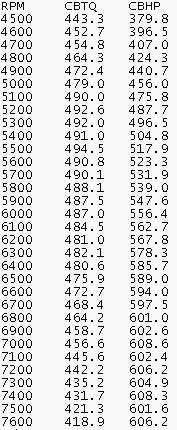
...not bad for a flat-top, 10.2:1 "premium unleaded only" solution.
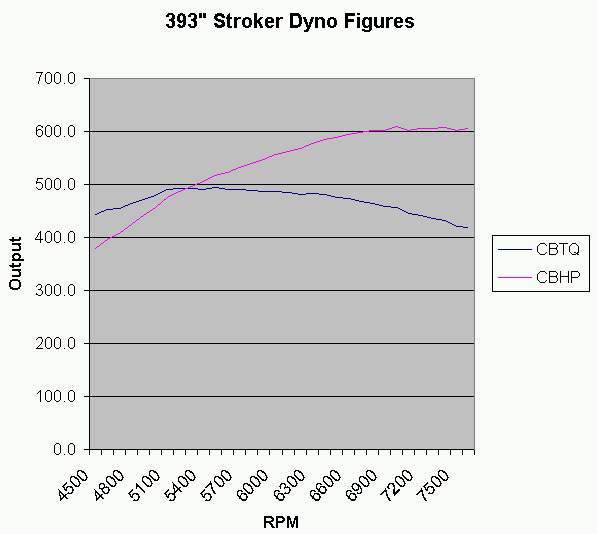
As you can see, I didn't make any where close to 510 TQ from 13 fewer cubic inches...but it sure made a LOT more than 547 HP from those fewer inches...so, what exactly does that prove, if anything?
MxB

Thread Starter
Instructor


Joined: Dec 2007
Posts: 246
Likes: 2
From: colonia New jeresy
Reading carefully, there are a lot of questions here beyond a random cylinder head recommendation
First, do you have a budget for the build? Budget drives more decisions than any other factor...and without a budget, design is impossible as the choices are virtually unlimited.
Next, is originality important? If it is...I'd highly suggest setting aside your original engine and starting from scratch. The cost increment is pretty small in the end, as you'll learn as you start working through the build.
400 HP at the crank is a very reasonable target and very nicely balanced for a C3. It's straightforward for a 355, and almost the minimum power even a mild 383 will make
The details from here are completely dependent on your budget and how you intend to use the engine. You note wanting to reuse parts - but you may find in many cases that the cost of machine work is higher than the cost of new parts, so careful planning is required.
You also note wanting a roller cam - definitely a great choice, but not required at the power level you're seeking, and not an inexpensive choice to retrofit to an older GEN I block.
More information on the budget and usage will help tune the guidance - lots of smart builder here and I'm sure the discussion will get "lively"
First, do you have a budget for the build? Budget drives more decisions than any other factor...and without a budget, design is impossible as the choices are virtually unlimited.
Next, is originality important? If it is...I'd highly suggest setting aside your original engine and starting from scratch. The cost increment is pretty small in the end, as you'll learn as you start working through the build.
400 HP at the crank is a very reasonable target and very nicely balanced for a C3. It's straightforward for a 355, and almost the minimum power even a mild 383 will make
The details from here are completely dependent on your budget and how you intend to use the engine. You note wanting to reuse parts - but you may find in many cases that the cost of machine work is higher than the cost of new parts, so careful planning is required.
You also note wanting a roller cam - definitely a great choice, but not required at the power level you're seeking, and not an inexpensive choice to retrofit to an older GEN I block.
More information on the budget and usage will help tune the guidance - lots of smart builder here and I'm sure the discussion will get "lively"
