






Start and run engine without body.

Thread Starter
Pro

Joined: Nov 2011
Posts: 517
Likes: 20
From: Scroggins Tx
 Start and run engine without body.
My body is off and I have about finished everything on the frame and motor side. Before I put the body back on I would like to start and run the motor and rebuilt transmission, check for leaks and in general see if they work. I know which wires to connect, but wondering about hooking up the radiator. Could I just take the radiator mount from the body and bolt it to the frame and hook it up? What other things should I look for?
Right now I am having a problem with oil getting to the upper end and if this thing is going to crater I would rather it be with the body off.
Thanks Dave.
Right now I am having a problem with oil getting to the upper end and if this thing is going to crater I would rather it be with the body off.
Thanks Dave.

Race Director


Joined: Nov 2002
Posts: 12,142
Likes: 54
From: Taylor Michigan
There is no mentality in a engine. It doesn't know a frame from a engine stand...it merely performs where ever its located...wont hurt a thing,,,if it makes you feel better hook up the radiator and give it a thorough checkout.....

Racer

Joined: Sep 2010
Posts: 259
Likes: 1
From: Mt Airy, NC
I'm not an expert but I think I've read that you have to have the correct tool to pre-oil with or a modified distributor. If your just spinning the oil pump shaft I'm not sure you will get oil to everything. You may be doing it right, I'm just throwing it out there for thought.
Never mind I just read the pre-oil thread.
Never mind I just read the pre-oil thread.
Last edited by GT's 78; Apr 1, 2012 at 08:33 PM.

Instructor
Joined: Jun 2006
Posts: 123
Likes: 0
From: Westminster MD
[QUOTE=oledave60;1580441396]... I know which wires to connect, but wondering about hooking up the radiator. Could I just take the radiator mount from the body and bolt it to the frame and hook it up? .../QUOTE]
Yes, I have the front clip off, so to run the engine I have the radiator core support bolted to the frame and the radiator connected as normal, no problem.
Yes, I have the front clip off, so to run the engine I have the radiator core support bolted to the frame and the radiator connected as normal, no problem.

Safety Car


Joined: Oct 2007
Posts: 3,729
Likes: 267
From: Austin Texas
Corvette of the Year Winner 2017
2016 C3 of Year Finalist
just connect up some gauges, and a couple wires.
easy to do...

this picture shows the wire I ran to hold up the support and radiator.
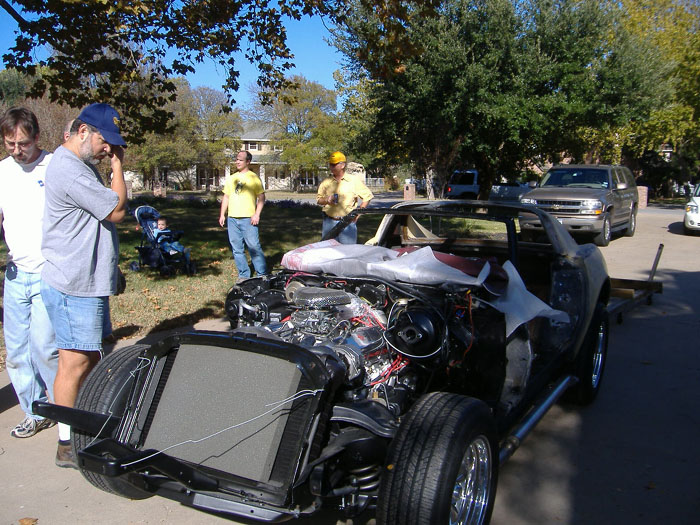
easy to do...
this picture shows the wire I ran to hold up the support and radiator.
Last edited by 69Vett; Apr 1, 2012 at 10:06 PM.

Pro
Joined: Jun 2006
Posts: 575
Likes: 3
From: Tampa / Ft. Myers FL
Here's a link to the thread where I asked a similar question:
http://forums.corvetteforum.com/c3-t...-body-off.html
http://forums.corvetteforum.com/c3-t...-body-off.html

Burning Brakes


Joined: Feb 2002
Posts: 752
Likes: 31
From: Melbourne Australia
Simple starter wiring
Hi, This is what I used on my 69 as a temporary wiring setup. It's a points ignition system and needs the ballast in place of the resistance wire in the loom. You can get a ballast resistor at most auto parts stores.

Joe
http://i130.photobucket.com/albums/p...ane/wiring.jpg
Joe
http://i130.photobucket.com/albums/p...ane/wiring.jpg
Corvette Stories
The Best of Corvette for Corvette Enthusiasts

150 hp to 1,250 hp: Every Corvette Generation Compared by the Specs That Matter
Joe Kucinski
8 Coolest Corvette Pace Cars (and Replicas) of All Time
Verdad Gallardo
Top 10 Corvette Engines RANKED by Peak Torque (70+ Years of Muscle!)
Joe Kucinski
Corvette ZR1X Will Be Pacing the Indy 500, And Could Probably Race, Too!
Verdad Gallardo
Top 10 Corvettes Coming to Mecum Indy 2026!
Brett Foote
Top 10 C9 Corvette MUST-HAVES to Fix These C8 Generation Flaws!
Michael S. Palmer
10 Revolutionary 'Corvette Firsts' Most People Don't Know
Joe Kucinski
5 Reasons to Upgrade to an LS6-Powered Corvette; 5 Reasons to Stay LT2
Michael S. Palmer
2027 Corvette vs The World: Every C8 vs Its Closest Competitor
Joe Kucinski
Le Mans Master

Joined: Sep 2004
Posts: 5,116
Likes: 5
From: Livonia MI
I see no reason you cant do this, but I'd for sure hook up some sort of radiator. Surely, if you watch any of the weekend car programs, you'll see them using an engine test stand, simulating exactly what you're talking about.

Melting Slicks


Joined: Oct 2002
Posts: 2,317
Likes: 111
From: St Louis MO
If you have an engine driven fan, make sure to use a radiator shroud to pull more air. Otherwise, the angle between the fan and radiator will cause a loss of effectiveness of pulling air - it will probably overheat after awhile.

Le Mans Master
Joined: Jul 2006
Posts: 8,117
Likes: 104
From: charlotte north carolina
if it's a newly rebuilt engine, it's going to get hot quickly. as mentioned, use a radiator shroud with the fan, or a garden hose that you can use to spray the radiator. a floor fan won't pass air thru the radiator well enough to cool the engine. also make sure you have the timing set and the vaccum advance attached-both will make the engine run a little cooler.
