



tire inflation?

Thread Starter
Team Owner


Joined: Apr 1999
Posts: 21,953
Likes: 1,445
From: Reno Nevada
2024 C3 of the Year Finalist- Modified

Le Mans Master


Joined: Oct 2007
Posts: 7,445
Likes: 971
From: Tennessee/Rhode Island

I have run close to maximum tire pressure for many years now after I attended a Skip barber racing driving school in the early 90's when they were using Michelin tires. The Michelin tire rep who spoke to the group one day said that all tire manufacturers make their tires to run at much higher pressures (the tire pressure designation) but the car manufacturers specify tire pressure in the door jam that is a compromise between ride, handling, and wear. According to Michelin, the pressure you may want to run for maximum grip, handling and wear is the most that you the driver can tolerate (ride quality) below the specified tires pressure designation on the sidewall, not the car door jam. Running maximum tire pressure does necessitate mandatory tire rotation for even wear though. My first set of tires that I tried running high pressures on were a 1992 Chevy Lumina with Goodyear Eagle GT + 4's that were Z rated (notorious for poor wear). At 50,000 miles on those tire, the tires were worn on the wear bars and the goodyear service center that serviced the car (company car), told me he had never seen that tire go 50,000 miles - lots of tire pressure!!
Last edited by jb78L-82; May 17, 2012 at 07:53 AM.
Melting Slicks

Joined: Aug 2010
Posts: 2,487
Likes: 10
From: Palm Beach Florida
St. Jude Donor '12
How many folks on here are running different size tires on thier c3? I don't believe there are many, But I have been wrong before.
Last edited by daanbc; May 17, 2012 at 09:35 AM.

Le Mans Master


Joined: Apr 2007
Posts: 7,353
Likes: 72
From: Graceland in a Not Correctly Restored Stingray
And yet IMOE the Michelin engineers for the ProSeries (who regularly compared data with that of mine) seemed baffled that their relatively high recommended cold pressures didn't often result in optimum temps for their racing slicks purpose-built for those specific Reynard chassis. IIRC, pretty much all of us started a few pounds below their pet numbers to actually optimize the contact patches once the tires came up to temp. While it might indeed work out in some instances, strictly going by max cold pressures as stamped on the sidewall simply does not, can not guarantee proper inflation in every case, any more so than strictly adhering to door jamb numbers.

Le Mans Master


Joined: Jun 2004
Posts: 6,231
Likes: 65
From: Seattle WA
St. Jude Donor '14
Using max cold inflation is virtually always going to result in a tire that "crowns" at operating temperature, giving a reduced contact patch.
That said, with a few exceptions my autocross testing across many different vehicles typically indicated a pressure of about 3-5 PSI higher than specified by the vehicle manufacturer. If you don't think a PSI or 2 makes a difference, then it's time for you to head to a local autocross!
If you're going to run this reduced patch,then certainly regular rotation is key - the fronts will be OK due to the roll to the edges, but the rears will wear in the center. But far better to optimize the contact patch by investing a little time and money - as TSW noted, the cheaper IR meters are good enough for a street car, but the additional cash for the probe type is well-spent. Mine gets borrowed constantly
If you're worried about tire wear and ride comfort, might I suggest a nice Prius?
That said, with a few exceptions my autocross testing across many different vehicles typically indicated a pressure of about 3-5 PSI higher than specified by the vehicle manufacturer. If you don't think a PSI or 2 makes a difference, then it's time for you to head to a local autocross!
If you're going to run this reduced patch,then certainly regular rotation is key - the fronts will be OK due to the roll to the edges, but the rears will wear in the center. But far better to optimize the contact patch by investing a little time and money - as TSW noted, the cheaper IR meters are good enough for a street car, but the additional cash for the probe type is well-spent. Mine gets borrowed constantly
If you're worried about tire wear and ride comfort, might I suggest a nice Prius?
Le Mans Master
Joined: Oct 2007
Posts: 7,445
Likes: 971
From: Tennessee/Rhode Island
I did not mean to imply that you should run the max pressure on the sidewall but a pressure something less than the max pressure and the factory recommendation. I have been running much higher pressures for 20 years on cars of all types including my C3 with excellent results on the street. Granted finding the right pressure is different for every vehicle and involves a little bit of an art and trial and error. For example, I run about 36-38 PSI on my C3's 255/45/50/17 ZRs, 40 PSI out of 44 Max on the 1994 Mustang GT, 40 out of 44 max on the 245/55/18's on my 300 etc. Running significantly higher pressures than the factory recommendation will drastically increase tire life, improve handling and steering response, require tire rotation, slight ride quality degradation and could result in some uneven tire wear although that has never been a significant problem with my cars over the years. The aforementioned early Goodyear GT+4's Z rated achieved incredible mileage (50,000 miles) but did have some crowning running 44 PSI max pressure. My experience in general has been that to achieve significant results on the street you will need to increase the tire pressure significantly-anywhere from 8-10 PSI if the factory recommendation is 28 PSI, to 4-6 PSI, at least, if the factory recommendation is 32 PSI, maybe 5 PSI in general again, if the factory recommendation is 35 PSI. Where tires are concerned, there is no free ride-everything is a compromise. There are big improvements by using the best tires for our C3's and significant improvements from adjusting tire pressure.
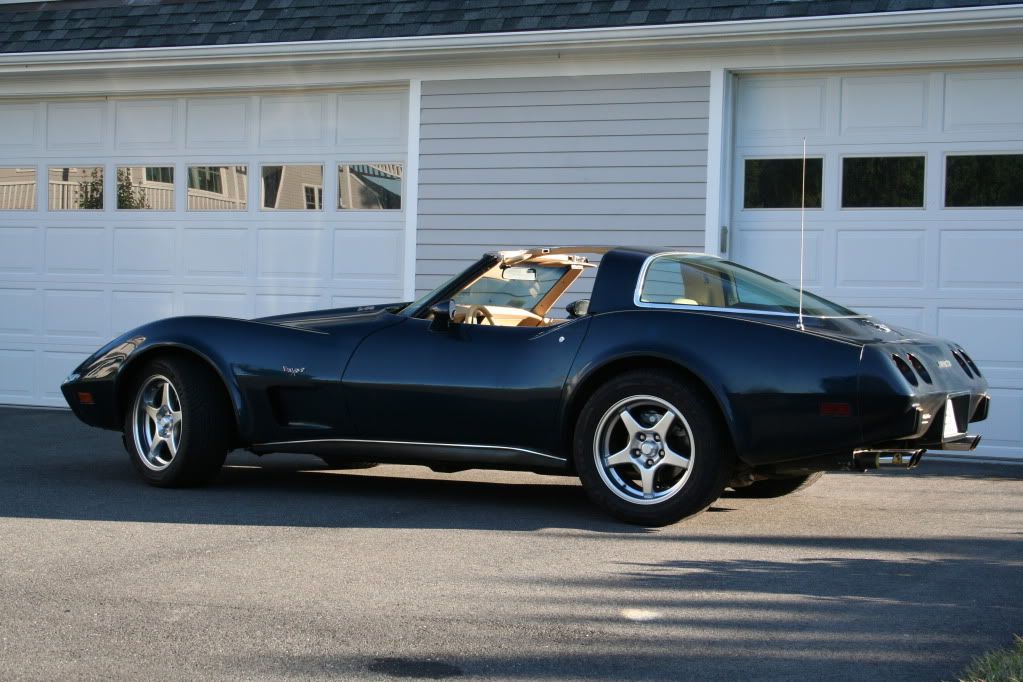
I do run different tires on my C3 and it was one of the biggest factors in improving the overall drivability of the car:
255/45/17 ZR front/255/50/17 ZR rear:
I do run different tires on my C3 and it was one of the biggest factors in improving the overall drivability of the car:
255/45/17 ZR front/255/50/17 ZR rear:
Last edited by jb78L-82; May 17, 2012 at 05:06 PM.
Le Mans Master
Joined: Jun 2004
Posts: 6,231
Likes: 65
From: Seattle WA
St. Jude Donor '14
My observation is still that there's no "art" or trial and error to it, specifically in terms of maximizing the contact patch. SOTP means nothing here, no more than timing an engine by ear.
Corvette Stories
The Best of Corvette for Corvette Enthusiasts

How Much Horsepower Every Corvette Engine "LOST" in 1972
Joe Kucinski
Top 10 DOs and DON'Ts for Protecting Your Convertible Top!
Michael S. Palmer
Top 10 Most Explosive Corvettes Ever Made: Power-to-Weight Ratio Ranked!
Joe Kucinski
150 hp to 1,250 hp: Every Corvette Generation Compared by the Specs That Matter
Joe Kucinski
8 Coolest Corvette Pace Cars (and Replicas) of All Time
Verdad Gallardo
Top 10 Corvette Engines RANKED by Peak Torque (70+ Years of Muscle!)
Joe Kucinski
Corvette ZR1X Will Be Pacing the Indy 500, And Could Probably Race, Too!
Verdad Gallardo
Top 10 Corvettes Coming to Mecum Indy 2026!
Brett Foote
Top 10 C9 Corvette MUST-HAVES to Fix These C8 Generation Flaws!
Michael S. Palmer
Le Mans Master


Joined: Dec 2006
Posts: 5,557
Likes: 9
From: Oquirrh Mountains
St. Jude Donor '09
Take a can of marking paint and paint a stripe of across the tread of your tires. Drive it a little ways. Get out and check what the wear pattern looks like. If the paint is gone from the center, remove some air. If it's missing from the shoulders, add air. Trial and error, but it works.
I'm a former goodyear franchise owner and got this right from the proverbial horse's mouth.
I'm a former goodyear franchise owner and got this right from the proverbial horse's mouth.
Le Mans Master
Joined: Jun 2004
Posts: 6,231
Likes: 65
From: Seattle WA
St. Jude Donor '14
Using a stripe across the tread is better than SOTP and will get into the ballpark, but is still not particularly accurate. I started in autocross using white shoe polish both on the sidewalls and across the bottom, looking both at sidewall rollover and contact patch. Then I got turned onto a pyro.
What I found was that high performance tires - maybe not Grandma's Honda Accord tires - varied dramatically once they were fully at temperature...and of course they don't stay at temp very long after you stop. The stripe across the tread wears off pretty quickly, and things have to be pretty far out of whack before you get a clear indication of over/under pressure, especially on the front tires that are often experiencing some level of "scrub" under hard cornering.
If close enough is good enough, then it's fine. If you really want to get the most possible traction out of the tire, borrow or spend the $$$ on a pyro. I spent something like $600 on my TIF, the new ones are < $200 for a decent one, about double that for a pro level.
'nuff said by me, I think at this point I'm
What I found was that high performance tires - maybe not Grandma's Honda Accord tires - varied dramatically once they were fully at temperature...and of course they don't stay at temp very long after you stop. The stripe across the tread wears off pretty quickly, and things have to be pretty far out of whack before you get a clear indication of over/under pressure, especially on the front tires that are often experiencing some level of "scrub" under hard cornering.
If close enough is good enough, then it's fine. If you really want to get the most possible traction out of the tire, borrow or spend the $$$ on a pyro. I spent something like $600 on my TIF, the new ones are < $200 for a decent one, about double that for a pro level.
'nuff said by me, I think at this point I'm

Racer

Joined: Jan 2010
Posts: 348
Likes: 2
From: Lowell MA
Chalk is OK but I use 8 x 11 copy paper. Spray 4 sheets with Windex (water works but for some reason Windex works better) and let the excess drip off. I pull my car into the garage smooth concrete floor and place a sheet under each tire. I don't start the vehicle because fan or exhaust may shift the paper. Push the vehicle over the paper one time and you will get a perfect imprint. Do it a few times with new paper each time and you will see the results are consistent. You will also notice if the imprint favors one side or the other. Try it out and let me know if it works for you. My 69 came with bias ply tires, now I have radials and inflation is the key. By the way, factory inflation is 24 lbs for my 69.
Race Director

Joined: Jan 2000
Posts: 12,399
Likes: 247
From: San Jose CA

Everything you said above was spot on, I'd just want to add that they should be using a NEEDLE pyrometer, not an IR gun, otherwise you may get an average reading of nearby surfaces.
Le Mans Master
Joined: Jun 2004
Posts: 6,231
Likes: 65
From: Seattle WA
St. Jude Donor '14

Race Director
Joined: Jan 2000
Posts: 12,399
Likes: 247
From: San Jose CA
Le Mans Master
Joined: Jun 2004
Posts: 6,231
Likes: 65
From: Seattle WA
St. Jude Donor '14
Tires cool from operating temps in a few minutes at most...so again, I can't see this approach delivering valid results. How about posting some pics of the results of this process, along with the pressures?
Le Mans Master
Joined: Apr 2007
Posts: 7,353
Likes: 72
From: Graceland in a Not Correctly Restored Stingray
I'm continually amazed whenever the topic of tire pressures comes up by how often the science of tire temp data is ignored in favor of guesstimation based on the most crude of methods. Come on people, this is the 21st century already!
FWIW, tires temps cool and/or even out substantially within less than a few minutes, so get those temps recorded ASAP while they're hot.
FWIW, tires temps cool and/or even out substantially within less than a few minutes, so get those temps recorded ASAP while they're hot.
Last edited by TheSkunkWorks; May 20, 2012 at 03:35 PM.
