



Confirm 427/390 from pics?

Thread Starter
Instructor


Joined: Jan 2007
Posts: 135
Likes: 0
From: Western Loudoun County VA
 Confirm 427/390 from pics?
Well if you have seen my other recent posts, you know I have been pulling the motor for the TKO changeover. I popped off the oil pan to look around and grabbed some pics to share to see if there is any way to confirm that the motor is a 427/390 without taking anything else apart. It is a '69, the block is a CE '69 and heads seems to match but the carb is dated '74 and the intake (340218) may not be corvette. I know everyone here loves pictures, so thoughts on what I've got?


Burning Brakes


Joined: Dec 2010
Posts: 848
Likes: 60
From: CA
CE engines started out as warranty replacements, either as a complete service engine assembly, a partial engine, a fitted cylinder case or just a block. You'll need to see what the casting number of the block is before you can assess what it is. Because it's a 2 bolt main (if it's a 427 block), then you have anywhere from a 335HP engine to a 400HP engine, depending on the cam. The heads you have (3964290) were used on the 69 396/325 and 396/350 engines, as well as the 427/335, 427/390 and 427/400, so no real help there.
However, after 33 years, anything could have happened and the engine could have been rebuilt. Several times!! Without tearing it down, you'll never know exactly what you have.
The 427/390 engine in 1969 used an aluminum intake (3947801), and the cast iron one on your engine is dated what appears to be C-1-78 (March 1st, 1978), which would make it a 454 application, so again, no help there.
The casting number of the block will at least narrow it down to either a 396 or a 427. The rest would just be guess work without knowing what cam is in there.
Although remote, that serial number (68642) is a VERY late 1969 replacement, so the engine "could" be a 402 or a 454. Highly doubtful, but the 402 and 454 engines were introduced in August, 1969 so it's possible. Not probable, but possible. What's the casting date of the block?
Ed
However, after 33 years, anything could have happened and the engine could have been rebuilt. Several times!! Without tearing it down, you'll never know exactly what you have.
The 427/390 engine in 1969 used an aluminum intake (3947801), and the cast iron one on your engine is dated what appears to be C-1-78 (March 1st, 1978), which would make it a 454 application, so again, no help there.
The casting number of the block will at least narrow it down to either a 396 or a 427. The rest would just be guess work without knowing what cam is in there.
Although remote, that serial number (68642) is a VERY late 1969 replacement, so the engine "could" be a 402 or a 454. Highly doubtful, but the 402 and 454 engines were introduced in August, 1969 so it's possible. Not probable, but possible. What's the casting date of the block?
Ed
Last edited by restoman1; Jul 9, 2012 at 12:18 AM.
Thread Starter
Instructor
Joined: Jan 2007
Posts: 135
Likes: 0
From: Western Loudoun County VA
The only way to find out the cam is to take it out, right? Longshot here, I need to buy and learn how to use a dial indicator for the TKO install, could that be used to measure the rocker arm movement maybe? Pulling the cam is getting more into the engine than I'm planning on right now. Here's more block pics:


Burning Brakes
Joined: Dec 2010
Posts: 848
Likes: 60
From: CA
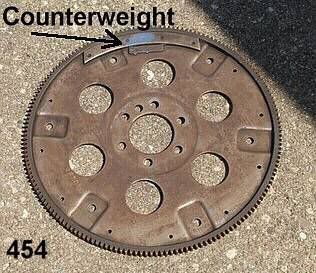
The 512 block was used on both the 427 and the 454, so now you need to find out which one it is. Since you've already pulled the engine, take a look at the flywheel (manual transmission) or the flexplate (automatic transmission). If there's an extra balance weight on the inside, it's a 454. If not, it's a 427 (see the picture below).
And yes, you can measure the lift of the cam with a dial indicator.
Ed
454 Flexplate:
454 Flywheel:

And yes, you can measure the lift of the cam with a dial indicator.
Ed
454 Flexplate:
454 Flywheel:
Thread Starter
Instructor
Joined: Jan 2007
Posts: 135
Likes: 0
From: Western Loudoun County VA
OK, here is the flywheel. The casting number (3988999N) seems to pop up in a lot of discussions around SBC applications. The picture does not have a balance weight on the flywheel, so if it really is a BBC wheel then we'd be leaning towards a 427. In looking back on the datecode of the crank, it looked to be dated D281, so was thinking that an April 27, 1971 made crank would have had to of been for a 454, but could that not have been the case and it was still a 427, just made later? I already put the oil pan back on, so can not get at the crank casting number.


Burning Brakes
Joined: Dec 2010
Posts: 848
Likes: 60
From: CA
You're correct. That flywheel was mostly used on small blocks, but it can be used on an internally balanced big block or even an externally balanced big block if it's been balanced. Those holes drilled in the 11:00 position of your picture indicate that it may have been used on a 454, but it could also have been used on a 427!
However, the crank date code equates to April 28th, 1971 (or 1981, 1991, etc...), so it's either an over the counter 427 service item, or it's from a 454! The casting number of the crank would really help, but since you've already buttoned her up, you're stuck without a definitive answer. The only other indicator is the front harmonic balancer. What's the casting number on it and does it have the extra balancing weight?
Ed
However, the crank date code equates to April 28th, 1971 (or 1981, 1991, etc...), so it's either an over the counter 427 service item, or it's from a 454! The casting number of the crank would really help, but since you've already buttoned her up, you're stuck without a definitive answer. The only other indicator is the front harmonic balancer. What's the casting number on it and does it have the extra balancing weight?
Ed
Last edited by restoman1; Jul 9, 2012 at 02:49 PM.
Thread Starter
Instructor
Joined: Jan 2007
Posts: 135
Likes: 0
From: Western Loudoun County VA
An oil pan gasket is a small price to pay to close the book on this question, though now it opens more question. Here is the casting number off the crank and looking it up says application is 396 or 402, but there are other references to it being a 427 as well. Still an internally balanced crank, so I'm OK with the current flywheel even if it is usually small block, any issues I'm getting setup for later?
Since this would be an internally balanced engine, the machine shop should balance the flywheel as well, separately? I went by there today, and they said they prefer to only balance flywheels with the full assembly and all I should do is get this one resurfaced.

Since this would be an internally balanced engine, the machine shop should balance the flywheel as well, separately? I went by there today, and they said they prefer to only balance flywheels with the full assembly and all I should do is get this one resurfaced.
Corvette Stories
The Best of Corvette for Corvette Enthusiasts

Every 2027 Corvette Engine Explained
Joe Kucinski
Designer Imagines A Corvette That Looks More Like a Corvette Than the Corvette
Verdad Gallardo
10 Ugly Corvettes That We Still Kinda Love
Joe Kucinski
Top 10 Most Expensive Corvettes Ever Sold on Bring A Trailer
Brett Foote
10 Things Every Corvette Owner Needs (2026 Edition)
Michael S. Palmer
8 Most "Only Corvette Owners Understand" Quirks and Problems
Pouria Savadkouei
10 Reasons the C6 Z06 is Still A Performance Benchmark After 20 Years
Joe Kucinski
How Much Horsepower Every Corvette Engine "LOST" in 1972
Joe Kucinski
Top 10 DOs and DON'Ts for Protecting Your Convertible Top!
Michael S. Palmer
Burning Brakes
Joined: Dec 2010
Posts: 848
Likes: 60
From: CA
The 3904815 crank is a nodular iron casting that was installed on 65-69 396 and 70-72 402 low HP engines. The date code tells us that it came out of a 1971 402 engine, but it also indicates your engine's been rebuilt at some point because the factory would not have used that crank on a service replacement 427.
At this point, it appears that you have a "home grown" 427 since the 396/402 crank has the same stroke as the 427, but I would venture to guess the cam is aftermarket, so who knows what HP rating the engine is.
Ed
At this point, it appears that you have a "home grown" 427 since the 396/402 crank has the same stroke as the 427, but I would venture to guess the cam is aftermarket, so who knows what HP rating the engine is.
Ed
Thread Starter
Instructor
Joined: Jan 2007
Posts: 135
Likes: 0
From: Western Loudoun County VA
Wow, what a train of clues it takes to figure this stuff out. I called American Powertrain and he said that as long as the flywheel is 168 tooth it should be fine for a big block and that sometimes those were used on both SBC and BBC, but the bolt patterns would be the same for the pressure plates, since I needed to order one of those today.
Still wondering on the need to balance the flywheel as the machine shop said it should not be done without the full assembly and to only resurface it?
So to see if I'm getting this all right. By process of elimination, the block casting says this has to be a 427 or 454, the crank casting eliminates the possibility of it being a 454, therefore we are left with the only reasonable answer being a 427 as a 402 would have required a different block altogether.
And that only answers the displacement, digging into horsepower would have required pulling the cam. If this thing is ever on the street (hopefully this will be the year), taking it to a dyno shop.
As I understand it, with the standard BBC hood, the cast iron intake on there now is probably not much worse off than anything else that will fit. Other than saving a few pounds is no better than the stock aluminum?
Thanks for taking the time to work through the info Ed.
Angelo
Still wondering on the need to balance the flywheel as the machine shop said it should not be done without the full assembly and to only resurface it?
So to see if I'm getting this all right. By process of elimination, the block casting says this has to be a 427 or 454, the crank casting eliminates the possibility of it being a 454, therefore we are left with the only reasonable answer being a 427 as a 402 would have required a different block altogether.
And that only answers the displacement, digging into horsepower would have required pulling the cam. If this thing is ever on the street (hopefully this will be the year), taking it to a dyno shop.
As I understand it, with the standard BBC hood, the cast iron intake on there now is probably not much worse off than anything else that will fit. Other than saving a few pounds is no better than the stock aluminum?
Thanks for taking the time to work through the info Ed.
Angelo
Burning Brakes
Joined: Dec 2010
Posts: 848
Likes: 60
From: CA
I agree with your shop. Just have them resurface the flywheel and you'll be okay. The stock aluminum 427/390 intake is expensive when you can find one, so unless you're doing the "numbers matching dance", it's not worth it. There are a lot of aftermarket aluminum intakes that fit under the stock big block hood, so go with one of those. I ran a Holley Street Dominator on my 427/390 until I found the "correct" 3947801 and it ran just fine with the stock Q-Jet. Probably even a little better! You can usually pick one up used for around $100 or so. This is an old auction, but HERE'S what it looks like.
Ed
Ed
Last edited by restoman1; Jul 9, 2012 at 06:27 PM.