




On vehicle MC bleeding

Thread Starter
Instructor

Joined: May 2012
Posts: 103
Likes: 0
From: Warren MI
 On vehicle MC bleeding
Got my '78 somewhat back together. Used Motive Power Bleeder and have brakes now something I didn't have before. Up on jackstands. Brakes do hold rear wheel while in reverse.
It's been 11 years since it was driven so I have no idea how the brakes work or felt. That being said, pedal feels a bit spongy and makes a wooshing air sound before feeling solid when applying them.
From what I've read it's called Bench Bleeding the MC or off vehicle but what about on vehicle bleeding?
It's been 11 years since it was driven so I have no idea how the brakes work or felt. That being said, pedal feels a bit spongy and makes a wooshing air sound before feeling solid when applying them.
From what I've read it's called Bench Bleeding the MC or off vehicle but what about on vehicle bleeding?
Race Director


Joined: Jan 2000
Posts: 12,399
Likes: 247
From: San Jose CA
It's still called bench bleeding, I believe. But it doesn't really matter, it's the same process although you may not get the same stroke out of the MC.
You probably don't want to cycle the MC as far as you would on the bench anyhow, as there is likely a lot of crud in untraveled portions of the bore and overstroking can destroy masters.
In other words, stick a 2x4 or your foot behind the pedal. Also, make sure to go slow because you don't want to spray your car with brake fluid.
You probably don't want to cycle the MC as far as you would on the bench anyhow, as there is likely a lot of crud in untraveled portions of the bore and overstroking can destroy masters.
In other words, stick a 2x4 or your foot behind the pedal. Also, make sure to go slow because you don't want to spray your car with brake fluid.

Burning Brakes

Joined: Oct 2008
Posts: 1,037
Likes: 14
From: Mobile Alabama
Bench bleeding is just a way of getting most of the air out of the master before hooking it up and pumping air into places that are harder to bleed. It is usually done when installing a new master cylinder. You can do the same thing on the car if you install tubing in the master discharge ports and loop them back into the fluid reservoir with their ends under the fluid level. Pump slowly and all the air will be pumped out. If this system was not used for 10 years you could have multiple problems.
Thread Starter
Instructor
Joined: May 2012
Posts: 103
Likes: 0
From: Warren MI
Well it started but the pedal went to floor, two caliper had leaked, replaced all four, both front lines due to damaged fittings, both rubber hoses and just taking it step by step. I'll pick up a MC Bleeding Kit. Thanks for the info.
Last edited by wptski; Jul 31, 2012 at 09:30 PM.

Race Director

Joined: Mar 2006
Posts: 14,112
Likes: 28
From: Florida
I hope you realize that there is a very good chance you will still have some air with that setup. the last bit of air can still just move back and forth in the tubing. Real bleed tubes have check valves.
Thread Starter
Instructor
Joined: May 2012
Posts: 103
Likes: 0
From: Warren MI
A purchased M/C bleeding kit has check valves in the fittings or do you mean the tubes? You can buy a SAE/Metric set for $10, sounds rather cheap if they have check valves and the tubing "looks" from pictures to be nothing special. I'll find out for sure later on today.
Corvette Stories
The Best of Corvette for Corvette Enthusiasts

Top 10 Most Expensive Corvettes Ever Sold on Bring A Trailer
Brett Foote
10 Things Every Corvette Owner Needs (2026 Edition)
Michael S. Palmer
8 Most "Only Corvette Owners Understand" Quirks and Problems
Pouria Savadkouei
10 Reasons the C6 Z06 is Still A Performance Benchmark After 20 Years
Joe Kucinski
How Much Horsepower Every Corvette Engine "LOST" in 1972
Joe Kucinski
Top 10 DOs and DON'Ts for Protecting Your Convertible Top!
Michael S. Palmer
Top 10 Most Explosive Corvettes Ever Made: Power-to-Weight Ratio Ranked!
Joe Kucinski
150 hp to 1,250 hp: Every Corvette Generation Compared by the Specs That Matter
Joe Kucinski
8 Coolest Corvette Pace Cars (and Replicas) of All Time
Verdad Gallardo
Race Director
Joined: Mar 2006
Posts: 14,112
Likes: 28
From: Florida
You can use the pictured copper tubes with no problems, just put your finger over the end when releasing the pistons, so the cylinder gets a fresh charge of fluid.
Thread Starter
Instructor
Joined: May 2012
Posts: 103
Likes: 0
From: Warren MI
This is a in-vehicle M/C bleeding job done by me, alone! Don't know if that's physically possible. I was also thinking of using a clear plastic tubing which is thicker anyway so I could see air bubbles from inside the vehicle too.
Melting Slicks


Joined: Nov 2001
Posts: 2,668
Likes: 43
From: Eastern US XX
Well, that's a true point but it has nothing to do with Corvettes - just brake M/C's - you should do both at the same time - not a good thing to be pumping the M/C without brake fluid in BOTH bowls - can lead to VERY premature breakdown of the cups.
Burning Brakes
Joined: Oct 2008
Posts: 1,037
Likes: 14
From: Mobile Alabama
This is a simple operation. Why do people have to make it complicated?
Yes the there may be some air in the top of the tubing, but you will remove the tubing to install the brake lines. You dont need check valves, you can use clear plastic tubing. You could even put your thumbs over the ports to act as check valves while someone pumps. (it would make a mess) You will still have a small amount of air introduced to the system when you hook up the brake lines. This procedure is just to get the master full of fluid (primed) so it will pump, and remove most of the air.
Yes the there may be some air in the top of the tubing, but you will remove the tubing to install the brake lines. You dont need check valves, you can use clear plastic tubing. You could even put your thumbs over the ports to act as check valves while someone pumps. (it would make a mess) You will still have a small amount of air introduced to the system when you hook up the brake lines. This procedure is just to get the master full of fluid (primed) so it will pump, and remove most of the air.
Race Director
Joined: Jan 2000
Posts: 12,399
Likes: 247
From: San Jose CA
Race Director
Joined: Mar 2006
Posts: 14,112
Likes: 28
From: Florida
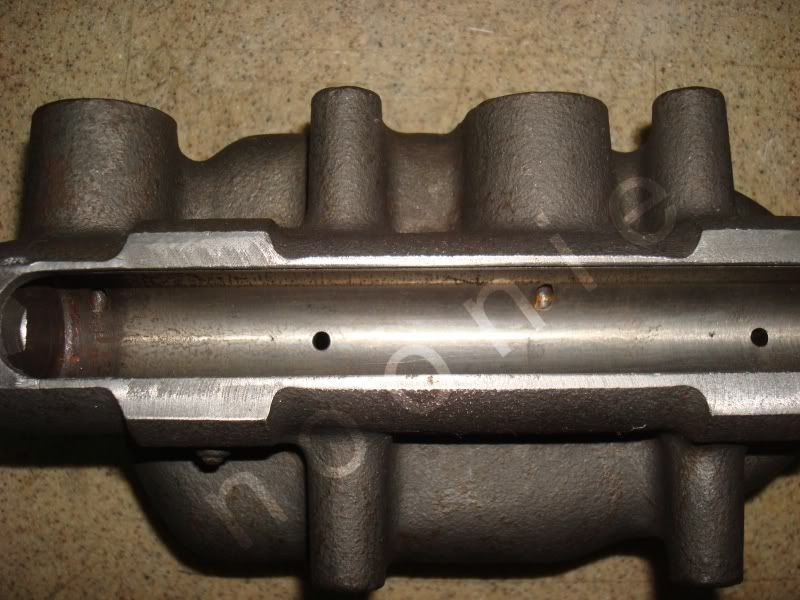
To avoid any more speculation, here is a pic of a master that was not bleed completely. You can see the pits where the air pockets were, mostly on the highest part at the left, but also in front of the primary piston. Reason for this is that the pressure ports are below the top of the cylinder.
So to bleed completely, out of the car is probably best where the master can be tilted to put the pressure ports at the very top. Then install and bleed the rest of the system to eliminate the air introduced by connecting the master.
Burning Brakes
Joined: Oct 2008
Posts: 1,037
Likes: 14
From: Mobile Alabama
With the clear tubing, you'll be able to see the air move back and forth.
To avoid any more speculation, here is a pic of a master that was not bleed completely. You can see the pits where the air pockets were, mostly on the highest part at the left, but also in front of the primary piston. Reason for this is that the pressure ports are below the top of the cylinder.
So to bleed completely, out of the car is probably best where the master can be tilted to put the pressure ports at the very top. Then install and bleed the rest of the system to eliminate the air introduced by connecting the master.
To avoid any more speculation, here is a pic of a master that was not bleed completely. You can see the pits where the air pockets were, mostly on the highest part at the left, but also in front of the primary piston. Reason for this is that the pressure ports are below the top of the cylinder.
So to bleed completely, out of the car is probably best where the master can be tilted to put the pressure ports at the very top. Then install and bleed the rest of the system to eliminate the air introduced by connecting the master.
Race Director
Joined: Mar 2006
Posts: 14,112
Likes: 28
From: Florida
All very true, except show me the bottom of the master where you cut it off. I bet you have the same corrosion in the bottom of the cylinder. The fact is the pistons/cups move over the cylinder (except where you point out corrosion) and keep it polished. Areas of no contact can become corroded from old fluid and its hygroscopic nature.
Clearly a result of an air pocket.

Heel & Toe
Joined: Aug 2012
Posts: 24
Likes: 0
From: Pascagoula Mississippi
I replaced the rear calipers on mine and when I bled them I guess I ruptured the diaphragm in the power booster. I got a MC/PB combo and didn't bench bleed and got nothing at all at the calipers when I bled them (except a very faint trickle at best). Long story short, the rear end was on jack stands in a gravel driveway. Then came the rain. The car fell off the jack stands but thankfully no apparent damage was done, but being fed up with it as I was, I left it there for a couple days until it dried out enough to get back to doing any realistic work on it. I jacked it back up and everything bled right up, no problems. Gravity bleed = Win! (I take much better precautions now against that happening again by the way...)