




Question for the painters out there!

Thread Starter
Drifting

Joined: Jan 2002
Posts: 1,411
Likes: 0
From: Dandridge TN
 Question for the painters out there!
What is the big difference in painting fiberglass cars vs. metal cars? Is there any, special primer, mixing ingriedients, cure time etc.. Thanks in advance.

Safety Car


Joined: Aug 2000
Posts: 3,711
Likes: 43
From: San Antonio TX
Re: Question for the painters out there! (Steve Adkins)
Once the body is ready to be primed, there is no difference at all between steel and fiberglass. No tricks, no "gotchas" or anything else.

Burning Brakes


Joined: Sep 2001
Posts: 1,166
Likes: 0
From: Tulsa Ok
Re: Question for the painters out there! (gerry72)
I can think of one gotcha. Body flex. No matter what you do, stress fractures are going to happen eventually if you drive the car. I've heard of flex additives for modern paint but don't know if they will help combat this problem.
Safety Car
Joined: Aug 2000
Posts: 3,711
Likes: 43
From: San Antonio TX
Re: Question for the painters out there! (FeedVaal)
Stress fractures are a sub-surface issue that can't be cured by an additive. Fexative or any other product that makes the paint pliable should be used only on parts that deform in very small areas like the stock urethane bumpers. You will not be able to harm or crack the paint on the fiberglass by pushing on the panel. If it does crack, it's probably because the paint is too thick. The load is distributed much like it is in a steel body and a very wide area is affected when you press on it. You should also not put anything in the paint to try to address a problem that isn't there like fisheye inhibitor or the flex additives (unless you are painting a urethane bumper, in which case a flex additive is absolutely necessary, but only for the bumper's paint). I know some folks put fisheye eliminators in the paint automatically, but they usually have names like Macco, and Scheibe.
Thread Starter
Drifting
Joined: Jan 2002
Posts: 1,411
Likes: 0
From: Dandridge TN
Re: Question for the painters out there! (gerry72)
Thanks guys. I am going to have to quit listening to people that have no clue what they are talking about. They told me that just because I have painted metal cars before that don't mean that I can paint a fibergless cars. I have done alot of fiberglass repairs/bodywork but never painted fiberglass before. So after the bodywork is done I can prep, prime, and paint as usual?
Safety Car
Joined: Aug 2000
Posts: 3,711
Likes: 43
From: San Antonio TX
Re: Question for the painters out there! (Steve Adkins)
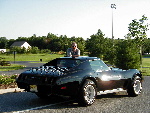
Exactly the same, Steve. The people who've told you otherwise would appear to have never painted a fiberglass car and are going by what a guy who know a guy whose brother's friend's uncle's pal's brother couldn't get it right and thinks it was because of the fiberglass. I painted both of the cars in my sig by myself, Steve, so you're not getting it anecdotal. It's the real deal.

Instructor

Joined: May 2002
Posts: 121
Likes: 0
From: Outside Houston Texas
Re: Question for the painters out there! (gerry72)
Nice car Gerry, does it make a difference in the outcome of Milla Miglia what color primer is underneath. I've got grey, but I've heard white makes it brighter and black makes it darker.
Safety Car
Joined: Aug 2000
Posts: 3,711
Likes: 43
From: San Antonio TX
Re: Question for the painters out there! (StingRayPonyGirl)
No, not really. The paint has no translucence so as long as your coverage is adequate, it doesn't make a difference what color the primer is. Both cars have grey primer underneath but the prevailing advice is that you should use a color-tinted primer that more easily hides stone chips. I can appreciate that since every chip shows the primer underneath.
Corvette Stories
The Best of Corvette for Corvette Enthusiasts

Top 10 Most Expensive Corvettes Ever Sold on Bring A Trailer
Brett Foote
10 Things Every Corvette Owner Needs (2026 Edition)
Michael S. Palmer
8 Most "Only Corvette Owners Understand" Quirks and Problems
Pouria Savadkouei
10 Reasons the C6 Z06 is Still A Performance Benchmark After 20 Years
Joe Kucinski
How Much Horsepower Every Corvette Engine "LOST" in 1972
Joe Kucinski
Top 10 DOs and DON'Ts for Protecting Your Convertible Top!
Michael S. Palmer
Top 10 Most Explosive Corvettes Ever Made: Power-to-Weight Ratio Ranked!
Joe Kucinski
150 hp to 1,250 hp: Every Corvette Generation Compared by the Specs That Matter
Joe Kucinski
8 Coolest Corvette Pace Cars (and Replicas) of All Time
Verdad Gallardo
Thread Starter
Drifting
Joined: Jan 2002
Posts: 1,411
Likes: 0
From: Dandridge TN
Re: Question for the painters out there! (gerry72)
Thanks Gerry. Yea your right, the person that told me has never painted a fiberglass car before, but knows someone who has. You already know how that goes. :bs Going by the looks of your cars your word stands good with me.

Burning Brakes
Joined: Mar 2002
Posts: 803
Likes: 0
From: South San Francisco CA
Re: Question for the painters out there! (Steve Adkins)
You use the same paint for both. Fiberglass will move more than metal so stress cracks can and sometimes do occur. Usually, after a car is a few years old....all the stress cracks that are going to happen....have happened. You don't need flex additive anywhere except the bumpers ...if that pertains to your car.
Thread Starter
Drifting
Joined: Jan 2002
Posts: 1,411
Likes: 0
From: Dandridge TN
Re: Question for the painters out there! (fontking1a)
fontking1a,
My car has the chrome bumpers so I don't need to worry about the flex additive. Is there some kind of special filler primer that keeps the fiberglass hairs from showing through on repaired areas or areas that the gel coat has been sanded off?
My car has the chrome bumpers so I don't need to worry about the flex additive. Is there some kind of special filler primer that keeps the fiberglass hairs from showing through on repaired areas or areas that the gel coat has been sanded off?

Safety Car


Joined: Oct 2000
Posts: 4,282
Likes: 172
From: Lake Wylie, South Carolina
Re: Question for the painters out there! (Steve Adkins)
Steve,
I am in the middle of doing my paint job right now. I have followed Lars's tech paper to a tee along with advice from Vettfixr and Zora_Rules just to name a couple. The PPG DP50 sealer works great for sealing these little glass hairs. After sealing the whole car with the DP I applied to wet coats of K36 and blocked the car. Everything is smooth flat and straight. Hope this helps. :cheers:
I am in the middle of doing my paint job right now. I have followed Lars's tech paper to a tee along with advice from Vettfixr and Zora_Rules just to name a couple. The PPG DP50 sealer works great for sealing these little glass hairs. After sealing the whole car with the DP I applied to wet coats of K36 and blocked the car. Everything is smooth flat and straight. Hope this helps. :cheers:

Safety Car


Joined: Mar 2000
Posts: 4,078
Likes: 27
From: Northeast South Dakota
Re: Question for the painters out there!
I used the products that Lars' listed in his paper, and applied them as he said, and my paint job came out very good. This is the first car I have ever painted, so if I can do it first time out, you can do it as a non fist timer. I would suggest sticking to Lars' paper as far as products go because I have found that auto painting is easy, the hard part is trying to find out how to mix and use the products. Seems that info is far to top secret to print on the label of the product. :rolleyes: Of course, if you've painted before you may have some favorite products already. :cheers:
Thread Starter
Drifting
Joined: Jan 2002
Posts: 1,411
Likes: 0
From: Dandridge TN
Re: Question for the painters out there! (Dalannex)
Thanks for the info wadew10 and Dalannex. I have a post here asking where I can find the Lars painting info. Can you guys tell me where to find it? Thanks

Race Director


Joined: Feb 1999
Posts: 16,978
Likes: 7
From: In Dreams There Is Truth Ohio
Re: Question for the painters out there! (Steve Adkins)
Rule of thumb regarding to primer.....light color, use gray primer, dark color use dark primer, this aids in coverage. But either dark or light primer can be used regardless of color.
One other thing.......use a catalyst primer to seal body work.
One other thing.......use a catalyst primer to seal body work.
Burning Brakes
Joined: Sep 2000
Posts: 922
Likes: 0
From: Maine
Re: Question for the painters out there! (GDaina)
Link for Lars' paper:
https://www.corvetteforum.com/techti...=111&TopicID=3
Also, FWIW, my local PPG rep. tells me that the flex additive is really only useful when painting flexible parts (ex. bumpers) off the car and that it evaporates after several weeks. He said it acts to prolong cure time, to allow installation after painting.
https://www.corvetteforum.com/techti...=111&TopicID=3
Also, FWIW, my local PPG rep. tells me that the flex additive is really only useful when painting flexible parts (ex. bumpers) off the car and that it evaporates after several weeks. He said it acts to prolong cure time, to allow installation after painting.
Le Mans Master

Joined: Jul 1999
Posts: 9,206
Likes: 17
From: Sewell NJ
Re: Question for the painters out there! (Steve Adkins)
All good advice from the above posts. I think the most important part of painting is paying attention to the details and using the proper materials. I've found (the hard way) that any defect, no matter how small, will eventually show through the topcoats. This is the reason I stripped and painted my car twice. On metal cars you don't have to worry about seams but on vettes you do. If you have an older car you may want to grind out the seams and fiberglass them even if they appear somewhat solid. It's only a matter of time before they stress crack and if you've got the car down to fiberglass you may as well do it right. If you use any type of filler at all use the thinnest coat you can get by with and make sure you use one of the new catalyzed ones. The older fillers just shrink and expand too much and will show through. Seal every repair you make with a good sealer or that will show through also. Does it sound like I have a black car? :lol: Also make sure you use the correct reducers for the temperature you are spraying at. If a reducer is too fast or too slow for the temperature you are shooting at you will get a finish that at best will require a lot of color sanding to get correct. And lastly, don't be afraid. It's not rocket science. If you are carefull and follow the steps correctly you will have a finish that you can proudly say you did yourself.
Le Mans Master
Joined: Jul 1999
Posts: 9,206
Likes: 17
From: Sewell NJ
Re: Question for the painters out there! (Steve Adkins)
Steve, it really isn't a matter of reduction as much as the type of reducer used. I'm not as familiar with the new catalized paint as I am with lacquer but the rules are pretty much the same. Lacquer thinners span a range of temperatures from about 55 degrees through 90 degrees with 3 different thinners. You have to use the thinner that is correct for the temperature on the day you will be shooting. Catalized paint isn't dependent on evaporation like lacquer is so there are fewer reducers but you still should use the correct one. Lacquer is also more forgiving about mixture. You can mix lacquer 1 to 1 with thinner or go higher (1 to 2) because the thinner only delivers the paint to the surface. Once there it evaporates pretty quickly. If you use a fast thinner on a hot day it will evaporate so fast you will be spraying dust (I've made that mistake). Catalized paint is more ridgid in it's reduction because this type of paint dries by hardening caused by the catalyst, much like bondo hardens when you add the hardener to it. If your mixture is wrong you will not get good results. If you want a good sight where you can ask the experts questions about painting go to http://www.autobodystore.com . They have a board there much like this one that is devoted to auto refinishing and they have a lot of pro and semi pros as regulars. They can give you the best advice on the correct reducers, substrates and topcoats. I think there are a few reps from the big paint companies that frequent the board also. I learned a lot from that board when I painted my car and the people there were always friendly and helpful. Hope this helps a little and if you are going to spray a catalized paint sometime in the future read up on the safety precautions. Those paints can be killers.