




Holley carb question
Thread Starter
Le Mans Master


Joined: Mar 2008
Posts: 5,948
Likes: 72
From: Oxford MA-----You just lost the game!!!!
 Holley carb question
Hi, everybody!
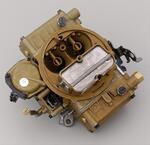
I have a question about Holley carbs, and since it's the carb in my '80 'vette, I figured I would make use of the wealth of knowledge on this forum. I have a 1850 Holley carb (standard 600 cfm Holley four barrel, vacuum secondary, 4160 type carb) It has a secondary metering plate instead of a secondary metering block. I would like to convert it to a secondary metering block, in order to be able to adjust secondary enrichment using jet changes. The conversion kit from Holley,
http://www.summitracing.com/parts/hly-34-6/overview/
contains basically a secondary metering block, a longer fuel transfer tube, and some gaskets. Could I save a few bucks by just getting the longer fuel transfer tube,
http://www.summitracing.com/parts/hly-26-114/overview/
and using a primary metering block from another parts carb, with the idle mixture screws screwed all the way in? Or does the secondary metering block need to be a dedicated secondary metering block? Feel free to get fairly technical with your answer, I know the basics fairly well, just not sure what the differences are between primary and secondary metering blocks, I've never dealt with them at all. Thanks,
Scott
I have a question about Holley carbs, and since it's the carb in my '80 'vette, I figured I would make use of the wealth of knowledge on this forum. I have a 1850 Holley carb (standard 600 cfm Holley four barrel, vacuum secondary, 4160 type carb) It has a secondary metering plate instead of a secondary metering block. I would like to convert it to a secondary metering block, in order to be able to adjust secondary enrichment using jet changes. The conversion kit from Holley,
http://www.summitracing.com/parts/hly-34-6/overview/
contains basically a secondary metering block, a longer fuel transfer tube, and some gaskets. Could I save a few bucks by just getting the longer fuel transfer tube,
http://www.summitracing.com/parts/hly-26-114/overview/
and using a primary metering block from another parts carb, with the idle mixture screws screwed all the way in? Or does the secondary metering block need to be a dedicated secondary metering block? Feel free to get fairly technical with your answer, I know the basics fairly well, just not sure what the differences are between primary and secondary metering blocks, I've never dealt with them at all. Thanks,
Scott
Pro


Joined: Dec 2006
Posts: 695
Likes: 5
From: tx
I dont have a technical answer, BUT if it was me I'd just buy the kit and be done with it. The corner cutting method usually results in a carb that doesn't function at 100% thus leaving everyone who trys to tune it scratching their head.
Drifting


Joined: Jan 2012
Posts: 1,908
Likes: 129
From: Fredericksburg Virginia
I'd agree with Mr. Glackore. It's tough enough to "get it right" when dealing with any carb. And have you seen how many little holes and pathways there are in one of those widgets?
Even if they WERE the same, I'd probably just get the 'right' part with all the new gaskets and stuff and take the $40 on the chin.
Of course, if I was being TOTALLY honest, when dealing with my carb the last time, I just bypassed the entire question and bought a new 650 Double Pump QuickFuel. That has the metering blocks on the secondaries...problem solved!
Even if they WERE the same, I'd probably just get the 'right' part with all the new gaskets and stuff and take the $40 on the chin.
Of course, if I was being TOTALLY honest, when dealing with my carb the last time, I just bypassed the entire question and bought a new 650 Double Pump QuickFuel. That has the metering blocks on the secondaries...problem solved!

Safety Car


Joined: Aug 2000
Posts: 3,711
Likes: 43
From: San Antonio TX
You can use a secondary metering block from another Holley, but the emulsion circuit will not likely be good enough to not cause you any issues.
A simpler solution is the metering plate kit from Quick Fuel with just replaces the Holley plate with a plate for jets and includes a new float to clear the plate.
What indicators are you using to suggest the secondary is lean? Most times, you just end up with a block or plate that happens to correlate to the fuel flow capacity of the original Holley plate. They try to make these carbs as simple and out-of-the-box useful as they can.
A simpler solution is the metering plate kit from Quick Fuel with just replaces the Holley plate with a plate for jets and includes a new float to clear the plate.
What indicators are you using to suggest the secondary is lean? Most times, you just end up with a block or plate that happens to correlate to the fuel flow capacity of the original Holley plate. They try to make these carbs as simple and out-of-the-box useful as they can.
Thread Starter
Le Mans Master
Joined: Mar 2008
Posts: 5,948
Likes: 72
From: Oxford MA-----You just lost the game!!!!
After thinking about it for awhile, I have realized that the primary metering block cannot be easily substituted for the secondary metering block on vacuum secondary carbs. The back of the carb body is flat, no room for a power valve plug, so the metering block would need to be modified by blocking off the pvcr circuit. I think you guys are right, best just to get the kit and be done with it. Thanks for the input, though. Have a good one!
Scott
Scott

Drifting

Joined: Dec 2004
Posts: 1,714
Likes: 42
From: Austin Texas
There are other options also. Adding a metering block will make the carb longer and possibly cause it to interfere with the vacuum port on the back of the manifold. Regardless, you could also...
1. look at something like Quick fuel 34-2 which is a plate that accepts jets.
Or
2. Take your metering plate out, plug the holes on the bottom and then drill and tap it for jets. I just went and bought the tap for about $3.
Are you using an A/f gauge ?
1. look at something like Quick fuel 34-2 which is a plate that accepts jets.
Or
2. Take your metering plate out, plug the holes on the bottom and then drill and tap it for jets. I just went and bought the tap for about $3.
Are you using an A/f gauge ?
Drifting
Joined: Dec 2004
Posts: 1,714
Likes: 42
From: Austin Texas
Scotty,
Here is a link to a thread that helped me. http://www.hotrodders.com/forum/seco...lp-150145.html
I have not made the conversion because my A/F ratio turned out to be around 12.5-13:1 at WOT. My motor is a 350 with a similar carb as you.
Have you seen this conversion chart? www.holley.com/data/Catalogs/Holley/90.pdf
My carb has the metering plate 134-39 which shows to be equal to a 69 jet. I basically have 69 jets in front and back.
Here is a link to a thread that helped me. http://www.hotrodders.com/forum/seco...lp-150145.html
I have not made the conversion because my A/F ratio turned out to be around 12.5-13:1 at WOT. My motor is a 350 with a similar carb as you.
Have you seen this conversion chart? www.holley.com/data/Catalogs/Holley/90.pdf
My carb has the metering plate 134-39 which shows to be equal to a 69 jet. I basically have 69 jets in front and back.
Corvette Stories
The Best of Corvette for Corvette Enthusiasts

Top 10 Most Explosive Corvettes Ever Made: Power-to-Weight Ratio Ranked!
Joe Kucinski
150 hp to 1,250 hp: Every Corvette Generation Compared by the Specs That Matter
Joe Kucinski
8 Coolest Corvette Pace Cars (and Replicas) of All Time
Verdad Gallardo
Top 10 Corvette Engines RANKED by Peak Torque (70+ Years of Muscle!)
Joe Kucinski
Corvette ZR1X Will Be Pacing the Indy 500, And Could Probably Race, Too!
Verdad Gallardo
Top 10 Corvettes Coming to Mecum Indy 2026!
Brett Foote
Top 10 C9 Corvette MUST-HAVES to Fix These C8 Generation Flaws!
Michael S. Palmer
10 Revolutionary 'Corvette Firsts' Most People Don't Know
Joe Kucinski
5 Reasons to Upgrade to an LS6-Powered Corvette; 5 Reasons to Stay LT2
Michael S. Palmer
Thread Starter
Le Mans Master
Joined: Mar 2008
Posts: 5,948
Likes: 72
From: Oxford MA-----You just lost the game!!!!
Scotty,
Here is a link to a thread that helped me. http://www.hotrodders.com/forum/seco...lp-150145.html
I have not made the conversion because my A/F ratio turned out to be around 12.5-13:1 at WOT. My motor is a 350 with a similar carb as you.
Have you seen this conversion chart? www.holley.com/data/Catalogs/Holley/90.pdf
My carb has the metering plate 134-39 which shows to be equal to a 69 jet. I basically have 69 jets in front and back.
Here is a link to a thread that helped me. http://www.hotrodders.com/forum/seco...lp-150145.html
I have not made the conversion because my A/F ratio turned out to be around 12.5-13:1 at WOT. My motor is a 350 with a similar carb as you.
Have you seen this conversion chart? www.holley.com/data/Catalogs/Holley/90.pdf
My carb has the metering plate 134-39 which shows to be equal to a 69 jet. I basically have 69 jets in front and back.
The engine in question is a relatively stock L48, (block-hugger headers, 2 1/2" dual exhaust, Performer intake) but I am planning a cam and head upgrade in the near future, and I am trying to look ahead at the tuning process after the switch. The vacuum port should clear just fine, I have a 1", 4-hole, phenolic carb spacer under the carb.
Just ordered the kit from Summit, so the point is moot, now! Still, thanks for everybody's input. See ya!
Scott
Drifting
Joined: Dec 2004
Posts: 1,714
Likes: 42
From: Austin Texas
Cool.
I was surprised at the a/f ratio readings i got from the factory metering plate considering all the mods I had made. Holley had the stiff black sec spring in and I swapped to the lightest.
Happy tuning
I was surprised at the a/f ratio readings i got from the factory metering plate considering all the mods I had made. Holley had the stiff black sec spring in and I swapped to the lightest.
Happy tuning

Le Mans Master


Joined: Oct 2010
Posts: 6,930
Likes: 843
From: melbourne florida
2023 C3 of the Year Finalist - Modified
i wouldn't do anything without changing to center hung bowls, and for that money you'd be better off to get a new carb. unless you can find a swap meet carb you can pirate what you need. nice thing about holleys