






Exhaust system 4.0

Thread Starter
Tech Contributor


Joined: Jun 2004
Posts: 20,910
Likes: 962
From: I tend to be leery of any guy who doesn't own a chainsaw or a handgun.
 Exhaust system 4.0
Been through several iterations of the exhaust system the past year in search of better efficiency (ie: a few free horsepower) and quieter interior noise.
I added a crossover H pipe in an effort to reduce the idle harshness and the drone at 1500 RPM. I've run crossovers in the past but they were always too far rearward to be efficient so I installed one as far forward as I could (at the collector reducers).

Made a noticeable difference in the idle harshness quality. According to Vizard this should be good for a handful of horsepower too.
Next item in the 3" system is an exhaust pulse termination box. The idea here is for the header pipes to empty into a large volume so that the exhaust pulses don't run into any long pipe/system resistance (backpressure) when the cylinder exhaust mass suddenly dumps out of the headers. This EPTB box is about 770 cubic inches, the biggest I could package in the space between the transmission and differential.
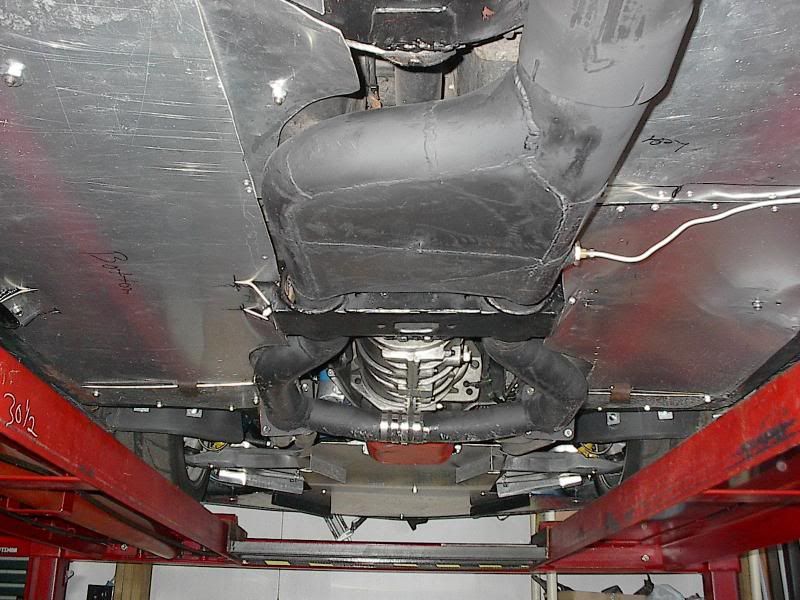
On the right side is a port to measure backpressure or install a WBO2 sensor. Here's the gauges I was using at the last track day to measure a few items on the car, including the exhaust backpressure with the previous 2 1/2' mufflers.

The outlet of the EPTB is a 4" pipe running on the right side (a large pipe is lighter than two smaller pipes, and the exhaust flow is now more steady-state flow rather than pulsed flow), which then splits into two 3" pipes feeding the mufflers.

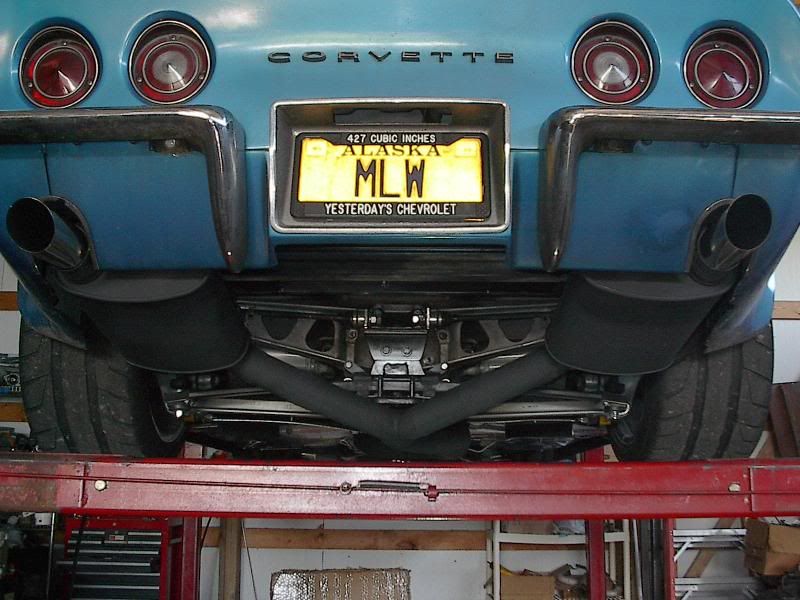
Finally the mufflers. These are 3" Dynamax turbo mufflers with about 35% more flow capacity (at the same pressure drop) compared to the 2 1/2" turbo mufflers I'd been running the past several years. These are bigger and longer than the previous mufflers (hence the more efficient flow capability) but they were a slight PITA to package back there. Due to the tubing inlet/outlet positions I couldn't space them as far apart as I would have liked, and as such I'm slightly shy of room for the spare tire. I guess I'll deal with that at a later time.
I'm trying to get things put completely back together in time for a track day in the next couple weeks to compare the flow rate (via backpressure readings) of these mufflers versus the old parts.
I added a crossover H pipe in an effort to reduce the idle harshness and the drone at 1500 RPM. I've run crossovers in the past but they were always too far rearward to be efficient so I installed one as far forward as I could (at the collector reducers).

Made a noticeable difference in the idle harshness quality. According to Vizard this should be good for a handful of horsepower too.
Next item in the 3" system is an exhaust pulse termination box. The idea here is for the header pipes to empty into a large volume so that the exhaust pulses don't run into any long pipe/system resistance (backpressure) when the cylinder exhaust mass suddenly dumps out of the headers. This EPTB box is about 770 cubic inches, the biggest I could package in the space between the transmission and differential.

On the right side is a port to measure backpressure or install a WBO2 sensor. Here's the gauges I was using at the last track day to measure a few items on the car, including the exhaust backpressure with the previous 2 1/2' mufflers.

The outlet of the EPTB is a 4" pipe running on the right side (a large pipe is lighter than two smaller pipes, and the exhaust flow is now more steady-state flow rather than pulsed flow), which then splits into two 3" pipes feeding the mufflers.

Finally the mufflers. These are 3" Dynamax turbo mufflers with about 35% more flow capacity (at the same pressure drop) compared to the 2 1/2" turbo mufflers I'd been running the past several years. These are bigger and longer than the previous mufflers (hence the more efficient flow capability) but they were a slight PITA to package back there. Due to the tubing inlet/outlet positions I couldn't space them as far apart as I would have liked, and as such I'm slightly shy of room for the spare tire. I guess I'll deal with that at a later time.

I'm trying to get things put completely back together in time for a track day in the next couple weeks to compare the flow rate (via backpressure readings) of these mufflers versus the old parts.
Thread Starter
Tech Contributor
Joined: Jun 2004
Posts: 20,910
Likes: 962
From: I tend to be leery of any guy who doesn't own a chainsaw or a handgun.
Thanks for the interest, guys. Answering the questions:
The engine is a streetable ZL-1 I built a few years ago. Didn't dyno it, but other than this engine having a touch more carb and IIRC cam specs it's rather similar to the 427/480 crate motor Chevy sells.
The suspension is a '96 front and an '84 rear, grafted onto a spare frame so I wouldn't have to cut up the original (in case the project turned out to be a grand failure ). I narrowed the suspension to the stock C3 width so that I could run C3 wheels for a stock appearance on the street. Using the early C4 rear knuckles freed up another inch or so of room back there. I recently replaced the C4 toe rods for C6 units so I could tweak the toe curve better.
I initially just put a belly pan under the front of the car, from the spoiler to the oil pan, in an effort to somewhat clean up that area (and hopefully reduce lift). The underside of a C3 is a pretty rough pathway for air to flow. I got a decent deal on some aluminum sheet a while ago so I just started to add more in the areas I could. I made several changes to the exhaust and trans crossmember shape, and had to remove and cut/rivet the aluminum several times. Once I'm reasonably sure I'm not going to hack up the sheetwork anymore I'll go back and make it a little "prettier". I haven't come up with a brake cooling ductwork I'm happy with yet so I've just added a few tabs under the pan to redirect some air to the wheels and rotor areas. So far it seems to be working sufficiently (I'm not losing any pedal due to fluid boiling), and any air that goes out the wheel area is less air to cause lift under the car.
The EPTB is just an empty box, a large volume that looks like open atmospheric pressure to the headers (assuming that the mufflers downstream aren't restricting the damped out flow). The idea is that once the positive pressure wave coming out of the exhaust port makes its way down the header tube and enters the large EPTB volume, a corresponding negative pressure wave reflects back to the exhaust port to help scavenge the residual exhaust. There's all sorts of parameters to play with (tube length, gas temperature, wave speed, RPM, etc), but in a Corvette you have limited options on where you can place these large volumes. From the info I've been able to work with this looks like about a 4000 RPM efficiency point with this positioning. Not ideal for drag racing, but usable for autocross and corner exit power on road courses. I haven't done any WOT runs with these mufflers yet, but I don't expect that the sound will be significantly different than the previous turbo mufflers. I'll be doing some pressure measurements at the next track day, and if my video camera cooperates I might get some sound readings too.
The engine is a streetable ZL-1 I built a few years ago. Didn't dyno it, but other than this engine having a touch more carb and IIRC cam specs it's rather similar to the 427/480 crate motor Chevy sells.
The suspension is a '96 front and an '84 rear, grafted onto a spare frame so I wouldn't have to cut up the original (in case the project turned out to be a grand failure
). I narrowed the suspension to the stock C3 width so that I could run C3 wheels for a stock appearance on the street. Using the early C4 rear knuckles freed up another inch or so of room back there. I recently replaced the C4 toe rods for C6 units so I could tweak the toe curve better.I initially just put a belly pan under the front of the car, from the spoiler to the oil pan, in an effort to somewhat clean up that area (and hopefully reduce lift). The underside of a C3 is a pretty rough pathway for air to flow. I got a decent deal on some aluminum sheet a while ago so I just started to add more in the areas I could. I made several changes to the exhaust and trans crossmember shape, and had to remove and cut/rivet the aluminum several times. Once I'm reasonably sure I'm not going to hack up the sheetwork anymore I'll go back and make it a little "prettier". I haven't come up with a brake cooling ductwork I'm happy with yet so I've just added a few tabs under the pan to redirect some air to the wheels and rotor areas. So far it seems to be working sufficiently (I'm not losing any pedal due to fluid boiling), and any air that goes out the wheel area is less air to cause lift under the car.
The EPTB is just an empty box, a large volume that looks like open atmospheric pressure to the headers (assuming that the mufflers downstream aren't restricting the damped out flow). The idea is that once the positive pressure wave coming out of the exhaust port makes its way down the header tube and enters the large EPTB volume, a corresponding negative pressure wave reflects back to the exhaust port to help scavenge the residual exhaust. There's all sorts of parameters to play with (tube length, gas temperature, wave speed, RPM, etc), but in a Corvette you have limited options on where you can place these large volumes. From the info I've been able to work with this looks like about a 4000 RPM efficiency point with this positioning. Not ideal for drag racing, but usable for autocross and corner exit power on road courses. I haven't done any WOT runs with these mufflers yet, but I don't expect that the sound will be significantly different than the previous turbo mufflers. I'll be doing some pressure measurements at the next track day, and if my video camera cooperates I might get some sound readings too.

Burning Brakes


Joined: Mar 2008
Posts: 1,038
Likes: 39
From: Denver, CO
St. Jude Donor '08-'09-'10
i had read before that indy cars (and/or other ridiculously high cost cars) actually tune mufflers according to sin wave of the exhaust sound. my limited understanding was the better the sound moved through the exhaust, the better the sound would help "push" everything else out...
Your stuff looks really interesting. 2:1:2 always seemed like a step in the wrong direction before.. seems like youve done a bit of research here though. I might have to rethink my next exhaust build.
Your stuff looks really interesting. 2:1:2 always seemed like a step in the wrong direction before.. seems like youve done a bit of research here though. I might have to rethink my next exhaust build.
Thread Starter
Tech Contributor
Joined: Jun 2004
Posts: 20,910
Likes: 962
From: I tend to be leery of any guy who doesn't own a chainsaw or a handgun.
i had read before that indy cars (and/or other ridiculously high cost cars) actually tune mufflers according to sin wave of the exhaust sound. my limited understanding was the better the sound moved through the exhaust, the better the sound would help "push" everything else out...
Your stuff looks really interesting. 2:1:2 always seemed like a step in the wrong direction before. seems like youve done a bit of research here though. I might have to rethink my next exhaust build.
Your stuff looks really interesting. 2:1:2 always seemed like a step in the wrong direction before. seems like youve done a bit of research here though. I might have to rethink my next exhaust build.
Corvette Stories
The Best of Corvette for Corvette Enthusiasts

Top 10 Most Expensive Corvettes Ever Sold on Bring A Trailer
Brett Foote
10 Things Every Corvette Owner Needs (2026 Edition)
Michael S. Palmer
8 Most "Only Corvette Owners Understand" Quirks and Problems
Pouria Savadkouei
10 Reasons the C6 Z06 is Still A Performance Benchmark After 20 Years
Joe Kucinski
How Much Horsepower Every Corvette Engine "LOST" in 1972
Joe Kucinski
Top 10 DOs and DON'Ts for Protecting Your Convertible Top!
Michael S. Palmer
Top 10 Most Explosive Corvettes Ever Made: Power-to-Weight Ratio Ranked!
Joe Kucinski
150 hp to 1,250 hp: Every Corvette Generation Compared by the Specs That Matter
Joe Kucinski
8 Coolest Corvette Pace Cars (and Replicas) of All Time
Verdad Gallardo
Thread Starter
Tech Contributor
Joined: Jun 2004
Posts: 20,910
Likes: 962
From: I tend to be leery of any guy who doesn't own a chainsaw or a handgun.
Did a track day at Heartland Park Topeka today. Had the low pressure gauge hooked up to the EPTBox again. The upsized rear pipes and mufflers dropped the backpressure down to 10" H2O, compared to the earlier 2 1/2" rear system reading of 24" H2O. Hopefully the improved VE due to better cylinder emptying made up for the 10# weight gain caused by the bigger exhaust pieces.