




Fuel system design help

Thread Starter
Pro


Joined: May 2008
Posts: 582
Likes: 9
 Fuel system design help
I currently have the body off the frame and have finished my frame, suspension and just installed the transmission and engine. I now need to figure out a good fuel system that will be reliable, safe and will support my engine with a carburetor now, and be easy to adapt to fuel injection in the future.
Engine is a fresh rebuild 10:1 355 with AFR heads, comp hydraulic roller 224/230 at .050. Same engine set up but burning lots of oil and with sportsmen II heads was dyno at the wheels at 335 hp. So I figure that I will be, I hope over 400 but not over 450 at the flywheel with the AFR heads.
Here is my plan and some ideas, please chime in and let me know what of this will work and what better options are there to use.
As mentioned before I will be running a carburetor for a while but want to make sure a switch to fuel injection is possible, at least with the lines that run from the tank to the engine compartment.
I plan to stay away from the pre bent lines because of the price.
I have a concern of vapor lock and to add to this I live in the west desert area so summer time its usually over 100 degrees and altitude here is 4500 feet with occasional road trips to over 8000 ft. (mountain twisties!!)
I know I want to stick with a return line type system, both now and will be needed for FI. Not sure on the line size to use. Was thinking of making both the main and return 3/8, or 3/8 on the return and 1/2 for the main line. The problem for 1/2 bulk tube is I don't see it available in steel, only in aluminum. Is aluminum safe and reliable?
Next issue is the fuel pump. I am worried that the some 30 GPH flow is not going to do the job. Before not actual driving, but say doing a long burn out at high RPM the engine would some times cut out and the A/F monitor showed lean, so I feel that the stock pump is not feeding the engine.....but it is a 15 year old pump.
But if I go to a aftermarket pump, maybe a 80GPH pump I would no longer have the return line off the pump and then I would have vapor lock problems. I have read about when using a aftermarket pump that you can have on the carburetor feed line a port after the secondary that has a fuel pressure regulator that then returns fuel to the tank from there and that prevents vapor lock by giving fuel vapors a rout back to the tank. Any thoughts on this?
As far as a fuel filter I plan to use a AC delco GF652 filter with the adapters. This would be on 3/8 line between the fuel pump and the carb.
Any thought or ideas on this or something complete different that will work would be greatly appreciated. Plan to start gathering the parts as soon as figure out what to do.
Engine is a fresh rebuild 10:1 355 with AFR heads, comp hydraulic roller 224/230 at .050. Same engine set up but burning lots of oil and with sportsmen II heads was dyno at the wheels at 335 hp. So I figure that I will be, I hope over 400 but not over 450 at the flywheel with the AFR heads.
Here is my plan and some ideas, please chime in and let me know what of this will work and what better options are there to use.
As mentioned before I will be running a carburetor for a while but want to make sure a switch to fuel injection is possible, at least with the lines that run from the tank to the engine compartment.
I plan to stay away from the pre bent lines because of the price.
I have a concern of vapor lock and to add to this I live in the west desert area so summer time its usually over 100 degrees and altitude here is 4500 feet with occasional road trips to over 8000 ft. (mountain twisties!!)
I know I want to stick with a return line type system, both now and will be needed for FI. Not sure on the line size to use. Was thinking of making both the main and return 3/8, or 3/8 on the return and 1/2 for the main line. The problem for 1/2 bulk tube is I don't see it available in steel, only in aluminum. Is aluminum safe and reliable?
Next issue is the fuel pump. I am worried that the some 30 GPH flow is not going to do the job. Before not actual driving, but say doing a long burn out at high RPM the engine would some times cut out and the A/F monitor showed lean, so I feel that the stock pump is not feeding the engine.....but it is a 15 year old pump.
But if I go to a aftermarket pump, maybe a 80GPH pump I would no longer have the return line off the pump and then I would have vapor lock problems. I have read about when using a aftermarket pump that you can have on the carburetor feed line a port after the secondary that has a fuel pressure regulator that then returns fuel to the tank from there and that prevents vapor lock by giving fuel vapors a rout back to the tank. Any thoughts on this?
As far as a fuel filter I plan to use a AC delco GF652 filter with the adapters. This would be on 3/8 line between the fuel pump and the carb.
Any thought or ideas on this or something complete different that will work would be greatly appreciated. Plan to start gathering the parts as soon as figure out what to do.

Drifting


Joined: Apr 2005
Posts: 1,917
Likes: 451
From: Central NJ
I don't like aluminum for a street car because it dents easily and any stress on the lines will cause fatigue and will crack so you would need to add in soft line at some point between the frame and the motor.
If you want to go with 1/2" I'm sorry to say cost will not be your friend. You would need to go with AN style tube and fittings and the basic braided line isn't suitable because the fuel fumes permeate through the rubber and will make your garage smell awful and could be dangerous which means you would need Teflon braided tubing and that would cost $$$$$$$$.
Good news is with 450 max flywheel hp I really think 3/8" line is plenty.
As far as losing your return line with the new pump-are you using a mechanical pump now? whats the set up?
Yes a fuel pressure regulator plumbed in anywhere after the fuel pump will return fuel back to the tank. This is my system and I have chosen to put the return reg immediately after my inline pump and I have an additional (deadhead regulator) up front.


If you want to go with 1/2" I'm sorry to say cost will not be your friend. You would need to go with AN style tube and fittings and the basic braided line isn't suitable because the fuel fumes permeate through the rubber and will make your garage smell awful and could be dangerous which means you would need Teflon braided tubing and that would cost $$$$$$$$.
Good news is with 450 max flywheel hp I really think 3/8" line is plenty.
As far as losing your return line with the new pump-are you using a mechanical pump now? whats the set up?
Yes a fuel pressure regulator plumbed in anywhere after the fuel pump will return fuel back to the tank. This is my system and I have chosen to put the return reg immediately after my inline pump and I have an additional (deadhead regulator) up front.
Drifting


Joined: May 2005
Posts: 1,968
Likes: 44
From: East TN
Originally I was going to go with a TPI set up, but ended up going with a carb.
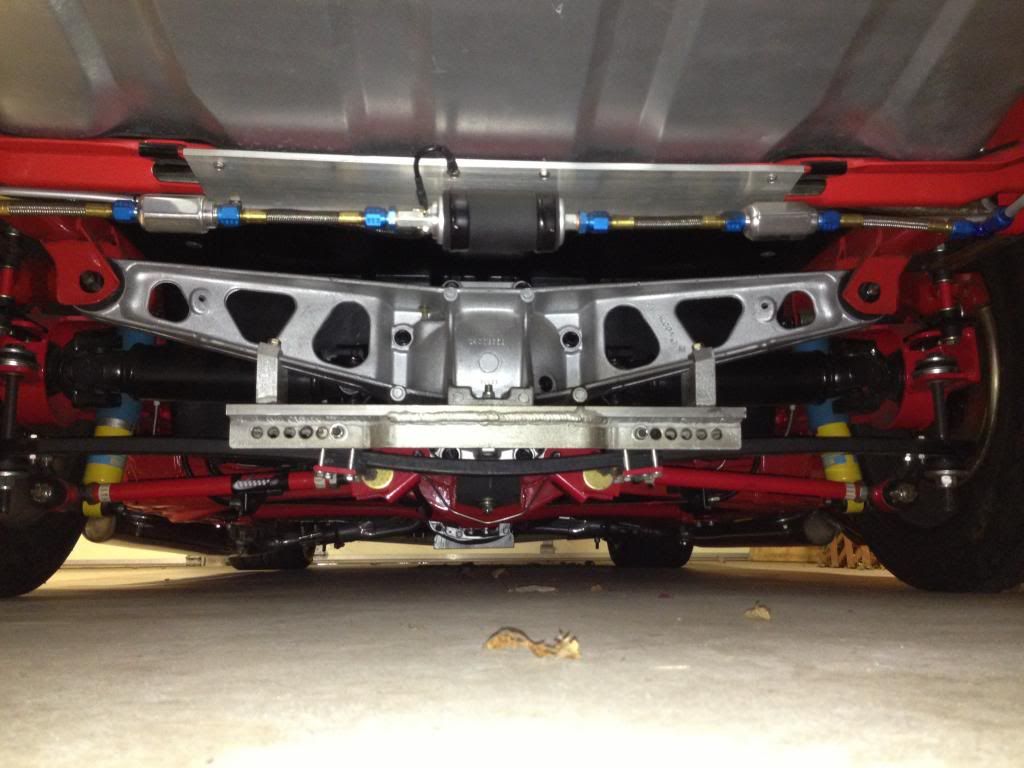
I had bought a high pressure electric fuel pump from Jegs, so I bought a regulator to lower the pressure for the carb setup. I also bought pre and post filters (different microns).
I haven't had any issues with my fuel system and it wouldn't be very hard to switch to fuel injection.


I had bought a high pressure electric fuel pump from Jegs, so I bought a regulator to lower the pressure for the carb setup. I also bought pre and post filters (different microns).

I haven't had any issues with my fuel system and it wouldn't be very hard to switch to fuel injection.
Drifting
Joined: May 2005
Posts: 1,968
Likes: 44
From: East TN
Nope. My in-line fuel pump is right between the 2 filters below the fuel tank in the photo I posted below. It has a ground lead coming off of it going to the aluminum mounting plate that I made. Right behind it is the return line going back to the fuel tank. If you look closely you can see both fuel lines.
Last edited by MIKE80; Jul 26, 2013 at 09:41 AM.
Drifting
Joined: May 2005
Posts: 1,968
Likes: 44
From: East TN
I have the stock pick up/ sending unit on the top of the tank. I blocked off the connection on the tank for the charcoal canister and used a section of Goodyear fuel injection hose http://www.goodyearep.com/ProductsDetail.aspx?id=17700 and connected to the 3/8" hard lines I ran down the right side of the fuel tank, under the tank (where the pump and filters are located) and across to the left frame rail, then up to the left side near the steering box. From there the hard lines connect to stainless braided lines which go to the regulator on the top front of the engine. I have thermal insulation wrapped around the lower section of the braided lines to insulate them from heat coming off the header.
Corvette Stories
The Best of Corvette for Corvette Enthusiasts

Top 10 Most Expensive Corvettes Ever Sold on Bring A Trailer
Brett Foote
10 Things Every Corvette Owner Needs (2026 Edition)
Michael S. Palmer
8 Most "Only Corvette Owners Understand" Quirks and Problems
Pouria Savadkouei
10 Reasons the C6 Z06 is Still A Performance Benchmark After 20 Years
Joe Kucinski
How Much Horsepower Every Corvette Engine "LOST" in 1972
Joe Kucinski
Top 10 DOs and DON'Ts for Protecting Your Convertible Top!
Michael S. Palmer
Top 10 Most Explosive Corvettes Ever Made: Power-to-Weight Ratio Ranked!
Joe Kucinski
150 hp to 1,250 hp: Every Corvette Generation Compared by the Specs That Matter
Joe Kucinski
8 Coolest Corvette Pace Cars (and Replicas) of All Time
Verdad Gallardo
Drifting
Joined: May 2005
Posts: 1,968
Likes: 44
From: East TN
Drifting
Joined: Apr 2005
Posts: 1,917
Likes: 451
From: Central NJ
Yeah Mike I'd be wary to keep running it like that. The only pump I'm aware of that will actually pull fuel is made from Weldon and even that pump is only designed to pull 12 inches upward.
This quote is right off the like you posted
"JEGS external, in-line, high pressure fuel pumps are designed specifically for fuel injection applications where additional fuel delivery is needed for modified or power adder engines. Ideal for installation with a fuel cell, drop sump style tank or when an in-tank unit is not practical. Includes fuel pump to 3/8" hose barb fittings."
Pump could overheat, fail, cause fuel starvation under full throttle etc.
How long you had that in there ?
This quote is right off the like you posted
"JEGS external, in-line, high pressure fuel pumps are designed specifically for fuel injection applications where additional fuel delivery is needed for modified or power adder engines. Ideal for installation with a fuel cell, drop sump style tank or when an in-tank unit is not practical. Includes fuel pump to 3/8" hose barb fittings."
Pump could overheat, fail, cause fuel starvation under full throttle etc.
How long you had that in there ?
Drifting
Joined: May 2005
Posts: 1,968
Likes: 44
From: East TN
Yeah Mike I'd be wary to keep running it like that. The only pump I'm aware of that will actually pull fuel is made from Weldon and even that pump is only designed to pull 12 inches upward.
This quote is right off the like you posted
"JEGS external, in-line, high pressure fuel pumps are designed specifically for fuel injection applications where additional fuel delivery is needed for modified or power adder engines. Ideal for installation with a fuel cell, drop sump style tank or when an in-tank unit is not practical. Includes fuel pump to 3/8" hose barb fittings."
Pump could overheat, fail, cause fuel starvation under full throttle etc.
How long you had that in there ?
This quote is right off the like you posted
"JEGS external, in-line, high pressure fuel pumps are designed specifically for fuel injection applications where additional fuel delivery is needed for modified or power adder engines. Ideal for installation with a fuel cell, drop sump style tank or when an in-tank unit is not practical. Includes fuel pump to 3/8" hose barb fittings."
Pump could overheat, fail, cause fuel starvation under full throttle etc.
How long you had that in there ?
I've been using the pump since I got my vette back on the road summer of 2010. I have never noticed any issues with the fuel system. Here's a long video I made for another post where I open it up a few times at 4:00, 11:45, and 18:45 in the video, also with just normal cruising and it runs fine, revs right up to about 7000.
Not sure, maybe I won't get a long life out of the pump?
I just sent Jegs tech and email:
I have a 1980 Corvette with a carb, but looking to go to fuel injection in the near future. My question is, the stock fuel pickup/ sending unit is mounted on the top of the fuel tank, so I'm planning on using one of Jegs Hi-Pressure Inline Fuel Pumps like part number 555-159000 and was wondering if it will be a problem because it will need to pull the fuel up the fuel pickup? I plan on mounting the pump under the tank with pre and post in line filters.
They got back to me pretty quick. Here's their response:
Hello
Thank you for giving Jegs the opportunity to assist you with your technical question.
Jegs 159000 inline pump will work fine using the stock pump pick up port from your sending unit.
Should you need further assistance please feel free to contact us.
Sincerely
Bob Grace
Technical Sales Representative
800-345-4545
ext # 868
Bob.Grace@jegs.com

Drifting
Joined: May 2005
Posts: 1,968
Likes: 44
From: East TN




The ORIGINAL and bestest

Joined: Oct 2000
Posts: 10,009
Likes: 240
From: Toronto Ontario
Toronto Events Coordinator
I went with pre-bent SS lines. I already had a SS 3/8" feed on the car that I installed during the body-off resto, and I then had them make me a SS 3/8" return line with the same bends as the factory return line when I made the switch to EFI. I am using an in-tank fuel pump set up from Rock Valley. I didn't find the price of the pre-bent lines to be outrageous, especially since they were SS.
I based my fuel system on this diagram from Aeromotive:
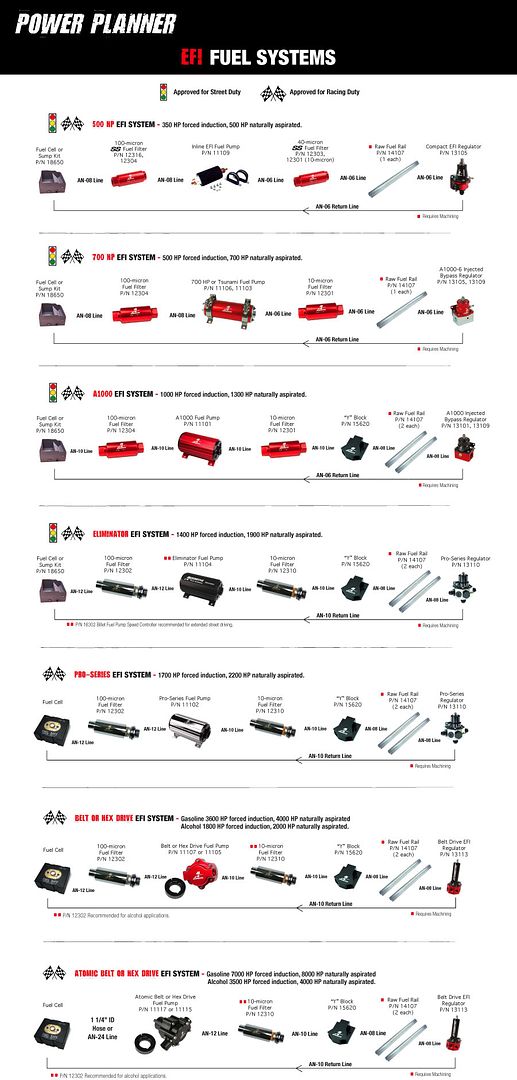
Any questions, let me know.

I based my fuel system on this diagram from Aeromotive:
Any questions, let me know.
Thread Starter
Pro
Joined: May 2008
Posts: 582
Likes: 9
I went with pre-bent SS lines. I already had a SS 3/8" feed on the car that I installed during the body-off resto, and I then had them make me a SS 3/8" return line with the same bends as the factory return line when I made the switch to EFI. I am using an in-tank fuel pump set up from Rock Valley. I didn't find the price of the pre-bent lines to be outrageous, especially since they were SS.
I based my fuel system on this diagram from Aeromotive:
Any questions, let me know.
I based my fuel system on this diagram from Aeromotive:
Any questions, let me know.
Drifting
Joined: May 2005
Posts: 1,968
Likes: 44
From: East TN
That's what I did, used stainless pre-bent brake lines and made my own fuel lines with a roll of 3/8" tubing from Napa. I used stainless steel clamps and screws to fasten all the lines to the frame rails. I also painted the fuel lines with aluminum paint.

Safety Car


Joined: Nov 2008
Posts: 3,720
Likes: 557
From: Seattle Washington
I would skip the Rolls of Tube and go with pre bent Tube when ever possible. How are You going to terminate the Ends? To correctly Flair the ends requires the Tools to do it. Then there are a number of diffrent Flairing options and each takes its own set of Tools. I did mine in JIC SS Tubeing and I would not recomend doing it this way again. I was prone for Leaks and it took quite a wile to fix them. I have a Hydaulic Flairing Machine (Yep I do this in my Job) and still had leaks. Like any other part for these cars, if somebody else makes it on a production job its pretty hard to do it yourself and come out ahead unless you have the specific tools on hand.
As Far as the Pump goe's I would highly recomend an in Tank Pump. I did the in line pump and the angry bees buzzing sound drove me nuts so I had to do it all over again. There is a reason why the Factory puts them there.
As Far as the Pump goe's I would highly recomend an in Tank Pump. I did the in line pump and the angry bees buzzing sound drove me nuts so I had to do it all over again. There is a reason why the Factory puts them there.
Drifting
Joined: May 2005
Posts: 1,968
Likes: 44
From: East TN
I would skip the Rolls of Tube and go with pre bent Tube when ever possible. How are You going to terminate the Ends? To correctly Flair the ends requires the Tools to do it. Then there are a number of diffrent Flairing options and each takes its own set of Tools. I did mine in JIC SS Tubeing and I would not recomend doing it this way again. I was prone for Leaks and it took quite a wile to fix them. I have a Hydaulic Flairing Machine (Yep I do this in my Job) and still had leaks. Like any other part for these cars, if somebody else makes it on a production job its pretty hard to do it yourself and come out ahead unless you have the specific tools on hand.
As Far as the Pump goe's I would highly recomend an in Tank Pump. I did the in line pump and the angry bees buzzing sound drove me nuts so I had to do it all over again. There is a reason why the Factory puts them there.
As Far as the Pump goe's I would highly recomend an in Tank Pump. I did the in line pump and the angry bees buzzing sound drove me nuts so I had to do it all over again. There is a reason why the Factory puts them there.
The in-line fuel pump does make quite a bit of noise, especially with the key just turned to on, but don't hear it too much when the engine is running. I'm sure an in-tank pump would have less noise.
What I do like about my setup is having a fuel filter before my fuel pump to catch any possible debris which may damage it. Also, the fuel pump, pre and post filters are easy to get to.
Thread Starter
Pro
Joined: May 2008
Posts: 582
Likes: 9
For me, I went off the beaten path for the pre-bent lines and needed to run down the left frame rail, which is why I made my own. If you are going with stainless get the pre-bent because it is difficult to flare, steel is easy to work with which is why I went with it for the fuel lines. The flaring and tube bending tools worked out great for me, just took my time. I haven't had any issues with leaks.
The in-line fuel pump does make quite a bit of noise, especially with the key just turned to on, but don't hear it too much when the engine is running. I'm sure an in-tank pump would have less noise.
What I do like about my setup is having a fuel filter before my fuel pump to catch any possible debris which may damage it. Also, the fuel pump, pre and post filters are easy to get to.
The in-line fuel pump does make quite a bit of noise, especially with the key just turned to on, but don't hear it too much when the engine is running. I'm sure an in-tank pump would have less noise.
What I do like about my setup is having a fuel filter before my fuel pump to catch any possible debris which may damage it. Also, the fuel pump, pre and post filters are easy to get to.
Mike80, I like your set up a lot but it looks like you can not install the spare tire. Also I wanted to thank you for emailing me all that info on reinforcing the frame, what I think 6 months ago. It all worked out really well and I took your advice on going with the powder coating instead of paint and am really glad.
So I am down to deciding on going with the electric pump, which if using the stock pick up it only makes since to run the feed line on the left side of the car. If I do then would it be best to use a bypass regulator and run the return line on the right side?
Or just running two 3/8 lines on the right side and just use a mechanical pump for now, but still worried about if the stock pump will supply adequate fuel for this engine. I do not want to use a aftermarket mechanical pump because of not having the return line.
This may take a while to decide on..........
Mike80 why did you decide on the carb vs FI?