




69 steering colum

Thread Starter
Safety Car


Joined: Sep 2005
Posts: 4,226
Likes: 643
From: Orange County Ca
 69 steering colum
My steering wheel will go in and out about 1/16". I've been having intermittet problems with the right turn signal not canceling and this seems to be the problem. If I push it away from me, it works. Pull it out and no worky. The column seems to be stationary, but the inner shaft moves. I can see it at the rag joint.
So, I'm thinking a bearing or ??
Think this is dangerous?
How to fix, or is it just something I should live with. I do not want to r&r and rebuild this column.
So, I'm thinking a bearing or ??
Think this is dangerous?
How to fix, or is it just something I should live with. I do not want to r&r and rebuild this column.

Le Mans Master


Joined: Jul 2000
Posts: 6,001
Likes: 113
From: Saginaw Michigan
My steering wheel will go in and out about 1/16". I've been having intermittet problems with the right turn signal not canceling and this seems to be the problem. If I push it away from me, it works. Pull it out and no worky. The column seems to be stationary, but the inner shaft moves. I can see it at the rag joint.
So, I'm thinking a bearing or ??
Think this is dangerous?
How to fix, or is it just something I should live with. I do not want to r&r and rebuild this column.
So, I'm thinking a bearing or ??
Think this is dangerous?
How to fix, or is it just something I should live with. I do not want to r&r and rebuild this column.

This picture shows the housing and bearing assembly. The bearing should be a press fit into the housing then a thin cast lip on the housing is supposed to be "spun over" to retain the bearing permanently in the housing. If the bearing is still in decent condition you might be able to disassemble the upper end of your steering column and carefully epoxy the bearing case back into the housing. There also might be remnants of the housing lip that you might be able to pean over to help hold the bearing in place.
The correct procedure would be to pull the column from your car. Disassemble it so you can fully access the housing and bearing.
Here is the location of three papers on 1969-1976 standard Corvette steering column disassembly and repair.
http://jimshea.corvettefaq.com/?p=959
Also, these pics may be of some value. However, these pics show the later standard Corvette column with the dimmer switch and the upper bearing assembling from the instrument panel side rather than the driver side of the housing.
http://jimshea.corvettefaq.com/?p=964
Jim
Thread Starter
Safety Car
Joined: Sep 2005
Posts: 4,226
Likes: 643
From: Orange County Ca
Thanks, Jim.
I'll check this all out and try to fix it in the car first.
Side note to others. Many times when I want to work on this car, I reach in through the open window and pull on the steering wheel and push on the top of the rear tire to push/pull the car out of the gararge. Alot of rolling resistance, so it is pretty hard for 1 guy, and is probably why this bearing may be pulled out. I don't like to run the car for 30 seconds to just run it out because it gets a lot of water vapor in the exhaust system.
Sometimes you can't win. Strain a gut to push the car out to save the exhaust system and break the steering column.
I'll check this all out and try to fix it in the car first.
Side note to others. Many times when I want to work on this car, I reach in through the open window and pull on the steering wheel and push on the top of the rear tire to push/pull the car out of the gararge. Alot of rolling resistance, so it is pretty hard for 1 guy, and is probably why this bearing may be pulled out. I don't like to run the car for 30 seconds to just run it out because it gets a lot of water vapor in the exhaust system.
Sometimes you can't win. Strain a gut to push the car out to save the exhaust system and break the steering column.
Burning Brakes


Joined: Dec 2008
Posts: 971
Likes: 45
From: Middlesex NJ
Thanks, Jim.
I'll check this all out and try to fix it in the car first.
Side note to others. Many times when I want to work on this car, I reach in through the open window and pull on the steering wheel and push on the top of the rear tire to push/pull the car out of the gararge. Alot of rolling resistance, so it is pretty hard for 1 guy, and is probably why this bearing may be pulled out. I don't like to run the car for 30 seconds to just run it out because it gets a lot of water vapor in the exhaust system.
Sometimes you can't win. Strain a gut to push the car out to save the exhaust system and break the steering column.
I'll check this all out and try to fix it in the car first.
Side note to others. Many times when I want to work on this car, I reach in through the open window and pull on the steering wheel and push on the top of the rear tire to push/pull the car out of the gararge. Alot of rolling resistance, so it is pretty hard for 1 guy, and is probably why this bearing may be pulled out. I don't like to run the car for 30 seconds to just run it out because it gets a lot of water vapor in the exhaust system.
Sometimes you can't win. Strain a gut to push the car out to save the exhaust system and break the steering column.
Could the lower clamp on the bottom of the steering shaft be loose therefore allowing the shaft to move up and down in the column?
Thread Starter
Safety Car
Joined: Sep 2005
Posts: 4,226
Likes: 643
From: Orange County Ca
My car was manual steering so I believe my upper bearing was obliterated due to all the heavy handing to just steer the car when not in motion.
Could the lower clamp on the bottom of the steering shaft be loose therefore allowing the shaft to move up and down in the column?
Could the lower clamp on the bottom of the steering shaft be loose therefore allowing the shaft to move up and down in the column?
Burning Brakes
Joined: Dec 2008
Posts: 971
Likes: 45
From: Middlesex NJ
Jim Shea is the absolute Authority on columns.
Might be helpful to have someone sit in the car and move the steering wheel in the directions that you indicate.
Then you go outside and look at the bottom of the steering column. I have seen this kind of play show up at the rag joint as well due to the rubber insulator getting soft or tearing.
I don't have a picture of the column shaft up at that bearing location behind where Jim was indicating. I just can't recall if there was a raised area on the shaft to prevent it from pulling through the bearing.
Jim might have a picture of the bare shaft at that location.
Might be helpful to have someone sit in the car and move the steering wheel in the directions that you indicate.
Then you go outside and look at the bottom of the steering column. I have seen this kind of play show up at the rag joint as well due to the rubber insulator getting soft or tearing.
I don't have a picture of the column shaft up at that bearing location behind where Jim was indicating. I just can't recall if there was a raised area on the shaft to prevent it from pulling through the bearing.
Jim might have a picture of the bare shaft at that location.
Le Mans Master
Joined: Jul 2000
Posts: 6,001
Likes: 113
From: Saginaw Michigan
The steering column steering shaft is actually made in two pieces. The solid upper shaft (where the steering wheel attaches) and the lower tubular shaft (that extends out past the lower bearing and has a cast flange attached to it) are held in place by injected plastic up inside the strg column. The plastic shears and the two shafts are designed to slide over each other in a severe frontal collision. So from late 1969 through 1982 the lower end of the steering column steering shaft could actually be made to slide back into the lower bearing if you pried on the lower shaft and broke the plastic injection joint.
Corrosion through the years between the bare lower steering shaft and the lower bearing can pretty effectively "lock" the shaft and bearing together. In that case, the only way the upper shaft and steering wheel can move in and out would be if the plastic injection is sheared and the upper bearing can move in and out of the turn signal switch housing. It is the round wire rings on either side of the upper bearing in the column head that prevents the two piece steering shaft from moving.
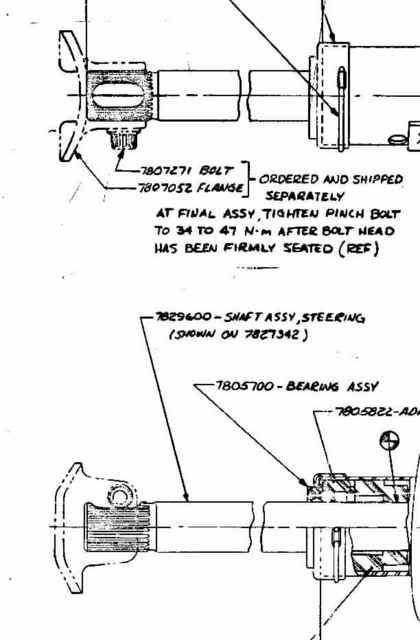
Early 1969 columns did have a clamp on the lower steering shaft. However, that clamp was positioned with a gap of about 1/4 to 1/2 inch between it and the lower bearing. The clamp was part of the energy management (in a severe collision). The clamp really wasn't part of the design that normally kept the steering shaft in place.

Jim
Corrosion through the years between the bare lower steering shaft and the lower bearing can pretty effectively "lock" the shaft and bearing together. In that case, the only way the upper shaft and steering wheel can move in and out would be if the plastic injection is sheared and the upper bearing can move in and out of the turn signal switch housing. It is the round wire rings on either side of the upper bearing in the column head that prevents the two piece steering shaft from moving.

Early 1969 columns did have a clamp on the lower steering shaft. However, that clamp was positioned with a gap of about 1/4 to 1/2 inch between it and the lower bearing. The clamp was part of the energy management (in a severe collision). The clamp really wasn't part of the design that normally kept the steering shaft in place.

Jim
Last edited by Jim Shea; Mar 1, 2014 at 07:28 AM.
Thread Starter
Safety Car
Joined: Sep 2005
Posts: 4,226
Likes: 643
From: Orange County Ca
I do have a early 69 with the clamp. I did adjust the clamp up against the lower bearing and this did remove some play. I then removed the steering wheel and looked at the bearing. It was loose in the housing. After removing the bearing and cleaning it, I greased it and epoxied it back into the housing. I peened the housing edge over slightly also. I'll let the epoxy cure for a while then reassemble.
With the bearing out, the upper shaft seems to bear towards 1 side of the housing. The installed bearing does center it. Would this signify a misalignment with the steering box?
I have the flange locking bolt and the clamp loose now and I will tighten them after the upper steering is all assembled. Is this the correct method?
Again, thanks all.
With the bearing out, the upper shaft seems to bear towards 1 side of the housing. The installed bearing does center it. Would this signify a misalignment with the steering box?
I have the flange locking bolt and the clamp loose now and I will tighten them after the upper steering is all assembled. Is this the correct method?
Again, thanks all.
Corvette Stories
The Best of Corvette for Corvette Enthusiasts

Top 10 Most Expensive Corvettes Ever Sold on Bring A Trailer
Brett Foote
10 Things Every Corvette Owner Needs (2026 Edition)
Michael S. Palmer
8 Most "Only Corvette Owners Understand" Quirks and Problems
Pouria Savadkouei
10 Reasons the C6 Z06 is Still A Performance Benchmark After 20 Years
Joe Kucinski
How Much Horsepower Every Corvette Engine "LOST" in 1972
Joe Kucinski
Top 10 DOs and DON'Ts for Protecting Your Convertible Top!
Michael S. Palmer
Top 10 Most Explosive Corvettes Ever Made: Power-to-Weight Ratio Ranked!
Joe Kucinski
150 hp to 1,250 hp: Every Corvette Generation Compared by the Specs That Matter
Joe Kucinski
8 Coolest Corvette Pace Cars (and Replicas) of All Time
Verdad Gallardo
Le Mans Master
Joined: Jul 2000
Posts: 6,001
Likes: 113
From: Saginaw Michigan
I do have a early 69 with the clamp. I did adjust the clamp up against the lower bearing and this did remove some play. I then removed the steering wheel and looked at the bearing. It was loose in the housing. After removing the bearing and cleaning it, I greased it and epoxied it back into the housing. I peened the housing edge over slightly also. I'll let the epoxy cure for a while then reassemble.
With the bearing out, the upper shaft seems to bear towards 1 side of the housing. The installed bearing does center it. Would this signify a misalignment with the steering box?
I have the flange locking bolt and the clamp loose now and I will tighten them after the upper steering is all assembled. Is this the correct method?
Again, thanks all.
With the bearing out, the upper shaft seems to bear towards 1 side of the housing. The installed bearing does center it. Would this signify a misalignment with the steering box?
I have the flange locking bolt and the clamp loose now and I will tighten them after the upper steering is all assembled. Is this the correct method?
Again, thanks all.
There is a slight design angle between the steering column and the steering gear. That in itself may cause the upper end of the steering shaft to appear to "tip" when the upper bearing is removed. Look at the flexible coupling. The stop pins should be central in the cutouts in the flange that is attached to the steering column shaft. Turn the steering wheel one quarter turn and recheck to make sure they are still central. If they are central, then you are good to go.

The stop pin in this picture is not particularly centered but it does have clearance on both sides.
Jim