




Poly Bushings

Melting Slicks


Joined: Mar 2008
Posts: 2,666
Likes: 289
From: Spring Park MN


If I couldn't feel every tiny thing going on when racing my Top Fuel bike, I probably wouldn't still be here today.
You can't just say nobody can tell the difference because I can't!
I believe the reason a lot people say there car rides harsher with poly is they put on stiffer springs, shocks, and bars at the same time. My 64 SS is anything but harsh and it did tighten up the steering on that big barge.

Drifting


Joined: May 2005
Posts: 1,968
Likes: 44
From: East TN
Now, I look forward to some occasional track days with my vette after I finish a little more work to it.

Instructor


Joined: Apr 2011
Posts: 217
Likes: 0
From: Shearwater Nova Scotia
Rubber has lasted on my car for 36 years. You don't put poly in some spots on the suspension (trailing arms). Rubber can go everywhere. Rubber is cheaper than poly.
I am rebuilding the suspension with rubber.

Team Owner


Joined: Apr 1999
Posts: 21,953
Likes: 1,445
From: Reno Nevada
2024 C3 of the Year Finalist- Modified

http://www.vbandp.com/auto-parts.htm...yword=bushings

Race Director

Joined: Jul 2001
Posts: 15,892
Likes: 42
You actually believe the the bonded rubber in this bushing has the ability to stretch over 90 degrees?
http://www.vbandp.com/auto-parts.htm...yword=bushings
http://www.vbandp.com/auto-parts.htm...yword=bushings
Where?
Race Director
Joined: Jul 2001
Posts: 15,892
Likes: 42
Nope, sorry. That's incorrect. The inner tube is rigidly held in place by the bolt and washer. Some bushings have a serration on the end surface and a matching serration on the inside of the washer to ensure their is no movement. This is why a car must be sitting on it's wheels before the suspensions bolts/nuts are tightened.
http://www.import-car.com/Article/73...omplaints.aspx
"To eliminate wearing surfaces, the rubber bushing is bonded to inner and outer metal sleeves. The outer sleeve is usually pressed into the control arm or spring while the inner sleeve is clamped to the frame by a retainer bolt."

http://www.pistonheads.com/gassing/t...+arm+bushes%3F
A poly bushing, because of it's inability to flex or compress must be allowed to rotate across a mating surface, which is where the clearance, movement and wear comes from.
http://www.import-car.com/Article/73...omplaints.aspx
"To eliminate wearing surfaces, the rubber bushing is bonded to inner and outer metal sleeves. The outer sleeve is usually pressed into the control arm or spring while the inner sleeve is clamped to the frame by a retainer bolt."
http://www.pistonheads.com/gassing/t...+arm+bushes%3F
A poly bushing, because of it's inability to flex or compress must be allowed to rotate across a mating surface, which is where the clearance, movement and wear comes from.

Race Director

Joined: May 2003
Posts: 10,956
Likes: 409
From: California
MW is correct:-) omg,
but Poly still do handle tighter, and yes i can tell, i have 4 vettes and i race them at the track... I can see the desire in rubber... and if you do NOT race, i think the rubber is better...
but Poly still do handle tighter, and yes i can tell, i have 4 vettes and i race them at the track... I can see the desire in rubber... and if you do NOT race, i think the rubber is better...
Corvette Stories
The Best of Corvette for Corvette Enthusiasts

Top 10 Most Expensive Corvettes Ever Sold on Bring A Trailer
Brett Foote
10 Things Every Corvette Owner Needs (2026 Edition)
Michael S. Palmer
8 Most "Only Corvette Owners Understand" Quirks and Problems
Pouria Savadkouei
10 Reasons the C6 Z06 is Still A Performance Benchmark After 20 Years
Joe Kucinski
How Much Horsepower Every Corvette Engine "LOST" in 1972
Joe Kucinski
Top 10 DOs and DON'Ts for Protecting Your Convertible Top!
Michael S. Palmer
Top 10 Most Explosive Corvettes Ever Made: Power-to-Weight Ratio Ranked!
Joe Kucinski
150 hp to 1,250 hp: Every Corvette Generation Compared by the Specs That Matter
Joe Kucinski
8 Coolest Corvette Pace Cars (and Replicas) of All Time
Verdad Gallardo
Team Owner
Joined: Oct 2004
Posts: 81,241
Likes: 3,063
From: altered state
St. Jude Donor '05
In certain cases rubber can help prevent suspension binding.
I simply dont trust any rubber product made today to last like the originals so polygraphite it is.
Hell my rubber body bushings are only two yrs old anc cracking already.
I simply dont trust any rubber product made today to last like the originals so polygraphite it is.
Hell my rubber body bushings are only two yrs old anc cracking already.
Team Owner
Joined: Apr 1999
Posts: 21,953
Likes: 1,445
From: Reno Nevada
2024 C3 of the Year Finalist- Modified
Now wonder my car is so screwed up I didn't assemble it like an import car!
I was changing springs out a few years ago and I had a set of lower Rubber bushings and my poly were years old so I thought what the heck I'm already here and I wanted to media blast my a-arms and paint them anyway.
I did not assemble these on the ground. 600# QA-1 semi coil overs

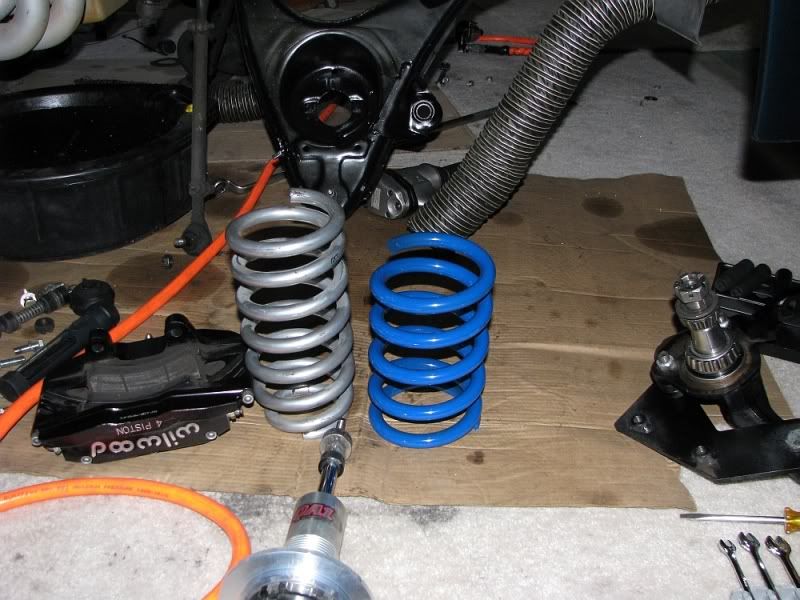 [/URL]
I was changing springs out a few years ago and I had a set of lower Rubber bushings and my poly were years old so I thought what the heck I'm already here and I wanted to media blast my a-arms and paint them anyway.
I did not assemble these on the ground. 600# QA-1 semi coil overs
[/URL]

Cruising
Joined: Mar 2014
Posts: 13
Likes: 0
From: Escondido California
Jim78SA - I would love to hear your decision results, how the install went and what you think of the new handling. My next project is the front end on my 81. It is loose, drifting and pulling after years of sitting and rotting. So your project is of keen interest as I have been looking at poly vs. rubber and can't see a reason to NOT do poly even though I want a daily driver... I want it tight like a sports car should be. Thanks in advance.


Advanced
Joined: May 2006
Posts: 75
Likes: 0
Loctite
Did you use the red or blue?

Pro

Joined: Nov 2013
Posts: 730
Likes: 37
From: Catoosa Okla
Wow... opinions for each day of the week. Gotta love it. Here is mine. I needed to replace the 40 year old rubber in my 74 convertible one way or another. I chose poly, pretty much deciding on the difference between a loaded bushing and an unloaded bushing as being the basis for change. More accurately, a loaded RUBBER bushing. I may have a 1/2" ID in the bushing, but when loaded it looks more like an egg. This "egg effect" is transmitted into my steering, effecting things like handling and tire contact here and there. The camber is undoubtedly effected, and done so because of bushing load. You create this load in cornering BTW. And I like to corner... When camber changes while cornering, I lose traction due to poor tire contact. Deflection Steering is another issue present using rubber bushings, but that's another subject altogether. On our Vettes, these issues can effect BOTH the front AND rear in terms of handling. Will you notice the difference driving to the grocery store or to the monthly Vette meet?? Probably not. But if your carving your way through the back hills in Spavinaw or slingshotting your way through the Kiamichi Mountains, I don't know about you, but I want to KNOW I have the best possible tire contact on the road at all times, ESPECIALLY during cornering. My odds of this happening are far greater with Poly-graphite bushings than they ever will be with rubber. Feel free to hate me. Will some comfort be sacrificed? Yes. I Still have to steal from Peter to pay Paul... But it's a tradeoff I was willing to make. I think if most will spend a little time doing research on the pros and cons of Graphite vs Rubber, they will have enough information to make an educated decision based upon their own personal needs. Personally, I see green grass on both sides of the field. In a daily driver car or truck, given the option, I'd probably stay with rubber, for the sheer comfort and help in silencing road noise. But if I'm driving something where I tend to push the proverbial envelope, it's Polygraphite all the way.

Melting Slicks
Joined: Apr 2010
Posts: 2,794
Likes: 1,195
From: Canberra Australia
2025 C3 of the Year Finalist - Modified
Always discussion that brings up the extremes.
Mike is correct many people would not be able to tell the difference or even care.
However if you are an enthusiastic driver and like the tighter feel of poly go with it.
I have a poly through my front end and my mate has rubber.
He has observed the difference in overall tightness that it exhibits between the two cars.
Living on the other side of the world we have always considered US cars (a generalization) as worse handling in comparison to European models. Australian ones lent more to europe in suspension feel and tightness (you may call it harshness). So anything we can do to tighten up the vette is a good route to take.
So if you like the tighter feel as I said make that choice if not stay rubber.
We do however both also drive modified later model cars with suspension mods etc so possibly we should be categorized out of the decision equation as boy racers. :-)
Mike is correct many people would not be able to tell the difference or even care.
However if you are an enthusiastic driver and like the tighter feel of poly go with it.
I have a poly through my front end and my mate has rubber.
He has observed the difference in overall tightness that it exhibits between the two cars.
Living on the other side of the world we have always considered US cars (a generalization) as worse handling in comparison to European models. Australian ones lent more to europe in suspension feel and tightness (you may call it harshness). So anything we can do to tighten up the vette is a good route to take.
So if you like the tighter feel as I said make that choice if not stay rubber.
We do however both also drive modified later model cars with suspension mods etc so possibly we should be categorized out of the decision equation as boy racers. :-)
Last edited by CraigH; Mar 26, 2014 at 05:25 PM.

Instructor
Joined: Jan 2004
Posts: 242
Likes: 4
From: deland fl
When I rebuilt my 75 convertible I used all rubber bushings. I figured that when the GM engineers designed the suspension system on these cars they probably took the compliance of rubber bushings into consideration. Those guys are a lot smarter than me. Wouldn't adding the "stiffness" of poly tend to maybe move some stress to locations possibly not designed to handle it? Just wonderin'.....
Larry
Larry

Le Mans Master

Joined: Oct 2007
Posts: 7,453
Likes: 976
From: RI, Now Franklin/Nashville TN
When I rebuilt my 75 convertible I used all rubber bushings. I figured that when the GM engineers designed the suspension system on these cars they probably took the compliance of rubber bushings into consideration. Those guys are a lot smarter than me. Wouldn't adding the "stiffness" of poly tend to maybe move some stress to locations possibly not designed to handle it? Just wonderin'.....
Larry
Larry

Safety Car

Joined: Mar 2007
Posts: 3,652
Likes: 49
From: Bridgewater nj
I ordered black. I didn't want to attract attention to the original 100k + miles of road dirt under my car
Poly does clean up well because the dirt and grease doesn't soak in like rubber.
Let me add one more thing to this debate.
When a rubber bushing begins to fail. It is a major project to replace it.
When poly begins to fail. You can pop them out with your fingers and grease then replace in less than 5 minutes once the bushing is exposed.
Poly does clean up well because the dirt and grease doesn't soak in like rubber.
Let me add one more thing to this debate.
When a rubber bushing begins to fail. It is a major project to replace it.
When poly begins to fail. You can pop them out with your fingers and grease then replace in less than 5 minutes once the bushing is exposed.

Racer
Joined: Sep 2013
Posts: 254
Likes: 0
From: Charleston SC
I ordered black. I didn't want to attract attention to the original 100k + miles of road dirt under my car
Poly does clean up well because the dirt and grease doesn't soak in like rubber.
Let me add one more thing to this debate.
When a rubber bushing begins to fail. It is a major project to replace it.
When poly begins to fail. You can pop them out with your fingers and grease then replace in less than 5 minutes once the bushing is exposed.
Poly does clean up well because the dirt and grease doesn't soak in like rubber.
Let me add one more thing to this debate.
When a rubber bushing begins to fail. It is a major project to replace it.
When poly begins to fail. You can pop them out with your fingers and grease then replace in less than 5 minutes once the bushing is exposed.
thanks
Instructor
Joined: Jan 2004
Posts: 242
Likes: 4
From: deland fl
There are many items, suspension and engine components, that were just not available when the C3 suspension was designed and actually being built from 1963-1982 that were just not available back then-one of them poly bushings. Others examples are stronger rear strut rods with heim joint ends, synthetic fluids, better tire technology etc. You get folks who say don't use a synthetic diff fluid because Eaton never recommended it back then. Well, synthetics were not around............does not mean it is not better now.