




MSD Atomic EFI Install - '76

Thread Starter
Pro


Joined: Aug 2000
Posts: 708
Likes: 21
From: Montrose CA

I'll give those settings a try
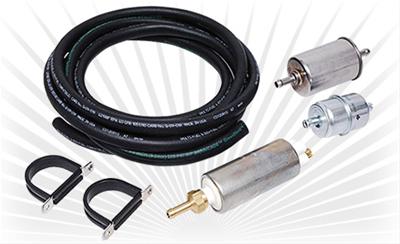
Regarding the fuel lines... running the fuel hose was not too bad... routed down behind the passenger side bank next to the distributor - then - I mounted the fuel regulator on the face of the passenger footwell - then ran the hose back along the inside of the frame up and around the wheelwell back to the tank... not too bad - used perhaps 20-clips to hold the fuel line.
Back at the tank I was lucky to have a new style bladder tank - the bladder tank has a large opening for the gage sending unit... I was able to screw the electric fuel pump to a piece of sheet metal and use the old fuel outlet as the new return line inlet and add one new nipple for the new pressure side fuel feed. I ran the electric line through the old fuel return line. So far so good - hope the sheetmetal screws do not loosen up and fall apart.
Purchasing that submersible fuel line was pricy - I believe it was on the order of $40 for a foot and a half. Also had to be careful shopping for the electric wire to ensure it was suitable for immersion in the gas tank - found it at the local hardware store.
A surprise - the fuel pump is loud and the regulator makes a pulsing noise noticeable at idle that is annoying.
BTW - I sent in the document requesting Historical Vehicle registration earlier today.
Best to all - Carl
Regarding the fuel lines... running the fuel hose was not too bad... routed down behind the passenger side bank next to the distributor - then - I mounted the fuel regulator on the face of the passenger footwell - then ran the hose back along the inside of the frame up and around the wheelwell back to the tank... not too bad - used perhaps 20-clips to hold the fuel line.
Back at the tank I was lucky to have a new style bladder tank - the bladder tank has a large opening for the gage sending unit... I was able to screw the electric fuel pump to a piece of sheet metal and use the old fuel outlet as the new return line inlet and add one new nipple for the new pressure side fuel feed. I ran the electric line through the old fuel return line. So far so good - hope the sheetmetal screws do not loosen up and fall apart.
Purchasing that submersible fuel line was pricy - I believe it was on the order of $40 for a foot and a half. Also had to be careful shopping for the electric wire to ensure it was suitable for immersion in the gas tank - found it at the local hardware store.
A surprise - the fuel pump is loud and the regulator makes a pulsing noise noticeable at idle that is annoying.
BTW - I sent in the document requesting Historical Vehicle registration earlier today.
Best to all - Carl
Some more advance could actually help you achieve the higher A/F ratios; lean burns require a bit more spark.
14.7 should get your CO numbers down a bit further, and I don't have any reason to believe the car couldn't handle that.
How bad was plumbing the new fuel lines? That, and the price, are the two big things making me hesitate doing the install.
14.7 should get your CO numbers down a bit further, and I don't have any reason to believe the car couldn't handle that.
How bad was plumbing the new fuel lines? That, and the price, are the two big things making me hesitate doing the install.

Drifting


Joined: Aug 2005
Posts: 1,443
Likes: 65
From: Wauconda IL
I can imagine that pump is quite loud-
Hard to tell from the photo but it looks like it's mounted right against that sheet metal 'tuning fork' with no cushioning between the pump and the sheet metal?
Hard to tell from the photo but it looks like it's mounted right against that sheet metal 'tuning fork' with no cushioning between the pump and the sheet metal?

Drifting


Joined: Apr 2005
Posts: 1,917
Likes: 451
From: Central NJ
Do you notice any fuel vapor smell coming from those rubber lines?
Honestly I really dont care for that in tank set up you made-looks like it is very flimsy and those self tapping screws holding up the whole deal is just begging for trouble.
I hope you didnt use those same type screws to support the reg and filter.
Honestly I really dont care for that in tank set up you made-looks like it is very flimsy and those self tapping screws holding up the whole deal is just begging for trouble.
I hope you didnt use those same type screws to support the reg and filter.
Drifting
Joined: Aug 2005
Posts: 1,443
Likes: 65
From: Wauconda IL
Drifting
Joined: Apr 2005
Posts: 1,917
Likes: 451
From: Central NJ

Does anyone live close to the OP? He must be STOPPED!!!

Last edited by tektrans; Dec 11, 2014 at 05:42 PM.
Drifting
Joined: Apr 2005
Posts: 1,917
Likes: 451
From: Central NJ
Corvette Stories
The Best of Corvette for Corvette Enthusiasts

Top 10 Most Expensive Corvettes Ever Sold on Bring A Trailer
Brett Foote
10 Things Every Corvette Owner Needs (2026 Edition)
Michael S. Palmer
8 Most "Only Corvette Owners Understand" Quirks and Problems
Pouria Savadkouei
10 Reasons the C6 Z06 is Still A Performance Benchmark After 20 Years
Joe Kucinski
How Much Horsepower Every Corvette Engine "LOST" in 1972
Joe Kucinski
Top 10 DOs and DON'Ts for Protecting Your Convertible Top!
Michael S. Palmer
Top 10 Most Explosive Corvettes Ever Made: Power-to-Weight Ratio Ranked!
Joe Kucinski
150 hp to 1,250 hp: Every Corvette Generation Compared by the Specs That Matter
Joe Kucinski
8 Coolest Corvette Pace Cars (and Replicas) of All Time
Verdad Gallardo
Thread Starter
Pro
Joined: Aug 2000
Posts: 708
Likes: 21
From: Montrose CA
some of the questions...
no vapor smell from any part of the system - operates normal.
Regarding the rubber for the fuel pump mounts - I had that same question as to whether the rubber was suitable for immersion - contacted MSD and they sent back an email from the engineer verifying it was specified for immersion - one would think that is a no-brainer but since it is not explicitly stated in the instructions - had to ask.
The matter of the sheetmetal screws bothers me too... using screws allowed for quicker fabrication and what you see is the result of two iterations with the tin snips... so the screws were useful. I could have easily hit the edges with a few tack welds to lock them together - guess I'll do that should I ever have a problem with the pump becoming loose.
and yes - sheet metal screws through the fiberglass floorboard to hold the filter and regulator onto the firewall. Those screws may be changed to bolt and nuts quicker than the sheetmetal screws in the tank.
so if y'all need some fabrication help bring a sixer and come on over
 we can pull up under the shade tree and get-r-done!!
Best to all!!
no vapor smell from any part of the system - operates normal.
Regarding the rubber for the fuel pump mounts - I had that same question as to whether the rubber was suitable for immersion - contacted MSD and they sent back an email from the engineer verifying it was specified for immersion - one would think that is a no-brainer but since it is not explicitly stated in the instructions - had to ask.
The matter of the sheetmetal screws bothers me too... using screws allowed for quicker fabrication and what you see is the result of two iterations with the tin snips... so the screws were useful. I could have easily hit the edges with a few tack welds to lock them together - guess I'll do that should I ever have a problem with the pump becoming loose.
and yes - sheet metal screws through the fiberglass floorboard to hold the filter and regulator onto the firewall. Those screws may be changed to bolt and nuts quicker than the sheetmetal screws in the tank.
so if y'all need some fabrication help bring a sixer and come on over
we can pull up under the shade tree and get-r-done!!Best to all!!
Last edited by Carl in LA; Dec 12, 2014 at 09:39 AM. Reason: typo

Thread Starter
Pro
Joined: Aug 2000
Posts: 708
Likes: 21
From: Montrose CA
Upon further review. .. I think I need to write a song about this install. ..
The tag line would be:
Tin-snips, vise-grips, and sheet metal screws - with the melody from Rednecks, white socks, and Blue Ribbon beer.
Fun times it is.
Also... I can see that it is time to archive this thread. The dialog was much appreciated!
Carl
The tag line would be:
Tin-snips, vise-grips, and sheet metal screws - with the melody from Rednecks, white socks, and Blue Ribbon beer.
Fun times it is.
Also... I can see that it is time to archive this thread. The dialog was much appreciated!
Carl
Last edited by Carl in LA; Dec 12, 2014 at 11:12 AM. Reason: Contemplation

Thread Starter
Pro
Joined: Aug 2000
Posts: 708
Likes: 21
From: Montrose CA
The break here in California is 1975 to 1976 model years. The issue is so **** retentive there is written clarification that even if your 1976 model car was built in 1975 - it is subject to smog check.
Carl
Thread Starter
Pro
Joined: Aug 2000
Posts: 708
Likes: 21
From: Montrose CA
Hello Shark Racer:
The historic registration is done.
Not too bad - I already had the Haggerty classic car insurance in place - which may have made the process easier (did some DMV staffer actually check???). All I did was print the form from DMV website - entered the information - cut the $25 check - mailed it in - and a month later - the plates and the new registration sheet arrived in the mail... guess that's it...
I actually like the "Historical Vehicle" designation - it's certainly historic to me.
(allright - no funny comments about the towel under the engine!!! I am hunting for one last pesky leak!)
Carl
The historic registration is done.
Not too bad - I already had the Haggerty classic car insurance in place - which may have made the process easier (did some DMV staffer actually check???). All I did was print the form from DMV website - entered the information - cut the $25 check - mailed it in - and a month later - the plates and the new registration sheet arrived in the mail... guess that's it...
I actually like the "Historical Vehicle" designation - it's certainly historic to me.
(allright - no funny comments about the towel under the engine!!! I am hunting for one last pesky leak!)
Carl
I planned on doing this as well. A few thoughts:
1. Historic vehicles come with rules that limit how you drive them; moreso than classic car insurance.
2. It took forever to find someone who even knew how the exemption worked; I talked to multiple people at the DMV and BAR before I found someone who said that such a program even existed. Most wouldn't even bother looking up the vehicle code for it.
3. The car has to be in original configuration to qualify as a historic vehicle. Your car likely does not cover this.
What does that mean? To me, #2 means finding a smog shop who will do a tail-pipe only test is going to be a pain as they likely won't know about the law. Not sure what hoops you have to jump through to get the plate, but if #3 is scrutinized I think you'll likely be out of luck.
Not trying to be negative, just passing what I learned along. I gave up on that route...
1. Historic vehicles come with rules that limit how you drive them; moreso than classic car insurance.
2. It took forever to find someone who even knew how the exemption worked; I talked to multiple people at the DMV and BAR before I found someone who said that such a program even existed. Most wouldn't even bother looking up the vehicle code for it.
3. The car has to be in original configuration to qualify as a historic vehicle. Your car likely does not cover this.
What does that mean? To me, #2 means finding a smog shop who will do a tail-pipe only test is going to be a pain as they likely won't know about the law. Not sure what hoops you have to jump through to get the plate, but if #3 is scrutinized I think you'll likely be out of luck.
Not trying to be negative, just passing what I learned along. I gave up on that route...
Last edited by Carl in LA; Jan 4, 2015 at 01:06 PM. Reason: added content...
Thread Starter
Pro
Joined: Aug 2000
Posts: 708
Likes: 21
From: Montrose CA


Melting Slicks


Joined: Apr 2006
Posts: 2,331
Likes: 61
From: Sunnyvale CA
A.I.R. and 0xygen Sensor?
As I understand things, you currently have exhaust manifold, not headers. Are they GM Rams' Horn or those shiny "smoothies" I saw in your pictures.
Also, do you have the A.I.R. system installed (I thought you did) and if so, where is your oxy sensor installed? I thought it had to be UPSTREAM of A.I.R. if A.I.R is present, though I can't figure out how you could that.
Lots of great pictures. Looks like really nice work!

Steve
Also, do you have the A.I.R. system installed (I thought you did) and if so, where is your oxy sensor installed? I thought it had to be UPSTREAM of A.I.R. if A.I.R is present, though I can't figure out how you could that.
Lots of great pictures. Looks like really nice work!
Steve
Race Director


Joined: Jan 2000
Posts: 12,399
Likes: 247
From: San Jose CA
As I understand things, you currently have exhaust manifold, not headers. Are they GM Rams' Horn or those shiny "smoothies" I saw in your pictures.
Also, do you have the A.I.R. system installed (I thought you did) and if so, where is your oxy sensor installed? I thought it had to be UPSTREAM of A.I.R. if A.I.R is present, though I can't figure out how you could that.
Lots of great pictures. Looks like really nice work!
Steve
Also, do you have the A.I.R. system installed (I thought you did) and if so, where is your oxy sensor installed? I thought it had to be UPSTREAM of A.I.R. if A.I.R is present, though I can't figure out how you could that.
Lots of great pictures. Looks like really nice work!
Steve

If you look at the first pic of his thread, it looks like he has the AIR hooked up in the default location. I would imagine the same thing, as you're injecting raw oxygen into the exhaust and it could skew the mixtures a little leaner than they actually are. Of course, I'm fairly confident the air pump pulse is a MUCH smaller contributor to O2 readings than the combination of cylinders.
I'm no expert, though. I know GM was using AIR w/ E4ME (feedback carb) cars in the "wrong" position.
It looks like the LG4, L81 and L83 (crossfire) all had AIR at the highest points in the port; i.e. before the O2 sensor. And sure, those are low-tech motors but the C5 had the AIR input in the same spot as well, as near as I can tell:

They could have solved AIR input with the computer, of course, but I don't think it would be trivial with only a narrowband system available, and that would be erring on the side of danger (skewing the mixture towards lean once you start pulling fuel to compensate for AIR).
Thread Starter
Pro
Joined: Aug 2000
Posts: 708
Likes: 21
From: Montrose CA
Hello Steve:
Thank you for the compliment.
I do have stock manifolds just now. The chrome smoothies did not work out as the smoothies are sized for 2-1/2 exhaust and my L-48 pipe is 2-1/4. So I stopped the smoothies install until I can decide what to do with all these exhaust lose ends.
The stock AIR system is still in place too. On the 1976 model all the AIR goes into the passenger side half of the y-pipe. As such, I installed the MSD Atomic O2 sensor in the driver side half of the y-pipe and then set the Atomic to the "no AIR" setting. No problem.
I would like to do something with the exhaust... perhaps true duels with the chrome smoothies and 3-inch pipe or those radical headers and sidepipes.
I am still bothered that tampering with the exhaust is illegal so that aspect may hold me back from doing anything until the rules change.
Best to all...
Carl
Thank you for the compliment.
I do have stock manifolds just now. The chrome smoothies did not work out as the smoothies are sized for 2-1/2 exhaust and my L-48 pipe is 2-1/4. So I stopped the smoothies install until I can decide what to do with all these exhaust lose ends.
The stock AIR system is still in place too. On the 1976 model all the AIR goes into the passenger side half of the y-pipe. As such, I installed the MSD Atomic O2 sensor in the driver side half of the y-pipe and then set the Atomic to the "no AIR" setting. No problem.
I would like to do something with the exhaust... perhaps true duels with the chrome smoothies and 3-inch pipe or those radical headers and sidepipes.
I am still bothered that tampering with the exhaust is illegal so that aspect may hold me back from doing anything until the rules change.
Best to all...
Carl
As I understand things, you currently have exhaust manifold, not headers. Are they GM Rams' Horn or those shiny "smoothies" I saw in your pictures.
Also, do you have the A.I.R. system installed (I thought you did) and if so, where is your oxy sensor installed? I thought it had to be UPSTREAM of A.I.R. if A.I.R is present, though I can't figure out how you could that.
Lots of great pictures. Looks like really nice work!
Steve
Also, do you have the A.I.R. system installed (I thought you did) and if so, where is your oxy sensor installed? I thought it had to be UPSTREAM of A.I.R. if A.I.R is present, though I can't figure out how you could that.
Lots of great pictures. Looks like really nice work!
Steve
Last edited by Carl in LA; Jan 7, 2015 at 12:01 AM.