





Long soft brake pedal problem

Thread Starter
Tech Contributor


Joined: Jun 2004
Posts: 20,795
Likes: 959
From: I tend to be leery of any guy who doesn't own a chainsaw or a handgun.
 Long soft brake pedal problem
Been dealing with a long pedal issue for too long, and I can't narrow it down sufficiently to fix the guilty part.
Prior to any track day I always bleed the brake system. However, it rarely fixes the problem, and it seems to get worse each year (I had to cancel a T&T track day tomorrow because the brakes were just too marginal.)
My brake system is comprised of the stock power booster, a C5 master cylinder, the stock combination valve, and Wilwood Dynalite calipers. The f&r calipers are mounted vertically to minimize air retention in the bores. (Here's some ancient pictures from when I was mocking up/putting the system together years ago.) In light of the bleeder post location "offset" that Ignatz has pointed out on other Wilwood calipers, I might need to take a closer look at the piston bore locations relative to the bleeder screws.
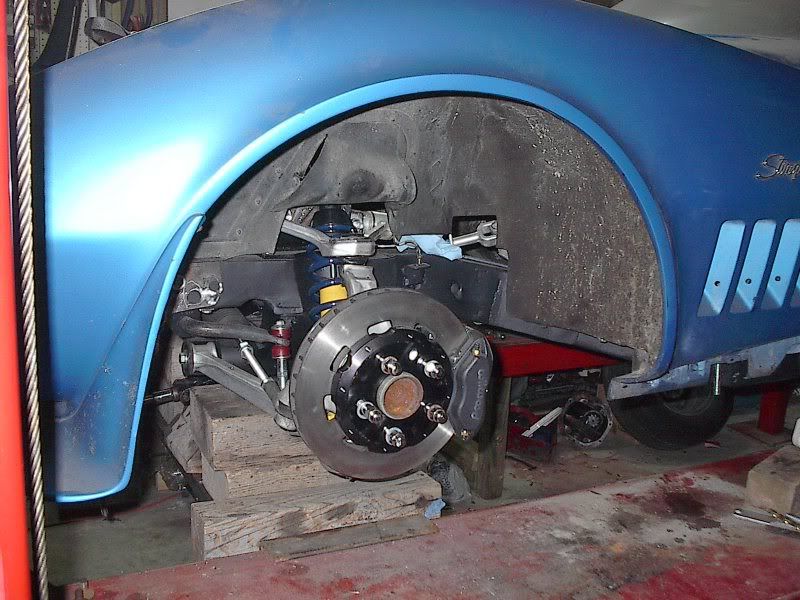

The odd part of this problem is that when I bleed the system the pedal seems to be fairly firm (although not quite as high as I would like, more on that later), but as soon as I start the engine (and obviously supply vacuum to the booster) the pedal will go almost to the floor with just modest pressure. I'm not following what's going on here (unless there's still a lot of air in the system, and the added assist from the booster is compressing the air farther than I could/did with the engine off).
When I installed the C5 m/c years ago I had to shorten the "pushrod" that goes between the booster and m/c. I think I shortened it to the correct length (I made a fixture to measure the depths each way), but is there any possibility that when vacuum is supplied to the booster that the diaphragm center point (that pushes on the pushrod) moves rearward a bit, meaning that my non-vacuum method of measuring the depth that the pushrod goes into the booster is incorrect, and the pushrod is now too short? Perhaps I need to invest in a vacuum pump to test this theory/question to see if the pushrod depth changes.
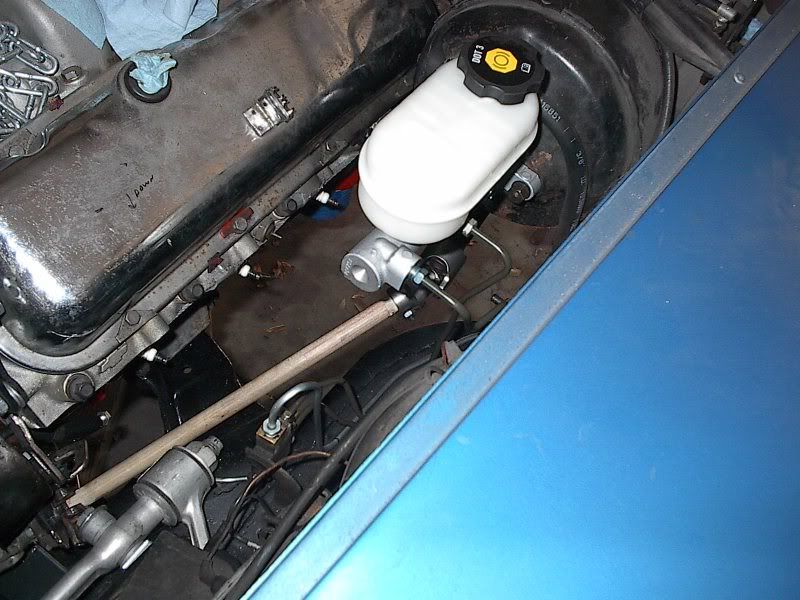
Are the m/c piston seals leaking, allowing fluid (and pressure) to leak across the bore/seal interface? I don't think so, but perhaps a small imperfection in the bore or seal is allowing leakage. I suppose I can pull the m/c apart and look at the internals if that's the prime suspect.
I'm curious if there's any way air could be sticking in the combination valve (I pulled the valve off the original frame and transplanted it onto the "new" frame when I put the later suspension on it). I've spent a small fortune on brake fluid, bleeding this system multiple times a year, and the pedal still isn't high or as firm as I'd like.
I've got speed bleeders on the calipers, and I've tried bleeding the brakes using the bleeders' internal valve action, and also used the "one stroke & hold the pedal down by sticking a 20" 2x2 between the pedal and the seat cushion" method to rule out any air getting sucked past the bleeder threads if the pedal is released while the bleeder is loose.
That's about all that I can think of at the moment. Any constructive suggestions or questions are appreciated.
Prior to any track day I always bleed the brake system. However, it rarely fixes the problem, and it seems to get worse each year (I had to cancel a T&T track day tomorrow because the brakes were just too marginal.)
My brake system is comprised of the stock power booster, a C5 master cylinder, the stock combination valve, and Wilwood Dynalite calipers. The f&r calipers are mounted vertically to minimize air retention in the bores. (Here's some ancient pictures from when I was mocking up/putting the system together years ago.) In light of the bleeder post location "offset" that Ignatz has pointed out on other Wilwood calipers, I might need to take a closer look at the piston bore locations relative to the bleeder screws.


The odd part of this problem is that when I bleed the system the pedal seems to be fairly firm (although not quite as high as I would like, more on that later), but as soon as I start the engine (and obviously supply vacuum to the booster) the pedal will go almost to the floor with just modest pressure. I'm not following what's going on here (unless there's still a lot of air in the system, and the added assist from the booster is compressing the air farther than I could/did with the engine off).
When I installed the C5 m/c years ago I had to shorten the "pushrod" that goes between the booster and m/c. I think I shortened it to the correct length (I made a fixture to measure the depths each way), but is there any possibility that when vacuum is supplied to the booster that the diaphragm center point (that pushes on the pushrod) moves rearward a bit, meaning that my non-vacuum method of measuring the depth that the pushrod goes into the booster is incorrect, and the pushrod is now too short? Perhaps I need to invest in a vacuum pump to test this theory/question to see if the pushrod depth changes.

Are the m/c piston seals leaking, allowing fluid (and pressure) to leak across the bore/seal interface? I don't think so, but perhaps a small imperfection in the bore or seal is allowing leakage. I suppose I can pull the m/c apart and look at the internals if that's the prime suspect.
I'm curious if there's any way air could be sticking in the combination valve (I pulled the valve off the original frame and transplanted it onto the "new" frame when I put the later suspension on it). I've spent a small fortune on brake fluid, bleeding this system multiple times a year, and the pedal still isn't high or as firm as I'd like.
I've got speed bleeders on the calipers, and I've tried bleeding the brakes using the bleeders' internal valve action, and also used the "one stroke & hold the pedal down by sticking a 20" 2x2 between the pedal and the seat cushion" method to rule out any air getting sucked past the bleeder threads if the pedal is released while the bleeder is loose.
That's about all that I can think of at the moment. Any constructive suggestions or questions are appreciated.
Last edited by 69427; Jun 19, 2015 at 12:05 AM. Reason: Multiple postings to prevent system from timing out on me.

Safety Car


Joined: May 2004
Posts: 4,340
Likes: 1,567
From: los altos hills california
When I read your first post last night I was going to guess rotor runout somewhere, but with the edits and as the pedal goes immediately down it's likely not that. As far as entrapped air in the calipers looks very unlikely given the mounting.
As to the combination valve, I wouldn't think there be so much air in it that you'd lose a lot of pedal. For the calipers I assume there is some sort of internal passage between top and bottom cylinders that works well in the mounted vertical mounted position (for my own situation I never thought there might be entrapped air in the lower cylinders until just now).
I don't see how the hoses route in these pictures but if you're trying to isolate to the M/C or somewhere else, you might try plugging the hose ends to eliminate calipers. I don't know how you'd bleed that and it sounds like a lot of fooling around but it's all I've got.
As to the combination valve, I wouldn't think there be so much air in it that you'd lose a lot of pedal. For the calipers I assume there is some sort of internal passage between top and bottom cylinders that works well in the mounted vertical mounted position (for my own situation I never thought there might be entrapped air in the lower cylinders until just now).
I don't see how the hoses route in these pictures but if you're trying to isolate to the M/C or somewhere else, you might try plugging the hose ends to eliminate calipers. I don't know how you'd bleed that and it sounds like a lot of fooling around but it's all I've got.
Advanced


Joined: Jun 2014
Posts: 58
Likes: 2
From: New Jersey
69427, you seem very knowledgeable about what you are putting together so I am sure that you considered this. Is the C5 master's piston big enough given the pick-up point of the actuator rod on the C3 pedal (travel) and the piston area of the calipers (required amount of fluid)? I know that this gets into actual braking force as well as travel.
Safety Car
Joined: May 2004
Posts: 4,340
Likes: 1,567
From: los altos hills california
Silicon brake fluid? I got a bunch of flak here for complaining abut the stuff (based on personal experience) but there's a Youtube video of some guy actually "boiling" the air out of some. His advice from his video
DOT 5 brake fluid is an amazing product if used properly. Its great for classic cars which are driven only during the warm seasons, and are parked during the cold weather. DOT 5 won't adversely affect paint or take on moisture either.
The problem with it is that it will dissolve air into solution. Even when used from a fresh bottle it can still have air entrained. I always put it into a bell jar and evacuate it with a vacuum pump. This boils off any dissolved air and produces superior results.
NEVER use a vacuum hand pump to suck DOT 5 into your brake system, always push it in with pressure.
DOT 5 brake fluid is an amazing product if used properly. Its great for classic cars which are driven only during the warm seasons, and are parked during the cold weather. DOT 5 won't adversely affect paint or take on moisture either.
The problem with it is that it will dissolve air into solution. Even when used from a fresh bottle it can still have air entrained. I always put it into a bell jar and evacuate it with a vacuum pump. This boils off any dissolved air and produces superior results.
NEVER use a vacuum hand pump to suck DOT 5 into your brake system, always push it in with pressure.
Thread Starter
Tech Contributor
Joined: Jun 2004
Posts: 20,795
Likes: 959
From: I tend to be leery of any guy who doesn't own a chainsaw or a handgun.
69427, you seem very knowledgeable about what you are putting together so I am sure that you considered this. Is the C5 master's piston big enough given the pick-up point of the actuator rod on the C3 pedal (travel) and the piston area of the calipers (required amount of fluid)? I know that this gets into actual braking force as well as travel.
(I'm assuming the same theoretical pedal travel availability in all three m/c scenarios. This assumption goes out the window if I have some "slop" in the linkage due to some funniness in the booster.)
Thread Starter
Tech Contributor
Joined: Jun 2004
Posts: 20,795
Likes: 959
From: I tend to be leery of any guy who doesn't own a chainsaw or a handgun.
Silicon brake fluid? I got a bunch of flak here for complaining abut the stuff (based on personal experience) but there's a Youtube video of some guy actually "boiling" the air out of some. His advice from his video
DOT 5 brake fluid is an amazing product if used properly. Its great for classic cars which are driven only during the warm seasons, and are parked during the cold weather. DOT 5 won't adversely affect paint or take on moisture either.
The problem with it is that it will dissolve air into solution. Even when used from a fresh bottle it can still have air entrained. I always put it into a bell jar and evacuate it with a vacuum pump. This boils off any dissolved air and produces superior results.
NEVER use a vacuum hand pump to suck DOT 5 into your brake system, always push it in with pressure.
DOT 5 brake fluid is an amazing product if used properly. Its great for classic cars which are driven only during the warm seasons, and are parked during the cold weather. DOT 5 won't adversely affect paint or take on moisture either.
The problem with it is that it will dissolve air into solution. Even when used from a fresh bottle it can still have air entrained. I always put it into a bell jar and evacuate it with a vacuum pump. This boils off any dissolved air and produces superior results.
NEVER use a vacuum hand pump to suck DOT 5 into your brake system, always push it in with pressure.
Corvette Stories
The Best of Corvette for Corvette Enthusiasts

2027 Corvette vs The World: Every C8 vs Its Closest Competitor
Joe Kucinski
10 Most Common Corvette Problems of the Last 20 Years!
Joe Kucinski
5 MOST and 5 LEAST Popular Corvette Model Years in History!
Joe Kucinski
2027 Corvette Buyer's Guide: Everything You Need to Know!
Joe Kucinski
10 Things C8 Corvette Owners Hate (But Won't Tell You)
Joe Kucinski
10 Best Corvettes Coming to Barrett-Jackson Palm Beach 2026!
Brett Foote
Every Corvette Grand Sport Explained! (C2, C4, C6, C7, & C8)
Joe Kucinski
Grand Sport & Grand Sport X Launch Alongside All-New 535hp LS6 V8!
Michael S. Palmer
5 Reasons Bad Drivers Crash & 5 Ways to Avoid a Costly Mistake!
Joe Kucinski
Thread Starter
Tech Contributor
Joined: Jun 2004
Posts: 20,795
Likes: 959
From: I tend to be leery of any guy who doesn't own a chainsaw or a handgun.
Power booster influence on pedal travel?
Was working on my C4 today to have a track ready car while I scratch my head about the '69 brake issue. I noticed in a C4 shop manual that when measuring the brake pedal travel that the book advises to pump the brakes several times first to exhaust the residual vacuum in the booster. This aligns with my concern that the booster is somehow affecting/increasing the pedal travel in the car. As I mentioned earlier, the pedal height is reasonably acceptable (not perfect, but at least acceptable) after I bled everything, but as soon as I start the engine and vacuum is applied to the booster, the pedal will sink to the floor with only modest pressure. So, I need to do a bit of reading to get myself a bit more comfortable with the details of how the booster internals work.
Le Mans Master


Joined: Oct 2006
Posts: 7,123
Likes: 433
From: Gladstone MO
C3 of Year Finalist (appearance mods) 2019
Another thought- pump the brakes a few times to bleed off any residual vacuum and also to totally fill the calipers under pressure. Then start the engine while holding the brake. See how much additional travel you get when you get the vacuum assist. I'd bet the pedal falls away.
Thread Starter
Tech Contributor
Joined: Jun 2004
Posts: 20,795
Likes: 959
From: I tend to be leery of any guy who doesn't own a chainsaw or a handgun.
Another thought- pump the brakes a few times to bleed off any residual vacuum and also to totally fill the calipers under pressure. Then start the engine while holding the brake. See how much additional travel you get when you get the vacuum assist. I'd bet the pedal falls away.

Le Mans Master
Joined: Dec 2007
Posts: 6,422
Likes: 591
From: McHenry Illinois
On my 75, I had bled the brakes to the point that I knew with certainty there was no air in the system. What I eventually found was that the original booster was the problem. When I removed it to install the hydro boost, I found that age had deteriorated the booster so that if I pressed the input rod and output rod together, it was slightly spongy between the two. I had assumed it would be a solid coupling between the two, but it seems there is rubber sandwiched between the input and output rods in the booster. When I installed the hydro-boost, I pulled the master cylinder back with the lines attached, removed the vacuum booster and installed the hydro-boost with no bleeding and discovered a rock hard pedal and still very firm with boost. This may be your issue, apparently the booster deteriorates internally.
Thread Starter
Tech Contributor
Joined: Jun 2004
Posts: 20,795
Likes: 959
From: I tend to be leery of any guy who doesn't own a chainsaw or a handgun.
On my 75, I had bled the brakes to the point that I knew with certainty there was no air in the system. What I eventually found was that the original booster was the problem. When I removed it to install the hydro boost, I found that age had deteriorated the booster so that if I pressed the input rod and output rod together, it was slightly spongy between the two. I had assumed it would be a solid coupling between the two, but it seems there is rubber sandwiched between the input and output rods in the booster. When I installed the hydro-boost, I pulled the master cylinder back with the lines attached, removed the vacuum booster and installed the hydro-boost with no bleeding and discovered a rock hard pedal and still very firm with boost. This may be your issue, apparently the booster deteriorates internally.
I've got a spare '84 booster that I've got plans to install in the '69 eventually as it's 4# lighter than the C3 booster. If the problem is the present booster then I may have to move up the timetable for the swap.
I appreciate the input.

Thread Starter
Tech Contributor
Joined: Jun 2004
Posts: 20,795
Likes: 959
From: I tend to be leery of any guy who doesn't own a chainsaw or a handgun.
What does a reaction disc do?
Pulled the m/c off to get the pushrod out and re-measure its length and its reach into the master cylinder. I took a mirror and flashlight to look into the booster front cavity (where the pushrod comes out) and the internal "thrust surface" that pushes on the booster side of the pushrod looks nice and shiny. However, on page 5-11, Fig 29 of my 1969 Chassis Overhaul Manual it shows a cutaway diagram of the Bendix Double Diaphragm in our C3 pb equipped cars, and there is an item called a "reaction disc" that pushes on the pushrod. From the drawing I am concluding (correctly or incorrectly, I don't know) that the reaction disc is a rubber or plastic disc of not insignificant thickness. I don't have one of those in my booster. I make no claim that I didn't accidentally pull out the disc years ago (when I shortened the pushrod) and forgot to put it back in. The other possibility is that the disc deteriorated and crumbled away in the past 46 years. I'm thinking the odds are probably higher that I'm the cause of the missing part.
Either way, anybody know what this disc does? It's the weekend so I can't stop at a local brake place and hope that they have spares or even know WTH I am talking about. I googled brake booster reaction disc and got some less than complete descriptions of what it does other than prevent metal to metal contact inside the booster. I'll keep looking though.
If anybody knows please impress me with your knowledge. The sooner the better.
Edit: Anyone have a spare booster sitting around that they could possibly measure the size of the disc? I'll confess I don't know how one of these could fall out of a booster (if that's what happened to mine) that is sitting motionless on the car.
Either way, anybody know what this disc does? It's the weekend so I can't stop at a local brake place and hope that they have spares or even know WTH I am talking about. I googled brake booster reaction disc and got some less than complete descriptions of what it does other than prevent metal to metal contact inside the booster. I'll keep looking though.
If anybody knows please impress me with your knowledge. The sooner the better.
Edit: Anyone have a spare booster sitting around that they could possibly measure the size of the disc? I'll confess I don't know how one of these could fall out of a booster (if that's what happened to mine) that is sitting motionless on the car.
Last edited by 69427; Jun 20, 2015 at 04:24 PM.
Instructor
Joined: Feb 2013
Posts: 228
Likes: 67
From: Kennewick WA
Reation Disk
Pulled the m/c off to get the pushrod out and re-measure its length and its reach into the master cylinder. I took a mirror and flashlight to look into the booster front cavity (where the pushrod comes out) and the internal "thrust surface" that pushes on the booster side of the pushrod looks nice and shiny. However, on page 5-11, Fig 29 of my 1969 Chassis Overhaul Manual it shows a cutaway diagram of the Bendix Double Diaphragm in our C3 pb equipped cars, and there is an item called a "reaction disc" that pushes on the pushrod. From the drawing I am concluding (correctly or incorrectly, I don't know) that the reaction disc is a rubber or plastic disc of not insignificant thickness. I don't have one of those in my booster. I make no claim that I didn't accidentally pull out the disc years ago (when I shortened the pushrod) and forgot to put it back in. The other possibility is that the disc deteriorated and crumbled away in the past 46 years. I'm thinking the odds are probably higher that I'm the cause of the missing part.
Either way, anybody know what this disc does? It's the weekend so I can't stop at a local brake place and hope that they have spares or even know WTH I am talking about. I googled brake booster reaction disc and got some less than complete descriptions of what it does other than prevent metal to metal contact inside the booster. I'll keep looking though.
If anybody knows please impress me with your knowledge. The sooner the better.
Edit: Anyone have a spare booster sitting around that they could possibly measure the size of the disc? I'll confess I don't know how one of these could fall out of a booster (if that's what happened to mine) that is sitting motionless on the car.
Either way, anybody know what this disc does? It's the weekend so I can't stop at a local brake place and hope that they have spares or even know WTH I am talking about. I googled brake booster reaction disc and got some less than complete descriptions of what it does other than prevent metal to metal contact inside the booster. I'll keep looking though.
If anybody knows please impress me with your knowledge. The sooner the better.
Edit: Anyone have a spare booster sitting around that they could possibly measure the size of the disc? I'll confess I don't know how one of these could fall out of a booster (if that's what happened to mine) that is sitting motionless on the car.
I've been down this PB road a bunch, got a newly rebuild Napa PB that I was having trouble with push rod (length?) issues. I was removing the PB plunger/push rod enclosure and it pulled the reaction disk out and it fell into the from of the booster housing, evidently this is not an uncommon issue. So I pulled mine apart to get the RD out but could not get the 2 halves back together again so I had my original rebuilt.
The diameter is the size of the hole in the PB and the disk looks like it's about 1/8", of some type of rubber consistency, Napa used a lot of petroleum grease inside the booster.
Here are a couple of pix of the disk and its orientation in the PB:
Thread Starter
Tech Contributor
Joined: Jun 2004
Posts: 20,795
Likes: 959
From: I tend to be leery of any guy who doesn't own a chainsaw or a handgun.
Hey Basque, I appreciate it!
I found a brake rebuilder shop online that I'm going to call Monday to see if they'll sell me one of those. Hopefully the guy on the phone can also tell me what it does that deserves the fancy name.
I found a brake rebuilder shop online that I'm going to call Monday to see if they'll sell me one of those. Hopefully the guy on the phone can also tell me what it does that deserves the fancy name.
Instructor
Joined: Feb 2013
Posts: 228
Likes: 67
From: Kennewick WA
Sorry, forgot about what it does, supposedly it's to give pedal feedback to the driver. Not sure what if anything it does when it goes missing as I'm guessing many of them get left out over time when being worked on?

Safety Car
Joined: Mar 2007
Posts: 3,518
Likes: 37
Be sure to check if the brake pedal is adjusted to the highest it can be with no pressure on the pedal. Sounds simple but some cars have the pedal adjusted so it is half way to the floor before even engaging the brake. So it bottoms out before it can put all the travel on the pedal and it seems soft.

Drifting

Joined: Feb 2005
Posts: 1,879
Likes: 38
From: Los Gatos CA
69427 - I guess I wonder why you don't install a hydroboost? Just curious...
Personally I had nothing but trouble getting a decent pedal until I pressure bled using the Motive Bleeder.ways, good luck.
Anyways good luck.
Personally I had nothing but trouble getting a decent pedal until I pressure bled using the Motive Bleeder.ways, good luck.
Anyways good luck.

Advanced
Joined: Jun 2015
Posts: 85
Likes: 4
From: Richmond Hill
Hey brake booster gives you a hard as a rock pedal or you hear a vacuum leak, possible rough running engine,
Try bleeding lines off master, pressure on pedal, crack one line at a time, start closes to fire wall, check for air release with fluid, pinch all four flex hoses off before calipers, check for pressure, then release one at a time . The master could be bad if no air is found, it is by passing internally .
Try bleeding lines off master, pressure on pedal, crack one line at a time, start closes to fire wall, check for air release with fluid, pinch all four flex hoses off before calipers, check for pressure, then release one at a time . The master could be bad if no air is found, it is by passing internally .
Last edited by BK n BLK; Jun 21, 2015 at 02:45 PM.