




LS temp issues

Thread Starter
Drifting


Joined: Jan 2008
Posts: 1,518
Likes: 37
From: The Woodlands Texas
 LS temp issues
My LS3 temp is running 210 driving, 220 sitting, 240 with AC (vintage air) running ( car sitting). When I drive with AC on it runs 220.
Do these temps seem normal to others who have similar setup?
I have LS3-480 hot cam
LS radiator (not Dewitt's)
5 sped manual
Do these temps seem normal to others who have similar setup?
I have LS3-480 hot cam
LS radiator (not Dewitt's)
5 sped manual
Melting Slicks


Joined: Feb 2009
Posts: 2,797
Likes: 608
From: Dallas Georgia
2020 Corvette of the Year Finalist (track prepared)
C3 of Year Winner (track prepared) 2019
If mine touches 220, something is wrong let alone 240. According to my Autometer gauge, it sits at 205-210 all day long a/c or not. This is with a DeWitts and dual Spal fans and stock thermostat.
What fans do you have? I will ask the obvious, but have you confirmed both are coming on?
What temp are they programmed to turn on at?
Do they run non-stop when the A/C is on (ground override)?
What fans do you have? I will ask the obvious, but have you confirmed both are coming on?
What temp are they programmed to turn on at?
Do they run non-stop when the A/C is on (ground override)?
Last edited by fleming23; Jun 26, 2015 at 11:16 AM.

Melting Slicks

Joined: Sep 2004
Posts: 2,655
Likes: 19
What fans? How many amps do they pull? Got a shroud, good seals? Also consider 1 fan on trinary switch to help with when AC is on.
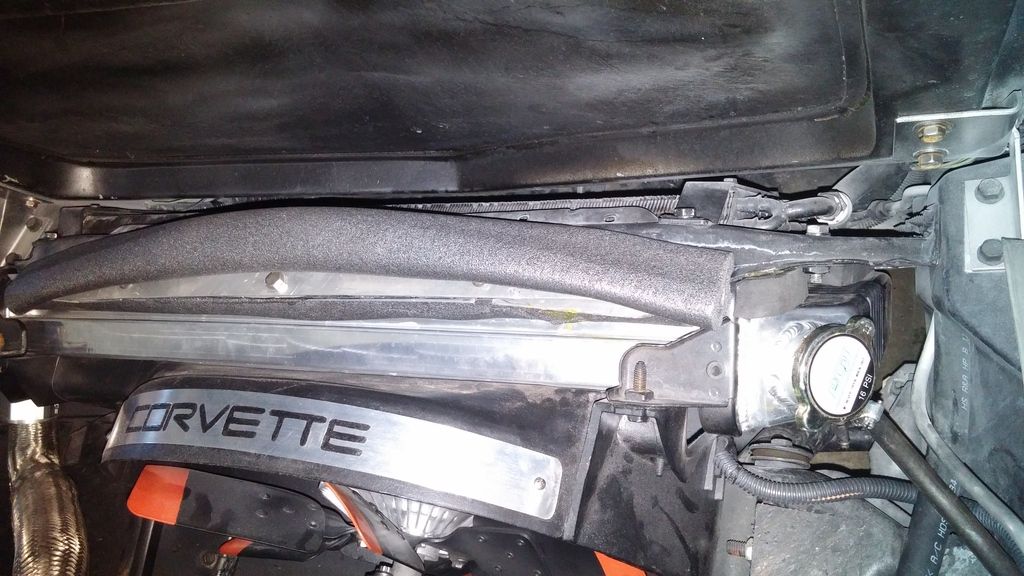
Where is your radiator cap? Mine, on the radiator, was not at the highest point with my LS swap.
Mine runs around 200, hot cold, AC, traffic, hiway.
Also double check with gauge, ecu, IR temp gun.
Where is your radiator cap? Mine, on the radiator, was not at the highest point with my LS swap.
Mine runs around 200, hot cold, AC, traffic, hiway.
Also double check with gauge, ecu, IR temp gun.
Thread Starter
Drifting
Joined: Jan 2008
Posts: 1,518
Likes: 37
From: The Woodlands Texas
Thread Starter
Drifting
Joined: Jan 2008
Posts: 1,518
Likes: 37
From: The Woodlands Texas
What fans? How many amps do they pull? Got a shroud, good seals? Also consider 1 fan on trinary switch to help with when AC is on.
Where is your radiator cap? Mine, on the radiator, was not at the highest point with my LS swap.
Mine runs around 200, hot cold, AC, traffic, hiway.
Also double check with gauge, ecu, IR temp gun.
Where is your radiator cap? Mine, on the radiator, was not at the highest point with my LS swap.
Mine runs around 200, hot cold, AC, traffic, hiway.
Also double check with gauge, ecu, IR temp gun.
I have the trinity switch setup.
Radiator cap is on the drivers side top I think it's the highest point. No overflow setup.
Gauges are Dakota digital, running through the ECU feed.
Corvette Stories
The Best of Corvette for Corvette Enthusiasts

Top 10 Most Explosive Corvettes Ever Made: Power-to-Weight Ratio Ranked!
Joe Kucinski
150 hp to 1,250 hp: Every Corvette Generation Compared by the Specs That Matter
Joe Kucinski
8 Coolest Corvette Pace Cars (and Replicas) of All Time
Verdad Gallardo
Top 10 Corvette Engines RANKED by Peak Torque (70+ Years of Muscle!)
Joe Kucinski
Corvette ZR1X Will Be Pacing the Indy 500, And Could Probably Race, Too!
Verdad Gallardo
Top 10 Corvettes Coming to Mecum Indy 2026!
Brett Foote
Top 10 C9 Corvette MUST-HAVES to Fix These C8 Generation Flaws!
Michael S. Palmer
10 Revolutionary 'Corvette Firsts' Most People Don't Know
Joe Kucinski
5 Reasons to Upgrade to an LS6-Powered Corvette; 5 Reasons to Stay LT2
Michael S. Palmer
Melting Slicks
Joined: Feb 2009
Posts: 2,797
Likes: 608
From: Dallas Georgia
2020 Corvette of the Year Finalist (track prepared)
C3 of Year Winner (track prepared) 2019
Is this a new issue, or just showing up with hot summer time temps?
I know many people do radiators and electric fans on the cheap and they work perfectly fine, but I wonder if the fans are not generating enough CFM under load.
I don't think 220 is really all that hot for an LS motor. If it got much more north of 240 and kept creeping I would be concerned. 250 and I would shut it down.
You could always try a 160 stat and recalibrate the fan on temps. That is what most of the LS tuning shops do anyway.
I know many people do radiators and electric fans on the cheap and they work perfectly fine, but I wonder if the fans are not generating enough CFM under load.
I don't think 220 is really all that hot for an LS motor. If it got much more north of 240 and kept creeping I would be concerned. 250 and I would shut it down.
You could always try a 160 stat and recalibrate the fan on temps. That is what most of the LS tuning shops do anyway.
Last edited by fleming23; Jun 26, 2015 at 04:27 PM.
Burning Brakes

Joined: Oct 2008
Posts: 1,037
Likes: 14
From: Mobile Alabama
I think the stock thermostat is ~190f, so you shouldn't get much hotter.
If the rest of the system is in good shape, you should have excess cooling capacity and the thermo would regulate temp. Mine runs around 190 all the time.
Gary makes a good point about getting air out of the system, and with the steam vents not used, you could have air/steam in the heads leading to hotter temps. I am not saying the vents are definitely the problem, but it could be a combination of things.
If air is trapped in the system, the vents will help. Even if you can fill the system with no air, this engine generates steam from around the exhaust valve pockets. That is why Chevy engineered the vents to continuously remove steam from the heads.
If the rest of the system is in good shape, you should have excess cooling capacity and the thermo would regulate temp. Mine runs around 190 all the time.
Gary makes a good point about getting air out of the system, and with the steam vents not used, you could have air/steam in the heads leading to hotter temps. I am not saying the vents are definitely the problem, but it could be a combination of things.
If air is trapped in the system, the vents will help. Even if you can fill the system with no air, this engine generates steam from around the exhaust valve pockets. That is why Chevy engineered the vents to continuously remove steam from the heads.
Burning Brakes

Joined: Oct 2011
Posts: 956
Likes: 86
From: McDonough Georgia
I believe the LS series of motors run at 200 to 210 degrees normally.
This is different from us "Old Skool" guys as we are used to our flat tappet non roller motors running at 165-180.
It is my understanding that LS motors run hotter because they seal better, and for emissions. Emissions requiring a hotter burn in the motor.
Also, the oils of today are much better allowing todays engines to run hotter.
Check out the following I lifted from: http://www.vincihiperformance.com/LS...amshaft%20Life!
It turns out that coolant (usually a 50/50 mixture of coolant and water) has some fantastic properties that are ideal for use in engines. With a properly pressurized cooling system, coolant will not freeze until –30°F, and it won’t boil until +270°F (new oils don’t start to break down until well over 270°F). With these characteristics, engine designers have decided that engines should operate at approximately 210-215°F. Why, you ask? Well, it has to do with operating the engine at a high enough temperature to boil water out of the oil after the engine is cold started. If you have dew on the grass, it is certain that you have water in your oil, as the crankcase is open to atmospheric pressure! You can either remove the water by draining it out the bottom of the oil pan (remember the oil floats on water) or run the engine long enough and hot enough to boil the water out of the lubrication system. Years ago, coolants weren’t as sophisticated and engines were run at 165-180F, but the oil was changed every 1000 miles or so. That’s why many old timers think engines should run at 165-180F. Have you ever noticed that Ford doesn’t put temperature marks on their gauges? They just mark C for cold and H for hot and write “normal” through the center. If you hook up a scan tool to a GM, you will often find that the gauge reads much lower than the coolant temp sensor. That is because they know most drivers don’t understand how hot an engine should run.
I was really concerned about my old skool motor running in the 210 or so range on the highway. This was due to having a LeMans front clip on the car, and no valence. At highway speed I believe the air was being sucked under the car.
I mounted a valence and put in a two, One inch rows, aluminum radiator that cost me $200. Not $800 that De Witts is getting.
My temps went immediately to 165-175. I difference of 40-50 degrees!!!!!!! It does make me feel better with my old skool motor.
I would suggest that making sure your ducting is sealed and all air is going through the radiator is your best solution.
I am not a fan (pun intended ) of electric fans. Anything electric in my book, other than lifting the lights, is a bit risky. You need a bigger alternator in a C3. I would not recommend EF's unless you have a space issue.
The mechanical fan clutch works great and if you add a 6 or 7 blade fan should get plenty of cooling around town provided your shroud is properly sealed.
Just my .02 cents

BTW, I don't recommend using those chintzy flex fans as they tend to disintegrate at the most inopportune times. I have seen this happen with friends several times and will never use one.

This is different from us "Old Skool" guys as we are used to our flat tappet non roller motors running at 165-180.
It is my understanding that LS motors run hotter because they seal better, and for emissions. Emissions requiring a hotter burn in the motor.
Also, the oils of today are much better allowing todays engines to run hotter.
Check out the following I lifted from: http://www.vincihiperformance.com/LS...amshaft%20Life!
It turns out that coolant (usually a 50/50 mixture of coolant and water) has some fantastic properties that are ideal for use in engines. With a properly pressurized cooling system, coolant will not freeze until –30°F, and it won’t boil until +270°F (new oils don’t start to break down until well over 270°F). With these characteristics, engine designers have decided that engines should operate at approximately 210-215°F. Why, you ask? Well, it has to do with operating the engine at a high enough temperature to boil water out of the oil after the engine is cold started. If you have dew on the grass, it is certain that you have water in your oil, as the crankcase is open to atmospheric pressure! You can either remove the water by draining it out the bottom of the oil pan (remember the oil floats on water) or run the engine long enough and hot enough to boil the water out of the lubrication system. Years ago, coolants weren’t as sophisticated and engines were run at 165-180F, but the oil was changed every 1000 miles or so. That’s why many old timers think engines should run at 165-180F. Have you ever noticed that Ford doesn’t put temperature marks on their gauges? They just mark C for cold and H for hot and write “normal” through the center. If you hook up a scan tool to a GM, you will often find that the gauge reads much lower than the coolant temp sensor. That is because they know most drivers don’t understand how hot an engine should run.
I was really concerned about my old skool motor running in the 210 or so range on the highway. This was due to having a LeMans front clip on the car, and no valence. At highway speed I believe the air was being sucked under the car.
I mounted a valence and put in a two, One inch rows, aluminum radiator that cost me $200. Not $800 that De Witts is getting.
My temps went immediately to 165-175. I difference of 40-50 degrees!!!!!!! It does make me feel better with my old skool motor.
I would suggest that making sure your ducting is sealed and all air is going through the radiator is your best solution.
I am not a fan (pun intended
) of electric fans. Anything electric in my book, other than lifting the lights, is a bit risky. You need a bigger alternator in a C3. I would not recommend EF's unless you have a space issue. The mechanical fan clutch works great and if you add a 6 or 7 blade fan should get plenty of cooling around town provided your shroud is properly sealed.
Just my .02 cents


BTW, I don't recommend using those chintzy flex fans as they tend to disintegrate at the most inopportune times. I have seen this happen with friends several times and will never use one.

Melting Slicks
Joined: Sep 2004
Posts: 2,655
Likes: 19
My guess...your fans suck, probably less than 15 amps between the 2. OEM on a 6 cylinder GM car can pull over 40 amps.
Also check your rad cap is at the highest point. I needed a remote cap to get air out. The LS motor heads were higher than my radiator cap.
Wait, no overflow....then your radiator cap is sucking in air when it cools down???? Thare's your problem.....
Get a reservoir tank, plumb the bottom to the radiator overflow port.
Also check your rad cap is at the highest point. I needed a remote cap to get air out. The LS motor heads were higher than my radiator cap.
Wait, no overflow....then your radiator cap is sucking in air when it cools down???? Thare's your problem.....
Get a reservoir tank, plumb the bottom to the radiator overflow port.
Not sure what fan...dual fan design was part of the radiator I bought. Good seals I think. I just added one on top of the radiator frame support to hood.
I have the trinity switch setup.
Radiator cap is on the drivers side top I think it's the highest point. No overflow setup.
Gauges are Dakota digital, running through the ECU feed.
I have the trinity switch setup.
Radiator cap is on the drivers side top I think it's the highest point. No overflow setup.
Gauges are Dakota digital, running through the ECU feed.
Last edited by Garys 68; Jun 26, 2015 at 07:20 PM.
Burning Brakes
Joined: Oct 2008
Posts: 1,037
Likes: 14
From: Mobile Alabama
"I think the stock thermostat is ~190f, so you shouldn't get much hotter. If the rest of the system is in good shape, you should have excess cooling capacity and the thermo would regulate temp. Mine runs around 190 all the time."
Just so you will understand, excess capacity means more cooling ability than needed, so the coolant would go below the thermostat temp. As I said, "if the rest of the system is in good shape." Anyone can understand that the thermostat raises the temp of the coolant, it doesn't lower the temp.
I can take your quote,"A properly functioning Thermostat has NOTHING to do with how HOT it gets!!" - take it out of context like you did mine - and say the thermostat has EVERYTHING to do with how hot the coolant gets. How else would the coolant get to temp in the winter?

Melting Slicks
Joined: Nov 2001
Posts: 2,668
Likes: 43
From: Eastern US XX
I am sorry that you were not able to read the next sentence that I wrote.
"I think the stock thermostat is ~190f, so you shouldn't get much hotter. If the rest of the system is in good shape, you should have excess cooling capacity and the thermo would regulate temp. Mine runs around 190 all the time."
"I think the stock thermostat is ~190f, so you shouldn't get much hotter. If the rest of the system is in good shape, you should have excess cooling capacity and the thermo would regulate temp. Mine runs around 190 all the time."
Burning Brakes
Joined: Oct 2008
Posts: 1,037
Likes: 14
From: Mobile Alabama
Really??
You have nothing better to do than just say I am completely wrong, and not offer any real or factual information to prove otherwise?
I think I will take your opinion for what it is what it is worth. Thanks!
This ends my time with you.
You have nothing better to do than just say I am completely wrong, and not offer any real or factual information to prove otherwise?
I think I will take your opinion for what it is what it is worth. Thanks!
This ends my time with you.
Melting Slicks
Joined: Nov 2001
Posts: 2,668
Likes: 43
From: Eastern US XX
You are correct - that was a harsh and unnecessary comment that you caught before I did (and deleted it). A more appropriate and correct comment replaced it. Sorry about that!
Thread Starter
Drifting
Joined: Jan 2008
Posts: 1,518
Likes: 37
From: The Woodlands Texas
Back to me....... 
I added some insulation between the hood and the radiator support. This has helped. Today in Houston it's 95 and I was running 210 if moving and 220 max when sitting. Both conditions included VA running full speed.
I'm also having issues with my VA not cooling cold enough. The place I took it to suggested the condenser was too small and maybe I should consider a front pusher fan or go back to my OEM condenser.
The lower temp achieved by the radiator-hood insulation also helped the VA run colder, but still not perfect. We got temps about 45 degrees coming out of the vents running, but crept up to 50-52 sitting still.
I added some insulation between the hood and the radiator support. This has helped. Today in Houston it's 95 and I was running 210 if moving and 220 max when sitting. Both conditions included VA running full speed.
I'm also having issues with my VA not cooling cold enough. The place I took it to suggested the condenser was too small and maybe I should consider a front pusher fan or go back to my OEM condenser.
The lower temp achieved by the radiator-hood insulation also helped the VA run colder, but still not perfect. We got temps about 45 degrees coming out of the vents running, but crept up to 50-52 sitting still.
Melting Slicks
Joined: Sep 2004
Posts: 2,655
Likes: 19
One other thing that crops up occasionally.
The LS thermostats are designed to work best with a constant flow through the heater loop. Using aftermarket air heater control valves shut that off. I'm running 2 swaps with the regular heater control valve and no overheat issues, but have seen others with overheat problems. The Lincoln LS runs a 4 port electric HCV that could replace your electric Vintage Air valve.
But I would fix the seals, make sure your rad cap is at the highest point, and plumb it to an overflow reservoir before going with the 4 port HCV.
The LS thermostats are designed to work best with a constant flow through the heater loop. Using aftermarket air heater control valves shut that off. I'm running 2 swaps with the regular heater control valve and no overheat issues, but have seen others with overheat problems. The Lincoln LS runs a 4 port electric HCV that could replace your electric Vintage Air valve.
But I would fix the seals, make sure your rad cap is at the highest point, and plumb it to an overflow reservoir before going with the 4 port HCV.