When you click on links to various merchants on this site and make a purchase, this can result in this site earning a commission. Affiliate programs and affiliations include, but are not limited to, the eBay Partner Network.
Does anyone have the dimensions of a C3 front suspension or modeled it to see what changes would be beneficial?
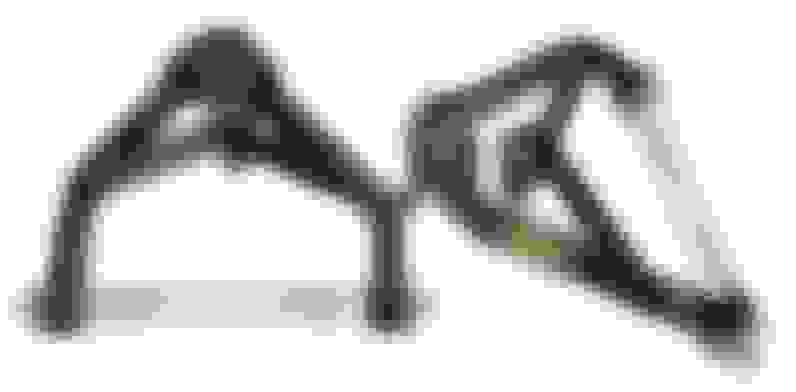
Specifically the upper control arm.
I have purchased a Howe extended upper ball joint that will effectively lengthen the spindle 0.9”.
I am considering relocating the inner pivot in 0.125” for initial camber and down 0.25” for camber gain and back 0.25” for additional caster.
Those who have tried changing the geometry on a C3 front end and wish to share their knowledge please do so.
From: Graceland in a Not Correctly Restored Stingray
Tho in addition to having spent a fair amount of time on track I've been developing an Excel workbook for C2/C3 chassis & suspension maths, optimum camber curves depend on a myriad of factors beyond the scope of the geometry alone. In addition to the obvious (tires, spring rates, anti-roll stiffness, ride heights...), even the nature of the circuit on which a car is operating plays a part in determining what may be an optimum setup. For instance, one might even desire less front camber gain for tracks where heavy braking has the predominant impact on lap times. So, from whatever baseline you choose to work once everything else is pretty much addressed/established up front, IMCO the best advice would be to invest in testing what works best for different circumstances so you have a decent idea of which way to go for a given circuit.
As for altering your upper CA mounts, I'd only go to such trouble only if you wish to increase anti-dive or permanently alter the upper CA pickup points, and only then if you really, really, really know what you're doing. Additional caster can be much more easily had with aftermarket CAs, assuming you actually need it. My $.02
TSW
.
Last edited by TheSkunkWorks; Jan 26, 2016 at 02:08 PM.
I tend to agree that aftermarket control arms would be easiest, but if you wan to do it yourself more power to you. Like TSW mentioned, if you are looking to increase camber gain, make sure you adjust roll center height and anti-dive angles to compensate.
I am aware that an after market control arm would be simpler and easier.
But they only add additional caster and most appear to be weak and poorly designed.
I would prefer to keep the factory upper control arm.
I could get additional caster by slotting the stock cross shaft.
The offset shafts sold are meant to address a sagging front cross member and to remove unwanted initial static camber.
I assume they could be reversed to add initial static camber.
I am not aware of a shaft that that changes both caster and camber.
My plan is to make a pair of upper control arm shafts.
I will move the mounting holes to add caster and remove some of the shim pack.
Lowering the inner pivot point would be simple to add to the new shaft.
The question is how much to lower it and is this a good idea?
I believe I want more camber while cornering without adding more additional static camber.
I have purchased a pair of Howe extended upper ball joints that will effectively lengthen the spindle and raise the upper ball joint 0.9”.
This should increase the camber gain with roll and upward suspension travel.
Others have lengthened the spindle as much as 1.5”.
Since I am limited to 0.9” should the inner pivot be lowered?
While I have a basic understanding I do not really know what I what I am doing.
That is why I am asking here, because there are a few people that do really know and might choose to share their knowledge.
I do not want to permanently alter the frame and have deliberately chosen not to add anti-dive.
TSW I would like to hear more about your Excel work book.
Do you have the basic dimensions of a C3 suspension?
I want to do some modeling of what changes might be beneficial
From: Graceland in a Not Correctly Restored Stingray
FYI, there are CA shafts out there that lower the inner link and have slots for caster adjustment w/o shims. There are also fully adjustable CAs available which allow one to place the upper ball joint precisely where desired relative to the car's x & y axes. And FWIW, Guldstrand used to sell offset solid CA bushings which allowed one to move the inner link w/standard shafts, but it might take some scrounging to find a set now that he has left us.
Heck, I'm not prepared to speculate as to where my own shark will ultimately end up being set, so it would be somewhat presumptive of me to prescribe a specific camber curve over the interweb for an application of which I know very little. And, even if I were to do, I'd still highly recommend testing any given spec against other settings. Thing is, however much analytics might go into guestimating a baseline from which to work, at the end of the day nothing beats a stopwatch and a well-calibrated backside, even in F1. So, don't expect to hit a bulls eye right out of the box (pun most applicable to pre-packaged kits). Anyway, unless you're already well down the path to sorting your car (tires, weights, heights, springs, bars, bumpsteer, toe-steer, etc. all pretty much done), IMHO you're premature worrying all that much about front camber gain while greater parts of the equation are yet to be determined.
Sorry, the Excel workbook is proprietary, not to mention being a work in progress. But, when completed it may well be put on offer. Nothing personal. It's just that I've invested a great deal of time in it already, and still have a fair amount left to do before I'll consider it done.
While I have a basic understanding I do not really know what I what I am doing.
That is why I am asking here, because there are a few people that do really know and might choose to share their knowledge.
I'm with you; I'm no expert but I'm smart enough to listen to the experts. I would study what John Greenwood wrote in "VIP - Vette Improvement Program" and Herb Adams wrote in "Corvette Handling - A Performance Workbook". They don't always agree but you'll have a much better understanding of the C3 suspension and what to do to improve it.
A couple other experts are Danny Popp and Brian Hobaugh; both are quite successful autocrossing C2 and C3s. I've heard they are going for more caster GAIN during suspension travel - spacing the front of the lower control arm down (putting a spacer block between the front of the control arm shaft and the frame), which causes more caster gain as the suspension compresses. This results in very minimal camber gain on compression, but lots of camber gain as the wheels are turned due to the high caster. So you get camber gain on hard cornering but no camber gain on hard braking.
So far I'm generally following Herb Adams' recommendations. I've installed a Rancho 1 1/4" sway in front with a 3/4" Rancho bar in the rear. Both with Heim joint links. Next I'll be cutting my front springs to get near the "Z" height Greenwood recommends. I probably won't go quite as low as he calls for; the streets are really crowned here and I don't want to scrape every time I pull into the driveway.
I'll also be installing GW tubular upper CAs.
And GW Del-a-Lum
bushings in the lower CAs.
The GW bushings are similar to the bushings Herb Adams recommended to control deflection.
Changing the angle of the lower control arm would cause more caster gain as the suspension compresses, but that also changes your pitch axis for anti-dive. I would have to look and see what the real effects would be, and weigh the pros and cons. Good for low speed autocross perhaps, but what about high speed maneuvers? Danny isn't going to take the C3 on a road course 'cause he doesn't want to risk hurting it so high speed changes are not in his best interest. Just some things to consider.
The reason I started this thread was to hopefully spark a discussion and learn about what changes to a C3 front suspension might be beneficial.
In the past I would have stopped in and talked with Dick Guldstrand and quickly learned the folly of my ways.
Unfortunately that is no longer possible.
I regret not being smart enough to ask him enough of the right questions or purchase more of his products when they were available.
My Corvette is a 69 350 4 speed and a daily driver with an emphasis on handling.
With the exception of wheels, tires, headers and lowering it appears to be mostly stock. But is not and I want to keep it that way.
It weighs less than 3000# with out losing any of the luxuries.
It has most of the suspension modifications of the Guldstrand school of thought that would be appropriate for a daily driver.
I have played with different alignments and it is fairly well sorted.
I have a set of 4 C5 N73 Corvette rear wheels 18x9.5 that will be going on.
I am refreshing the front end to prepare for the wider tires.
Aftermarket control arms are not needed nor wanted.
I am making new upper control arm shafts that fit the stock a arm.
I need more caster and will move the control arm back 0.25 to get it.
Without needing the thick shim pack for caster I plan to offset the shaft 0.125 for camber.
Howe now makes an extended 0.9”upper ball joint that will bolt in a C3.
I purchased a set and will be using them.
This brings back the original question.
If the upper ball joint is raised 0.9” should the inner pivot be lowered or not?
Will this help me gain camber without adding static camber?
My goal is to keep the tire flat while running straight and under braking.
But still have enough camber in a corner.
From: Graceland in a Not Correctly Restored Stingray
Sticking strictly to the maths... Yes, the taller upper ball joint will necessarily increase negative camber gain, but how much more progressive is the resultant gain depends on your static front Z ride height, and subsequently from what point on the camber curve you're working. And FWIW, if your front Z height happens to be at, let's say, 1.25", the 0.9" taller upper ball joints will also raise your front RC by approx. 1.5" (depending on tire/wheel fitments). They will also tend to reduce the total amount of travel into bump & roll during hard cornering before dynamic RC moves excessively away from your car's CL axis. (FWIW, limited RC movement is generally a good idea.)
That said, I firmly stand by my earlier advice to take the time to prove thru testing whether or not this (or any) particular mod actually improves performance and/or drivability for your specific build combination, road/track conditions and preferences. I would NOT experiment with further camber gain increases beforehand. And, tho the front end is a whole different animal, do keep in mind that modern tires don't require as much camber gain to maintain a good contact patch. ...which is why IMCO any C3 enthusiast serious about better handling should consider Mr. Greenwood's recommendation to reduce rear camber gain by lowering the inner rear camber strut links 1/2" below their stock height relative to the diff as the default setting until/unless a different adjustment proves itself better. My $.02, which I do hope is worth somewhat more for you.
.
Last edited by TheSkunkWorks; Jan 29, 2016 at 12:28 PM.
After you do your suspension mods make sure you check your bump steer. By lengthening your spindles you will be affecting it so be sure to check and be as close to zero as possible. If it is excessive and you get into a toe in-toe out situation it can be an uncomfortable feeling.
I'm not sure how much camber gain you are looking for, but I obtained considerable more camber gain on the front with just 0.5" longer ball joint on top. I have not touched the mount on the frame for the pivot bar.
I'm using Howe Racing ball joints on the upper a-arms. Notice spacer above spindle for the grease boot.
Thanks for the replies.
I greatly appreciate all the input.
Especially the first hand experience.
Whatever I end up with will be more adjustable than originally planed.
It is clear I gots more reedin an cyferin to do.
Apparently I have forgotten more of what I never really knew, than I thought.
I understand about proprietary information and value the efforts to edumacate me.
I truly appreciate the information and advice that has been given.
Can someone point me to the basic dimensions of a C3 front suspension?
I have tried to measure mine but without a bare chassis it is not easy to get accurate results.
Thanks for posting the camber curve.
To my indiscriminant eye that appears to be what I am after.
I would like to know what I don’t see in it.
Perhaps the 0.9 extension is already too much and I should order the 0.5 studs.
Did the Howe boots not hold up?
They seem rather thin
I'm with you; I'm no expert but I'm smart enough to listen to the experts. I would study what John Greenwood wrote in "VIP - Vette Improvement Program" and Herb Adams wrote in "Corvette Handling - A Performance Workbook". They don't always agree but you'll have a much better understanding of the C3 suspension and what to do to improve it.
A couple other experts are Danny Popp and Brian Hobaugh; both are quite successful autocrossing C2 and C3s. I've heard they are going for more caster GAIN during suspension travel - spacing the front of the lower control arm down (putting a spacer block between the front of the control arm shaft and the frame), which causes more caster gain as the suspension compresses. This results in very minimal camber gain on compression, but lots of camber gain as the wheels are turned due to the high caster. So you get camber gain on hard cornering but no camber gain on hard braking.
So far I'm generally following Herb Adams' recommendations. I've installed a Rancho 1 1/4" sway in front with a 3/4" Rancho bar in the rear. Both with Heim joint links. Next I'll be cutting my front springs to get near the "Z" height Greenwood recommends. I probably won't go quite as low as he calls for; the streets are really crowned here and I don't want to scrape every time I pull into the driveway.
I'll also be installing GW tubular upper CAs.
And GW Del-a-Lum
bushings in the lower CAs.
The GW bushings are similar to the bushings Herb Adams recommended to control deflection.
Then I'll start tweaking from there.
I don't think highly of those Global West bushings. I know they require welding the threaded "spud" in the lower control arm shaft, the lower shaft is a forging and I don't think highly of the process of adaptation. I make a solid Delrin bushing, use lower shafts that are checked for straightness and then I have to straighten the lower control arm bushing holes to get everything into proper alignment (using some jigs I fabricated years ago.) You would be surprised at how out of alignment al this assembly can be from, wrecks, to just the mounting surface on the crossmember not being flat causing the shaft to distort/bend when it is torqued into place. If your going to solid bushings you need to take into consideration all the requirements to have the completed assembly function smoothly when it is bolted into place and torqued up.
I don't think highly of those Global West bushings. I know they require welding the threaded "spud" in the lower control arm shaft, the lower shaft is a forging and I don't think highly of the process of adaptation. I make a solid Delrin bushing, use lower shafts that are checked for straightness and then I have to straighten the lower control arm bushing holes to get everything into proper alignment (using some jigs I fabricated years ago.) You would be surprised at how out of alignment al this assembly can be from, wrecks, to just the mounting surface on the crossmember not being flat causing the shaft to distort/bend when it is torqued into place. If your going to solid bushings you need to take into consideration all the requirements to have the completed assembly function smoothly when it is bolted into place and torqued up.
Thanks for the info. I am hoping to true up the CA cross shafts on a lathe before and after welding. I went this route trying to save a few bucks. If it seems too problematic I'll just buy their tubular lower CAs.
Control arms that pivot at the same vertical location have no impact on camber so no better than stock. The best solution would be to lower the inner pivot of the upper arm but there is not enough room. That's why the taller ball joints is the easiest solution. Someone made his spindle taller a few years back but it was a lot of work.
The amount of camber and caster should depend on spring rate and tires so that the contact patch is optimized.
Caster can be gained on the upper control arm by moving the ball joint location back or forward, slotting the two bolt holes on the shaft or slotting them.
There are some kits to help with toe steer.
I haven't been on here or worked on my car for quite a while but hope to get back to it this spring as the front end is my next focus after doing the rear a few years back.
Designer Imagines A Corvette That Looks More Like a Corvette Than the Corvette
Slideshow: A Jaguar designer's personal project imagines what a modern front-engined Corvette might look like if Chevrolet revisited the golden age of the Stingray.




 Front End Geometry