




Mufflers Whats Inside

Race Director


Joined: Jan 2000
Posts: 13,015
Likes: 2,259
From: Corsicana, Tx
2020 C2 of the Year - Modified Winner
2020 Corvette of the Year (performance mods)
C2 of Year Winner (performance mods) 2019
2017 C2 of Year Finalist

Yep...I also had 2 chamber ones on my Vette at one time. They weren't too bad with the 427 (423 RWHP)...cost about a tenth at the track.
Later on had them behind the 540 in it's first version with 3" pipes. Uncapping it was literally a 50 RWHP difference!
JIM
Later on had them behind the 540 in it's first version with 3" pipes. Uncapping it was literally a 50 RWHP difference!
JIM

Le Mans Master


Joined: Dec 2003
Posts: 5,727
Likes: 38
From: Fremont CA
Unless you have an inert gas welding chamber I don't see you successfully altering those Arvin C5 Ti mufflers.....what would a guy like me know? I need to back purge my stainless welds to satisfy myself.

Thread Starter
Racer


Joined: Jan 2004
Posts: 303
Likes: 28
From: los angeles ca
Welding titanium out side of a chamber is possible and in some ways more convenient.
Just follow procedures and the metal will tell you if you did it right.
twin flow meters
back purging
trailing cup
gas lens
proper rod
short weld length
clean
clean
and clean
All of the above plus lots of practice.
To properly weld thin stainless requires at least a back purge.
Thanks for the first reply that actually addresses the purpose of this thread.
Modifying C5 titanium mufflers to fit a C3 and building the accompanying titanium exhaust system.
Just follow procedures and the metal will tell you if you did it right.
twin flow meters
back purging
trailing cup
gas lens
proper rod
short weld length
clean
clean
and clean
All of the above plus lots of practice.
To properly weld thin stainless requires at least a back purge.
Thanks for the first reply that actually addresses the purpose of this thread.
Modifying C5 titanium mufflers to fit a C3 and building the accompanying titanium exhaust system.

Former Vendor
Joined: Jan 2016
Posts: 178
Likes: 5
Best sounding, worst flowing mufflers ever....
I do like them, and recently bought a set of Delta 40s for my dad's mild 358" SBC, they sound great on just about anything, but I wouldn't run them on anything that's making over 350-400hp....They just don't flow well...
A buddy of mine has a 78' Malibu with a mild/oldschool 468", 3" exhaust with x pipe to 2 chamber Flowmasters (the black/square ones like the original style from the early 90s), 3" tail pipes over the axles. He has QTP cut outs on it as well right before the muffs. On the chassis dyno, he gains 27 rwhp with the cut outs open... A-B-A test style, and this is only on a 350 rwhp car....
Now the Flowmaster shootout mufflers, that's another story...
On most cruiser type cars, 2 chamber Flows are great...
I do like them, and recently bought a set of Delta 40s for my dad's mild 358" SBC, they sound great on just about anything, but I wouldn't run them on anything that's making over 350-400hp....They just don't flow well...
A buddy of mine has a 78' Malibu with a mild/oldschool 468", 3" exhaust with x pipe to 2 chamber Flowmasters (the black/square ones like the original style from the early 90s), 3" tail pipes over the axles. He has QTP cut outs on it as well right before the muffs. On the chassis dyno, he gains 27 rwhp with the cut outs open... A-B-A test style, and this is only on a 350 rwhp car....
Now the Flowmaster shootout mufflers, that's another story...
On most cruiser type cars, 2 chamber Flows are great...
Flowmaster designs all of our mufflers for performance, but it is important to select the right muffler and appropriate size for your application. Running a muffler which is improperly sized, either too small or too large internally and externally, can cost you power. With a properly sized exhaust system and mufflers, Flowmaster mufflers will increase exhaust gas scavenging and free up available power. Our muffler designs have been improved upon over the years in search of more power, and we will continue to improve them into the future.
If anyone ever has a question about how a particular Flowmaster muffler or exhaust product will affect their system's performance, give our Tech Line a call at 707-544-4761 and we will make sure that we get you the correct components for the sound and performance needs of your vehicle.
Last edited by Ron@Flowmaster; Apr 11, 2016 at 02:04 PM.
Former Vendor
Joined: Jan 2016
Posts: 178
Likes: 5
Good question. A muffler or exhaust system that is too large in diameter will lose exhaust gas velocity. Exhaust gases will slow down because of the larger area that they have to occupy, which makes the engine work harder to push the exhaust gases out.
Burning Brakes

Joined: Jul 2015
Posts: 823
Likes: 57
From: Austin TX

Former Vendor
Joined: Jan 2016
Posts: 178
Likes: 5
Corvette Stories
The Best of Corvette for Corvette Enthusiasts

Top 10 Most Explosive Corvettes Ever Made: Power-to-Weight Ratio Ranked!
Joe Kucinski
150 hp to 1,250 hp: Every Corvette Generation Compared by the Specs That Matter
Joe Kucinski
8 Coolest Corvette Pace Cars (and Replicas) of All Time
Verdad Gallardo
Top 10 Corvette Engines RANKED by Peak Torque (70+ Years of Muscle!)
Joe Kucinski
Corvette ZR1X Will Be Pacing the Indy 500, And Could Probably Race, Too!
Verdad Gallardo
Top 10 Corvettes Coming to Mecum Indy 2026!
Brett Foote
Top 10 C9 Corvette MUST-HAVES to Fix These C8 Generation Flaws!
Michael S. Palmer
10 Revolutionary 'Corvette Firsts' Most People Don't Know
Joe Kucinski
5 Reasons to Upgrade to an LS6-Powered Corvette; 5 Reasons to Stay LT2
Michael S. Palmer


Le Mans Master

Joined: May 2006
Posts: 9,993
Likes: 1,136
From: League City Tx
We're glad to hear that you like the Flowmaster sound! There are many factors that come into play when discussing an exhaust system's performance. The exhaust system diameter, routing, crossover type, headers, and indeed the mufflers can all have an effect on how efficient, or inefficient, a vehicle's exhaust system is.
Flowmaster designs all of our mufflers for performance, but it is important to select the right muffler and appropriate size for your application. Running a muffler which is improperly sized, either too small or too large internally and externally, can cost you power. With a properly sized exhaust system and mufflers, Flowmaster mufflers will increase exhaust gas scavenging and free up available power. Our muffler designs have been improved upon over the years in search of more power, and we will continue to improve them into the future.
If anyone ever has a question about how a particular Flowmaster muffler or exhaust product will affect their system's performance, give our Tech Line a call at 707-544-4761 and we will make sure that we get you the correct components for the sound and performance needs of your vehicle.
Flowmaster designs all of our mufflers for performance, but it is important to select the right muffler and appropriate size for your application. Running a muffler which is improperly sized, either too small or too large internally and externally, can cost you power. With a properly sized exhaust system and mufflers, Flowmaster mufflers will increase exhaust gas scavenging and free up available power. Our muffler designs have been improved upon over the years in search of more power, and we will continue to improve them into the future.
If anyone ever has a question about how a particular Flowmaster muffler or exhaust product will affect their system's performance, give our Tech Line a call at 707-544-4761 and we will make sure that we get you the correct components for the sound and performance needs of your vehicle.
I've owned no less then 20 pairs of Flowmasters on various cars since they were introduced in the early 90s...
It wasn't until I really started getting into chasing ET/MPH that I discovered the design constraints...Ofcourse chasis dynos help with testing as well.
Flowmasters were the gold standard for performance mufflers in the 90s and still the gold standard for sound today...they satisfy looks, performance and sound for about 80% of car enthusiasts....the rest of us that are chasing every last HP know that a "straight through" design muffler makes the most power, this is already assuming the exhaust system is sized correctly..
Like I mentioned, I still like them, and I still buy them...I just don't put them on my "fast" cars..

Last edited by ajrothm; Apr 11, 2016 at 10:16 PM.
Former Vendor
Joined: Jan 2016
Posts: 178
Likes: 5
Nice reply! Thx.
I've owned no less then 20 pairs of Flowmasters on various cars since they were introduced in the early 90s...
It wasn't until I really started getting into chasing ET/MPH that I discovered the design constraints...Ofcourse chasis dynos help with testing as well.
Flowmasters were the gold standard for performance mufflers in the 90s and still the gold standard for sound today...they satisfy looks, performance and sound for about 80% of car enthusiasts....the rest of us that are chasing every last HP know that a "straight through" design muffler makes the most power, this is already assuming the exhaust system is sized correctly..
Like I mentioned, I still like them, and I still buy them...I just don't put them on my "fast" cars..
I've owned no less then 20 pairs of Flowmasters on various cars since they were introduced in the early 90s...
It wasn't until I really started getting into chasing ET/MPH that I discovered the design constraints...Ofcourse chasis dynos help with testing as well.
Flowmasters were the gold standard for performance mufflers in the 90s and still the gold standard for sound today...they satisfy looks, performance and sound for about 80% of car enthusiasts....the rest of us that are chasing every last HP know that a "straight through" design muffler makes the most power, this is already assuming the exhaust system is sized correctly..
Like I mentioned, I still like them, and I still buy them...I just don't put them on my "fast" cars..
Flowmaster works very closely with a number of race teams and professional car builders so that we can receive unbiased feedback about the quality and performance of our products. Aside from our full line of street mufflers, we also offer an entire line of race mufflers which have been designed for the absolute best performance in high horsepower applications.
Ultimately, your muffler choice is entirely up to you and we truly appreciate your support over the years. If you ever have a question about exhaust system performance in a race application, don’t hesitate to contact our Tech Line for additional information.

Tech Contributor

Joined: Jun 2004
Posts: 20,855
Likes: 959
From: I tend to be leery of any guy who doesn't own a chainsaw or a handgun.
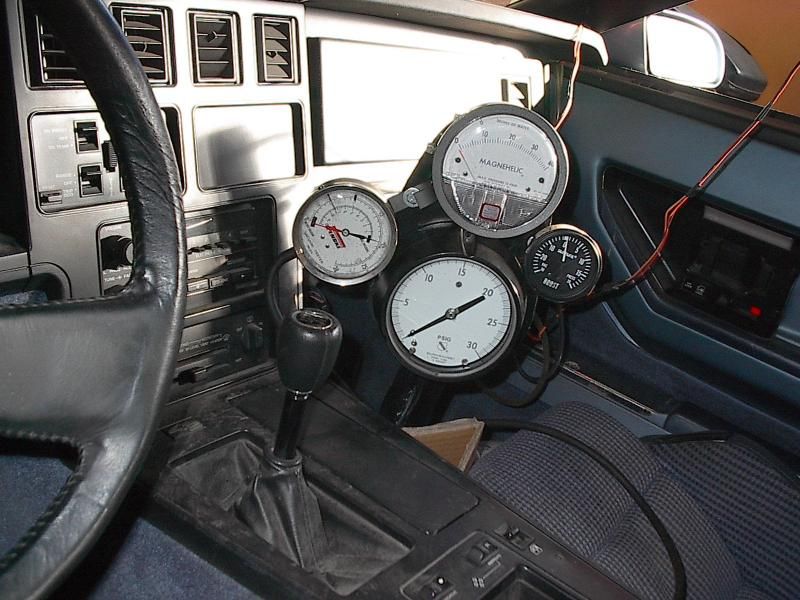
That's my take on physics, and my exhaust system build philosophy. I've run different size exhausts in my cars over the years, and in most cases I weld a pressure tap into the pipe as close to the headers as I can. This gives me actual readings of the backpressure of the systems, and an indication of the flow efficiency of the system. I use a low range Magnehelic gauge for measuring the exhaust (and intake pressure drops). This gauge has a range of 0-40" H2O, or about 1 1/2 psi max.

Tech Contributor
Joined: Jun 2004
Posts: 20,855
Likes: 959
From: I tend to be leery of any guy who doesn't own a chainsaw or a handgun.
I've been trying to take weight out of the '69 for several years as I like to do several track days each year. I can't stuff as much tire under the fenders as the guys with the Z06s and the 911GT3s, so my only option is getting the car to weigh about 300# less than their cars (I'm at about 2790# at the moment, with full factory interior). All the "easy" stuff is already done to the car, so I've had to start working on other ways, and they seem to end up being more time consuming each time. I've built mufflers (steel and aluminum) for the Corvettes and my garden tractor (I'm not paying John Deere prices for a stupid little muffler) over the years, but this one was a little more time consuming as I wanted to copy the external dimensions of the current mufflers on the car to keep a stock appearance. I made a jig to capture the external dimensions of the left side muffler (I figured I'd try that side first as I'm always trying to pull/move weight off the left side of the car), but left myself some freedom to build the inside as I saw fit. Here's a test fit of the muffler prior to polishing the tip, and painting the case flat black. The previous steel muffler, stainless tip, and entry elbow weighed 16#. This replacement came out at 9.9#.
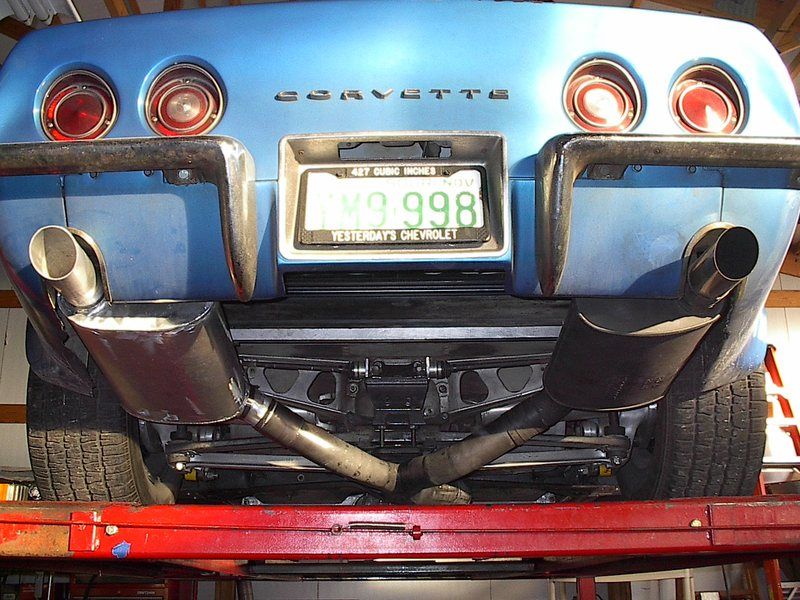
Here's a picture showing the three internal tubes/chambers. The right side chamber is essentially a surge tank to help soften some of the pressure/sound vibrations, while the center and left side tubes are parallel paths for the exhaust gas flow. The reasons for the two tubes are partially to minimize flow restriction, but mainly to increase the surface area of the tubes to the fiberglass dampening material surrounding the tubes. All three tubes have hundreds of small drilled holes and slots to allow the pressure/noise vibrations to be attenuated by the movement into and out of the surrounding volume.

Nothing new invented here, this muffler is just a combination of a chambered muffler and two glasspacks in parallel. I like having expansion/surge/reflection volumes in a muffler, but unless you have the noise frequency content measuring equipment (and I don't) to measure what frequencies you need to deal with, it's too much of a crapshoot for amateurs like me to not include dampening material in the design. I've got an inexpensive dB sound meter and measured the idle and 2000 RPM fast idle exhaust noise, and the readings are thankfully very close (Still waiting for a spring track day to see what the system sounds like at WOT). There is a subtle difference in sound "personality" between the two sides, but unless someone sticks their head right down between the bumpers I don't believe anyone will notice the difference in sound or build material between the two mufflers.
I built the aluminum muffler (3 1/2" I/O, and aluminum undercar piping) for my '84 a while back (before the muffler on the '69). I welded up this setup strictly for track day use (it's about 40# lighter than the stock dual muffler setup), but it's so reasonably quiet that I don't see a big need to take it off after each track day. The nice thing about a turbo is that it converts the pulsed exhaust exiting the exhaust port into more of a steady-state flow, easing the requirements of the system, particularly the muffler(s).

This is a straight through glasspack design, but like the muffler on the '69 there's an additional surge volume in the right half to allow additional tube surface area (with a crapload of holes) for noise vibrations to interact with the surrounding fiberglass packing.
FWIW, here's the gauge package I used to check out the system backpressure (at the turbine outlet), along with the turbine inlet pressure and the pressures at the compressor inlet and outlet.

Here's a picture showing the three internal tubes/chambers. The right side chamber is essentially a surge tank to help soften some of the pressure/sound vibrations, while the center and left side tubes are parallel paths for the exhaust gas flow. The reasons for the two tubes are partially to minimize flow restriction, but mainly to increase the surface area of the tubes to the fiberglass dampening material surrounding the tubes. All three tubes have hundreds of small drilled holes and slots to allow the pressure/noise vibrations to be attenuated by the movement into and out of the surrounding volume.

Nothing new invented here, this muffler is just a combination of a chambered muffler and two glasspacks in parallel. I like having expansion/surge/reflection volumes in a muffler, but unless you have the noise frequency content measuring equipment (and I don't) to measure what frequencies you need to deal with, it's too much of a crapshoot for amateurs like me to not include dampening material in the design. I've got an inexpensive dB sound meter and measured the idle and 2000 RPM fast idle exhaust noise, and the readings are thankfully very close (Still waiting for a spring track day to see what the system sounds like at WOT). There is a subtle difference in sound "personality" between the two sides, but unless someone sticks their head right down between the bumpers I don't believe anyone will notice the difference in sound or build material between the two mufflers.
I built the aluminum muffler (3 1/2" I/O, and aluminum undercar piping) for my '84 a while back (before the muffler on the '69). I welded up this setup strictly for track day use (it's about 40# lighter than the stock dual muffler setup), but it's so reasonably quiet that I don't see a big need to take it off after each track day. The nice thing about a turbo is that it converts the pulsed exhaust exiting the exhaust port into more of a steady-state flow, easing the requirements of the system, particularly the muffler(s).

This is a straight through glasspack design, but like the muffler on the '69 there's an additional surge volume in the right half to allow additional tube surface area (with a crapload of holes) for noise vibrations to interact with the surrounding fiberglass packing.
FWIW, here's the gauge package I used to check out the system backpressure (at the turbine outlet), along with the turbine inlet pressure and the pressures at the compressor inlet and outlet.

Last edited by 69427; Apr 14, 2016 at 01:34 PM. Reason: Partially finished adding additional content.
Thread Starter
Racer
Joined: Jan 2004
Posts: 303
Likes: 28
From: los angeles ca
69427
Thanks for posting the pictures of your aluminum muffler.
I have been hoping you would.
Did you pack the whole case with fiberglass or just the ends?
Did you consider using the stainless wool instead?
I have enough 2 ½ titanium tube and mandrel bends to go from the collectors to exhaust tips including an x pipe.
The Z06 titanium mufflers are 15x11x5 oval and about 9lbs with the big stainless hanger still on it.
They need the inlet and outlet reconfigured to offset on both ends.
I have some 2 ½ perforated tube to accomplish that.
I have been thinking that 3 tubes similar to yours might be the way to go and am considering U shaped deflectors at each end like a turbo muffler.
I am not sure if I should remove some or all of the baffles or not and if the center tube should be perforated.
Keeping it quiet is more important to me than power as it is my daily driver.
What I want is no drone and similar loudness to a stock Z06.
At the bottom of this page in
Similar Threads
Inside a stock muffler
C5 Tech
There are pictures of the inside of a titanium muffler.
I hope to lose 40lbs to 50lbs and go from the mid 2900lbs to high 2800lbs.
Any thoughts or ideas you might have would be greatly appreciated.
Thanks for posting the pictures of your aluminum muffler.
I have been hoping you would.
Did you pack the whole case with fiberglass or just the ends?
Did you consider using the stainless wool instead?
I have enough 2 ½ titanium tube and mandrel bends to go from the collectors to exhaust tips including an x pipe.
The Z06 titanium mufflers are 15x11x5 oval and about 9lbs with the big stainless hanger still on it.
They need the inlet and outlet reconfigured to offset on both ends.
I have some 2 ½ perforated tube to accomplish that.
I have been thinking that 3 tubes similar to yours might be the way to go and am considering U shaped deflectors at each end like a turbo muffler.
I am not sure if I should remove some or all of the baffles or not and if the center tube should be perforated.
Keeping it quiet is more important to me than power as it is my daily driver.
What I want is no drone and similar loudness to a stock Z06.
At the bottom of this page in
Similar Threads
Inside a stock muffler
C5 Tech
There are pictures of the inside of a titanium muffler.
I hope to lose 40lbs to 50lbs and go from the mid 2900lbs to high 2800lbs.
Any thoughts or ideas you might have would be greatly appreciated.
Tech Contributor
Joined: Jun 2004
Posts: 20,855
Likes: 959
From: I tend to be leery of any guy who doesn't own a chainsaw or a handgun.
69427
Thanks for posting the pictures of your aluminum muffler.
I have been hoping you would.
Did you pack the whole case with fiberglass or just the ends? I packed the material on all sides of the internal "perforated" tubing.
Did you consider using the stainless wool instead? Yeah, but I haven't run into a local source for the fine mesh stuff, so I just used what worked well for me on the '84. I did try the bigger mesh stuff I found somewhere a few years ago, but wasn't happy with it.
I have enough 2 ½ titanium tube and mandrel bends to go from the collectors to exhaust tips including an x pipe. Color me envious. Post some section weights of the system when you can.
The Z06 titanium mufflers are 15x11x5 oval and about 9lbs with the big stainless hanger still on it. That's pretty decent. There's a chart of C6Z06 parts weights in the C6 section, and I got the impression they were a bit heavier than that.
They need the inlet and outlet reconfigured to offset on both ends.
I have some 2 ½ perforated tube to accomplish that.
I have been thinking that 3 tubes similar to yours might be the way to go and am considering U shaped deflectors at each end like a turbo muffler.
I am not sure if I should remove some or all of the baffles or not and if the center tube should be perforated. Whichever direction you go, please post some photos of your progress.
Keeping it quiet is more important to me than power as it is my daily driver.
What I want is no drone and similar loudness to a stock Z06. The best thing I did to reduce the drone dramatically was to put an H pipe immediately behind the header collectors.
At the bottom of this page in
Similar Threads
Inside a stock muffler
C5 Tech
There are pictures of the inside of a titanium muffler.
I hope to lose 40lbs to 50lbs and go from the mid 2900lbs to high 2800lbs.
Any thoughts or ideas you might have would be greatly appreciated.
Thanks for posting the pictures of your aluminum muffler.
I have been hoping you would.
Did you pack the whole case with fiberglass or just the ends? I packed the material on all sides of the internal "perforated" tubing.
Did you consider using the stainless wool instead? Yeah, but I haven't run into a local source for the fine mesh stuff, so I just used what worked well for me on the '84. I did try the bigger mesh stuff I found somewhere a few years ago, but wasn't happy with it.
I have enough 2 ½ titanium tube and mandrel bends to go from the collectors to exhaust tips including an x pipe. Color me envious.
Post some section weights of the system when you can.The Z06 titanium mufflers are 15x11x5 oval and about 9lbs with the big stainless hanger still on it. That's pretty decent. There's a chart of C6Z06 parts weights in the C6 section, and I got the impression they were a bit heavier than that.
They need the inlet and outlet reconfigured to offset on both ends.
I have some 2 ½ perforated tube to accomplish that.
I have been thinking that 3 tubes similar to yours might be the way to go and am considering U shaped deflectors at each end like a turbo muffler.
I am not sure if I should remove some or all of the baffles or not and if the center tube should be perforated. Whichever direction you go, please post some photos of your progress.
Keeping it quiet is more important to me than power as it is my daily driver.
What I want is no drone and similar loudness to a stock Z06. The best thing I did to reduce the drone dramatically was to put an H pipe immediately behind the header collectors.
At the bottom of this page in
Similar Threads
Inside a stock muffler
C5 Tech
There are pictures of the inside of a titanium muffler.
I hope to lose 40lbs to 50lbs and go from the mid 2900lbs to high 2800lbs.
Any thoughts or ideas you might have would be greatly appreciated.