




Road vibration under power

Thread Starter
Racer

Joined: Sep 2011
Posts: 414
Likes: 55
From: Humboldt county Ca
 Road vibration under power
Installed a new 383 in the '75. Has a turbo 400 trans. At between 55-70 mph a vibration starts but the origin is hard to pinpoint, almost feels like a wheel in front out of balance. Slip it into neutral at the same speed and RPM and the vibration stops. Let off on the throttle at speed and the vibration stops. All 4 wheels just aligned and tires balanced after strut rod bushing replacement. New torque converter installed with engine (Continental, from SoCal) and new motor mounts.
Thoughts please.
Stump
Thoughts please.
Stump

2nd Gear
Joined: May 2016
Posts: 2
Likes: 0
Installed a new 383 in the '75. Has a turbo 400 trans. At between 55-70 mph a vibration starts but the origin is hard to pinpoint, almost feels like a wheel in front out of balance. Slip it into neutral at the same speed and RPM and the vibration stops. Let off on the throttle at speed and the vibration stops. All 4 wheels just aligned and tires balanced after strut rod bushing replacement. New torque converter installed with engine (Continental, from SoCal) and new motor mounts.
Thoughts please.
Stump
Thoughts please.
Stump
If your 383" doesn't have a 400" damper and flex plate it will vibrate.

Pro


Joined: Oct 2009
Posts: 664
Likes: 89
From: Marysville Ohio
Thread Starter
Racer
Joined: Sep 2011
Posts: 414
Likes: 55
From: Humboldt county Ca
Race Director


Joined: May 2006
Posts: 18,737
Likes: 2,582
you didnt specify the RPM but can you replicate the vibration by having someone hold the engine at that speed and checking your pulleys, belts, and fan.
the engine fan/clutch assembly is properly seated on the water pump pilot?
if you are running vacuum advance, disconnect it and plug the line and drive it. If the vibration goes away you have a timing related issue.
the engine fan/clutch assembly is properly seated on the water pump pilot?
if you are running vacuum advance, disconnect it and plug the line and drive it. If the vibration goes away you have a timing related issue.

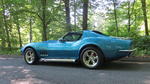
Is my vette stock?? HAHA


Joined: Oct 2015
Posts: 20,216
Likes: 9,354
From: Im not allowed to tell you
2020 C3 of the Year Finalist - Modified
2020 Corvette of the Year Finalist (performance mods)
2019 C3 of Year Winner (performance mods)
2016 C3 of Year Finalist
Check the u joints. If you're loosing one all that mass under power will move and as soon as you ket up it calms down.
Corvette Stories
The Best of Corvette for Corvette Enthusiasts

Top 10 Most Expensive Corvettes Ever Sold on Bring A Trailer
Brett Foote
10 Things Every Corvette Owner Needs (2026 Edition)
Michael S. Palmer
8 Most "Only Corvette Owners Understand" Quirks and Problems
Pouria Savadkouei
10 Reasons the C6 Z06 is Still A Performance Benchmark After 20 Years
Joe Kucinski
How Much Horsepower Every Corvette Engine "LOST" in 1972
Joe Kucinski
Top 10 DOs and DON'Ts for Protecting Your Convertible Top!
Michael S. Palmer
Top 10 Most Explosive Corvettes Ever Made: Power-to-Weight Ratio Ranked!
Joe Kucinski
150 hp to 1,250 hp: Every Corvette Generation Compared by the Specs That Matter
Joe Kucinski
8 Coolest Corvette Pace Cars (and Replicas) of All Time
Verdad Gallardo
Thread Starter
Racer
Joined: Sep 2011
Posts: 414
Likes: 55
From: Humboldt county Ca
Thanks to all for the thoughts. I'm thinking u joints also. The engine is 370 hp with 450 lb/ft of torque @3600. I confess to hammering the 90,000 mile u joints just a wee bit. Think I'll replace them all.
Thanks again!
Thanks again!

Melting Slicks

Joined: May 2011
Posts: 2,753
Likes: 119
From: Springfield Missouri
he puts in neutral, and the vibration stops, so it would point to the engine?? rpm goes down and vibration goes away. BUT engine was dyno tested, but not hooked up to a transmission, etc., so ???
Last edited by lvmyvt76; May 6, 2016 at 11:18 PM.

2026 Loser of the Year


Joined: Sep 2013
Posts: 36,599
Likes: 7,046
From: New Or-leens Loo-z-anna
The bearing "cups" should be a tight fit into the mating holes in the yoke.
If the bearing "cup" slides into the yoke hole easily, the hole has probably stretched oversize which will cause the bearing cup/needle-bearings to fail much sooner.