When you click on links to various merchants on this site and make a purchase, this can result in this site earning a commission. Affiliate programs and affiliations include, but are not limited to, the eBay Partner Network.
My C3 will be doing an EFI conversion this winter, an aluminum radiator and SINGLE electric fan will then happen to take advantage of my EFI's ability to do electric fan control AND because I want to keep the engine and new 4L60e cool, I also plan on installing a modern pop-out touch screen stereo(no crazy external amp or subwoofers or anything).
Am I going to be able to get by with a high quality 120amp alternator like this guy?:
I ask as I worry about your wiring. Adding lots of requirements are going to stress your electrical system- lots.
If you put too many requirements on a weaker system you will get dimming lights, slower fans, etc. If you put a too big alternator you could overload old wires, pop fuses etc.,
Please work with an electrical guy--- maintain balance!
I got flamed and belittled for wanting a larger alt and then people condescending assuming I didn't know that the wiring too would need to be upgraded,
While I believe that the 120 will get you by okay you are stepping up to lots of modern goodies and in my case I went with 140 I believe it was might have been 160 scored it off a nice fellow on ebay called him told him what I wanted it was I believe 150.00 shipped,
Having a bit more alt power is like a gun or condom, it's far better to have it and not need it than to need it and not have it.....
PS I haven't seen a c3 yet that actually had power demanding more than one alt, perhaps in the stereo competition world, don't know don't wanna know.
Last edited by The13Bats; Jun 23, 2016 at 09:33 PM.
I got flamed and belittled for wanting a larger alt and then people condescending assuming I didn't know that the wiring too would need to be upgraded,
While I believe that the 120 will get you by okay you are stepping up to lots of modern goodies and in my case I went with 140 I believe it was might have been 160 scored it off a nice fellow on ebay called him told him what I wanted it was I believe 150.00 shipped,
Having a bit more alt power is like a gun or condom, it's far better to have it and not need it than to need it and not have it.....
PS I haven't seen a c3 yet that actually had power demanding more than one alt, perhaps in the stereo competition world, don't know don't wanna know.
Here's you go-
I used just one of the N-D like above....The big thing is the Alt's performance at LOW RPM's- I also went w/ the smallest pulley so the Alt would be turning more RPM's at idle.
Like Bats said- there will be a guy that comes in here and tells you how to do it - but can't show you or give you any reason other than he said so....
30 years ago I did have twin alternators...
What works? Big wires- quality wire- not the copper coated aluminum crap- Upgraded grounds I run the alternator directly to the battery- then everything off the battery and I do sort of like what you'd call sub panels in places around the car.- nice size wire then have relays/fuses and then connected to the high current devices.
Battery does more than start your car- it stabilizes the voltage and filters the AC ripple from the Alternator.
Big wire 1/0 gu 4GU for the dash sub panel (ECU/injectors/Colis/PW/Locks/ heated seats/door poppers/Vintage AC)
Yes, you can easily power those upgrades with a single alternator. I would use a newer alternator model than a higher current one that looks like your current alternator. The one you linked is originally a ~60A alternator design rebuilt/boosted to produce 120A maximum. The newer models were designed from the start to produce that much current and also designed to produce much more current at idle. With EFI and electric fans you definitely want the idle current capability. A CS130 or CS144 or AD244 would all be good choices.
My personal choice would be run a nice 4 gauge wire from the alternator to a big power stud on the firewall (or fender or rad support) and then continue the 4 gauge wire to the starter solenoid. Use the big power stud to power the new high power accessories like the fan, headlights and EFI. GM has done it this way on 100's of millions of cars, so it will work on your car too. You don't need to run a wire to the battery and then back to the accessories for the battery to do any filtering. Make the connection to the battery with heavy wiring (like that nice heavy power cable running from the battery to the starter) and it's all good.
I went with Vintage Air's Front Runner system for small block chevy. This will upgrade all of the accessories at once and get rid of the v belts. The alternator is 170 amp. I've had the system since 2011 and am very happy with it. I would do dual electrical fans instead of a single.
My C3 will be doing an EFI conversion this winter, an aluminum radiator and SINGLE electric fan will then happen to take advantage of my EFI's ability to do electric fan control AND because I want to keep the engine and new 4L60e cool, I also plan on installing a modern pop-out touch screen stereo(no crazy external amp or subwoofers or anything).
Am I going to be able to get by with a high quality 120amp alternator like this guy?:
Or am I going to have to / should I get out my wallet and just buy a CS-144 alternator?
Did I forget to mention I want to do the DIY Angel Eye conversion?!?.. Oh yea... (Although I don't need 60watt halogen bulbs.)
Is this even possible on a single alternator?
Adam
anyway...
I have bought a few things from skip whites ebay store including my waterpump and I have always had good experiences from them.. They seem to go out of their way to be honest and offer different options explaining them well. I do plan on upgrading the guts of the alternator I rebuilt because im looking at light upgrades (55w HID which does not require rewiring contrary to popular belief here HIDs use LESS current than stock lights.) and have an amp in the back (might even add a second for a small sub if I buy one of those overpriced c3 speaker boxes on ebay. )
Last edited by augiedoggy; Jun 24, 2016 at 09:28 AM.
I would do dual electrical fans instead of a single.
Why Dual fans??
My thoughts on single fans:
total airflow across the radiator is ultimately what matters for cooling performance- although dual fans probably do more evenly spread the flow even with a shroud
The larger the diameter of the fan the faster it can spin for the same CFM, which means the quieter it will be
A single large fan will likely consume fewer watts than 2 smaller fans
anyway...
(55w HID which does not require rewiring contrary to popular belief here HIDs use LESS current than stock lights.) and have an amp in the back (might even add a second for a small sub if I buy one of those overpriced c3 speaker boxes on ebay. )
I've seen a video (of course I can't find it now) with a volt meter connected to the battery, somewhere inside the car, and then at the headlights of a C3 and it shows definite voltage droops with the stock wiring under a decent load- the video author claimed that these small drops result in a large drop in light output from HIDs.
As HID light output declines over time (eventually about 70% of when they were new); it still seems like a good idea to upgrade the headlight wiring, no?
total airflow across the radiator is ultimately what matters for cooling performance- although dual fans probably do more evenly spread the flow even with a shroud
The larger the diameter of the fan the faster it can spin for the same CFM, which means the quieter it will be
A single large fan will likely consume fewer watts than 2 smaller fans
I went with dual fans to get higher cfm air flow at idle where the fans are needed, there is a single fan I know of that will fit a corvette radiator that puts out the 4000cfm my duals do,
I like the duals I got that have a shroud that covers most of the radiator and doesn't leave some out wasted to some degree,
I wasn't concerned with how much dual fans consumed over a single fan as I upgraded my wiring and charging system,
I run both fans on low then both fans on high,
Many people here use one fan and are happy so it just boils down to personal preference.
The stock wiring is marginal for stock headlights most people agree that larger wire and at least relays not the headlight switch should carry the load.
Last edited by The13Bats; Jun 24, 2016 at 06:14 PM.
I totally understand and knew about having to upgrade the wiring; I'm a bit confused exactly how to do that and understand there seems to be some sort of controversy but is there anyone impartial enough to lay out the two options in front of me?
I'm going to plan on just having to budget for a good CS144 and wiring. I've heard that even 8 gauge should be fine for 140 watts, but I'm ok with using 4 gauge to be safe; 0 gauge seems like dramatic overkill and a PITA to run.
Regarding exactly how/ where to run it now....
I've read previously that it's important to upgrade the run from the alternator to the battery because when the battery runs itself down from sitting for a while (which will happen to my car over winter), you'll get a huge current flow going from the alternator back to the battery once you start it again. (I'll be using one of the portable lithium battery jump packs to the alternator to battery connection will be how the battery gets charged.)
I'm not quite clear on whether I need a run to straight from the alternator to the battery and then a different run from the alternator to say the fender (I like that spot), or if I can just run a really big wire- say AWG 2 from the alternator to the fender block and then AWG 4 to my battery and AWG 6 to my starter. -Then in the future when it comes time to power the EFI, Electric Fan, and new Headlights (I'm going to just buy the Speed Direct new headlight harness), then I can have a short run of wire right to the fender post, right?
The differences between the different types of alternators went over my head, too; what's the difference between a CS130 or CS144 or AD244?
Are all CS144 140amp alternators the same, essentially?
Do I need to get some sort of special mounting bracket or can I reuse the bracket from my existing alternator?
My 79 L82 is essentially completely stock- that means I want just a normal "v" pulley, right?
-If I find a good deal on a CS144 with a Serpentine pulley can I just take off the pulley and put on a V pulley and be ok?
How do I know if the alternator has good low RPM electrical performance? -Do all CS144's meet that requirement?
Do I need to buy a smaller pulley to get good perf @ low RPM -if so what size?
I totally understand and knew about having to upgrade the wiring; I'm a bit confused exactly how to do that and understand there seems to be some sort of controversy but is there anyone impartial enough to lay out the two options in front of me?
I'm going to plan on just having to budget for a good CS144 and wiring. I've heard that even 8 gauge should be fine for 140 watts, but I'm ok with using 4 gauge to be safe; 0 gauge seems like dramatic overkill and a PITA to run.
Regarding exactly how/ where to run it now....
I've read previously that it's important to upgrade the run from the alternator to the battery because when the battery runs itself down from sitting for a while (which will happen to my car over winter), you'll get a huge current flow going from the alternator back to the battery once you start it again. (I'll be using one of the portable lithium battery jump packs to the alternator to battery connection will be how the battery gets charged.)
I'm not quite clear on whether I need a run to straight from the alternator to the battery and then a different run from the alternator to say the fender (I like that spot), or if I can just run a really big wire- say AWG 2 from the alternator to the fender block and then AWG 4 to my battery and AWG 6 to my starter. -Then in the future when it comes time to power the EFI, Electric Fan, and new Headlights (I'm going to just buy the Speed Direct new headlight harness), then I can have a short run of wire right to the fender post, right?
Adam
impartial?...is anyone?
I know I am not all ego driven and good with most people not liking my build, I also know some people get super butt hurt if questioned or not hailed as genius.
the thing most people agree on is do not tap things like fans and lights off the alt lug itself, for several reasons.
Run a lug somewhere, like the pictures Richard posted.
I like to run my alt lead to starter and a lead from that starter lug to a lug for any lights or fans or whatever, but the simply fact is both the way Richard posted and the way lionelhutz posted will both work just fine,
However, in a high tech / performance way of thinking Richards is better for many reasons including any lug or connection is resistance and the less resistance the better, plus in Richards way the alt doesnt get hit when things start up and going right to the battery offers a nice buffer so to speak,
So as I move forward on my 69 wiring I will like Richard have a designated power lead from the battery that runs up to things like fans and light, it will have a lug to attach the things to and a breaker as I like breakers over fuses,
I realize some will now pick me apart....
Ok, I actually payed more attention to how Richard did it now. Totally agree with using the battery to cleanup the power output. (I work in IT and understand this one of the reasons why important things are connected through UPSes.)
-How is the stock wiring run? -Does anyone have a PDF that shows the stock wiring from 79?
Should I pull out the original wire running from the alt to the battery when I run the new wiring? -Any reason not to?
Here's one thing I don't understand: If I just run a big A$$ wire from the alternator to the battery via post connectors, and then where do I connect the return wire to?
Also- in this configuration, aren't the wires going from the alternator to the battery and the wire coming back to my breakout boxes touching each other direct? -Why would the current ever flow through the battery? And if it's now how would the battery be filtering / cleaning up the power or really doing anything?
I will have to step aside and let the cats who know stock wiring better answer some of that, the factory wasn't always the best way to do things
No one savvy digs the load being on a switch like the headlights, and people rewire with relays, kits are even sold for this.
If you upgrade wiring just to keep it clean/simple remove unused wire,
about 20 years ago,
The wiring on my 66 for example, ( modded from stock ) the + alt lug went to the lead on the battery that then was the big gauge battery/starter cable, and the other stuff in the car tapped off that same starter lug, I then had another wire from that lug running up to a lug I believe I had on the side of the radiator support for the fans and headlights, the relays were also right there.
My vw trike, the + alt goes right to the battery + ( with in line breaker ) then the breakers all tap right off the battery + and go to each system,
Both of those work fine, but I am not too ego driven to admit when someone has a better way and I happen to like the way Richard does it,
Like you said you like it from your IT standpoint and it does make great sense.
In the case of my 69 I would really like to do away with the old glass fuses and run breakers but in the interest of getting the car up and running/ driver faster I will likely do the wiring upgrades in stages.
I will have better lights, fans, stereo, door poppers etc, just no reason not to get modern with my wiring.
No one savvy digs the load being on a switch like the headlights, and people rewire with relays, kits are even sold for this.
Totally agree with that 100%; I'm very much comfortable with using a relay there. Wouldn't dream of running that load through the old switch.
-I built and wired my own 240v 6kw electric brewery control panel and used a number of large amp relays; these tiny baby relays don't scare me at all. Actually the electric system in the car is probably the thing I'm most comfortable with, Lol!
Totally agree with that 100%; I'm very much comfortable with using a relay there. Wouldn't dream of running that load through the old switch.
-I built and wired my own 240v 6kw electric brewery control panel and used a number of large amp relays; these tiny baby relays don't scare me at all. Actually the electric system in the car is probably the thing I'm most comfortable with, Lol!
Adam
I have been into DC wiring all my life tearing up toys when young etc, and then into car and cycle stuff, big into RC junk we just moved after 45 years into an old over 100 yo house and I did a crash course on AC and enjoy it too but yeah vehicle wiring is rather forgiving....
the thing I learn ids I keep learning something new, the way I wired my first trike 30 years ago isn't how I did the one I have now, the way I did my 66 isn't how I want to do my 69,
Likely with your background you will listen to what everyone says they do and like me run with the ideas you like and discard the ones you do not like and make your wiring job yours, that shouldnt offend anyone....
The CS130 is smaller with a lower current rating of about 105A. The CS144 is larger with a higher current rating of about 140A. The AD244 is similar to the CS144 and has a current rating of about 145A. It is an even newer alternator design with more improvements over the CS144. There is also a AD230 which is a little smaller and rated for about 120A.
As with the 10SI alternator you linked, many companies are taking the above alternators and modifying them to improve their output capability. So, depending on where you shop they are not necessarily all the same. But, you only need a stock capability CS144 alternator so no need for any expensive exotic improved alternator. You can find them for around $100 if you do some shopping.
You already have a VERY BIG wire that runs from the battery to the starter solenoid. Why not use it instead of adding another wire? This wire is almost 1/3 the resistance of a 4 gauge wire and more than 1/4 the resistance of a 6 gauge wire.
It is dead simple to prove using the wire resistances that running new smaller gauge wires like 4 or 6 gauge to and from the battery will result in MORE constant running voltage drop with almost no other significant system advantage. So, you have to run heavier than required wires to make up for the voltage drop due to that longer wire length. But you already have a big 1/0 wire you could use so why not just save yourself the expense and work of running another wire?
Besides, just running a wire to the battery and then from the battery to a load will in no way isolate the alternator from load surges. This is simple to understand if you just think about what each component is doing. The alternator is producing about 14V to ensure the battery gets charged. The battery is sitting there with a higher charge voltage applied. It will NOT begin to supply any appreciable current until the system voltage drops below about 12.5V. So, when a surge is applied, the alternator basically supplies as much current as it can. Then when it can't supply enough current, it's output is dragged down to the lower voltage of the battery where the battery begins to help the alternator by supplying the excess current.
Just remember that current will flow equally well down a wire in either direction and that it can reverse directions instantaneously as many times or as fast as necessary. The big heavy wire already running from the solenoid to the battery will make a decent low resistance connection to the battery allowing it to filter some of the alternator ripple and to make-up the current required when a surge load is applied to the system.
So, running a couple of new wires under hood and taking advantage of the existing large solenoid to battery wire works as well as another other method. For the 140A alternator you need right around a 4 gauge wire at the length you will use. The exact way to run the wires is up to you, since it makes little difference electrically if you change it up a little. You could just run a 4 gauge wire from the alternator to the starter solenoid and run wire(s) from the solenoid to power your accessories. Or you could run a 4 gauge wire from the alternator to a big terminal block for your accessories and then another 4 gauge from the terminal block to the starter solenoid.
Now the guy that keeps saying GM is so great- well they sort of cheated on how to use smaller cheaper wire in their vehicles-just because it works- doesn't mean it's the best way.
Why did I like to go to the battery? BMW's $100K MSRP did it...Overkill? Having a heated steering wheel is overkill- but the BMW engineers didn't wire it that way for the hell of it- as most of the buyers would have no idea that it was done or care less...but probably because it's a better way!
AND back it the day- I was in the Car Stereo industry-You know what solved alternator noise?? So yes the battery DOES filter. Electricity moves very slow compared to the speed of light...
Electronics like filtering...ever read say a Vintage Air install manual or MSD? They say go to the battery- so the electronics have nice clean power. So it's not just because I said so...
I have 1/0 going from the alt- then to the battery- and from the battery 1/0 to the starter.
Why I like bigger wire? As a rule of thumb- you need to go up one size due to heat. The wire is RATED at 70ºF- as it gets hotter the current rating goes DOWN.
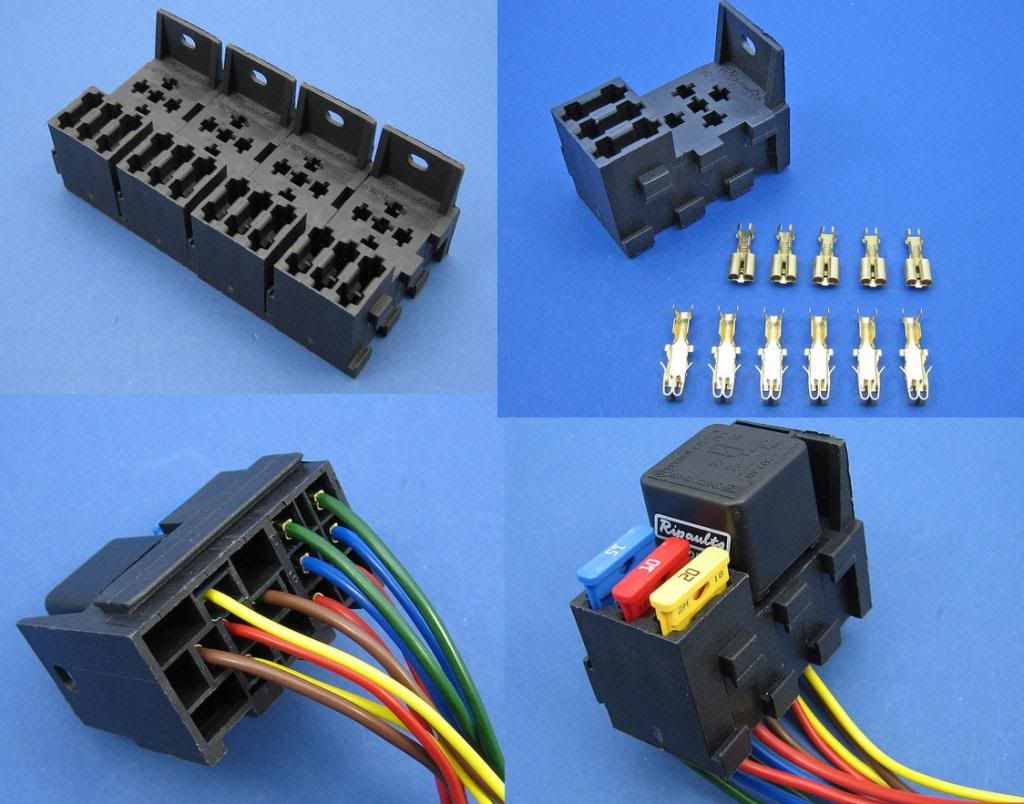
I like these relay/fuse holders - know I have used at least 18 in my car... Totally configurable-
Here they are tucked up next to my electric headlight motors-actually the two black fuse looking thingys are diodes from Ford as they used them years back that are the same size as blade fuses- isolates high and low beams for the headlight motors.
I also used them to do away w/ my fuse box and relocated them to access easier- also using the LED light fuses- so you can easily find a blown one. And rather than the ignition switch switching the power -the relays are doing that so the ignition switch just triggers the relays.
I rewired my headlights w/ 12 GU- eventually move over to LED but not there now..I still have a Plasma TV...
Another thing that is a better idea- that I've taken from other highend manufactures? The jump terminal under the hood. Makes sense as the electronics don't see a surge- and the power goes right where it's needed to the starter.
Designer Imagines A Corvette That Looks More Like a Corvette Than the Corvette
Slideshow: A Jaguar designer's personal project imagines what a modern front-engined Corvette might look like if Chevrolet revisited the golden age of the Stingray.






 Alternating between Alternate Alternators






 DSCN5177 by Richard Hayes, on Flickr
 DSCN5170 by Richard Hayes, on Flickr
 DSCN2514-1.jpg~original by Richard Hayes, on Flickr
 DSCN5081 by Richard Hayes, on Flickr





 )
)





 DSCN5160 by Richard Hayes, on Flickr
 DSCN5143 by Richard Hayes, on Flickr
 DSCN5181 by Richard Hayes, on Flickr
 DSCN5182 by Richard Hayes, on Flickr
