When you click on links to various merchants on this site and make a purchase, this can result in this site earning a commission. Affiliate programs and affiliations include, but are not limited to, the eBay Partner Network.
I am finishing up swapping in a 454 HO in my 74. I am feeding it with a 770 Holly Ultra Street Avenger.
I got it in and running with lots of help from this forum.
I have a few questions regarding timing. First, my installation instructions only give a BASE TIMING OF 4 DEGREES BTDC. What does base timing mean.
Second, is there a consensus when installing the distributor - do you set the timing at 0 TDC on the compression stroke on the No. 1 or give it a little advance maybe 8 to 12 degrees BTDC. I installed mine at 0 TDC and had to bump the distrib counter clockwise 5 times, almost a 1/2 inch before I could get it to idle without backfiring through the carb. A trick I learned from this forum.
Finally any suggestions for initial and total timing for my 454 HO and Holley 770.
base timing is the initial, lowest possible timing the engine can use. So if they say 4 degrees base, you will check that the engine shows only 4 degree with the timing light, as it's lowest starting point when there is no additional advance or vacuum advance being applied.
Mechanical advance is typically done with a spring/weight in a distributor. There are bushings and springs to adjust the speed and total amount of advance for the engine. Every engine is different, and factors such as compression ratio and application (race / daily) will affect how you time the curve and determine total advance overall. Vacuum advance is extra timing advance that is applied when the engine is in vacuum state, such as cruise or even idle. It is usually configured to add an additional 5 to 15* of timing. The mechanical advance can usually be configured in a wide range, from 5 to 35* of total additional mechanical advance, or more in some cases, and both of these additional advance mechanisms are applied to the BASE timing, the initial setting which sets the lowest limit, usually for idle speed.
If the engine is modern (1999+ year) and has aluminum heads, and a 9:1 compression ratio or 10:1 compression ratio, then it will probably enjoy around 24 to 28* btdc of total timing during wide open throttle, all in around 2800rpm is usually safe. The distributor will have instructions how to set the total timing and when to go "all in" with it. I would start with around 24* (always use the lower number first) and advance from there, on a dynometer if possible to determine if any extra advance is necessary. For example if you move from 24* to 28* and witness no significant additional torque output, then you could probably try an even lower number, around maybe 22* just to see what effect it has. You always want to choose the lowest number that still gives a good torque output. When you finally go too low, say you tried 18*, you will notice a large drop in torque, and a large increase in EGT (exhaust gas temperature), and that is your clue that you have gone too far retarded (not enough WOT timing). The EGT gauge can be used in lieu of the dynometer using this principle: retard timing until the EGT begins to significantly increase and advance slightly from there to bring the EGT back down. I don't have any experience with big blocks so maybe someone has timed one of them before with a mechanical advance can give you a better idea of what number would be ideal. In general, 350-400cid engines made after 1999 in naturally aspirated configurations tend to prefer between 22 to 28* of total timing at WOT, in my experience, but every engine is different.
The vacuum advance should be used for cruise/high vacuum fuel economy. It usually adds 5 to 15* of timing and this will help immensely with fuel economy for long drives on the highway. make sure you use vacuum advance if you intend to save fuel while cruising.
Last edited by Kingtal0n; Nov 28, 2016 at 06:06 AM.
From: I tend to be leery of any guy who doesn't own a chainsaw or a handgun.
Is there anything substantially different in this "HO" configuration than what the rest of us big block users are dealing with?
Can you give us some info on what distributor (and its timing curve specs) you're using?
A quick and simple method to find out what your particular engine wants for timing is to just start the engine up, and while it's idling (with the vacuum advance hooked up to manifold vacuum) just start turning the distributor CCW. If the idle speed increases you then know that the engine needs this extra timing to operate more thermally efficient. (Conversely, if the idle gets rough and slows down that's a good indication that it's over-advanced.) Adjust the carb idle speed screw during this operation to keep the idle at your desired point (that's your judgment call depending on how much cam you have, and if the transmission is a stick or auto). Keep adjusting the distributor position and carb idle speed to find the timing advance that gives you the best idle quality at the least throttle opening. This quick step gives you an indication of what timing your engine likes at idle. That's step one.
Step two: Read the idle timing advance you arrived at in step one, and write it down. Now disconnect the vacuum advance and read the static (distributor position) timing. (You might have to adjust the idle speed up a touch if the engine doesn't idle well enough with the vacuum advance removed.) This static timing number is your target point if you pull the distributor out again for any reason. Also, the first timing number minus the second number gives you an idea of how much advance your vacuum advance canister is contributing.
Step three. With the vacuum advance still disconnected slowly increase the RPM up to around 3500 RPM. Monitor how much the timing advances while you're doing that, and try to notice if the advance "peaks out", or if it keeps going. If it keeps going just make a note of what the timing was when you stopped at 3500 RPM. Running the engine above 3500 with your head down there trying to read the timing tab is a bit more danger and adventure than I'm comfortable with.
Step four: What was the number that the timing peaked out at in your last test (@ step 3)? Depending on your engine combination, most big blocks like 34-38* (some guys run 40-42*, but that scares the hell outta me) of timing at WOT above 3000 RPM. If your reading in step three was above 36-38* then you might consider getting your distributor curve shortened a touch to keep the WOT timing reasonable. If the timing topped out at less than 34* then you might want to consider advancing the static timing (the actual distributor position) to get the WOT timing up to around 34-36*. This will probably require that you shorten the vacuum advance slot travel a touch to restore the same idle timing that you arrived at in step one.
If the timing didn't max out as you hit the 3500 RPM area you might want to speed up the centrifugal advance curve by installing lighter springs in the distributor. There's a slight shortcut for doing step #3 that involves removing/substituting the distributor springs, but I don't know how familiar you are with the undercap mechanicals of your distributor.
This quick and dirty test gives you information on both sides of the timing curve (low RPM, light load and high RPM WOT). I wrote this kinda fast, so just give it a read and let me know if any parts don't make sense to you.
Good luck, and post a picture of that engine sometime.
The guidelines by 69427 are just about the best I have ever heard. He describes the best idle timing (what your engine likes in step 1) and how to measure and adjust your overall timing curve.
I like timing tapes to directly read and plot the curve. I like timing tapes better than my Snap-On dial back timing light... Just my 2 cents.
Good luck!
From: Some days your the dog and some days your the hydrant.
Royal Canadian Navy
I did a similar method to 69427 that might be quicker as just as effective. Disconnect the vacuum advance and p;ug hose. hook vacuum gauge to manifold vacuum port. Reduce idle to a point just above where it will stall. Turn dist'r CCW to increase initial advance. Keep increasing until the vacuum on the gauge is no longer increasing. Now, again reduce idle until you can just keep the engine idling. Advance timing again by rotating dist'r until max vacuum is reached on vacuum gauge. Keep repeating this until advancing the timing no longer increases the vacuum. This is your initial timing which may be in the 20's when you check it with the timing light. Now add the required mech'l advance to a max of 38* or lower to eliminate ping at any rpm. Hook up vacuum advance and reduce vacuum to eliminate ping at cruise. This worked for me.
The problem is trying to reduce mech'l advance and vacuum advance. If you do not have the means to take the steps to reduce mech'l and/or vacuum given a high initial advance, then adjust to the oem timing specs and most likely end up restricting the performance potential of the engine.
not a good idea to adjust timing by ear/rpm. Engine rpm will continue to rise as you increase timing well into the 30's or 40's. You have to be very old school to even consider doing it that way, rather than buying a $35 timing light. Do it the right way, use a light.
The 26* total is as I had guessed, the engine has a modern chamber. Don't try 30+ when using the recommended fuel (probably 91 or 93 octane) there will be very little benefit and can remove the headroom for temperature rise that the manufacturer had found to be acceptable.
Last edited by Kingtal0n; Nov 28, 2016 at 09:34 PM.
not a good idea to adjust timing by ear/rpm. Engine rpm will continue to rise as you increase timing well into the 30's or 40's. You have to be very old school to even consider doing it that way, rather than buying a $35 timing light. Do it the right way, use a light.
The 26* total is as I had guessed, the engine has a modern chamber. Don't try 30+ when using the recommended fuel (probably 91 or 93 octane) there will be very little benefit and can remove the headroom for temperature rise that the manufacturer had found to be acceptable.
My ZZ454 had the same recommendations, 4 & 26. It does not idle well at 4 degrees and can't get out of its on way at 26. I have 13-14 initial plus 22 mechanical for a total of 35-36. I also use Vac advance (14 degrees) on manifold vac. No overheat, nice idle, good vacuum, good response, no ping.
From: Some days your the dog and some days your the hydrant.
Royal Canadian Navy
Originally Posted by flyeri
My ZZ454 had the same recommendations, 4 & 26. It does not idle well at 4 degrees and can't get out of its on way at 26. I have 13-14 initial plus 22 mechanical for a total of 35-36. I also use Vac advance (14 degrees) on manifold vac. No overheat, nice idle, good vacuum, good response, no ping.
Yeah, it gets GM through the warranty period while the engine runs the *****.
From: I tend to be leery of any guy who doesn't own a chainsaw or a handgun.
Originally Posted by Kingtal0n
not a good idea to adjust timing by ear/rpm. Engine rpm will continue to rise as you increase timing well into the 30's or 40's. You have to be very old school to even consider doing it that way, rather than buying a $35 timing light. Do it the right way, use a light. A timing light only tells you what the timing is. It doesn't tell you what the engine wants. For those of us without an engine dyno in our garage, a vacuum gauge, tachometer, or a trained ear is the only equipment we have to figure out what spark timing our engine setup requires for good idle and low speed performance. A piece of paper with some timing numbers might mean something if everyone lived at the same altitude, had the same absolute humidity levels, and ran the same flow exhaust system on our cars. But we don't.
The 26* total is as I had guessed, the engine has a modern chamber. Don't try 30+ when using the recommended fuel (probably 91 or 93 octane) there will be very little benefit and can remove the headroom for temperature rise that the manufacturer had found to be acceptable.
What evidence do you have that this engine has "modern" chambers, whatever that means. I've seen nothing mentioned in any of the crate motor ads, other than the heads are 118cc, giving an 8.75 compression ratio. Running 4* idle timing with that combination looks like a good recipe for red hot exhaust valves and crappy gas mileage, and 26* at WOT sounds like the quick way to a slow accelerating car.
Sounds to me like a power killing spark curve designed to minimize warranty issues.
I printed out 69427 and Resdoggie's recommendations to try out their procedures to fine tune this engine. To answer some questions the 454 HO is at the bottom of the Chevy Performance Parts performence engine offerings. 425 horse power, 510 / 540 Hydraulic Roller Cam, forged steel crank. The price was right at $6700 for the long block. I am using a MSD 8572 Pro Billet Distributor with vacuum advance and tach drive.and a 6A box. I went with a Holley 770 Ultra St. Avenger. I also hooked it up to a Hurst 5 speed trans. I did not want to go too radical-this was expensive enough. I am using the middle of the road springs the distributor came with.
And yes Flyeri and Milwff 4 initial to 26 total timing sounded low to me also thats why i was confused about the term "base timing" I am more used to see an initail around 13 and a total around 30 I installed the distributor at 0 TDC. the engine started but backfired. I advanced the timing to 4 BTDC and the fireworks stopped This was verified with a timing light
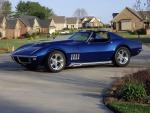
I will follow the procedures provided in the replyies and advise. Thanks for all the input. One last thing do you guys install your distributors 0 TDC or at the inital advanced timing. Here is a photo of my project
What evidence do you have that this engine has "modern" chambers, whatever that means. I've seen nothing mentioned in any of the crate motor ads, other than the heads are 118cc, giving an 8.75 compression ratio. Running 4* idle timing with that combination looks like a good recipe for red hot exhaust valves and crappy gas mileage, and 26* at WOT sounds like the quick way to a slow accelerating car.
Sounds to me like a power killing spark curve designed to minimize warranty issues.
hmm, didn't I recommend using a dynometer or EGT gauge?
Of course I did. Because nobody, not me or you, can know what the engine wants without checking the correct way. I am all about doing things the right way, and human ear-tuning is not exactly "a good way". Minimize warranty issues you say? You mean designed to NOT explode the engine earlier than necessary?
Furthermore, if the engine has a vacuum advance (it should) that will throw another 8 to 13 degrees at the motor while it idles (it did in my chevy days) giving you an 17-22* btdc idle. I did not actually think anybody would expect any chevy V8 to idle "well" at 4* btdc, that DOES sound terrible and I agree completely.
And one more note about WOT timing. Say you drive the car with 24, 28, 32, 36 total today and find that it seems to run best around 36. Well, of COURSE it does! The more timing you throw at a motor the "better" it will seem to run- in general. They are often also LOUD which disguises any audible noises ("ouch" type noises) an engine might be making while at WOT. So, what you WON'T realize is that the engine might be under great stress, borderline disastrous consequences, taking the abuse and handling it like a champ for a great while (some will survive a year like that, especially if the owner is driving infrequently. They don't just blow up immediately, especially when compression is that low). So all of this adds up the what I initially recommended: using a dynometer and/or EGT gauge to properly find the point of diminishing returns for torque/power while adjusting timing correctly. Please see that regardless of which engine we are talking about, from 2.0L to 7.0L the same principle can be applied to find optimal (in this case, daily driver) timing.
Ah and your question about modern chambers was relevant. What I mean when is say that is, usually engines made after 98+ enjoy less timing advance than say, those of the 70's or 80's era, and this is due to their modern chambers for the most part. A small block 2-piece rear seal iron head motor sometimes ran well with 36 or even 38* btdc, whereas many of the LSx series engines, from truck to vette, respond well to 26-28* btdc. Many inexperienced owners/"tuners" will push it, of course, for the reason I mentioned: it seems better, it seems to make more torque, and indeed you can verify that with a dyno meter, as more timing generally causes peak combustion chamber pressure to escalate and will give us a show of slightly more torque on a dyno, for example, along with jagged wavy peaks which require smoothing (they ask themselves, why is that?). The difference is often negligible (2% torque from 28* to 32* in many cases), and it pushes the engine towards the dangerous, cold, bleeding edge of the fuel quality (when using 93 octane).
From: Some days your the dog and some days your the hydrant.
Royal Canadian Navy
King, my way produced 357 rwhp @6000rpm on a Mustang dyno, the highest of three back-back-pulls. It's a 355 sbc running 91 octane, 10.7:1 scr, 35,000 miles on the bottom end. Car pulled real strong. It's been running fine on the street for a couple years. I don't expect it to blow up anytime soon, but it could as with any engine for a multitude of reasons even with a retarded timing curve. You have your way for determining the best curve and some of us have our way.
On all of the street and race motors I've built in the past 40 something years, I've found one thing in common on every one. Every motor has it's own "personality", and runs best on what it wants.
Start at the base line, test run and see. You can change the initial timing either way until it's good. You can change springs inside to obtain the timing advance that the motor is happy with.
I've seen arguments almost come to a fist fight over where the vacuum advance should be hooked to ported or full vacuum. The ported vacuum connection came to be the same time the emissions came to be. Amazing, huh?
Keep a record, and let us know what works?
Last edited by USAFVeteran; Dec 1, 2016 at 11:41 AM.
69427's point of idle/low load timing thru high rpm/hi load ignition timing illustrates an important point that so many seem to ignore. Your engine likes different timing under different load and rpm. I like to set initial based on highest manifold vacuum (which was his point) rather than simply set total. I will have to tailor the overall curve to get it correct. I do not have a dyno...
King, my way produced 357 rwhp @6000rpm on a Mustang dyno, the highest of three back-back-pulls. It's a 355 sbc running 91 octane, 10.7:1 scr, 35,000 miles on the bottom end. Car pulled real strong. It's been running fine on the street for a couple years. I don't expect it to blow up anytime soon, but it could as with any engine for a multitude of reasons even with a retarded timing curve. You have your way for determining the best curve and some of us have our way.
we can guess, sure, and maybe get lucky. People guess all the time.
but its just still just a guess, based on hope.
Timing advance is not a mysterious, guessing game. At least it shouldn't be when the engine is expensive or important. All gasoline piston engines operate on similar principles and all of them will show similar characteristics that may be used to determine the optimal timing curve per the application, within an interval of confidence that more or less guarantees the engines safety (NO guessing) per the application. That is how the factory are able to turn out millions of 'one size fits all' curves for a wide range of climates/atmospheric conditions for daily drivers around the world, without guessing.
Here is the general approach for ignition timing, and the results and applications called for therin:
Notice how the ultimate final timing advanced used varys per application- not only the engine in question, and its recorded temperatures and fuel types, but the way in which the engine is used, the number of hours or minutes spent at WOT, the highest achievable combustion chamber temperatures, and so forth. Timing is not set by "guessing"; it is a well defined, directed, often statistically/mathematically determined approach. Daily drivers use enough advance to keep from escalating EGT- but no further - in order to keep headroom for ever changing environmental conditions, including but not limited to fuel quality. By guessing, you may fall in any region, without any indication from the engine, since the performance and operation are similar enough that humans can not tell the difference aside from the most remarkable extremes at either end, and depending on the displacement, since we are talking small percentages which in large displacement engines can be enough difference "to feel" whereas in say, a 2L application, you will not "feel" 2% additional torque (not as likely as engine displacement decreases). Computers can tell, and the engine can tell, though, as you can see pressure escalates towards the colder side where increased torque is typically found, go far enough (or change climate/fuel quality enough) and that is how headgaskets fail, piston get fatigued and broken, etc...
Last edited by Kingtal0n; Dec 1, 2016 at 09:48 PM.
From: I tend to be leery of any guy who doesn't own a chainsaw or a handgun.
Originally Posted by Kingtal0n
hmm, didn't I recommend using a dynometer or EGT gauge?
Of course I did. Because nobody, not me or you, can know what the engine wants without checking the correct way. I am all about doing things the right way, and human ear-tuning is not exactly "a good way". Minimize warranty issues you say? You mean designed to NOT explode the engine earlier than necessary?
Furthermore, if the engine has a vacuum advance (it should) that will throw another 8 to 13 degrees at the motor while it idles (it did in my chevy days) giving you an 17-22* btdc idle. I did not actually think anybody would expect any chevy V8 to idle "well" at 4* btdc, that DOES sound terrible and I agree completely.
And one more note about WOT timing. Say you drive the car with 24, 28, 32, 36 total today and find that it seems to run best around 36. Well, of COURSE it does! The more timing you throw at a motor the "better" it will seem to run- in general. They are often also LOUD which disguises any audible noises ("ouch" type noises) an engine might be making while at WOT. So, what you WON'T realize is that the engine might be under great stress, borderline disastrous consequences, taking the abuse and handling it like a champ for a great while (some will survive a year like that, especially if the owner is driving infrequently. They don't just blow up immediately, especially when compression is that low). So all of this adds up the what I initially recommended: using a dynometer and/or EGT gauge to properly find the point of diminishing returns for torque/power while adjusting timing correctly. Please see that regardless of which engine we are talking about, from 2.0L to 7.0L the same principle can be applied to find optimal (in this case, daily driver) timing.
Dude, I'm not trying to sound rude here, but timing/tuning an engine isn't a foreign concept to me. I spent a couple decades working for one of the big three and I've done my share of engine dyno work here in the US and Europe. I also have thousands of development car test track miles under my backside. I know what an engine does when you modify the spark curves or tweak the fueling. I am also very familiar with what spark knock (detonation) sounds like. I have very good hearing, which was a requisite for calibrating the engine knock detection system used in a lot of cars (including Corvettes).
I'm not Smokey Yunick when it comes to engines, but I'm not a novice either.
If you want to get all geeky talking about engine tuning, I'm all ears. Nothing I love better than a dry, boring-to-most-people engineering discussion about the minutia of things (seriously). But right now we're on a "regular guy" enthusiast website trying to help out a fellow enthusiast who's in the same boat as the rest of us are (when we're not at work), which is working with what tools we got. I'm not aware of anyone here having his own engine dyno (although a good friend/coworker of mine is setting one up for his own personal use, and I openly admit my jealousy), so it's pointless to bring that up. (I'm not a big fan of chassis/inertia dynos.) So our options are to bring up/suggest ways to test/tune his engine with easily available tools and methods. That's what I, and others, are trying to do. If you've got some productive suggestions regarding BBC engine tuning for the OP that's great. But please don't put extra wear and tear on your keyboard explaining the facts of life about engine tuning to me.
As I said before, I'm not trying to be rude here. I also don't claim to be smarter than anyone else, but I do admit I have had the great fortune to work with very talented and experienced engineers in my career, and I've tried to learn from them.
If you want to get all geeky talking about engine tuning, I'm all ears.
Nothing I love better than a dry, boring-to-most-people engineering discussion about the minutia of things (seriously).
Anything you want to discuss is fine, I will gladly share and learn as well. I thought we are discussing this now?
I'm not aware of anyone here having his own engine dyno (although a good friend/coworker of mine is setting one up for his own personal use, and I openly admit my jealousy), so it's pointless to bring that up. (I'm not a big fan of chassis/inertia dynos.)
The above post (picture) is in relation to an EGT gauge, something anybody can buy from ebay for $50.0 ~ $50x10^1
So our options are to bring up/suggest ways to test/tune his engine with easily available tools and methods.
#2 timing light is a well known, valuable tool used to set ignition timing, and cheaper than an EGT gauge. Don't need a dyno to set the timing of an engine properly, especially when you have the factory specifications available (or factory service manual specs).
That's what I, and others, are trying to do. If you've got some productive suggestions regarding BBC engine tuning for the OP that's great. But please don't put extra wear and tear on your keyboard explaining the facts of life about engine tuning to me.
As I said before, I'm not trying to be rude here. I also don't claim to be smarter than anyone else, but I do admit I have had the great fortune to work with very talented and experienced engineers in my career, and I've tried to learn from them.
#3, dynometer are available all around the country, for $60 to $80/hour it is worth the one hour to run a car and move the distributor while using a $35 timing light after a couple passes with a reasonable a/f ratio. The total cost should be less than $200. I never imagined anybody would OWN such a device, nor is it necessary.
Here is an example of such a place, a dynometer where it cost me $80~ to run a car looking for optimal conditions, after setting my timing with a $40 timing light. This isn't rocket science and it isn't expensive, and it IS accessible to users around the country for relatively low cost. No excuses.








 454 HO Ignition Timing