When you click on links to various merchants on this site and make a purchase, this can result in this site earning a commission. Affiliate programs and affiliations include, but are not limited to, the eBay Partner Network.
Not an expert in this area but I would say light pistons and good connecting rods to start.
Then a valve train to handle the RPM. Good strong valve springs to avoid float, maybe some behives. Set them up closer to coil bind to control harmonics. Solid roller lifters and a cam with pretty good duration so the springs could keep up.
Then at least 7/8" rocker studs or maybe even a stud girdle to keep flex down to a minimum. And of course full roller rockers.
Good brand, light harmonic balancer.Light flywheel if applicapble, or small diameter (9.0" 9.5") torque converter.
I suppose it depends on how often and how long you plan on getting it to 7000 RPM as well.
7K is doable with any small block if you have the money to spend. Gaerty and Kistler do 410 small blocks that will do 9K in a WOO sprint car and do it with style and a $65k price tag. There are hundreds of small town builders producing 410's reaching 8K for half that amount. The last 8 years we raced a full size sprint we were in a limited and sealed class using 5.3L sbc Schwanke engines advertising 600hp on E100 ethanol. These computer controlled engines were chipped at 6,800 rpm and if you weren't hitting the chip you were losing. The last engine we bought was 4 years ago and cost plus shipping was $3,800 this price was for a turn key engine with radiator and headers included. I believe Schwanke has a few street and strip engines that run on pump gas but we have been out of the race business for 2 years now so engines and prices are probably different now.
The racing world has been doing high RPM engines for a long time. The biggest problem with high revs is component wear and the chance that every rev could be the last.
Jerry
Very doable. BUT , you should have good rods and pistons, at least polished rods w/sps bolts and forged pistons. Balanced lightweight assembly and forged crank. I used to shift my Vette race car at 7200 all the time and it was a home built engine on a budget.
I don't think a hydraulic cam will cut it. And you need a scattershield just in case.
Good luck and have fun. A small block Chevy sounds GREAT at those rpm's.
My 79 came with the l82 motor. It came with windage tray, forged crank and rods I ran it to over 7000 for many years. I had theRev limiter set to 7200. I had it balanced and blue printed 30 over with flat top two valve relief pistons
I used a crane h-flat lifter cam h278-2 with 1.6 rockers. I used good heads, 1.46 diameter valve springs with chromemoly 10 degree retainers. I disagree with running a spring near coil bind you run dual quality springs with 125. Seat # and mid 300open
Sfi damper sfi flex plate single plane 1 3/4 headers true duals with h pipe highly model th350. 3.55 gears and you end up with a consistent mid 12 second bracket car
Short stroke engines is a 1960s idea because of the limitations on metallurgy now with aftermarket forged parts we don't have limitations like 1960s. So only unknowlageable people would recommend less ci and the less tq. it is not a problem to spin a modern 383 to higher rpm than any 302 z 28 was capable of
Also side pipes are not tuned length headers. So they are a power loss compared to quality long tube merge collectors headers
Back in the late sixties my buddies and myself built 283's bored out to 292 with the 30-30 375 Horse/Z28 cam in them. They would spin to 7000 RPM. No roller anything, stock rockers. We used stock 283 rods and never had one blow up. Of course almost 50 years later, those same rods wouldn't be as trustworthy.
Mike
Last edited by v2racing; Mar 14, 2017 at 11:32 AM.
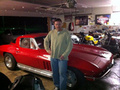
I built this 7,000 rpm 327 in 1970 for my '63 Corvette, from parts I gathered up after "damaging" the original engine. The short block was an over the counter block built for a modified class, circle track car but replaced mid season with a big block engine. A good deal of machine work had been done to it as prep for the injected stock car. I'd hate to tell you what I paid for it. Heads were Mondello's. Cam was a Crane solid-roller that would pull until you ran out of nerve. Intake was a new-at-that-time Edelbrock Tarantula topped with a 950 Holley.
I managed to run it through the quarter in mid 12's a few times, but I never had a chance to really sort it, so I have no idea what it could have done. Shortly after getting it together I was drafted and put the car in storage for 36 years. I shifted it at 7,000 most of the time, and it was still pulling hard, but I did not want to break anything - at least not yet.
I did manage to put a couple hundred miles on it, on the street as well. Traction was the limiting factor on the street and the strip. My class (FX) was limited to a 7" slick. By that time (1970-1971) FX was where they put "modified" cars that were not eligible for Stock or Super Stock, but also not eligible for Modified or Gas class.
These pictures were taken during teardown, after removing the car from storage for restoration.
I built this 7.000 rpm 327 in 1970 for my '63 Corvette, from parts I gathered up after "damaging" the original engine. The short block was an over the counter block built for a modified class, circle track car but replaced mid season with a big block engine. A good deal of machine work had been done to it as prep for the injected stock car. I'd hate to tell you what paid for it. Heads were Mondello's. Cam was a Crane solid-roller that would pull until you ran out of nerve. Intake was a new-at-that-time Edelbrock Tarantula topped with a 950 Holley.
I managed to run it through the quarter in mid 12's a few times, but I never had a chance to really sort it, so I have no idea what it could have done. Shortly after getting it together I was drafted and put the car in storage for 36 years. I shifted it at 7,000 most of the time, and it was still pulling hard, but I did not want to break anything - at least not yet.
I did manage to put a couple hundred miles on it, on the street as well. Traction was the limiting factor on the street and the strip. My class (FX) was limited to a 7" slick. By that time (1970-1971) FX was where they put "modified" cars that were not eligible for Stock or Super Stock, but also not eligible for Modified or Gas class.
These pictures were taken during teardown, after removing the car from storage for restoration.
GUSTO
Have you restored this engine. It would be cool because of the vintage race parts.
The 302 DZ could rev to 7000 with 700 gram pistons and stamped steel rockers......crazy to think about it......
The #1 limiting factor in a 7000 rpm small block is the size of the oil passages in the block. Even a Bow Tie block needs to be drilled to allow the volume of oil it requires to run 7 G reliably.
A Dart or Motown block eliminates this.......so in my eyes.....I would start with that foundation and just build around it.
More RPM than that requires a lot of changes......drainback being a huge one as well as oil control......
I was around a few Pro Stock truck 358 inch engines and they would repeatedly bump 10,000 on the dyno for 900 horsepower or better......nothing that sounds quite like that.....but it also cost about 50k to build one.
So to cap off....a premium block, a well crafted oil pan with windage tray, and premium valve springs will get you to 7000 reliably all day long.
Have you restored this engine. It would be cool because of the vintage race parts.
Mike
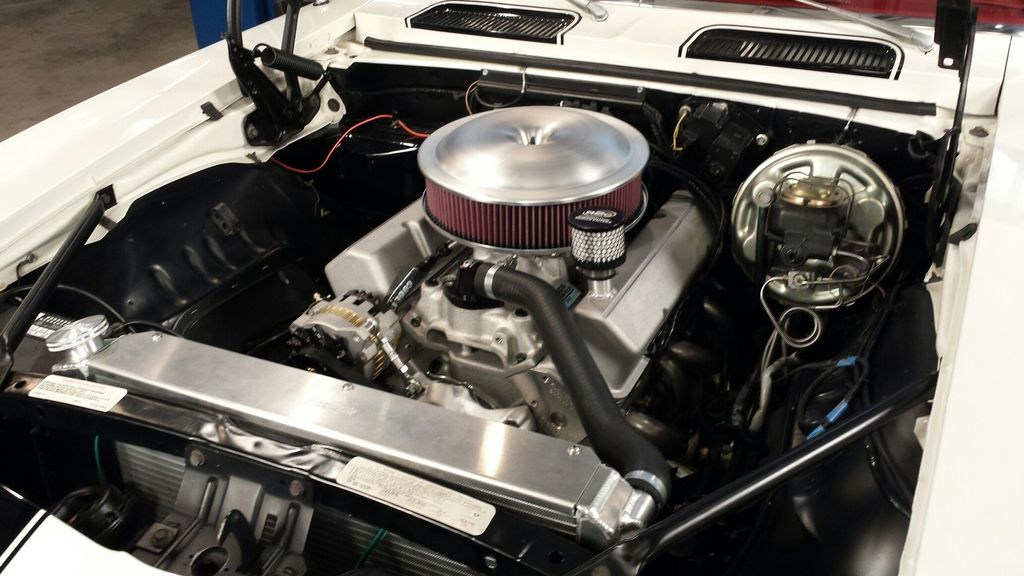
Mike, I want to be able to drive the car on the street and enjoy it. Back then, it was barely street-able, even with Sunoco 260 gas. Unfortunately between the block work and head work, the engine CR was about 12.5:1, so some things had to change. Essentially all we're using of the original is the short block, freshened up, the Tarantula intake and the restored dual-point distributor. The heads are Dart 76cc to lower the compression, a Comp Cams hydraulic roller, and a Barry Grant carb. I'm also using 2 1/2" exhaust manifolds instead of headers.
Based on what Comp Cams told me, the engine should be producing about the same horsepower as it did back in '71, but the lack of headers will cost me.
Here is my 372ci small block that I built to reliably run to 7,500 rpm. The main ingredients are a GM Bow Tie Sportsman block, Callies 4340 crank, Oliver 4340 rods, JE forged pistons, Cam Motion solid roller cam, Canfield 218cc CNC ported heads, Jesel Sportsman shaft rockers, Manton pushrods, Wilson ported Edelbrock Victor Jr. Intake, and an AED 950 carb.
[QUOTE=Neil B;1594297070]Here is my 372ci small block that I built to reliably run to 7,500 rpm. The main ingredients are a GM Bow Tie Sportsman block, Callies 4340 crank, Oliver 4340 rods, JE forged pistons, Cam Motion solid roller cam, Canfield 218cc CNC ported heads, Jesel Sportsman shaft rockers, Manton pushrods, Wilson ported Edelbrock Victor Jr. Intake, and an AED 950 carb.
If someone wanted to build a SBC that'll rev to 7,000 rpm just for the sake of doing it would it take?
Build an LT1 clone? Is the LT1 capable of 7,000 rpm (I know it redlines at 6,500).
Can you get to 7,000 rpm with hydraulic lifters?
What's the most mild cam that'll get to 7,000?
Hi Jim, not a real problem on most SB's.
I realize you have a longer stroke but here's a shot below of a 302" pump-gas, solid flat-tappet unit off the dyno at 7000+. Never skipped a beat?
I would add it made no power either, customer had been warned beforehand about using the "smog" heads he supplied. Other than the heads there was all good parts in play. It was a 6.250" long-rod build, low compression. We figure it was about 80/100 HP "light" with the heads.
We have another hyd flat-tappet going on now which will need to reach near 7500, all with a single 1.250" diameter spring (under .500" lift). This has the "R" hyd tappets (mentioned below here) incorporated.
Thanks, Gary in N.Y.
P.S. To reach that 7000 RPM area with a hyd flat-tappet would require some "R" tappets in place of the more conventional hyd ones.
[QUOTE would add it made no power either, customer had been warned beforehand about using the "smog" heads he supplied. low compression. We figure it was about 80/100 HP "light" with the heads.][/QUOTE]
Dont understand this
Why spend all the money for it knowing it will be a slug what was his reasoning someon on the internet told him
Cant help but wonder what he thinks knowing if he stands on a great sounding motor that camry next to him with kiddos in the back would smoke him.
the key is big enough flow through the entire system. 750 cfm carb, single plane (team G) 1/2 inch wood 4 hole spacer. 200 cc heads with 2.055 intake valves 1 3/4 hooker sc headers and free flowing exhaust.
They the key is NO VALVE FLOAT. When I built this H-rollers were not on the market yet.
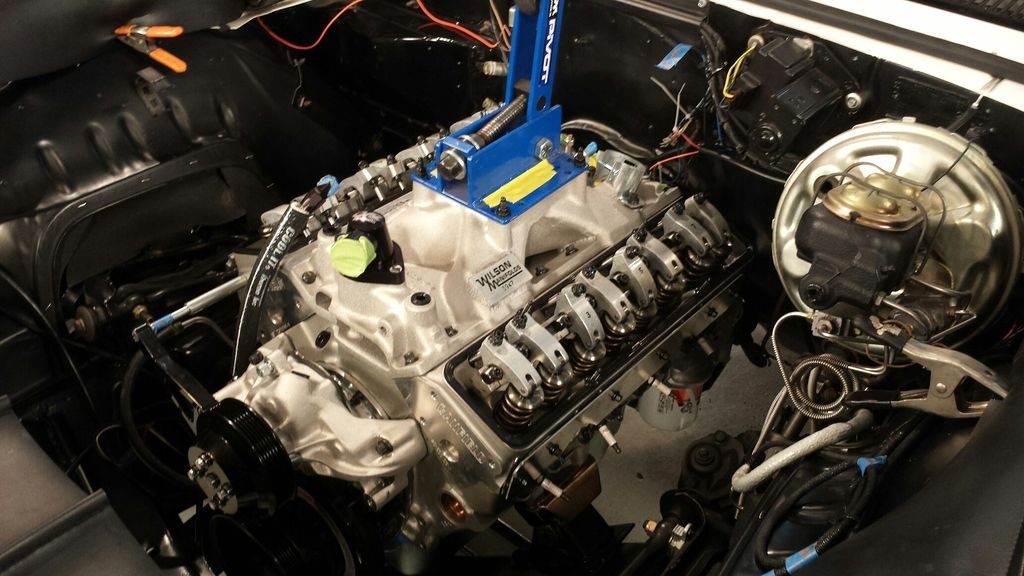
Here is my 372ci small block that I built to reliably run to 7,500 rpm. The main ingredients are a GM Bow Tie Sportsman block, Callies 4340 crank, Oliver 4340 rods, JE forged pistons, Cam Motion solid roller cam, Canfield 218cc CNC ported heads, Jesel Sportsman shaft rockers, Manton pushrods, Wilson ported Edelbrock Victor Jr. Intake, and an AED 950 carb.
I was wondering why you went to 372 ci
I built the engine for my '69 Z28. I wanted a big bore, short stroke engine like the original 302 (only on steroids). So I went with a 4.125" standard bore and 3.48" stroke. It makes peak hp at 7,100 rpm with a 268/274@.050 camshaft and it sounds like a NASCAR late model.
Designer Imagines A Corvette That Looks More Like a Corvette Than the Corvette
Slideshow: A Jaguar designer's personal project imagines what a modern front-engined Corvette might look like if Chevrolet revisited the golden age of the Stingray.






 7,000 rpm sbc?














 gusto
gusto