When you click on links to various merchants on this site and make a purchase, this can result in this site earning a commission. Affiliate programs and affiliations include, but are not limited to, the eBay Partner Network.
A couple of years back I restored a 1970 GMC with 396 (402). I built it bone stock. On the dyno it peaked at 408 lb-ft of torque, and the GM Heritage documents show the gross torque peak at 400, so very close.
Right now I'm dyno tuning my bone-stock L36 427 and it's making 498 lb-ft down low, tantalizingly close to 500.
First off this seems like a LOT of torque from an L36, is this typical?
Also, why would it make 80lb-ft more than the 396 with only 30 extra cubes? The cam profile in the 427 is better, but is it that much better?
A couple of years back I restored a 1970 GMC with 396 (402). I built it bone stock. On the dyno it peaked at 408 lb-ft of torque, and the GM Heritage documents show the gross torque peak at 400, so very close.
Right now I'm dyno tuning my bone-stock L36 427 and it's making 498 lb-ft down low, tantalizingly close to 500.
First off this seems like a LOT of torque from an L36, is this typical?
Also, why would it make 80lb-ft more than the 396 with only 30 extra cubes? The cam profile in the 427 is better, but is it that much better?
Well....peanut port truck heads with a stock cam really hold back torque.
The L36 was rated from the factory at 460 or so......but the big deal is the large oval port heads and a somewhat larger cam.......so with some dyno error and a tweak here and there I could see it.
I had a 427/400 that was slightly modified and bored to 440.....it made silly torque.
FWIW....dynos do not record well at very low RPM's.......beware of "popcorn" number where the engine is out torquing the dyno.
About 2500 rpm and up is where you would see accurate numbers.
Jebby
Last edited by Jebbysan; May 20, 2018 at 11:22 AM.
Well....peanut port truck heads with a stock cam really hold back torque.
The L36 was rated from the factory at 460 or so......but the big deal is the large oval port heads and a somewhat larger cam.......so with some dyno error and a tweak here and there I could see it.
I had a 427/400 that was slightly modified and bored to 440.....it made silly torque.
Jebby
It's not the 366 head, it's the normal passenger car head. The truck motor is more or less the 396/325 with an extra-poor intake manifold. So same ports! And very similar cam. That's why I'm surprised.
It's not the 366 head, it's the normal passenger car head. The truck motor is more or less the 396/325 with an extra-poor intake manifold. So same ports! And very similar cam. That's why I'm surprised.
I just edited my post.....and that may give you more insight.
Bone stock Truck Big Blocks had the peanut port head.....all of them....even my 454 (468) outside.......they actually work rather well if ported but with a mosquito bite cam....they are disappointing.
If you have a large oval truck motor....I have never seen one....but does not mean it doesn't exist.
I just edited my post.....and that may give you more insight.
Bone stock Truck Big Blocks had the peanut port head.....all of them....even my 454 (468) outside.......they actually work rather well if ported but with a mosquito bite cam....they are disappointing.
If you have a large oval truck motor....I have never seen one....but does not mean it doesn't exist.
Jebby
I hadn't thought that much about the ports so you could well be right. I know it's a different intake manifold. According to my notes, the heads are casting 3975950 which is indeed a truck specific head.
I assume they used a small, high velocity port for good low end torque, and yet the 427 makes much better low end torque anyway (more than the cubes alone would account for). Hence the question, I guess!
Or when they say "low end" do they mean way down at 1500 or something?
If I'm not mistaken, this is the truck head on the top and the "oval port" head on the bottom.
I hadn't thought that much about the ports so you could well be right. I know it's a different intake manifold. According to my notes, the heads are casting 3975950 which is indeed a truck specific head.
I assume they used a small, high velocity port for good low end torque, and yet the 427 makes much better low end torque anyway (more than the cubes alone would account for). Hence the question, I guess!
Or when they say "low end" do they mean way down at 1500 or something?
If I'm not mistaken, this is the truck head on the top and the "oval port" head on the bottom.
Those are both truck heads in the pic......the bottom one has been "venturi" ported to a large oval intake.
But anyhoo......the 427 is more efficient.....and that is a good thing.
Won't effect torque down low really.....not until it needs to breathe.....
383's and 406's make about the same torque down low......but many other factors come into play as well.....too many to list.
.150 of bore size will not make 90 ft/lbs. torque.......of course i have said too much at this point.
that is one of the old wife's tails. Very dumb one that the uniformed continue to spread. a cubic inch is a cubic inch.
if everything is exactly the same and I just change the bore and stroke. The longer stroker might have some frictional loss... the bigger bore might have some better cylinder filling
It could just be the picture but the heads at the bottom appear to have larger runners. I'm wondering if the torque increase was due to the slightly larger intake runners and slightly larger bore combination. I imagine if you stick the heads in that picture that are at the top on the 427 you will notice some loss of torque from that 498 number.
Last edited by bence13_33; May 21, 2018 at 09:23 AM.
Definitely I think as Jebby said the truck heads are way worse.
I'm just surprised down low, I thought the high velocity truck heads might fill the cylinders down low much better and win for torque.
But that's not what the dyno says. Perhaps the smaller ports give you better throttle response and driveability, but they're not winning the torque war.
Right now I'm dyno tuning my bone-stock L36 427 and it's making 498 lb-ft down low, tantalizingly close to 500.
First off this seems like a LOT of torque from an L36, is this typical?
Also, why would it make 80lb-ft more than the 396 with only 30 extra cubes? The cam profile in the 427 is better, but is it that much better?
I had my never-apart L36 professionally rebuilt in 2009. It was bored .030 over and essentially "zero-timed" along with a Comp 268H cam, lifters and valve springs. The CR was kept near stock. The engine was broke-in and tested on the dyno. I transferred the data to an Excel graph. This is what it made on the third pull. I can only assume it can do better with more timing, running better fuel than 93 octane E10 and tuning of the Q-Jet.
I would hardly call the L36 a "lump" or a "junkyard truck engine" as some on this forum have. After all...it is a 427. We loved them all back in the day for a reason.
I would hardly call the L36 a "lump" or a "junkyard truck engine" as some on this forum have. After all...it is a 427. We loved them all back in the day for a reason.
Pretty close to my stock numbers, so the 268H must be reasonably close to the factory hydraulic grind?
I actually think it's the third best factory big block. For driveability and street manners I think the leaderboard is:
1970 LS5 454
1969 L68 427
1969 L36 427
Otherwise you're into mechanical lifters and rectangular port heads, and those heads aren't really the hot ticket for street manners. If they were anywhere near as fast as people think they are they'd be worth it, but they're generally not. So you get crappy cold starts and poor idle and a 13- or 14-second car? No thanks!
I was going to say "What would be even better would be a 454 with a head somewhere between oval and rectangular", but that's pretty much exactly what the did with the ZZ502 and it's "Roval" ports.
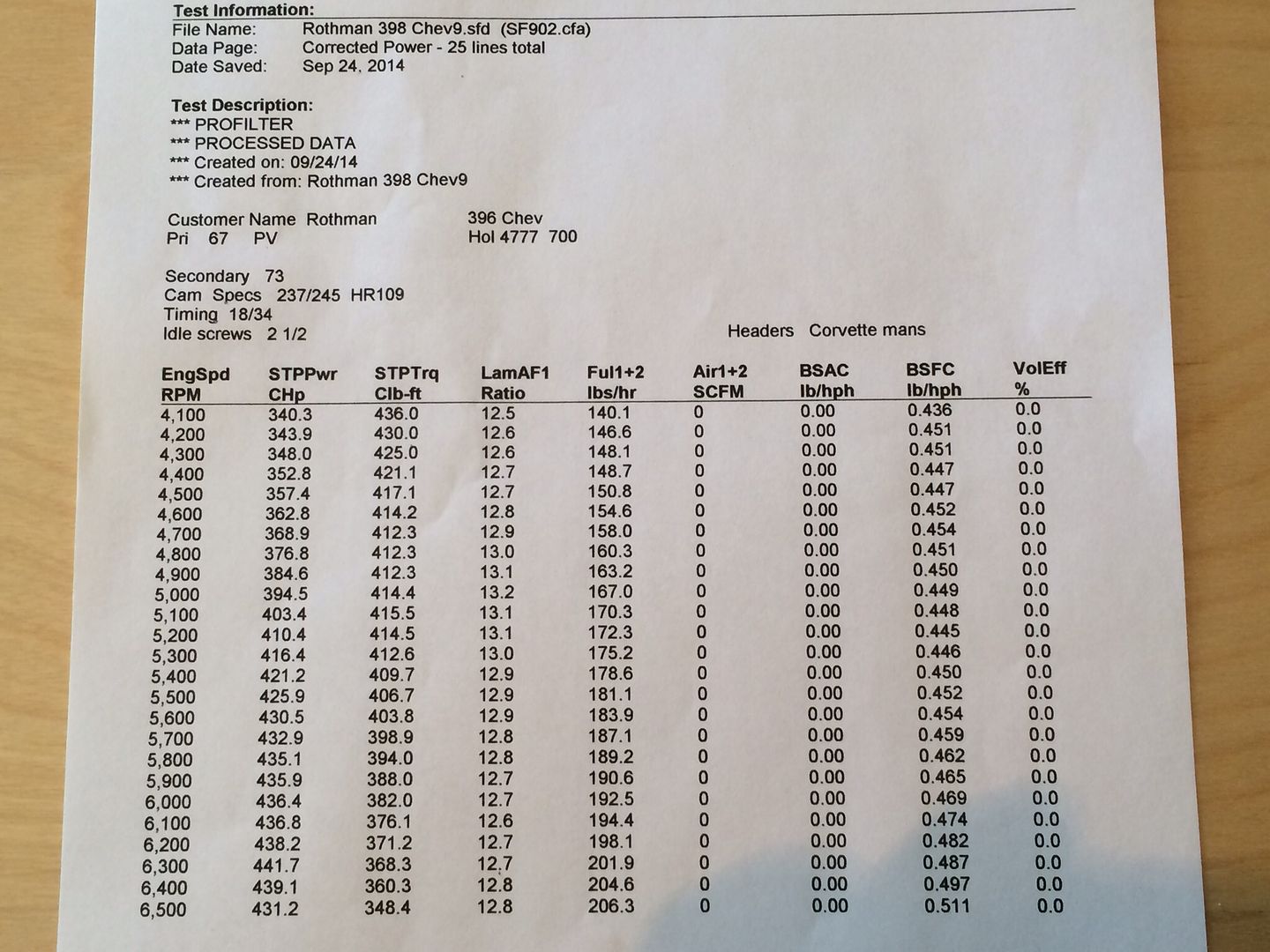
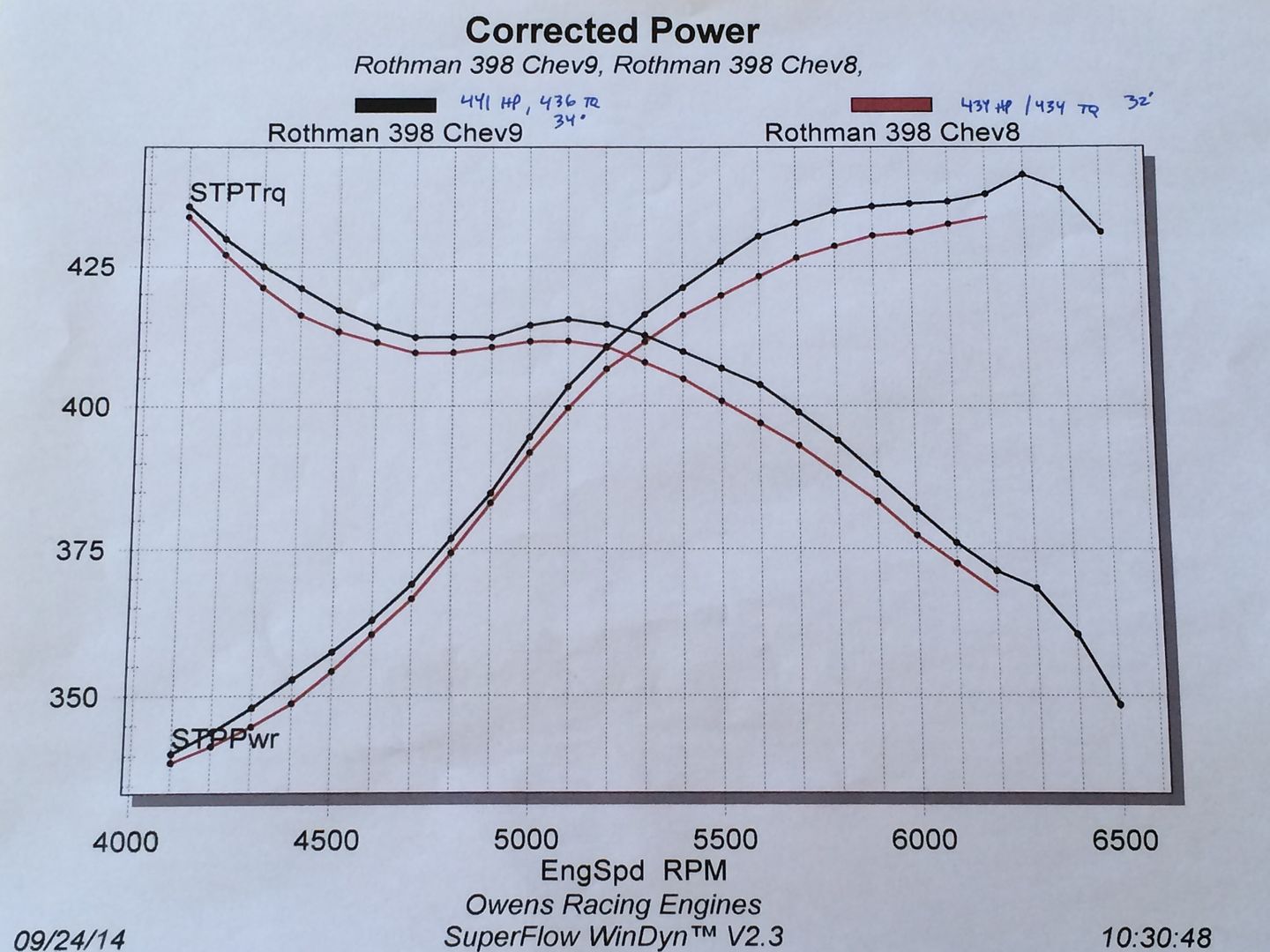
Here is the 396 we built a couple years ago for my dad's 65'...
This was with lowered compression (9.8-1), stock square port heads, stock Winters intake, and a 650 cfm carb (this was a mistake due to the model number..)... Also dynoed with stock exhaust manifolds.
Only thing really different is its a hyd roller as opposed to the oem solid flat tappet....
I know we left at least 10hp on the table with the small carb and probably 20-25hp with the stock manifolds...








 396 vs 427 stock torque