When you click on links to various merchants on this site and make a purchase, this can result in this site earning a commission. Affiliate programs and affiliations include, but are not limited to, the eBay Partner Network.
Ecklers alternator conversion kit for 1968 Corvette. Plug on left doesn't look like a direct fit without modifying existing wiring harness
Has anyone used the alternator conversion kit 25-103341 from Ecklers to modify wiring from one wire to two wires alternators to allow use of newer alternators on the 1968 Vette? The part with white/black wires appears to connect to the place that is blocked off on the side of the alternator where two male spade connectors are located, but the other plug has a plug that is supposed to connect to the wiring harness. My harness has only the positive red 10 gauge wire with loop connector and a negative 16 gauge black wire with loop that grounds to one of the bolts on the case of the alternator. There is no "plug". Suggestions?
One wire alternators are boat alternators. The 68 had an alternator without added voltage regulator installed. The long flat plug was plugged into regulator on firewall. Somebody changed your alternator and messed with the wiring.
[QUOTE=ronarndt;1597341374]
OK, Here is what is on the car now. In the conversion kit where does the short white/black wire plug with the two male spade connectors plug into? I know the female end will plug into the alternator where that black rectangular plug is located. The voltage regulator plug is also not an issue. I did not think the wiring harness looked like it had been cut and changed- or has it?
Your alternator pictured is a one wire Delcotron. Not OEM on any year C3. That style Delcotron is classified as a self exciting alternator. Your 1968 OEM alternator would of used the square two wire connector. The purpose of the flat black connector is to supply an ignition voltage supply to the field circuit, it would basically bypass the 1968 OEM regulator and allow it to run wide open which would be required for a conversion to a 1969 or later style OEM alternator [which has an internal voltage regulator] along with the other adapter pictured in the Ecklers kit. T
The original 10DN alternator had a square 2-pin connector on the back of the case. Your picture doesn't show that square 2-pin plug. It should be with the red and black wire.
The wires for the square 2-pin plug came from the flat 4-pin regulator connector.
I can't tell for sure, but it appears the flat 4-pin connector has no wire coming from the top-left terminal. Are there 4 wires coming from it or not?
If the square 2-pin connector does still exist somewhere in the harness then you could use it with that kit.
If the square 2-pin square connector has been removed then I'd recommend you re-wire to remove the 4-pin flat connector as well. Basically, you run 2 of the wires from it to the alternator directly.
- The brown/white wire going to terminal #4 of the connector gets run to terminal #1 of the alternator.
- The red (I believe it's red but might be another color like orange) wire going to terminal #3 of the connector gets run to terminal #2 of the alternator. The schematic shows this as a fusible link tapped off the main red wire from the alternator. So, you can extend it or replace it by jumping off the main stud of the alternator. Just do what makes sense depending on what you find after opening the harness.
[QUOTE=ronarndt;1597341374]
[QUOTE]
Well, It bothered me that the 1968 wiring diagram did not match what was on my car. There was supposed to be a white wire and a blue wire that allowed the field to be energized. Although the harness did not look like it had been messed with by the PO, it was the only one I did not replace with a new wiring harness two years ago. So I carefully removed the wrapping tape and found the two prong plug and wires carefully bent back and wrapped where it was not visible without un-wrapping everything. One more thing to blame on the PO. So I guess the alternator was the self-exciting type mentioned by terryst8roadster, which put out 13.5 volts with nothing going to the field coil. Does anyone have a photo to show the wiring coming out of the alternator that goes into my new-found plug? I will need to make a short pigtail to fit.
Anyway- it appears I can use the Ecklers kit. Thanks to all for their help. RA
lionelhutz: "I can't tell for sure, but it appears the flat 4-pin connector has no wire coming from the top-left terminal. Are there 4 wires coming from it or not?"
Yes there are four wires. Thanks.
Ecklers alternator conversion kit for 1968 Corvette. Plug on left doesn't look like a direct fit without modifying existing wiring harness
Has anyone used the alternator conversion kit 25-103341 from Ecklers to modify wiring from one wire to two wires alternators to allow use of newer alternators on the 1968 Vette? The part with white/black wires appears to connect to the place that is blocked off on the side of the alternator where two male spade connectors are located, but the other plug has a plug that is supposed to connect to the wiring harness. My harness has only the positive red 10 gauge wire with loop connector and a negative 16 gauge black wire with loop that grounds to one of the bolts on the case of the alternator. There is no "plug". Suggestions?
I just put this on my 68 as well. It works fine.
I capped off the regulator part, plugged in the adapter and ran the red wire to the horn relay.
Zoom in on this pic to see the wires plugged into the top of the alternator.
Well, It bothered me that the 1968 wiring diagram did not match what was on my car. There was supposed to be a white wire and a blue wire that allowed the field to be energized. Although the harness did not look like it had been messed with by the PO, it was the only one I did not replace with a new wiring harness two years ago. So I carefully removed the wrapping tape and found the two prong plug and wires carefully bent back and wrapped where it was not visible without un-wrapping everything. One more thing to blame on the PO. So I guess the alternator was the self-exciting type mentioned by terryst8roadster, which put out 13.5 volts with nothing going to the field coil. Does anyone have a photo to show the wiring coming out of the alternator that goes into my new-found plug? I will need to make a short pigtail to fit.
Anyway- it appears I can use the Ecklers kit. Thanks to all for their help. RA
I may have answered my own question. I found photo of the 10dn alternator and it has a direct plug-in socket on the back. I have another alternator ordered and should be able to hook it up the proper way now.
I just put this on my 68 as well. It works fine.
I capped off the regulator part, plugged in the adapter and ran the red wire to the horn relay.
Zoom in on this pic to see the wires plugged into the top of the alternator.
Thanks. I see you like chrome too. The PO of my car had chrome everywhere, so I am just following his example. Only downside, I had to take off the Chinese chrome plated intake and replace it with a Weiand aluminum one. Not quite as shiny, but it works better.
The 1-wire will work find on your car, probably just needs a small rev to get it started.
If you ordered a 10DN alternator then you need a voltage regulator too. I'd recommend the Wells solid state regulator over a mechanical one. But, a 10DN won't be any better than a 1-wire alternator.
The 1-wire will work find on your car, probably just needs a small rev to get it started.
If you ordered a 10DN alternator then you need a voltage regulator too. I'd recommend the Wells solid state regulator over a mechanical one. But, a 10DN won't be any better than a 1-wire alternator.
The one wire alternator pictured puts out only 8 volts and needs to be rebuilt. I have a solid state regulator- Autozone store brand.
My 6t8 originally had the external regulated only 42 amp alt. No where good enough for a vette with an electric fan. A 62 amp is barely adequate for that task. T
My 6t8 originally had the external regulated only 42 amp alt. No where good enough for a vette with an electric fan. A 62 amp is barely adequate for that task. T
I thought so too. I removed the stock stator and replaced it with a 105 amp stator from Quick Start. Also put the chrome plated front case and bullet pulley and fan on the Delco case. The chrome-plated back half of the case from my one-wire alternator will require using a Dremmel to put a hole for the plug from the voltage regulator. That's a job for another day, but I'm back on the road again.............Willie Nelson song in background..........................
My 1968 had the original alternator when I bought it. I too have electric fans now and I switched over to the single connection 120 amp alternator. The unit I have works fine, as it wakes up at 800 rpm and it supplies more power than I need at least now.
My unit looked like the chrome one in previous postings. Made by Delco as well.
The alternator makes a lot more power than the original so I got concerned about pushing 120 amps thru a system designed for a 42 amp alternator. I ran a #6 flexible wire from the alternator output to the starter terminal, this is so the power goes to the battery thru the starter wiring. I did connect the original output wire as well. At this time my ammeter does not show the full power. I had thought about getting the proper current shunt and installing a new ammeter just so I know the battery is getting charged. For now I am using a voltmeter that shows me the actual battery voltage.
Does anybody know how to to do the wiring any differently?
My alternator does have a provision to "wake up" with the ignition power, I used a piece of wire and made my self a short wire from the ignition on to the alternator. Now it starts up automatically when I turn the key.
I have been thinking about going to an EFI system and I want to be sure that all of the power bugs are gone. Then I go shopping for an EFI system that can handle my engine.
I love to see so many 1968 Owners, I really love how unique our Corvettes are. My Corvette is number 2595 and it had several 1967 Big block components on it. When I rebuilt the engine it took an expert eye to catch which parts were what year. I am eternally thankful to the experts at Tony's Corvettes in Gaithersburg Maryland.
Good Point about switch from the Ammeter and going to a straight volt meter! The volt meter would be more useful in the long run.
I have heard that some Corvette fires are caused in part because the ammeter and its wiring. Most ammeters like that have a "current shunt" that measures the amount of current accurately. The Corvettes used wires that have specific resistances built in for the ammeter's data. This way of measuring current can be more dangerous. If I were going to keep the ammeter I would be changing the current measurement system and use a proper "Current Shunt" which would be more precise.
When I installed the high amp alternator on my 1968 I did it by running the output directly to the starter solenoid. This gives the battery a good solid path for the current to flow. I specifically tried to avoid damaging the ammeter or accidentally setting my car on fire.




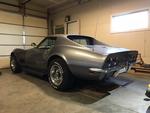




 1968 alternator conversion kit