When you click on links to various merchants on this site and make a purchase, this can result in this site earning a commission. Affiliate programs and affiliations include, but are not limited to, the eBay Partner Network.
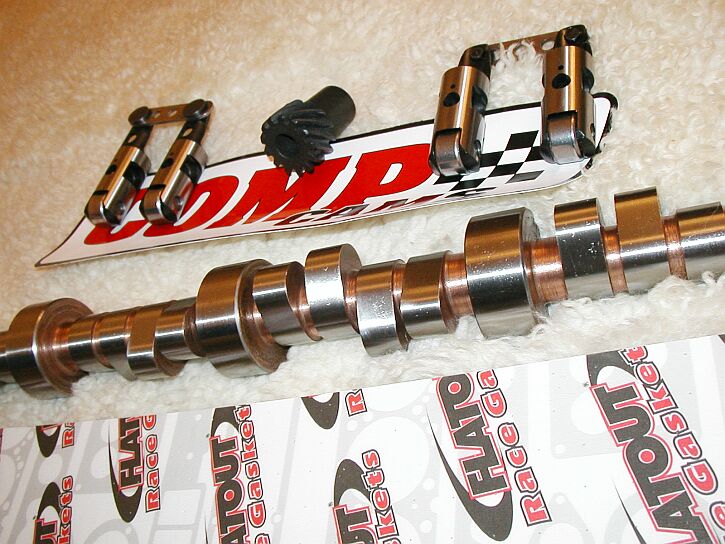
To continue discussing how to choose cam lobes from a cam lobe master catalog from a post Gkull made in another thread:
Last Post: Originally Posted by gkull
So your AFR heads give you a CFM at .100 .200.300...……… so you can just figure out the @ numbers for the .050 increments. The more information the more accurate
This is where I pick my roller lobes for custom cams. So if you turn to page 85, TC solid roller for small base circle cams. You could pick the 236 and 240 duration for example and they give the .200 duration numbers for comparison of how steep the rams are.
Or on page 29 the HLO hydraulic roller lobes havereally high lift to match the AFR lighter weight valves. You could use a #13779 235 dur and #13781 239 dur and have .644 I and .648 exhaust with 1.6 RR's or on page 28 extreme marine #3474 & 3376 or page 25 and use the high lift QXI lobes
I pulled some #'s from the HLO and QXI lobes in the Comp catalog and a TC solid roller lobe, then the High Energy, Magnum, and XE flat tappets, and did some quick comparisons:
Mike Jones EHR Series (most aggressive Hydraulic Roller I know of): #EHR75365 292 adv, 246 @ .050, 166 @ .200 (126 deg diff b/t adv & .200) -.547" with 1.5 RRs
TC Solid Roller Small base circle: #11470 287 adv, 256 @ .050, 176 @ .200 (111 deg diff b/t adv & .200) -.660" with 1.5 RRs
-I'm using the # of degrees difference between the adv duration and the .200 duration as the indicator of how steep the ramp is from 0.006" to .200" and then I assume you just infer the slope required to get from the .200" lift to the max lift. (Less duration change between adv and .200 indicates faster ramp; more lift with same duration indicates faster ramp).
There's some super interesting stuff in there; the adv vs .200 #s really show the initial ramp pretty well and you can see that the "XE" lobes in both the Flat Tappet ranges really do have the same ramp from 0.006" -0.200" although obviously the hydraulic roller version opens the valve more. I also noticed that the intake lobe from some of the magnum series cams got reused on the exhaust lobe in the extreme energy series (same lobe #). It also highlights just how stinking old and lazy the classic 60s and 70s "modern" lobes are; I tried to pull the #'s for the L82 but I can't find the .200" #'s anywhere; it's also worth noting that the L82s "advertised" duration was at 0.008" instead of 0.006" like the rest of the cams, so the L82 is even worse than it looks...
I'm aware of the reputation of the QXI lobes as a very aggressive (fast ramp) hydraulic roller design and the #'s show that, but I was not aware just how much more dramatically fast / steep solid roller cams are; the difference is ASTONISHING. I was also surprised that the Extreme Energy series and the QXIs seem so similar; seems the only difference is that the QXIs have more lift but from seat to .200 are near identical.
Question on the closing side of the ramp(s): How do you tell from the specs in the catalog what the closing side of the ramp looks like? My understanding is that even the opening side of the lobe and the closing side of the lobe on modern cams are different and that the goal on the opening side is to yank the valve open as fast as can be supported by the springs and RPM, but that on the closing side you want to start decelerating the valve from .200" down to close so you avoid the loud mechanical Comp XE flat tappet sewing machine sound and associated valve bounce and damage. (right?) -All the specs in the catalog seem like they're focused on the open side only.
Now when it comes to recommendations for a particular cam for a particular application, and particularly when finding a cam appropriate for Walter Taucher's build and goals on the other thread, that's where I get more confused. The AFR 195s aren't rated beyond 0.550" lift; I'm assuming because they don't see gains beyond that lift, I know that performance gains can definitely be had by lifting the valve past the point where the flow fails to increase (spend more time at higher lifts and lift the valve there faster), but how do you target/choose a certain max lift?
Were you recommending the HLO #13779 lobe as a good candidate for Walter's build? -If so why choose a less aggressive HLO roller lobe that can spin to up to 8,000 RPM if his goals, and that specific cam duration, will never see him make power certainly past 6,500 RPM? (My thought would be if you're going for max power with a light valve train and good springs, why not go for the most aggressive lobe for your desired RPM? (Why not go with the QXI lobe instead?)
-How should I interpret the diff between the HLO and QXI lobes? The HLO lobe has a less steep ramp between valve open and .200 than the QXI lobe, but it has a tiny bit more lift...
Adam
Last edited by NewbVetteGuy; Sep 21, 2018 at 07:55 PM.
It's useful for everyone to remember that your "Dynamic Compression Ratio", which is the VERY rough estimate of how much air / fuel is going to be trapped in the cylinder and a useful estimate to cylinder pressure / torque is HIGHLY correlated to intake duration (obviously LSA and whether the cam is ground or installed advanced/ retarded, too), so you get more torque when you have a smaller advertised duration. BUT, more duration from 0.050" and 0.200", and getting the valve into higher lift where the airflow is higher for longer helps you make more power and at higher RPM. -So the modern, more aggressive cams can accomplish both by having more duration at higher lifts, while keeping the duration at low lifts shorter (which helps DCR / cylinder pressure).
It's interesting for me to see the data and finally understand why some people have said that the newest generation, highly aggressive flat tappet cams are essentially "hydraulic roller lobes" and why that might cause longevity issues. -It also highlights that if you want your hydraulic roller motor to have advantages over the modern flat tappet cams, you need to go with a newer, more aggressive lobe, but obviously one that's appropriate for your RPM and then ensure that your springs and valvetrain are appropriate for the aggressiveness of your lobes and RPM combo.
-Then on the upper end of aggressive hydraulic roller cams, spring pressures to control it all can be too much for older-style hydraulic rollers so you need good rollers that have slower bleed down rates, & shorter travel and / or you have to make the valve train lighter so you can reduce spring pressure. (There's a reason lots of LS engines came with light valves, beehive springs, aggressively ramped cams, & slow bleed down rate hydraulic roller lifters.)
I also find it interesting in that aggressive flat tappet cams and basic hydraulic rollers can have very comparable ramps from open to .200", there's still a BIG JUMP going from hydraulic roller cams to that solid roller! I can definitely see how if I had big heads that would take advantage of more lift, that the benefits of a solid roller could be significant. (Comparing Comp #11470 vs Comp #13450 is crazy; same advertised duration but 21 degrees duration difference @ 0.050" and 20 degrees @ 0.200"!!!)
Adam
Last edited by NewbVetteGuy; Sep 21, 2018 at 07:48 PM.
I always found the best way to pick a cam is to let the cam grinder do it, he has more experience and knowledge, I used to use Ultradyne, Harold Brookshire was a genius, if I was to buy a cam today Tim at Bullit would be my go-to guy, comp cams does not make my list...
I know it's controversial, but David Vizard has a method for determining the ideal LSA on a SBC. Ideal is only from a "max HP and Max Torque Peak" perspective, but it seems a useful reference to keep and then move the LSA wider, taking into account your duration(s) to get to the vacuum that you need / require (assuming NA only engine).
Engine size divided by the number of cylinders. That number divided by the intake valve diameter. That number multiplied by .91. 128 minus that number equals LSA
I always found the best way to pick a cam is to let the cam grinder do it, he has more experience and knowledge, I used to use Ultradyne, Harold Brookshire was a genius, if I was to buy a cam today Tim at Bullit would be my go-to guy, comp cams does not make my list...
I agree; I called Mike Jones and had him pick out mine.
Having said that, if I knew more, and specifically how to determine what spring a given lobe required for a given RPM, I might "chance my arm" picking out my own.
If you know how much you want to balance longevity vs. performance vs. $$$ you can make decisions about the aggressiveness of the lobe and the weight of the major valve train components.
If you know where you want peak HP then you know pretty closely what duration range @ 0.050 you need and you just ensure that you match that to static CR and rear gear.
You use the Vizard formual to understand the LSA that's ideal for max power and then widen it to hit your vacuum goals.
If you have an 80% intake to exhaust flow in your heads, and a Pipe Max ideal exhaust system you can choose an exhaust duration that's the same as the intake. (How you figure out how much the exhaust duration should increase to account for decreasing I:E ratios or a non-ideal exhaust system I have no idea.)
How you figure out what spring to use with the cam lobes, RPM, and the rest of the valve train components, I have no idea. A guy posted a theoretically ideal formula on SpeedTalk but it involved knowing a list of like 20 or 30 things that I had no hope of having or knowing (including the duration of the cam at all lifts).
I'd love to someday be able to pick out my own cam, especially if I limit my self to NA SBCs only, but I think that day is quite a ways away...
Adam
Last edited by NewbVetteGuy; Sep 21, 2018 at 08:10 PM.
I just put it out there for every bodies information. I just whipped out some options to get you thinking. Anybody can order a cam a thinking person can make his own. I've been thinking up cams for over 20 years when the first desk top dyno and other more sophisticated software came out. I worked at a race car shop and I felt better making my own informed decisions. Most of my custom cams actually have different style lobes. Like I might use a QNI intake for higher lift and a QXX for the exhaust.
Your questions: but how do you target/choose a certain max lift? First you have to find a spring that can handle the lift. If I was going to lift a valve .648 I would find a spring with the desired closed and open pressures and of course you would want something like a max lift of near .700 so the spring would run cooler because it is not near coil bind at max lift. Why not go with the QXI lobe instead? Less aggressive lobes are more stable for a given spring pressure. Springs degrade with time and use. So lets say you start with 145# seat closed pressure and 400 open. No valve float and the thing runs great. Well a year or two down the road when the spring loose 25 pounds the aggressive lobe can cause valve float. Lobes can also be asymmetrical. really radical lift and then a gentile closing so you don't get the valve bouncing off the seat
both are 239 @ .050 and the QXI has 160 degrees duration @ .200 inches of lift The HLO has 156 degrees of duration @ .200 with .648 valve lift. The bigger the .200 number the steeper the ramp making the valve open faster. The HLO just happens to have higher lift. I like higher lift and the least duration that I can get away with for a given octane and compression ratio.
Intake opens at 38 degrees before TopDeadCenter, closes at 70 degrees After BottomDeadCenter…….. for the exhaust. Then compare it to another mild cam type with the same duration and look at both cam cards. You will notice that the Extreme series might be advancing the intake opening 4 degrees sooner. Which will cause more intake reversion and that rumpity rump sound that people want to hear so people can tell that it has a cam in it and the bragging starts. So I ran 100's of man hours on engine simulation software and watching what happened when I retarded or advanced the cam. My conclusion was to have my cams ground 4 degrees retarded compared to a comp cams Extreme series. So I have less reversion and have the piston moving to increase the intake signal. There is also an advantage in opening later it increases the intake valve to piston clearance. My big SBC has .686 and .714 valve lift with big .200 duration numbers. Valve clearance with 2.10 diameter valves can become a problem. So go ahead a try juggling your valve events from a cam card and retard all of them 2,4,6,8 degrees and even advance the numbers 2,4,6 Change the LC from 106, 108, 110, 112, 114 and watch how the peak TQ and HP change.
The other lesson is "Spring Charts" from Comp cams. You first look at the installed height that your valve can do. Because I have am forced to use .200 longer valve stems to get the big lifts. I use spring with an installed height of 2.05 or so and a coil bind of 1 .250 Which is saying that my max lift is .800 Way above my .714 max lift
Lots to learn from those charts. Like installing a spring with a higher installed height to get the seat pressure and the open you want and how it increased the springs max lift and runs cooler, lasts longer, and higher rpm before valve float.
As to Redvettes statement. yes a guy that has been grinding cams forever has gotten lots of feed back over the years of what works and what doesn't work. Way back when choices we limited I bought Clay Smith cams and Chet Herbert for solid rollers for drag racing. I also took the time to measure unknown cams to see what they were doing on some of these impressive race cars. The Historic GT1 cams from GM were really crap with only top end in mind.
One thing that I can't stress enough is small cam companies have limited resources and choices. It cost a lot for the tooling to make a type of cam. So you are left with a limited amount of choices that they made. So saying that this guy is a genius and makes the best cams is dumb. Because he might have only tested a few ideas, not 100's. Year ago all the small guys bought their cam blank cores from crane cams. I used to buy all Crane cams and they were good guys on the phone. But one day I ask if they could make me something not in their book of choices and it was explained to me about making the tooling to grind a new lobe and how they could do it for big bucks. That when I initially talked to Comp cams and they sent me the lobe & spring catalog.
I have too much to learn here before i am qualified to participate here. But Chuck , my engine builder and the engineers at Howard cams came up with this grind for my 383, with Pro-M EFI and Tremec wide ratio TKO 500 This is a hydraulic roller. Planning to purchase 1.5 ratio comp cam roller rockers. This 383 is at 9.8:1 being a 90 - 91 octane compatible engine.
Designer Imagines A Corvette That Looks More Like a Corvette Than the Corvette
Slideshow: A Jaguar designer's personal project imagines what a modern front-engined Corvette might look like if Chevrolet revisited the golden age of the Stingray.






 Using Cam Lobe Master Catalogs