When you click on links to various merchants on this site and make a purchase, this can result in this site earning a commission. Affiliate programs and affiliations include, but are not limited to, the eBay Partner Network.
I have my original, correct casting #s, appropriately date-coded to car's build date, 454 stripped down and at the engine builder's shop for preliminary evaluation and magnaflux. I am scheduled to speak with him tomorrow about what we're going to do and the cost estimate. I'd like a little advice on what to absolutely do (the budget will just have to stretch and live with it) and what would be "nice" to do but could be eliminated because of low bang for the buck. The car is going to be a street-driven mechanical and cosmetic refresh with an eye toward a future full restoration by someone down the road; meaning I don't want to harm someone else's efforts with what I do now. Mileage for the car while I own it will likely be a couple thousand miles/year over the next 10-20 years. The engine has never been rebuilt since new: block wear is minimal, but heads need full rebuild. The engine in the car will look absolutely stock with orig. manifolds, air cleaner, Q-Jet carb, and even the mechanical points distributor. (It also has power steering, brakes, and A/C attached - no smog AIR though.)
One of my problems in all of this is that I really don't know what my budget is for this and am unsure what kind of costs I'm looking at. I see it more as a necessity to get the engine back in the car and I'll deal with the cost as it comes in, but, it would be nice to up the performance in the process.
The rebuilder has been in the business for about 30 years, has come highly recommended by local car enthusiasts, and does quite a few racing motors for the local racers. Here's the basic outline of what I'd like done along with what needs to be done:
I'd like to raise compression from 8.5 to 10:1 but he recommends 9.5 given the state of gasoline. I also have a stock 427 with 10.25:1 and 65k miles and have zero problems with detonation - is he being too conservative? Will going from GM spec of 8.5 to 9.5 be enough of a difference to "feel" it in my seat?
New valve guides and seat re-cutting. He recommends bronze liners. I don't recall what he said about the valve seats... My searches here indicate not to install new seats, just recut the old if servicable. Advice?
Camshaft -- with all of the vacuum system on the car and my desire to keep it sounding fairly stock (slight rumble is good, loping=not good), he said we'd probably just go with something very similar to the hydraulic cam GM put in in '72. Advice on a cam upgrade; anything specific to boost performance with the vacuum and sound restrictions?
He mentioned moving to a roller hydraulic lifter setup rather than flat-tappet. My impression is that this is a nicety but an expensive one. (Am I remembering him correctly that roller lifters also have to have the spring seats cut deeper?) Advice on moving to lifter rollers? What is the downside of keeping regular hydraulic style?
I think that's it. I know it's been a long question but I do appreciate all comments and advice.
If you are planning to keep it close to stock, then your current plan is good, but you won’t feel much seat of the pants difference in performance.
If you really want to feel seat of the pants differences, then, replace the heads, intake, and exhaust, because keeping the stock is going to kill any performance gains just adding compression and a different cam.
I’m building a 496 for my 73 and going full roller.
It is costly but the different available cam grinds with a hydraulic roller will really open things up for you.
A good set of aluminum heads will be a game changer for any big block and can be painted Chevy orange to help mask the upgrade.
? Do you wish to preserve the codes stamped into block's stamp pad located just forward of right cylinder head ?
During overhaul, it's commonplace for block to be decked which USUALLY mills those stampings into oblivion. Some shops' equipment can preserve; others' cannot.
If you require preserving those stampings, this matter should be discussed with BOTH builder & machine shop ASAP & any agreement(s) made in writing.
I have my original, correct casting #s, appropriately date-coded to car's build date, 454 stripped down and at the engine builder's shop for preliminary evaluation and magnaflux. I am scheduled to speak with him tomorrow about what we're going to do and the cost estimate. I'd like a little advice on what to absolutely do (the budget will just have to stretch and live with it) and what would be "nice" to do but could be eliminated because of low bang for the buck. The car is going to be a street-driven mechanical and cosmetic refresh with an eye toward a future full restoration by someone down the road; meaning I don't want to harm someone else's efforts with what I do now. Mileage for the car while I own it will likely be a couple thousand miles/year over the next 10-20 years. The engine has never been rebuilt since new: block wear is minimal, but heads need full rebuild. The engine in the car will look absolutely stock with orig. manifolds, air cleaner, Q-Jet carb, and even the mechanical points distributor. (It also has power steering, brakes, and A/C attached - no smog AIR though.)
One of my problems in all of this is that I really don't know what my budget is for this and am unsure what kind of costs I'm looking at. I see it more as a necessity to get the engine back in the car and I'll deal with the cost as it comes in, but, it would be nice to up the performance in the process.
The rebuilder has been in the business for about 30 years, has come highly recommended by local car enthusiasts, and does quite a few racing motors for the local racers. Here's the basic outline of what I'd like done along with what needs to be done:
I'd like to raise compression from 8.5 to 10:1 but he recommends 9.5 given the state of gasoline. I also have a stock 427 with 10.25:1 and 65k miles and have zero problems with detonation - is he being too conservative? Will going from GM spec of 8.5 to 9.5 be enough of a difference to "feel" it in my seat?
New valve guides and seat re-cutting. He recommends bronze liners. I don't recall what he said about the valve seats... My searches here indicate not to install new seats, just recut the old if servicable. Advice?
Camshaft -- with all of the vacuum system on the car and my desire to keep it sounding fairly stock (slight rumble is good, loping=not good), he said we'd probably just go with something very similar to the hydraulic cam GM put in in '72. Advice on a cam upgrade; anything specific to boost performance with the vacuum and sound restrictions?
He mentioned moving to a roller hydraulic lifter setup rather than flat-tappet. My impression is that this is a nicety but an expensive one. (Am I remembering him correctly that roller lifters also have to have the spring seats cut deeper?) Advice on moving to lifter rollers? What is the downside of keeping regular hydraulic style?
I think that's it. I know it's been a long question but I do appreciate all comments and advice.
9.5:1 on the compression is definitely pump gas safe. Is it a little too cautious? Maybe...???
Raising the compression on a motor safely involves taking a few things into consideration. Static compression ratio is just the start of it. Camshaft selection/installation, cylinder head material, and combustion chamber shape also play into this.
You can run more compression on a fast burn style combustion chamber vs a wedge style chamber. You can run a lot more static compression if your running a camshaft with a lot of overlap vs one vs very little overlap. Aluminum heads are more forgiving with higher compression vs iron heads.
If your looking for more power better heads can achieve way more power, economy, and so on than raising your compression 1 a point. Plus you would pull about 40 lbs off the front of the car if you went with aluminum.
As for going with hydraulic roller lifters I would do it. Other than cost everything else is a win there. Cam breakin will be a non issue. Worries of wiping a lobe will be nearly non existent. You can run regular engine oil vs something with a zinc additive. As others have eluded to, going hydraulic roller opens up your cam selection options ALOT. Will you need deeper seats cut for your valve springs if you go hydraulic roller? Possibly, but then the consideration of running different heads also becomes a consideration as well.
Basically by looking at adding more power and doing this and doing that your saying to hell with all the NCRS stuff, which is fine.
If it were mine I would convert it to hydraulic roller, purchase a set of bare aluminum heads (probably square port) similar to if not these https://www.summitracing.com/parts/edl-60549 and have my builder finish the heads out according to the rest of the build.
? Do you wish to preserve the codes stamped into block's stamp pad located just forward of right cylinder head ?
During overhaul, it's commonplace for block to be decked which USUALLY mills those stampings into oblivion. Some shops' equipment can preserve; others' cannot.
If you require preserving those stampings, this matter should be discussed with BOTH builder & machine shop ASAP & any agreement(s) made in writing.
My builder is the machinist as well and he is completely on-board with not decking so as to retain the #s and broach marks. Thank you for your concern - I forgot to mention that.
This is an oval port engine. You can very good power out of those heads but the port work is pricey as iron is very time consuming to cut. Vortecpro would be somebody to talk to about making those heads sing. An aluminum LS6 intake would be a bolt-on slight improvement port mismatch and all. Still fit your stock big block hood.
I built about the same engine you are building for my NOM 73. I should have my 4-1/2 year frame off done within the month. First, I bored the engine a little as possible. It was already bored .030 so I went to .040 and it cleaned up. I probably have one more bore left in it. As recommended by my builder, I went to 9.5CR, same as your builder recommends. I went with a Lunati 20010711 roller. My logic for the roller is my car sits months as a time without being started and I don't want to wipe a cam. The roller protects me from this.
The Lunati was one level below what my builder recommended but I wanted it to be absolutely streetable and have good vacuum. If I used the springs and retainers from Lunati (that came with the kit), I would have had to cut the exhaust pockets. I found Comp springs and retainers that saved me from cutting the pockets. I probably would go with a similar Comp cam now. There are more options with the parts Comp has available. I would also check if a Mk VI cam fits your block. Mine was drilled for the flange, but when I saw the drilled holes I already had the cam. Instead, I went with a Torrington front bearing and a cloyes adjustable timing chain cover.
The machinist put bronze liners into the valve guides. The valves are canted and according to him, the valve guides are not necessarily true to the valve seat. The misaligned valve guides are trued to the seat in the factory machining process. Changing these apparently is a nightmare to get true. He machined my intake valve seats for larger valves (2.19"?) My hardened exhaust valve seats were good so he just cleaned up the smaller exhaust seats. I went with Comp Gold rockers.
I went with hypereutectic pistons and if I had it over, I would go with forged pistons.
I would change to main bearing studs. By the time everything was checked over and over, I must have put 20 cycles on the bolts. One of my rod's wrist pin hole was copper coated and I didn't want to reuse that rod. Apparently copper coating was a factory "fix" for an out of tolerance rod. I bought new aftermarket H beam rods that were cheaper than having the rods resized and finding a new rod.
Pretty much everything but the crank, the block and the heads is new. the block was align honed. Pistons were custom fit to the bores and the crank was custom machined to match the main bearings. The rotating assembly was balanced. I have close to $7500 in the engine and the machinist/builder was a friend that supposedly gave me a break on the price.
Last edited by 2mnyvets; Apr 12, 2020 at 09:40 PM.
I too have a BB in my '73. One piece of advice is that if you go with aluminum heads, get ones with the exhaust ports in the stock location. I'm using AFR heads and the exhaust ports are raised 3/8" and that caused my passenger side Hedman headers to hit the frame. The raised ports also make it a bit more difficult to install the spark plugs.
I'd definitely put it up to 10.5 compression. If I was buying pistons anyway I'd be boring it...and if it was me I'd use forged pistons. But truthfully...GOOD hypereutectics would be OK for what you describe. But you must be really good on your tune. And even though it's not many miles per year...if it's me those will be FUN miles so you want it built strong.
And then..if I was going this far....I'd get a 4.25" crank and add some cubes. Even a cast SCAT crank would do fine and not cost much. As mentioned...ck on the price of new rods vs rebuilding stockers with good bolts. Stock will work...but a longer rod allows for a lighter piston.
Hyd roller cam opens all sorts of possibilities. Most heads can easily handle well over .600" lift with proper springs...so no big issue there. Ck on price of rebuilding heads vs new aluminum. You can paint them orange.
But again...with a Q-jet, stock type manifold and exhaust manifolds you aren't going to rev it to the moon. You can have a LOT of fun with a 489-496" engine with pocket ported iron oval ports with 2.19 intakes installed and a hyd roller cam. Don't worry about hardened seats.
Ideas? OK. If you really want it to look 100% stock on the outside, that's fine. But it does limit the areas to get easy power improvements.
The intake and exhaust manifolds are probably your biggest limiting factor. If it's your engine and it ran well and was not over-heated you may not need to line-bore it. As long as the bare crank spins easily in the bearings. Piston replacements are required for a bore job.
Hypereuetics are OK for mild carb'd engine builds, but I like to think of the extra couple hundred for forged pistons as just "durabilty insurance". You can lean on it more often and worry about it less.
To recon the rods vs buy a new decent set is about a wash.
A 4.25" stroker crank would let you build a 500 incher and be your cheapest performance improvement. The $800 for crank costs is your only extra cost for 50 extra ft-lbs. You just buy different pistons/rods. If your current crank is a steel forged it's worth a couple hundred.
A mild hydraulic roller is a great durabilty/maintenance item these days and probably $800 ish..
If you enjoy that huge low end BB TQ you don't want to lose that with a big cam. So a little more than the stock one is as far as I would go. My LS6-similar 230/240 still makes 15-17" vacuum at idle because it has quick ramps.. And you may not even want one that big. Stock is 214/218 @ .050 A nice 224/224 ro 224//230 would give you a nice HP bump and still run great down low and pull better up top. Similar duration to a 350-350 L46 SB cam. Much more than that and the bottom end starts to drop pretty quickly and will only gain you 10-15hp.with your contraints. How about a Comp 280HR or GM ZZ-502 HR or similar. For a Hyd there was a Crane Marine 228/236 I liked. That's as big as I would go for a stock sounding engine. These are not big cams, but will have a little more rumble than stock.
The main difference between this engine and the ZZ-502 would be 50 year newer heads and head flow and 50HP.
The valve guide liners are an excellent suggestion.
9.5-10.0 would be as high as I would want to run with a mild cam like this and iron heads.
I'd guess close to 425-450HP and 560ft lbs. Or you could save the $1600 and have 425HP/510TQ
My 468 made 485hp and 555ftlbs with rect port heads.
Here's my engine cost spreadsheet Just finished feb this year.. But I had to buy everything, you already have a complete engine.
Last edited by leigh1322; Apr 13, 2020 at 12:53 AM.
I could not add much more than what was already posted but my first thought would be to stroke it. Given the appearance, RPM range and idle quality restraints, a long stroke is a no brainer. Very cost effective.
If you have an additional $1000 you could consider a roller cam upgrade. A flat tappet cam will still get the job done if you would rather keep the cash. Wider lobe centers (lower overlap) work better for cast iron exhaust manifolds and full mufflers. Look for split pattern cams with longer exhaust events for the same reasons.
I think the most important thing you have to do is match the compression ratio to the cam. I believe that most want a dynamic compression ratio of around 8. My build came in at 7.76 with 9.5 static compression ratio and the lunati cam. You can go to 10-10.5 or higher as long as your cam gets bigger too but then you start getting drivability and vacuum concerns. Nothing is free.
Last edited by 2mnyvets; Apr 13, 2020 at 08:25 AM.
Ideas? OK. If you really want it to look 100% stock on the outside, that's fine. But it does limit the areas to get easy power improvements.
The intake and exhaust manifolds are probably your biggest limiting factor. If it's your engine and it ran well and was not over-heated you may not need to line-bore it. As long as the bare crank spins easily in the bearings. Piston replacements are required for a bore job.
Hypereuetics are OK for mild carb'd engine builds, but I like to think of the extra couple hundred for forged pistons as just "durabilty insurance". You can lean on it more often and worry about it less.
To recon the rods vs buy a new decent set is about a wash.
A 4.25" stroker crank would let you build a 500 incher and be your cheapest performance improvement. The $800 for crank costs is your only extra cost for 50 extra ft-lbs. You just buy different pistons/rods. If your current crank is a steel forged it's worth a couple hundred.
A mild hydraulic roller is a great durabilty/maintenance item these days and probably $800 ish..
If you enjoy that huge low end BB TQ you don't want to lose that with a big cam. So a little more than the stock one is as far as I would go. My LS6-similar 230/240 still makes 15-17" vacuum at idle because it has quick ramps.. And you may not even want one that big. Stock is 214/218 @ .050 A nice 224/224 ro 224//230 would give you a nice HP bump and still run great down low and pull better up top. Similar duration to a 350-350 L46 SB cam. Much more than that and the bottom end starts to drop pretty quickly and will only gain you 10-15hp.with your contraints. How about a Comp 280HR or GM ZZ-502 HR or similar. For a Hyd there was a Crane Marine 228/236 I liked. That's as big as I would go for a stock sounding engine. These are not big cams, but will have a little more rumble than stock.
The main difference between this engine and the ZZ-502 would be 50 year newer heads and head flow and 50HP.
The valve guide liners are an excellent suggestion.
9.5-10.0 would be as high as I would want to run with a mild cam like this and iron heads.
I'd guess close to 425-450HP and 560ft lbs. Or you could save the $1600 and have 425HP/510TQ
My 468 made 485hp and 555ftlbs with rect port heads.
Here's my engine cost spreadsheet Just finished feb this year.. But I had to buy everything, you already have a complete engine.
I had that Comp Cams Retro Roller 224/230 Cam in my stock '73 454. Just like the man said, this is a mild cam that has just a tiny bit of lope out the exhaust. The engine started easily, idled well, and had plenty of low end torque. I suggest this cam if you keep the engine cubes stock, but if you stroke it, you need to go with a little longer duration cam.
I really like the idea of using modern 10.5 compression aluminum heads and painting them orange A really nice side effect of Aluminum heads, intake, and water pump is that it will knock about 100 pounds off the front end. That's always a good thing!
I did not make my selections lightly. With 100% original exterior components you are limited by the in & ex manifolds.
The 496 stroker crank can add 75 ft lbs to a 71 LS5 and a XR 272 HR can add 90HP to the top end. Bigger cams than that have no effect or hurt because of the manifolds.
Now just realize if you start changing exterior hard parts as well, especially heads and all manifolds, this same engine can make another 100HP all the way to 550HP.
But you can still have a quite significant improvement over a 71 LS5 for about $1600-2000 and it's all internal.
10 to 1 is fine......going from 8:1 to 10:1 will see 30 horspower from bottom to top.
Flat tappets can be difficult to break in and on a Big Block need the inner springs removed to do so. Other than that....nothing wrong with them. Hydraulic Roller is the industry standard now on any push rod V-8 but you will have $600 over a flat tappet to do so.
I have this cam/lfters on the shelf I was going to put in my old 82' C20 454 but ended up selling it.......I would make you a killer deal on it....this would be a mild "RV" style cam....and is bran new in box. https://www.summitracing.com/parts/s...make/chevrolet
Bronze liners are good....but if you do them....go to an 11/32 stem stainless valve in Manley or Ferrera......these are back cut out of the box and will improve low lift flow....team this with a 5 angle Serdi valve job and blend the ports to the valve job......this is HUGE. The mentioned member, Mark @ Vortecpro does this and it is the key for making power with these engines........
The mentioned items teamed with a stock LS-5 intake witl give you way over 500 ft/lbs. of torque......and somewhere in the 420 horse range...... a nice smooth, lazy setup.....that will scoot!
But OP says he's sticking with OE manifolds for absolutely stock look ... rather restrictive ... but ...
... perhaps OP should consider Extrude Hone aka AFM treatment $$ for his intake & exhaust manifolds.
Wow, I'm overwhelmed with the responses and suggestions!
I met with the builder/machinist yesterday and breathed a big sigh of relief that Magnafluxing showed no cracks. I'm leaning toward trusting his instincts on the CR. He commented that 10:1 may be fine on pump gas but it also may require retarded timing which then kills the power increase you were after with higher CR. Part of my brain wants 10:1, but then the other part says, "trust him, he wants to build a strong engine that performs well." I need to make up my mind in the next 24 hours...
He's grinding/polishing the original steel crank and using a one-piece rear seal. Said it is a specialized seal used in either drag racing or sprint car (I don't recall which) but much better than the standard 2-piece. He'll check the crank and rods for straightness, recut the rod halves, new bolts, mount the pistons, then balance the the whole shebang.
We're going to use the bronze insert guides with stainless valves but not putting in new seats. He commented that although GM flame-hardened the seats and they were helped by leaded gas, they're not true hardened seats, and when he does the cutting that hardened layer will be cut through. Being that the car will only go about 1000 miles/yr, he agreed that new seats were not cost effective. He cc'd the heads and was surprised they came in at 112cc -- they certainly look bigger than that, but they're rectangular ports and won't mate to an LS-6 aluminum oval port intake.
The roller cam is probably out due to the high cost. He's not worried about the flat tappet as long as he is the one to break it in on his dyno to ensure it's done correctly. We also talked about the absolute need for zinc oils for the cam -- I can buy almost 120 extra quarts of oil before I break-even on the costs for a roller cam. He recommends an "RV" cam that will have lots of low-end torque -- which appeals to me more than high end hp. He also said something about the 3.08 rear gears would be a hindrance to an aggressive cam -- at least, I think that's what he said -- there was a lot of information coming my way and my gearheadedness hasn't been used much for 35 years.
It looks like this is going to be a mild rebuild but upgraded internally to make it a solid and strong engine that's easy to live with. The estimate came in near $5750 including the break-in and dyno.
I'd like to thank everyone for giving their suggestions - even if it doesn't seem as though I followed them. It would be a lot of fun to build a second engine with what was recommended, just for kicks and giggles, but $$$$$. Believe me when I say it has been a learning experience and the replies here have helped me immensely with my ability to speak with the builder.
In my mind, 10 is just a number. IIRC you get about a 3% improvement in efficiency for each unit of compression. Converting that to hp means you will pick up 6 to 7 hp for that half a unit. My guess is for the way you will be driving it you won't notice.
Like you I wanted a driver. I think mine will pull down to about 1600 RPM with the lunati. I thought the RV cams were too mild for me. Also the RV cam is probably why your builder is concerned with the 10 CR and is ok with a flat tappet. The RV cam's small duration will result in a higher dynamic compression ratio and earlier pinging. The lower lift of the RV cam will allow him to use lighter springs with less potential to wipe the cam.
I have two c3s. This 73 and a 69 350. The 69 gets about 350 to 500 miles per year (for the last 40 years) and the 73 was only supposed to need a wiring harness when I towed it home. Both wiped cams with the stock cam and valve train. I went with the roller because I experienced the wiped cam twice.
. You will have slightly more torque than me with the RV cam. I believe I can break every component in the drive train with the torque the engine will put out. Good new is that with stock tires they will "break" first.
I don't believe you mentioned whether you car was stick or automatic.
Good luck with your build. It sounds like you will have a very nice engine when you are finished.
I'm leaning toward trusting his instincts on the CR.....Part of my brain .... says, "trust him, he wants to build a strong engine that performs well." I need to make up my mind in the next 24 hours... Good Move. A little bit too low is better than a little bit too high. It all depends on the DCR with the chosen cam
He's grinding/polishing the original steel crank and using a one-piece rear seal. That's an Excellent modification!
The roller cam is probably out due to the high cost. That's OK now we know where your head is at.
He recommends an "RV" cam that will have lots of low-end torque -- which appeals to me more than high end hp. He also said something about the 3.08 rear gears would be a hindrance to an aggressive cam -- I kind of agree, but I really do not like true 80s style RV cams. I hope he is just generalizing.
It looks like this is going to be a mild rebuild but upgraded internally to make it a solid and strong engine that's easy to live with. Excellent goal!
The estimate came in near $5750 including the break-in and dyno. Seems fair & reasonable. My best friend owns a machine shop, has built 5000 engines literally.
I would suggest you pick cam and compression together to make sure you get the DCR is OK. 8.0 or less is recommended for street gas. Don't rush this part of the process. Why don't you run the cam selection by us here for confirmation before committing?
Example 1:
The duration determines the low end performance and the high end HP peak. This is a graph I did previously. LS5 on left. L71 in middle, L88 on right, all in a 454 Cu. Sounds like you want the 215-220 range. No need to go lower.
Here's two cam examples. Crane has a duplicate of the LS5 cam, and the other is a Com High Energy Cam. BTW Comp Cam alone has six camshafts between these two, High Energy, Magnum and Extreme Energy. The three series keep making the ramps "faster" increasing the "hydraulic intensity" from 55 to 40. It helps them build cylinder pressure but can also make the DCR go very high very quickly unless the static CR is spot-on. This XE268H would probably ping on 10 or 10.5 CR and would need 9.0 or 9.5 max. The real old school RV cams really shot up cylinder pressure and I don't like them for modern engines. They were designed for 8.0 CR engines. And they don't rev at all. You'd be miles ahead by going with any of these Comp Cam style grinds, or other similar brand, that use modern lobe profiles. My LS6 clone cam has 230 duration but makes plenty of very low end tq at 555ft lbs at 2800 due to the modern lobe profile, and short adv duration. You didn't mention if you have a stick or an automatic. With a stick you can tolerate just a little more duration and not sacrifice driveability. Keep an eye on where they say the low end power kicks in. Some of these say 800 rpm, but then it quickly climbs to 1200, 1600, 2000 etc. With 3.08 stay low. Only go to the 16-1800 rpm cams if you have a stick.
Have fun and good luck!
Last edited by leigh1322; Apr 15, 2020 at 11:57 AM.





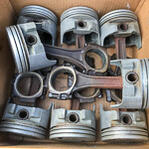

 '72 454 Engine Rebuild Advice, Please
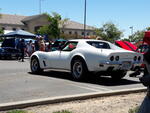








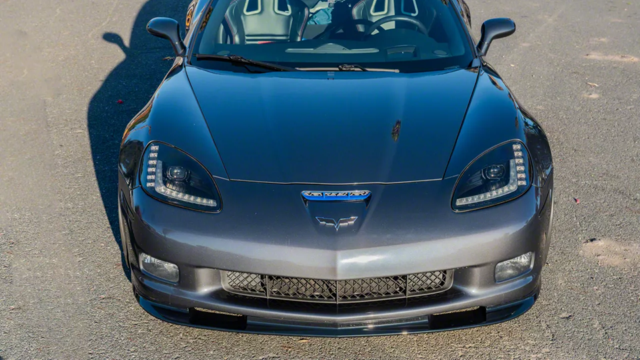



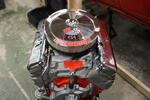





 A really nice side effect of Aluminum heads, intake, and water pump is that it will knock about 100 pounds off the front end. That's always a good thing!