When you click on links to various merchants on this site and make a purchase, this can result in this site earning a commission. Affiliate programs and affiliations include, but are not limited to, the eBay Partner Network.
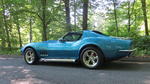
I am putting together my '73 project that I bought as a pile of parts. I have the battery in and have started it (it is an LS3/TR6060 conversion) and have started hooking up the lights. The rear lights all work great. The front lights do not work at all if I have more than one plugged in, with one plugged in it is very dim. I should add that I am using all LED lights and that I don't think I have the birdcage fully grounded yet. I hooked up the large ground wire from the front of the harness to that spot on the front of the radiator shroud and the smaller one to the headlight bar, which I believe is correct. Thinking it may be a bad ground I jumpered a ground from the engine/frame to the wire at the front and that had no effect. The front light does turn on/off with the rear lights when I pull the light switch, but as I said, it is very dim. Any ideas where I should start looking?
What is the battery voltage?
When you say front lights, headlights?
I have a new battery and I have a trickle charger hooked up to it and the voltage is right at 12.5 V. I am just looking at the front marker lights for now and when I measure the voltage in the plug it is about 7.75 V to the ground in the plug into a good ground on the frame. I only have the front marker lights and parking lights plugged in right now. Here is how one of the sad parking lights looks right now at 7.75 V. Scott
What is the battery voltage?
When you say front lights, headlights?
Also FYI, when I have no bulbs plugged in to the front wiring the voltage goes up to about 10.4 V but as soon as I put in one bulb it burns pretty dim and it drops the voltage down to ~7 volts.
Are those lamps on pigtails connected to the front lamp harness like in my '79? If so clean the connectors. I had the exact same sort of problem when I removed the front lamp harness to add some additional wiring. I cleaned everything except those connectors for some stupid reason.
Voltage drop is common with old wiring, the copper go's green inside the insulation. Causing resistance. Sounds to me like you need a new front harness.
Voltage drop is common with old wiring, the copper go's green inside the insulation. Causing resistance. Sounds to me like you need a new front harness.
Is there a way I can measure the resistance across a few wires to verify this before I commit to a new harness?
Start at the battery or alternator hot stud and right to the wire at the bulb. Then find a mid point. Firewall connector would be a good start. First hit that point with batt 12v. Or the switch itself.
Start at the battery or alternator hot stud and right to the wire at the bulb. Then find a mid point. Firewall connector would be a good start. First hit that point with batt 12v. Or the switch itself.
Thanks for the quick response. I unplugged the harness from the fuse block and cleaned everything up and checked for resistance to the bulb and it was 0.3 ohms so that seemed to be ok. After poking around a bit it seems the ground that normally goes to the alternator was bad. I have swapped out the original engine with an LS3 and connected that ground to the block, which I have grounded to the frame on the other side. It seems that ground was not enough. I moved that ground to the frame and the two parking lights lit up nicely so it seems that is resolved. The front marker lights are very dim, however, where should I look to resolve that? Thanks again for the help.
A vette is a boat. Every thing electrical not mounted to the frame or engine has to have it's own ground. Sometimes after 50 years a ground you can see connected doesn't pass current any more. The wire attaches to the socket and the frame. Either end could be corroded and open circuit. Where it bolts to frame would be first place to check.
Last edited by derekderek; Jul 19, 2020 at 12:37 PM.
A vette is a boat. Every thing electrical not mounted to the frame or engine has to have it's own ground. Sometimes after 50 years a ground you can see connected doesn't pass current any more. The wire attaches to the socket and the frame. Either end could be corroded and open circuit. Where it bolts to frame would be first place to check.
Thanks. I should mention I do not have the entire dash in yet, I just put the speedo/tach side of the dash in enough to hook up the light switch. I think I will need to hook up at least the directional bulbs in the back of the dash for the turn signal to work, correct? I did replace the OEM style flasher with the LED compatible flasher that has an external ground so that should not be an issue.
Dash needs ground for bulbs to work. They are all daisy-chained together (the grounds) on the sort-of dash pcb. Some bulbs are daisy chain too. Others have a ground running back thru harness to a ground point. I notice the horn has no ground. So the headlight support bar it is bolted to has to be grounded to the frame. And it may not. When a car is new you can trust all those bracket mount points to pass electricity. This is a spot that needs checked. That headlight support is sheet metal. A little corrosion goes a long way.
Last edited by derekderek; Jul 19, 2020 at 02:36 PM.
I might point out that checking for voltage drop with an ohm meter is incorrect. If you have one strand left out of 30 in a typical wire, it will read good with an ohm meter. But will not pass enough voltage. You may wish to goggle "how to do a voltage drop test".
I presume you're certain the pigtail connections I mentioned are clean, correct? I'm almost positive they're present in your '71. With the harness installed the connectors are hard to find as they're deep in the nose on each side. There are two and they power only the park/turn and marker lights on their respective sides. It's difficult but not impossible to clean them with the harness installed. Get some good contact cleaner, surround the connector with an absorbent towel and spray very generously. You can also use a brass wire brush on the male connections without scraping up your knuckles too badly
The above is 100% correct in that the tiniest connection will cause a voltmeter to show correct voltage when there's no load on the circuit. But with the lamp installed you can definitely check for drop along the circuit. For testing purposes I would remove the LEDs and install incandescents.
Also know that without some rewiring the front turn and marker lamp circuits are incompatible with LEDs because in some conditions they use the filaments of the non-burning lamps to obtain ground. Not only do LEDs lack filaments but by definition a diode only allows current to pass one direction so it's utterly impossible to get a "backfeed" ground through them. It's a very slick circuit that allows a number of functions with minimal wiring and simple switching.
I had to review the schematics and circuit descriptions to say this but the stock park/turn side indicator circuit is completely incompatible with LEDs! While the park lights and hazard circuits [should] work with good connections, clean grounds, etc. the turn signals will NOT as an interconnection requires the front to find its ground through filaments in both the front and rear.
Considering how easy it is to change the exterior lamps in our cars (well the front markers are a bit of a pain until you feel the path) and the fact that there are no DOT approved LEDs for our fixtures I truly suggest you forget about LEDs for anything except the backup lamps and interior courtesy illumination.
Last edited by SwampeastMike; Jul 19, 2020 at 07:06 PM.
I had to review the schematics and circuit descriptions to say this but the stock park/turn side indicator circuit is completely incompatible with LEDs! While the park lights and hazard circuits [should] work with good connections, clean grounds, etc. the turn signals will NOT as an interconnection requires the front to find its ground through filaments in both the front and rear.
Considering how easy it is to change the exterior lamps in our cars (well the front markers are a bit of a pain until you feel the path) and the fact that there are no DOT approved LEDs for our fixtures I truly suggest you forget about LEDs for anything except the backup lamps and interior courtesy illumination.
Thanks for the feedback. I have replaced the front lamps with conventional bulbs and they now all work correctly when the parking lights are on, the blinkers do not work, I will replace the rear with non-LEDs to see if that fixes the blinker issue. I have cleaned up all of the terminals to the front lights and on the light switch in the dash and cleaned up the ground connections on the back of the gage cluster as well and made sure the grounding is all good.









 73 Front lights very dim










