When you click on links to various merchants on this site and make a purchase, this can result in this site earning a commission. Affiliate programs and affiliations include, but are not limited to, the eBay Partner Network.
In the process of replacing the worn and cracked rubber bushings in the cars back end. Replacing those trailing arm bushing looks like a bitch. How can you tell if they are shot and need to be replaced? What are the symptoms of worn out trailing arm bushings?
if there original, there long done. remove wheel, shock and unbolt strut rod and half shaft. now ,How much does it move side to side? how much twist.
Without taking half your rear end apart. How does it handle? Like a sports car? or twitchy? wondering when going down a rutted road?
I have a lot of documentation that came with the car, none indicate the rear end bushings (leaf spring, strut or trailing arm) were ever replaced. The leaf spring, strut and shock bushings are cracked and old, but still in one piece. Can’t get a good look at the trailing arm bushings, hence my question.
I’ll replace the shocks and leaf spring bushings but might leave the strut and trailing arms bushings to a professional. From what I’ve read those can be a real problem and require tools I don’t have.
Any idea what it might cost to have a shop do the strut and trailing arm bushings?
I just removed a set of bushings from a 69 today. You have to remove the arm and if that is all you are going to do, which probably the best idea given the history, you will need a cut off wheel, chisel- pneumatic preferred, hammer, punch. Cut across the bushing face into the rubber. Tap off the washer. Cut across the sleeve in 4-6 places and then collapse it into the center with the chisel. Drive out the sleeve with the punch, use the chisel to drive the bushings up and out, same for the steel cup. Done. Installation requires the tool to compress and flare the new bushings in place.
To go through that and just replace the bushings on a 50 year old set of arms makes no sense as the parking brakes are probably seized, the bearings dried out, and who know where the rotor runout is.
Great pics. Sounds like a lot of work to get the bushing out of the arm after a lot of work to get the arm out of the car.
I’m pretty handy, but thinking this might be a job for an expert. Finding an expert I trust with the car is a problem.
From: Some days your the dog and some days your the hydrant.
Royal Canadian Navy
You can do it! It's not hard except for the labour you put into it. The bushings are not hard to get out with an air chisel or a hammer and chisel. Labour intensive but technically easy.
Sawzall and good blade are required to cut through the bolt holding them in. Some people were able to actually get the nuts to break free and avoid cutting. They are what we call the minority.
My guess would be if the shims are rusty the bushings were never replaced at least in the last 30 years. Almost anyone would have used stainless shims since them. You can certainly pull the TA's yourself with some labor - once I accepted my fate and gave up on the nuts coming off, then accepted my fate and decided to buy the right tool, then accepted my fate and bought the right blade I had them out in 15 minutes. I probably had 4 or 5 hours in before that.
Last edited by vince vette 2; Aug 11, 2021 at 04:18 PM.
Thanks for the link, lots of good info. Your last comment in the thread stated you had the TA’s out and were sending them out for rebuilding.
What does that entail? I assume the TA gets detached from the wheel hub before sending out, or is that part of the rebuild?
Here you go I wrote this 14 years ago to help guys like you out so you can understand what is involved. I will say to do the best job takes time, there are many places offering this work but they are not all the same. You have to be very careful so you should read this thread completely.
I have more time into prep work then some places take to build the whole job but there's a huge difference. Many guys have done this at home, some better then others but they all know what they got when they were done, not something you can say about every job you send out. Last bit of advice, don't get caught up on price alone. Some jobs are low balled to get your work, then you get a completely revised bill later. Also, the advertised prices you find online, in a catalog, on ebay, etc they usually only cover the common parts. Until the arms are inspected by an honest, knowledgeable, experienced person you won't get a real quote. Kind of like some guys I walk through a build and they now know more from doing one than what I experienced working on vettes since 1978.
You will need some tools, a lot of patience, but if you want to do it you can.
Thanks for the link. Great pics detailing spindle bearings that I assume would be part of the TA rebuild. I’ve done some bearing replacements in the past, but not to this level of end play measurement. Seems you have developed tools and a process to perform an excellent rebuild.
Do you do this job for others? If not, would you suggest Van Steel for the work?
Thanks for the link, lots of good info. Your last comment in the thread stated you had the TA’s out and were sending them out for rebuilding.
What does that entail? I assume the TA gets detached from the wheel hub before sending out, or is that part of the rebuild?
Obviously Gary has answered much better than I could. I ultimately sent them to Bairs who will do a generally good job, but will target original spec tolerances and not the tighter tolerances which Gary and some other true craftsman will work to. My issue was to get the car running (which still is intermittent for me if you see my other recent posts), and workload at another restorer, Dub, was longer than I wanted to wait. Dub did though give me good advice on a couple things to ensure.
A primary item was that if you plan to keep the rotors that are on it be sure the guys doing it know the difference between allowed thickness for minimum after refinishing vs replacement end. By the book, if the rotor is being refinished it can be taken down to 1.230". Replacement is required at 1.215". Some people who do this work seem not to know the difference and assume as long as the refinish leaves more than replacement it's OK. It's not. Any refinish that takes it down below 1.230" won't have much life left, especially as these specs were written for cars that used organic brake pads, not the newer semi-metallic and metallic pads.
Also, the original rotors will be riveted to the hubs. My understanding this was done to facilitate assembly on the production line. It is necessary that the rotor stay with the TA it was trued up on and indexed as it was when trued. If it was bolted on the hub, in assembly the line guy would have and to pull the lug nuts before putting the tire on, and extra step. So instead, the rotors were riveted in place. But after that, if the rotor is removed, for servicing, which requires drilling out the rivets, and then either refinished or replaced, it is not necessary to rivet them back into place. They can just be held on by lug nuts until put on the car, the nuts then can be pulled, and the tire put on. All that is necessary is to ensure that if the rotor is removed after being trued up to the hub, that it be put back on with the same indexing which it came off. There's no need to rivet it on and then someday having to drill out rivets to replace it.
And that is pretty much everything I think I know about TA rebuilds.
Interesting points about the rotors. I’m sure I saw past rotor replacement in the documentation that came with the car, and they look in great shape. I know the front ones aren’t riveted (maybe never were), but the rear ones appear to be riveted. Would they have re-riveted replacements? I can’t believe they are original.
Interesting points about the rotors. I’m sure I saw past rotor replacement in the documentation that came with the car, and they look in great shape. I know the front ones aren’t riveted (maybe never were), but the rear ones appear to be riveted. Would they have re-riveted replacements? I can’t believe they are original.
The fronts are not riveted on. You would be surprised how long the originals last if they only ever had organic pads used. I'm not sure of your age, but today people simply accept that rotors have to be replaced almost as often as pads and certainly after 2 sets of pads. But being 63, I can attest to the fact that through the 60's and 70's changing rotors usually meant something went wrong. My grandfather owned a garage and resurfacing them was just a normal service and it cost very little as even then the machine for it ran automatically, so labor was minimal. I recall the shock I had the first time I pulled a tire off my wife's 83 or 84 Firebird and saw the uneven wear on the rotors. I had never seen that type of pattern before.
As for my 80', it still has the original rotors which have all been resurfaced once after about 90k miles. So not knowing your mileage I can say if the rotors are original, but they may be. On the other hand, some restorers such as Bairs will rivet them on unless you tell them not to.
On the topic of organic pads, a lot of folks will likely note they don't brake as well as semi-metallic and metallic. I agree if they are wet. But the brake design in the C3's is excellent including the very large pad surfaces which do a far better job of dissipating heat as compared to the smaller pads on other cars. My brother's 79 280 ZX pads were minuscule in comparison. The braking on an these cars with original equipment is enough to give you a head rush, literally. Hit the brakes at 60 or 70 and ride them to a full stop just short of skidding and you'll get a little dizzy. The short coming of organic is when they get wet. But most C3's only get wet if the weather forecast is wrong.
Last edited by vince vette 2; Aug 12, 2021 at 05:58 AM.
Thanks everyone for all the great pics and knowledge. Also being 63 I have owned/worked on quite a few cars and have some skills. I also own a 73 Datsun 240Z that my sister bought new that had a similar rear suspension bar that was a bear to get out to replace the strut shock. As previously mentioned the vette came to me with a lot of documentation that supports the car has about 100k miles with no record of any trailing arm work. That said I would imagine the bushing is due for a change and the process will require some cutting (shock and TA mounts). Once out I will asses if the rebuild needs to be sent out.




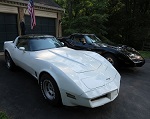







 68 trailing arm bushings