When you click on links to various merchants on this site and make a purchase, this can result in this site earning a commission. Affiliate programs and affiliations include, but are not limited to, the eBay Partner Network.
2025 c3 ('74-'82) of the Year Finalist - Unmodified
2023 C3 of the Year Finalist - Unmodified
2022 C3 of the Year Finalist - Unmodified
2020 C3 of the Year Finalist - Unmodified
Originally Posted by 0311 jarhead
Nice looking engine compartment. Did you do all the paint touch up with rattle cans? I'm going to try and put that CAI on my 72 if I can figure out the room.
Thanks. Yeah, I used Dupli-Color engine enamel on everything. Orange, low gloss black, silver...
I had the air cleaner base powder coated.
I also filled & smoothed the firewall...
I'm really liking your snorkel setup.. I currently have open air filter and been considering going back but my 76 was originally a single snorkel. Where does one find your dual setup and where does the snorkel on the passenger side connect?
The large plastic piece that sits above the radiator, and the dual-snorkel air cleaner housing, are not reproduced. I pieced together sets from Craigslist and eBay.
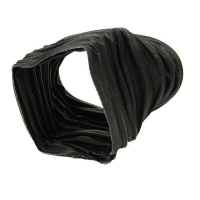
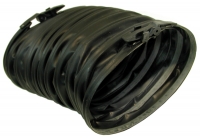
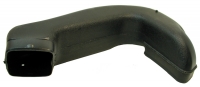
The accordions, the plastic duct under the AC compressor on the passenger side, and the (chrome) air cleaner cover, are reproduced, so you can get them from a vendor.
One final note: I can only confirm that the dual-snorkel system fits 78-81. I'm not sure when the change occurs, but early cars do not have the room under the hood (or the top radiator surround).76 might have space, but never came with this system originally. I don't know if there is a fit difference at the radiator, as it passes by the AC, or elsewhere.
I'm really liking your snorkel setup.. I currently have open air filter and been considering going back but my 76 was originally a single snorkel. Where does one find your dual setup and where does the snorkel on the passenger side connect?
Sometimes you can find them here on C3 Parts for sale or try Ebay too. I have seen them there. It would be interesting to see a picture of the core support/ radiator area, top part where the intake goes. I am not sure how much difference, if any, there is between the years. There is the main snorkel that goes between the radiator and core support, the other part that connects to the main snorkel and mounts with two screws to the passenger side fender, the two different flexible air duct connectors and the air cleaner assembly. I think the main concern if yours is a 76 Vette, is that it probably has the Lager A/C compressor on the passenger side of the motor. I don't know for sure but I think since that you may have the longer A6 compressor but that would not let you use the duct work due to the longer compressor.
Here are the parts for reference. You will need all of these below plus the actual air cleaner assembly. It shows Corvette Pacifica has all the parts below. I included links to the first two items.
Thanks. Yeah, I used Dupli-Color engine enamel on everything. Orange, low gloss black, silver...
I had the air cleaner base powder coated.
I also filled & smoothed the firewall...
Sure looks like alot of work, but the result looks great. Wiper motor and heater box look different.I need to put mine together as well. So far all I've got done is the engine.
Sometimes you can find them here on C3 Parts for sale or try Ebay too. I have seen them there. It would be interesting to see a picture of the core support/ radiator area, top part where the intake goes. I am not sure how much difference, if any, there is between the years. There is the main snorkel that goes between the radiator and core support, the other part that connects to the main snorkel and mounts with two screws to the passenger side fender, the two different flexible air duct connectors and the air cleaner assembly. I think the main concern if yours is a 76 Vette, is that it probably has the Lager A/C compressor on the passenger side of the motor. I don't know for sure but I think since that you may have the longer A6 compressor but that would not let you use the duct work due to the longer compressor.
Here are the parts for reference. You will need all of these below plus the actual air cleaner assembly. It shows Corvette Pacifica has all the parts below. I included links to the first two items.
Thanks
Thanks for posting! I actually just ordered everything from Pacifica. I had found an NOS L82 dual intake air cleaner that I had been using with my L48 based set-up.
I'm really liking your snorkel setup.. I currently have open air filter and been considering going back but my 76 was originally a single snorkel. Where does one find your dual setup and where does the snorkel on the passenger side connect?
Check out the first page in the "C3 parts for sale" section, there's a whole setup available for $250, which is a good buy for everything!!! (No affiliation with seller)👍
The rule of thumb is that for every 10 degrees of hot air, you lose 1% of your HP. With the computer hooked up to my FAST XFI, I can monitor intake temps. My big block will run 150-160 at the intake. If I could lower that to 100F, I would pick up ~5% or roughly 25HP.
Just a decision everyone needs to make for themselves.
The rule of thumb is that for every 10 degrees of hot air, you lose 1% of your HP. With the computer hooked up to my FAST XFI, I can monitor intake temps. My big block will run 150-160 at the intake. If I could lower that to 100F, I would pick up ~5% or roughly 25HP.
Just a decision everyone needs to make for themselves.
That would be true for FI that can accommodate high temps by adjusting the mixture to maintain ideal A/F ratio.
With a carb it would be more. The engine is losing 1% per degree if it's tuned for that condition.
Since the carb cannot be continuously tuned for the variable conditions to accommodate those conditions precisely it is also running rich under high heat conditions further reducing the HP.
From: Some days your the dog and some days your the hydrant.
Royal Canadian Navy
Originally Posted by SteveG75
The rule of thumb is that for every 10 degrees of hot air, you lose 1% of your HP. With the computer hooked up to my FAST XFI, I can monitor intake temps. My big block will run 150-160 at the intake. If I could lower that to 100F, I would pick up ~5% or roughly 25HP.
Just a decision everyone needs to make for themselves.
and i am always amazed how well the 70's mechanical vacuum and pre heat controls the air into carb.
i think set to 130f as ideal on a 79.. i do a lot of cold driving too..
when full throttle it draws ambient air from lack off vacuum to open door.. it's pretty cool..
Put on an open element Edelbrock aircleaner and PERFORMANCE WILL GO BACKWARDS.
You will remove the 'cold air' twin snorkel intake with cold air being rammed into the twin intakes from the 40% better air 'scoop' under the car in a 80-82
and substituting a 'hot air intake' from behind the radiators and over the hot engine.
It is well known with published info that the twin snorkel plenum intakes (as in your 81) 'gives' 5 HP
Hot air intake open element filters reduce HP by 5
So you'll effectively give up 10!
There is a REASON Chevy stopped with the open element air cleaners in the 60's early 70's.
It would be interesting to see someone publish intake temperatures as the car is actually going down the road and cooler fresh air is being forced into the air cleaner versus at idle temperatures Anyone willing to do this with their fuel injected systems that can monitor air intake temps? I would but my car is all apart right now prepping for paint.
Call it 5% across the curve. I have never had mine engine dynoed but it made 413 rwhp at 5600 rpm. So, 500 at the crank would be a reasonable assumption. So, ~25hp at 5600 rpm. SWAG (Scientific Wild A$$ed Guess).
From: Some days your the dog and some days your the hydrant.
Royal Canadian Navy
Originally Posted by MattoonVette
It would be interesting to see someone publish intake temperatures as the car is actually going down the road and cooler fresh air is being forced into the air cleaner versus at idle temperatures Anyone willing to do this with their fuel injected systems that can monitor air intake temps? I would but my car is all apart right now prepping for paint.
A few in here have done this. Results vary widely due to engine compartment setups for removing hot underhood air. Underhood air temps at cruising speed can be as little as a few degrees above outside air temp to 160* F or more.
From: Some days your the dog and some days your the hydrant.
Royal Canadian Navy
Originally Posted by SteveG75
Call it 5% across the curve. I have never had mine engine dynoed but it made 413 rwhp at 5600 rpm. So, 500 at the crank would be a reasonable assumption. So, ~25hp at 5600 rpm. SWAG (Scientific Wild A$$ed Guess).
I agree and it is a curve - exponential. So 3 hp at 60 mph cruise? It will save on fuel a little bit but the real benefit for a proper cai setup, not the restrictive factory snorkels, is way up in the rpm band where professional racers and serious enthusiasts are most concerned. For guys like me who don't don't race and see the odd blast of acceleration on freeway on ramps, an open element works just fine. Btw, at least one forum member has tossed the factory cai for an open air element because it reduced his et's.
It would be interesting to see someone publish intake temperatures as the car is actually going down the road and cooler fresh air is being forced into the air cleaner versus at idle temperatures Anyone willing to do this with their fuel injected systems that can monitor air intake temps? I would but my car is all apart right now prepping for paint.
It would be interesting to see someone publish intake temperatures as the car is actually going down the road and cooler fresh air is being forced into the air cleaner versus at idle temperatures Anyone willing to do this with their fuel injected systems that can monitor air intake temps? I would but my car is all apart right now prepping for paint.
Call it 5% across the curve. I have never had mine engine dynoed but it made 413 rwhp at 5600 rpm. So, 500 at the crank would be a reasonable assumption. So, ~25hp at 5600 rpm. SWAG (Scientific Wild A$$ed Guess).
I don't believe the effects nor the Torque loss would be consistent across the RPM spectrum. There would be a loss across the entire spectrum for sure.
At low RPMS (below peak torque) the loss would be felt due to the loss of air density creating an airflow who's direction of flow could more easily be changed. Since the air is less dense it therefore has less inertia.
Similar to comparing water to air and it's density. both are fluids one has significantly more inertia than the other. One is significantly more dense than the other.
So if I take a fluid and reduce it's density (lbs per cubic foot) I reduce it's mass per volume.
Lower mass items are easier to move or stop or reverse direction.
One way this plays in the engine is during the induction (intake) phase of the 4 strokes. during the induction phase, velocity and thereby the inertia, of the intake charge is responsible for filling the cylinder. Less density makes the air more "squishy" or "streachy" for lack of a better term. So when pulled on during the induction phase it moves slower reducing it's velocity into the cylinder and reducing it's inertia as well.
This reduces cylinder filling.
During compression some fresh charge is always lost during the rise of the piston before the intake valve can close. How much is lost is a function of the inertia of the intake charge and the density among other factors. More dense air is basically "thicker", denser, and is harder to change it's direction of flow due to it's mass. Due to it's mass the inertia gained during it's filling the cylinder resists getting pushed back out of the cylinder into the intake port before the valve can close.
Less density=less mass= less resistance to direction change= less charge retained.
So the effects of less dense air will be felt even before peak torque. You feel it as less throttle response and slower acceleration of the engine.
This does not even factor in that less air means less fuel to retain the air fuel ratio..
Less fuel=less power.
If you feed the engine the same fuel for a less dense air mass, then that's an additional loss due to poor A/F ratio
So now move to past peak torque.
The effects of intake reversion are minimized. Now the limit is getting enough fresh charge (fuel+air) into the engine before the valve closes in a much smaller time frame. So time becomes the enemy. This is why torque falls off past peak torque, not enough time to get the fresh charge into the cylinder(s).
If we agree that less dense air has less mass and thereby less inertia then it's speed into the cylinder is also reduced since we cannot accelerate the air as well due to it's "squishyness" or "streachyness" really. ( is that a word?)
The air is being sucked into the cylinder (s) not pushed in. So if you pull on a small rubber band vs a thick rubber band some of the effort is lost in the streachiness of the rubber band. So a less dense medium is subject to more streachyness than a more dense medium with the same pull.
Past peak torque you are going to get less cylinder filling now due to valve open time limitations AND air density limitations.
Isn't this why supercharging and turbocharging came about?
Of course if there is a restriction to air flow into the engine that is greater than the demands of the engine, regardless of air density, there is going to be areduction in power. The engine must be allowed sufficient airflow to meet it's demands.
The member here mentioned that gained power with an open filter was due to trying to power a 400HPish engine with a single snorkel CAI on a 77 vette. Not sufficient air for that engine regardless of whether it was cold or hot air.
Great write up and information. Now I wonder what the difference would be in air flow of the single snorkel system vs the dual snorkel system. Granted, looking at them, one would think twice as much air flow since they doubled the inlets.










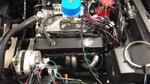


 https://www.corvettepacifica.com/sea...&submit=SEARCH
 https://www.corvettepacifica.com/pro...or-used-78-81/