



Valvetrain noise or something else?

Thread Starter
Cruising

Joined: May 2022
Posts: 13
Likes: 1
 Valvetrain noise or something else?
Hello,
I'm just hopping into the older car world with my new-to-me '69 427 Big Block L36. Recently had the pistons replaced due to a few of the originals being cracked. I'm going to struggle through some of the technical words but from what I was told the timing was too far advanced and running hotter which led to the pistons cracking. The timing was retarded to what was deemed an acceptable value (I likely also need to learn the exact degrees of timing with inches of vacuum). I've been driving it now for just about ~400 miles since the new pistons. Everything seems to run nice and smooth. I haven't pushed it over 3500 RPM yet until I do an oil change, but I started noticing what I think is valvetrain noise but am not certain. The video is on a warm engine.
https://photos.app.goo.gl/NxLJKan9puqaKz5v5
My question is could this be noise escaping through an exhaust leak? Is this excessive noise or anything to be worried about? I feel like the noise is more noticeable when on the passenger side but that could be a plethora of things I'm uncertain of.
I'm just hopping into the older car world with my new-to-me '69 427 Big Block L36. Recently had the pistons replaced due to a few of the originals being cracked. I'm going to struggle through some of the technical words but from what I was told the timing was too far advanced and running hotter which led to the pistons cracking. The timing was retarded to what was deemed an acceptable value (I likely also need to learn the exact degrees of timing with inches of vacuum). I've been driving it now for just about ~400 miles since the new pistons. Everything seems to run nice and smooth. I haven't pushed it over 3500 RPM yet until I do an oil change, but I started noticing what I think is valvetrain noise but am not certain. The video is on a warm engine.
https://photos.app.goo.gl/NxLJKan9puqaKz5v5
My question is could this be noise escaping through an exhaust leak? Is this excessive noise or anything to be worried about? I feel like the noise is more noticeable when on the passenger side but that could be a plethora of things I'm uncertain of.

Le Mans Master


Joined: May 2002
Posts: 5,086
Likes: 787
From: Lebanon Township New Jersey
I think you've been given some bad information. That engine does not look like it was recently removed, completely disassembled for piston replacement, cylinders bored and entirely reassembled and reinstalled.
Not sure about the noise issue but it might need to have valve lash adjusted.
Not sure about the noise issue but it might need to have valve lash adjusted.

Race Director

Joined: Jul 2015
Posts: 13,082
Likes: 3,400
From: SW Florida.
5 foot piece of hose. half inch or so. now you have a stethoscope. one end in one ear. pass the other end along both valve covers, both header flanges and under the car along the oil pan and header flanges again. and around the header collectors too.this will most likely tell you where the noise is coming from.
Thread Starter
Cruising
Joined: May 2022
Posts: 13
Likes: 1
I think you've been given some bad information. That engine does not look like it was recently removed, completely disassembled for piston replacement, cylinders bored and entirely reassembled and reinstalled.
Not sure about the noise issue but it might need to have valve lash adjusted.
Not sure about the noise issue but it might need to have valve lash adjusted.
Let me look into valve lash adjustment. At least gives me something to learn more about. Thanks!
5 foot piece of hose. half inch or so. now you have a stethoscope. one end in one ear. pass the other end along both valve covers, both header flanges and under the car along the oil pan and header flanges again. and around the header collectors too.this will most likely tell you where the noise is coming from.
1967 Pedal Car Champion

Joined: Mar 2020
Posts: 9,250
Likes: 4,319
From: US-PNW
Did you have the work done or was it prior to your ownership?
I'm having a hard time hearing anything - maybe in the first few seconds of the video. In my experience, misadjusted lifters make a clattering sound whereas an exhaust leak is more of a ticking. Follow derekderek's advice with the stethoscope. Easy to snug down the header bolts to see if that makes any difference.
I'm having a hard time hearing anything - maybe in the first few seconds of the video. In my experience, misadjusted lifters make a clattering sound whereas an exhaust leak is more of a ticking. Follow derekderek's advice with the stethoscope. Easy to snug down the header bolts to see if that makes any difference.
Thread Starter
Cruising
Joined: May 2022
Posts: 13
Likes: 1
Did you have the work done or was it prior to your ownership?
I'm having a hard time hearing anything - maybe in the first few seconds of the video. In my experience, misadjusted lifters make a clattering sound whereas an exhaust leak is more of a ticking. Follow derekderek's advice with the stethoscope. Easy to snug down the header bolts to see if that makes any difference.
I'm having a hard time hearing anything - maybe in the first few seconds of the video. In my experience, misadjusted lifters make a clattering sound whereas an exhaust leak is more of a ticking. Follow derekderek's advice with the stethoscope. Easy to snug down the header bolts to see if that makes any difference.
I had the work done. First few second of the video you can't really hear much. You can possibly hear more once I'm on the passenger side and close to the valve covers.
Thread Starter
Cruising
Joined: May 2022
Posts: 13
Likes: 1
I think you've been given some bad information. That engine does not look like it was recently removed, completely disassembled for piston replacement, cylinders bored and entirely reassembled and reinstalled.
Not sure about the noise issue but it might need to have valve lash adjusted.
Not sure about the noise issue but it might need to have valve lash adjusted.
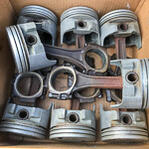
Anyway, the engine was not removed or rebored. Factory spec lighter pistons were installed with the motor still in place. The reason behind this was because I was quoted 9.7k for a rebuild that would detune to the engine to be lower HP and TQ outputs (about ~100 less each), not including installation costs, and have a 3-4 month wait time. We decided to just replace the pistons now and address an engine rebuild later on once the price of things comes down to a more acceptable amount, and I can get a warranty for a more "aggressive" rebuild. I wanted to get the car on the road so the sale could be completed. (Family member wanted the vehicle to be driveable before selling it to me).
I'll look into valve lash adjustment and see what I can learn. At least gives me something to look into further. Thank you!
Thread Starter
Cruising
Joined: May 2022
Posts: 13
Likes: 1
So get an extended piece of hose to be able to extend the stethoscope abilities to try and target the exact location of the noise? If I'm reading that right that's definitely something I can try doing. Thanks!
Corvette Stories
The Best of Corvette for Corvette Enthusiasts

5 Best & 5 Worst Corvette Daily Drivers
Joe Kucinski
The Headlights of Every Corvette Generation Explained
Joe Kucinski
5 Best & 5 Most Overrated Corvette Track Packages of All Time!
Joe Kucinski
Every 2027 Corvette Engine Explained
Joe Kucinski
Designer Imagines A Corvette That Looks More Like a Corvette Than the Corvette
Verdad Gallardo
10 Ugly Corvettes That We Still Kinda Love
Joe Kucinski
Top 10 Most Expensive Corvettes Ever Sold on Bring A Trailer
Brett Foote
10 Things Every Corvette Owner Needs (2026 Edition)
Michael S. Palmer
8 Most "Only Corvette Owners Understand" Quirks and Problems
Pouria Savadkouei
Le Mans Master

Joined: Apr 2011
Posts: 6,284
Likes: 1,172
From: Hermosa
I’m not really hearing anything on the video either.
Hearing the story of replacing some pistons makes me wonder if the replacement pistons properly fit the bore or maybe they are forged pistons which exhibit piston slap until fully warmed up and expanded. Any idea as to whether they are forged or hypertuetic pistons? Makes me wonder about the crank balance as well.
Hearing the story of replacing some pistons makes me wonder if the replacement pistons properly fit the bore or maybe they are forged pistons which exhibit piston slap until fully warmed up and expanded. Any idea as to whether they are forged or hypertuetic pistons? Makes me wonder about the crank balance as well.
Thread Starter
Cruising
Joined: May 2022
Posts: 13
Likes: 1
I’m not really hearing anything on the video either.
Hearing the story of replacing some pistons makes me wonder if the replacement pistons properly fit the bore or maybe they are forged pistons which exhibit piston slap until fully warmed up and expanded. Any idea as to whether they are forged or hypertuetic pistons? Makes me wonder about the crank balance as well.
Hearing the story of replacing some pistons makes me wonder if the replacement pistons properly fit the bore or maybe they are forged pistons which exhibit piston slap until fully warmed up and expanded. Any idea as to whether they are forged or hypertuetic pistons? Makes me wonder about the crank balance as well.
Not forged. We knew the pistons weren't going to be an exact fit without a rebore. The engine had 78xxx original miles on it and the walls looked to be in great condition even though 3 original pistons were cracked.
Race Director
Joined: Jul 2015
Posts: 13,082
Likes: 3,400
From: SW Florida.
putting in a new set of standard pistons is not a bad thing. but there are not many people i would trust to put bearings in from below. you gotta be careful to get everything in right..
Race Director
Joined: Jul 2015
Posts: 13,082
Likes: 3,400
From: SW Florida.
you are laying on your back finessing the upper rod bearing shell around the crank journal. easy to eff up and have the tang miss the notch it has to sit in. upper mains are also big fun but rarely need replaced.
Le Mans Master

Joined: Aug 2017
Posts: 8,336
Likes: 2,810
From: Cool Northern Michigan
Car up on ramps:
You lay a hand towel in the bore under the big end of the con-rod. This will keep the rod from scratching the cyl walls on the way in.
A piece of rubber hose over the rod bolts prevents scratching the crank on the way down.
Tap-tap-tap. Slow and easy. Helps to have crank journal facing towards the cylinder you are working on.
Not much fun. But doable.
A helper on the top side tapping pistons, compressing rings and you underneath guiding the con-rod is easier.
Hopefully all the rod caps have been cylinder number-punched earlier.
You lay a hand towel in the bore under the big end of the con-rod. This will keep the rod from scratching the cyl walls on the way in.
A piece of rubber hose over the rod bolts prevents scratching the crank on the way down.
Tap-tap-tap. Slow and easy. Helps to have crank journal facing towards the cylinder you are working on.
Not much fun. But doable.
A helper on the top side tapping pistons, compressing rings and you underneath guiding the con-rod is easier.
Hopefully all the rod caps have been cylinder number-punched earlier.