When you click on links to various merchants on this site and make a purchase, this can result in this site earning a commission. Affiliate programs and affiliations include, but are not limited to, the eBay Partner Network.
Hey guys,
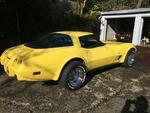
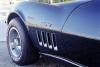
A buddy of mine was looking for his first Corvette and we found this nice little '78. Price was right so I went and picked it up for him a couple days ago. 1978, Code 83 Dark Blue on Oyster Leather, L-48, automatic trans with 76,000 original miles. Seller bought the car from original owner when it was just a couple years old, came with a file full of receipts for all work done to the car. A real nice project. It had been sitting in his clean dry garage for the last 30 years, up on blocks, so it's going to need the usual sorting out before it's roadworthy again. Original engine with all orig. equip still in place under the hood. CLR (California emissions) suffix and matching 17058502 carb rated at 175 HP. Ten hp less the the Federal L-48 which was listed at 185 hp. In 1978 L-82 and/or 4 speed trans were not available in California . And, because we're still in California, we're going to have to keep this thing smoggable. So, question for those of you with a '78 L-48, either California or Federal, is the 10 hp loss simply due to tuning adjustments or is there any different equipment on board?
Cheers, Greg
After pressure washing all the black widow spiders and webs out from underneath!
So, question for those of you with a '78 L-48, either California or Federal, is the 10 hp loss simply due to tuning adjustments or is there any different equipment on board?Cheers, Greg
Interesting question, while we can say that the carb jetting differs between the 175 hp and185 hp, the block carries a different suffix, which raises the question of whether there are differences mechaniclly. I suspect there is but have no idea what it could be...cam lift?
I see a fixed mast so must be a non-power antenna?
No engine designer here. However, if one was to mandate a reduction of 10 horse build design, a different cam, different heads, different exhaust manifolds and carb would be way too cost effective.
A simpler, cheaper, easier solution would be a head gasket (thicker) swap during production which would drop the C.R. just a bit.
Just a thought, IDK.
Through the 70's many models of cars with low HP numbers were merely rated at a lower RPM with little to no change in the actual drivetrain. This can be verified by looking at the factory published specs.
Ignition curve/vacuum advance setup is a good guess. Check the factory service manual.
Different distributor, vacuum advance, air pump, different type of EGR. Diagram from factory manual.
Easiest way to get extra hp and stay equipment compliant is with adjusting timing to be 36degrees; all in by 2500. And dual exhaust with two free-flowing Magnaflow cats(or test pipes for off-road) and Magnaflow mufflers. Higher capacity air-intake would also help; L-82 had dual snorkel.
Charlie
Hind sight is always 20/20 and I know the technology has moved considerably in the last 45 years but it's too bad they didn't work a little harder at the whole emissions/horsepower/fuel economy problem back then. I'm sure they could have done better.
They seemed to take it as axiomatic that a reduction in emissions had to go hand in hand with a reduction in horsepower and pushed these numbers to ridiculous lows.
Today you can get a new Corvette with 500 - 600 horsepower that passes emission tests with ease.
Looking at the distributor chart you actually have a great place to make easy to reverse mods (for smog check day). The centrifugal mechanism is perfect for performance except for the stiff springs. The vacuum advance canister is perfect as-is to use it hooked up to manifold vacuum. Super easy to switch it all back to stock as needed to pass inspection. Move the hose, reset the initial timing and switch the springs and you are back to "hot street".
Here is the PDF from GM Heritage for the 78. It shows that the California L48s received as std a 3.55 rear axle, unlike the regular L48s that got 3.08.
I'm dropping the gas tank today for a good flush and inspection. I gotta tell you guys, I love working on these barn/garage finds in southern California. The upside is, things like the suspension and exhaust bolts come apart like they were installed yesterday.
The downside is, a lot of creepy **** still lives up in there.
This one has about 3,000 black widows.
In the past I've found plenty of rat evidence along with the spiders and lizards, but worst one was when a big fat snake dropped out and slithered away while I was underneath on my creeper.
It's like an undercar zoo!
Here is the PDF from GM Heritage for the 78. It shows that the California L48s received as std a 3.55 rear axle, unlike the regular L48s that got 3.08.
The L-82 is the remains of the earlier LT1. It has 4 bolt mains with better rods, crank and pistons. I think the CR may be higher as well. If you are going modify your engine, the L-82 is more robust, but unless you're trying to make big HP, the L-48 would work OK, but I'm no engine guru. My current ride is a 79' with the L-48 and a 4-speed. I rebuilt it with Aluminum heads, better cam and a Lars carb rebuild and real dual exhaust. It is faster than the stock 78' L-82 I had before it.
Wish we could go that way too Duke, but here in California 1978 still has to pass smog. So we'll build it back to mostly what it was in order to pass and then probably re-tune it afterwards.
That is a beautiful car. Perhaps clean it up, sell it out-of-state, and buy a car that can be modded where you choose to live? Otherwise, aren't there CARB approve crate engines, and manual transmissions?










 1978 L-48 Owners?
 . And, because we're still in California, we're going to have to keep this thing smoggable. So, question for those of you with a '78 L-48, either California or Federal, is the 10 hp loss simply due to tuning adjustments or is there any different equipment on board?